


Two of China’s top driverless car companies, Pony.ai and WeRide, have applied to list their shares in Hong Kong. This marks a major step for China’s autonomous vehicle (AV) industry as it seeks global recognition and funding. The twin IPO filings show how far the country’s robotaxi and self-driving technologies have advanced, and how investors are beginning to take them seriously.
IPO Details and Plans: Billions at Stake in the Driverless Race
Pony.ai, based in Guangzhou, plans to offer around 42 million Class A shares in its global offering, including a small portion to Hong Kong retail investors. The company’s maximum offer price is about HK$180 (roughly US$23) per share, which could value it at more than US$10 billion.
WeRide, also based in Guangzhou, aims to issue about 88 million shares at up to HK$35 each. Its total valuation could reach several billion dollars, depending on final pricing. Both listings are expected to take place on the Hong Kong Stock Exchange in early November 2025.
The filings follow regulatory approval from China’s securities regulator, which has been cautious about allowing tech companies to list abroad. Both firms are among the first autonomous-driving startups to receive the green light for an overseas IPO since 2023.
Why These IPOs Matter
The twin listings mark a turning point for China’s driverless tech sector. For years, companies like Pony.ai and WeRide relied on venture capital to fund expensive research and testing. Going public gives them access to new capital to expand fleets, build partnerships, and improve AI systems.
The move also reflects China’s growing ambition to lead in driverless mobility. While U.S. players like Waymo and Cruise have faced setbacks, Chinese developers are pushing ahead with pilot robotaxi services in major cities. Both Pony.ai and WeRide already hold licenses to operate driverless rides in parts of Beijing, Guangzhou, and Shanghai.
Public listings also help build transparency and investor confidence. For a young industry that has long been seen as futuristic and risky, IPOs show that companies believe they are close to commercial scale.
By the Numbers: Key IPO Metrics
Some of the main data points from the filings include:
- Pony.ai’s estimated valuation: Over US$10 billion.
- Pony.ai shares offered: 42 million Class A shares.
- WeRide shares offered: About 88 million shares.
- WeRide’s Q2 2025 revenue: ¥127 million (about US$18 million).
- WeRide’s Q2 2025 net loss: ¥406 million (about US$57 million).
While both firms continue to post losses, their revenue growth shows increasing demand for pilot robotaxi services and partnerships with automakers.
Company Background and Performance
Pony.ai was founded in 2016 and quickly became one of China’s most valuable AV startups. It operates driverless taxis, freight trucks, and test vehicles in China, the United States, and several other regions.
The company plans to expand its fleet from about 250 vehicles to over 1,000 by 2025. It has received investment from Toyota and other global carmakers.
WeRide was founded in 2017 and focuses on robotaxis, robobuses, and self-driving vans. It has already completed more than 30 million autonomous kilometers in testing and public operations.
In the second quarter of 2025, WeRide reported revenue of around ¥127 million (about US$18 million), up 60 percent from the same period last year. Despite the growth, it posted a net loss of about ¥406 million as it continues to invest in development.
Both companies face heavy competition from domestic rivals like Baidu’s Apollo Go and international peers such as Waymo, Motional, and Cruise. The key challenge for all is finding a clear path to profitability in a market where hardware, mapping, and AI costs remain high.
Robotaxis on the Rise: Market Forecasts and Growth Drivers
The global robotaxi market is still young but growing quickly. Analysts estimate that the total market value for autonomous driving services could reach US$60 billion to US$70 billion by 2030.

McKinsey estimates that advanced driving (AD) and driver-assistance (ADAS) systems could bring in US$300–400 billion each year by 2035. Vehicles with Level 2+ automation typically include US$1,500–2,000 in component costs, while Level 3 and Level 4 systems cost even more.
Moreover, consumer demand for smart driving features is rising. More commercial models are adopting them. So, the market for autonomous technology is on track to be one of the auto industry’s biggest growth areas.
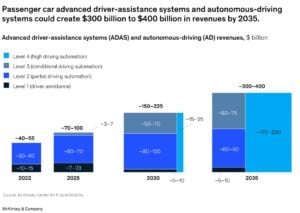
China could lead this growth. The country’s large cities, dense traffic, and strong government support for AI testing make it an ideal environment for scaling driverless fleets. Industry data shows that more than 20 Chinese cities now allow robotaxi testing or limited paid rides.
By 2030, China’s robotaxi sector could handle hundreds of millions of rides per year, potentially replacing a portion of traditional ride-hailing services. Consultancy forecasts suggest that robotaxis could account for 5% to 10% of all urban rides in major Chinese cities by the end of the decade.
Global automakers and tech companies are also watching closely. Toyota, Volkswagen, and Hyundai have all invested in autonomous-driving startups.
The rise of AI and electric vehicles is driving convergence between the auto and tech industries. This makes driverless transport one of the next big technology frontiers.
The chart below indicates that early growth will be slow as companies complete testing, secure permits, and scale their fleets. Once safety records improve and regulations ease, adoption will speed up, driven by cost savings, AI advancements, and public acceptance. After this rapid expansion, growth is likely to level off as the market matures and competition increases.

The Roadblocks Ahead
Amid rapid progress, driverless mobility still faces big challenges. The technology is expensive, requiring advanced sensors, lidar systems, and high-precision maps. Safety remains a concern, with each incident drawing public scrutiny and slowing adoption.
Regulation also varies by region. Some Chinese cities allow fully autonomous operation, while others limit it to specific zones or hours. International expansion adds more complexity, as each country has its own testing rules and data-sharing policies.
Another major hurdle is profitability. Many experts say it could take until the late 2020s before most robotaxi operators achieve positive margins. Until then, they will need continued investment to cover R&D and fleet expansion.
Industry Outlook: Why Investors Are Watching Closely
For investors, Pony.ai and WeRide’s IPOs offer an early opportunity to enter the driverless-car market through publicly traded shares. The listings also set a benchmark for valuing future AV firms.
For the industry, these IPOs symbolize maturity. They show that China’s autonomous-driving sector is confident enough to open its books and attract global investors. Success could encourage more companies — in lidar, battery tech, or mobility software — to follow suit.
Investors will closely watch how quickly Pony.ai and WeRide can scale their fleets, control losses, and turn pilot projects into profitable transport networks.
Pony.ai and WeRide’s Hong Kong IPO filings signal a new phase for China’s driverless vehicle industry. The twin listings bring visibility and funding to two of the world’s most advanced AV developers.
They also highlight China’s ambition to lead in autonomous mobility — a field that blends artificial intelligence, clean energy, and smart transport. While profitability may still be years away, this progress shows that the race toward self-driving transportation is no longer science fiction. It is an industry preparing to enter the next stage of real-world growth.
The post Pony.ai and WeRide File Hong Kong IPOs as China’s Robotaxi Market Takes Off appeared first on Carbon Credits.

EU carbon credit claims changed on 27 September 2026, the day the Directive (EU) 2024/825 began to apply across the European Union. The change is narrow. It changes how a company can talk about the credits it buys. A product can no longer be called neutral on the strength of compensation alone; however, every specific, evidenced statement about what a company measured, reduced, and funded stays fully available.

The post Promoting Improved Cooking Practices in Nigeria appeared first on Terrapass.



-
Climate Change1 year ago
Guest post: Why China is still building new coal – and when it might stop
-

 Greenhouse Gases2 years ago
嘉宾来稿:满足中国增长的用电需求 光伏加储能“比新建煤电更实惠”
-
Greenhouse Gases1 year ago
Guest post: Why China is still building new coal – and when it might stop
-

 Climate Change2 years ago
嘉宾来稿:满足中国增长的用电需求 光伏加储能“比新建煤电更实惠”
-

 Renewable Energy12 months ago
Sending Progressive Philanthropist George Soros to Prison?
-
Climate Change2 years ago
Bill Discounting Climate Change in Florida’s Energy Policy Awaits DeSantis’ Approval
-
Greenhouse Gases1 year ago
嘉宾来稿:探究火山喷发如何影响气候预测
-

 Climate Change2 years ago
Analysis: China’s CO2 falls 1% in Q2 2024 in first quarterly drop since Covid-19