

The Tropical Forest Forever Facility (TFFF) – a new global fund for rainforest protection led by Brazil – can be launched successfully at COP30 with strong political backing from other countries even without reaching its $25-billion target for capital from donor governments, Brazil’s lead finance expert said.
The hope is that other countries will come forward with pledges at the UN climate summit but no minimum set amount is required for the fund to get off the ground, he emphasised.
The TFFF is being structured as a blended finance instrument that could raise $4 billion per year to help keep tropical forests standing by investing in financial markets. The fund’s concept note estimates that, as startup capital, it would need $25 billion from governments and $100 billion from private investors.
João Paulo de Resende, climate and economics advisor at Brazil’s Finance Ministry and its lead TFFF expert, told a webinar hosted by Climate Home News on Thursday that Brazil is seeking clear political support from both donor and rainforest countries for the TFFF at COP30. It is due to be launched at a leaders’ summit in the Amazon city of Belém on November 6.
“What we need to reach by COP is a certain level of commitment that shows that there is enough interest in the international community to make this happen, because we can carry on in the following months,” de Resende said.
-
Brazil hails World Bank decision to host forest fund ahead of COP30 launch
Brazil’s showcase forest protection proposal, the Tropical Forest Forever Facility (TFFF), is betting on financial markets to keep rainforests standing -
Climate adaptation can’t be just for the rich, COP30 president says
Vulnerable people should not be left to fend for themselves in a warming world, Brazil’s COP president says, calling for the UN climate summit to agree concrete ways to help them -
World failing on goal to halt deforestation by 2030, raising stakes for Amazon COP
An annual progress report shows that agriculture and wildfires continue to decimate forests despite a global promise to stop their loss this decade


He added that talks are at a mature stage with five potential donor countries – Germany, Norway, UK, France and the United Arab Emirates (UAE). Discussions with other potential donors – such as Australia, Japan, Canada and China – have only kicked off recently, he noted.
“We don’t expect to get pledges from these countries that we’ve just started talking to. We can perfectly get those at the COP. And the Brazilian presidency [of COP30] runs through the next year. What we do need to get at the COP is a political message that this is the way forward,” he said.
Brazil is so far the only country to have pledged money to the TFFF, with an initial $1 billion investment announced at the UN General Assembly in New York in September. President Luiz Inácio Lula da Silva has personally promoted the fund at meetings with other world leaders and has been “talking about a commitment” with Indonesia during a state visit to Jakarta this week, de Resende said.
Tørris Jaeger, executive director of the Rainforest Foundation Norway which is promoting the fund, said that in his conversations with Germany’s ministry of finance, “they are asking very tough questions about how the fund is configured.” De Resende joked that “it seems Ethiopia may be more willing to commit to this than the UK and France”, suggesting Brazil is getting impatient with some governments’ reservations.
The TFFF achieved a key milestone ahead of COP30 this week, as the World Bank confirmed it will take on most of the fund’s administrative workload, serving as interim secretariat host and trustee.
Brazilian Finance Minister Fernando Haddad said this transforms the TFFF “from an idea into a fully operational reality”, although de Resende said on Thursday that many of the details will be worked out next year between countries that sign up to the TFFF.
Managing risk in TFFF investments
Despite their vital role in absorbing and storing climate-heating carbon, forests face a $216-billion funding gap for their protection every year, according to a 2025 report from the UN Environment Programme. Existing financing mechanisms like the Global Environment Facility or the Green Climate Fund rely on government development budgets, which de Resende said are unstable.
The TFFF’s approach is to invest initial capital raised from governments and private sources such as sovereign wealth funds and pension funds. The returns would be used to pay developing countries that can demonstrate they are keeping their forests standing and reducing deforestation to an agreed level.
“There is some risk. In very exceptional years like the (COVID-19) pandemic or the 2008 financial crisis you may need to suspend payments,” said the Brazilian government expert. “But it should be a lot more regular than what you see today with government aid.”
Explainer: Can a new climate fund help save the world’s rainforests?
The fund’s main strategy is to invest in emerging market bonds, which are riskier but can generate high enough returns to pay forest countries. The TFFF also has an exclusion policy for investments in polluting industries like oil and gas, which de Resende also said would force investors to take on more risk.
Jaeger highlighted the fund’s role in creating incentives for protecting old-growth forests. At a global level, primary forests have been cleared at concerning rates, with 6.7 million hectares lost in 2024 alone.
“As with any investment there is a risk. But let’s not forget that there’s also a risk on the other end in that we’re not stopping deforestation and these intact forests get lost,” Jaeger told the event.
Indigenous communities call for support
Once TFFF payments are up and running, local communities will need support in building the skills and legal structures needed to access the funds, said Juan Carlos Jintiach, an Ecuadorian Indigenous leader and executive secretary of the Global Alliance of Territorial Communities.
“We have to have an equal level of information. This inter-cultural dialogue is sometimes very challenging for some countries, because all the time they come from the top to the ground. This is not acceptable anymore,” Jintiach said during Climate Home’s panel.
The fund’s proposal foresees that 20% of payments to forest countries will be reserved for Indigenous peoples who are often the ones looking after forests on the ground. Some experts have said this devolved funding could be hard to implement in practice due to a lack of legal and administrative capacity.
World failing on goal to halt deforestation by 2030, raising stakes for Amazon COP
“We need to change the narratives,” the Indigenous leader said. “It’s not good to only look at me as a simple beneficiary. You will look at me as a real partner who can do this together with you, because I’m going to be on the ground giving my life protecting you.”
Pakhi Das, public policy advisor with NGO Plant-for-the-Planet, said the TFFF is an “evolving concept”, adding that concerns from observers have been taken into account in shaping its latest version.
Her organisation has developed a platform called TFFF Watch that will track investments and provide estimates of potential payments to countries with tropical forests.
“There is a very positive notion that [the TFFF] will evolve into something that is tailored-made for the greater good,” Das told Climate Home’s event.
The post Political backing more important than money for new forest fund at COP30, Brazil says appeared first on Climate Home News.
Political backing more important than money for new forest fund at COP30, Brazil says

Continue Reading
Three countries have been named by the Paris Agreement’s compliance committee for failing to submit a nationally determined contribution (NDC) and repeatedly snubbing offers of help with their climate plans.
After months of internal debate over whether to identify serial non-responders, the Paris Agreement’s Implementation and Compliance Committee (PAICC) named the three countries which have failed to engage with it over their NDCs on Friday.
It named Democratic Republic of Congo, Senegal and North Korea in a footnote of its annual report, adding that it decided to name them “with a view to facilitating engagement”, adding that representatives of the three nations had been invited to its meeting in early 2027 “with the purpose of identifying any challenges and constraints”.
“The Committee noted the importance of Parties engaging with the Committee in a timely manner, while noting that some delays may be due to the national capabilities and circumstances of the Parties”, the report said.
-
Under US pressure, World Bank says it will back gas “where appropriate”
The US wants the World Bank to expand its gas support while climate campaigners are pushing for it to end – its head spoke this week of limited backing for the fossil fuel -
IPCC scientists vow to press on with climate reports despite political deadlock
After governments again failed to agree a timeline, nearly 120 IPCC authors pledged to complete their assessment on time and with full scientific rigour -
Paris Agreement committee snubbed over missing NDC climate plans
Many governments have still not submitted a nationally determined contribution to the UN, breaching a key requirement of the Paris Agreement

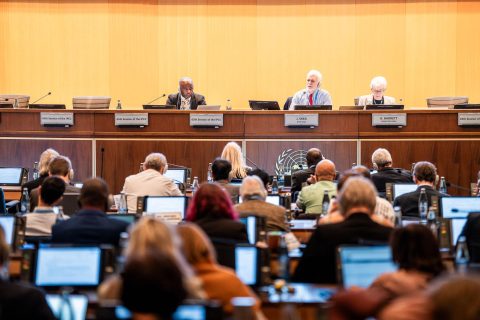

In July, PAICC said 12 countries had ignored its repeated attempts to discuss why they had not published an NDC as required every five years under the 2015 Paris accord.
Members of the committee had been divided over whether to name them, but at a September meeting decided to do so in their annual report to the annual climate COP summit.
By the time the report was published on Friday, only Congo, Senegal and North Korea “had not communicated an NDC or submitted a [Biennial Transparency Report] and had not yet responded to any of the Committee’s notifications, despite several reminders issued by the Committee in this regard”.
Rainforest and renewable energy ambitions
The silence from Congo and Senegal is notable because the former is home to much of the Congo Basin rainforest while the latter has sought billions of dollars in climate finance to support its renewable energy ambitions.
After Brazil, Congo has more rainforest than any country in the world. This forest, and the country’s peatlands, absorb huge amounts of greenhouse gas but are fast being lost to expanding farmland, charcoal production, logging and mining.
Senegal signed a Just Energy Transition Partnership with Canada and wealthy European nations in 2023, to help it meet its renewable energy targets under the-then government of Macky Sall. It was chair of the Least Developed Countries group between January 2022 and December 2023.

Tejas Rao, who is researching the PAICC as part of a doctoral thesis at Cambridge University, said the governments of the three countries should engage with the committee.
“Engagement costs these governments very little and the committee has shown it will listen,” he said.
“Silence leaves the committee with no basis to help, and it leaves the [governments] exposed to the narrative that they are simply disengaged,” he told Climate Home News.
Paris Agreement requirement
The 2015 Paris Agreement requires all parties to publish an NDC every five years outlining their emissions reduction targets, with each plan meant to be more ambitious than the country’s last NDC.
The latest set – the third round of plans, with new targets for 2035 – was due in February 2025. While most countries missed this deadline, all but around 30 – mostly small emitters but including Egypt, Vietnam and Argentina – have now submitted them.
Over the year, the PAICC – which is made up of government climate officials from developed and developing countries – has been communicating with governments that have not submitted NDCs and trying to overcome barriers to them doing so.
Some nations have cited exceptional circumstances as the reason for not submitting an NDC, a process that requires a significant amount of work in tracking emissions and consulting on how to curb them across the economy. For example, a letter from a Sudanese official to the PAICC, seen by Climate Home News, said that the country’s civil war had led to the suspension of its NDC preparation.
-
IPCC scientists vow to press on with climate reports despite political deadlock
After governments again failed to agree a timeline, nearly 120 IPCC authors pledged to complete their assessment on time and with full scientific rigour -
Under US pressure, World Bank says it will back gas “where appropriate”
The US wants the World Bank to expand its gas support while climate campaigners are pushing for it to end – its head spoke this week of limited backing for the fossil fuel -
Who shapes climate science? The equity question facing the IPCC
Early completion of the next global climate science assessment reports risks excluding research from the Global South, which is key to ensuring the findings are fair
The US and Iran are not signed up to the Paris Agreement and so do not have active NDCs, nor does Taiwan, which is not a UN member state.
Rao said that because the PAICC is “facilitative and non-punitive”, naming the countries “is meant to open a door, not close one – the invited consultation is the point”.
“In recent months, governments that explained their constraints, whether capacity, finance or domestic process, have been met with follow-up and support rather than sanction, and the number of silent governments has fallen sharply,” Rao said.
The post Paris Agreement committee names three countries snubbing it over NDCs appeared first on Climate Home News.
Paris Agreement committee names three countries snubbing it over NDCs