


Nissan has struck a new emissions-pooling deal with BYD, a Chinese electric vehicle maker. This partnership aims to help meet the European Union’s tough carbon dioxide limits for carmakers set for 2025. Nissan’s partnership with BYD lets it combine its European fleet emissions with BYD’s low-emission record. This helps Nissan avoid penalties while it shifts to electric mobility.
The move shows how traditional automakers are adapting to quick climate rules. They are forming strategic partnerships to stay compliant and grow their electric lineups.
Understanding EU Emission Rules
The European Union enforces some of the toughest vehicle emission standards in the world. Starting in 2025, carmakers must limit their average emissions to about 93.6 grams of CO₂ per kilometer. This is measured using the Worldwide Harmonised Light Vehicle Test Procedure (WLTP). The rule applies to every automaker based on the average emissions of the new cars they sell in the EU each year.
If a company’s average exceeds its target, it faces a fine of €95 for each gram per kilometer above the limit multiplied by the number of cars sold. For large manufacturers, this can easily translate to hundreds of millions, or even billions, of euros in penalties.

Analysts say the combined risk for the industry could reach over €10 billion if several automakers fail to meet the new limits.
The EU wants to speed up the shift to electric vehicles (EVs) and plug-in hybrids. They aim to stop selling new petrol and diesel cars by 2035. While many automakers have increased EV output, the pace of change remains uneven across brands and regions.
Pooling 101: How Automakers Share Emissions to Survive
To give companies flexibility, EU rules allow them to form “emissions pools.” This system lets manufacturers combine their vehicle fleets and calculate an average CO₂ figure together.
If one company has a cleaner fleet—such as an EV producer—it can offset the higher emissions of another. The combined average determines whether the group meets the EU target.
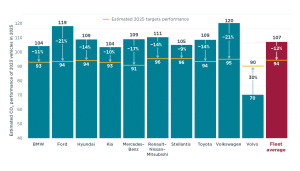
Pooling has become a common compliance tool in Europe. Tesla made hundreds of millions of euros by teaming up with legacy automakers like Fiat Chrysler and Honda. They used Tesla’s zero-emission cars to meet their emissions goals. Nissan’s new agreement with BYD follows the same principle.
By linking with BYD, Nissan can count a share of BYD’s low-carbon vehicle sales toward its own compliance calculation. This partnership will lower Nissan’s average emissions in Europe by 2025. This move helps the company steer clear of hefty fines.
Why Nissan Turned to BYD
Nissan had previously joined an emissions pool with Renault as part of their long-time alliance. Nissan has decided to partner with BYD, one of the largest EV makers. This choice comes as the Renault–Nissan partnership operates more independently and EU rules get stricter.
BYD’s growing success in Europe made it an attractive partner. The company has quickly grown its market share. This is thanks to all-electric and plug-in models that create almost no tailpipe emissions.
Nissan’s strong performance helps offset the higher emissions from its petrol and hybrid models. These models still account for a large part of its sales in Europe.
Industry analysts say this decision reflects both opportunity and necessity. It gives Nissan breathing room as it works to increase its electric lineup in Europe. The company plans to sell only fully electric cars in Europe by 2030. For now, pooling provides a temporary solution to stay compliant as EV production increases.
The Debate: Compliance Shortcut or Climate Setback?
The deal benefits both companies in different ways. For Nissan, the partnership avoids immediate financial penalties and protects its market position during a challenging transition.
For BYD, it could provide a new revenue stream, as the company may receive payment or carbon credits for its contribution to the pooled fleet. It also strengthens BYD’s presence in Europe, where competition in the EV market is intensifying.
However, not everyone sees pooling as a long-term solution. Environmental groups and some policymakers say these deals can slow real emission cuts. High-emission automakers rely on cleaner partners rather than fully changing their production lines. These strategies might meet legal rules, but they do little to speed up the actual drop in transport emissions.
Still, the system remains a legal and effective compliance method under EU law. Most experts agree that pooling will last until electric vehicle production and sales are strong. This strength will make partnerships between automakers unnecessary.
A Growing Trend in the Auto Industry
Nissan and BYD’s collaboration is part of a wider trend among carmakers facing tighter environmental rules. Over the past few years, multiple manufacturers have entered pooling agreements with EV specialists to avoid penalties.
According to industry data, nearly a dozen major automakers are now part of emissions pools across Europe. These arrangements are likely to increase in the short term.
- RELEVANT: EU’s 2025 Emission Rules Led Tesla and Mercedes to Pool Carbon Credits to Avoid $15.6 Billion Fine
EV sales are rising fast, but challenges remain. Traditional carmakers struggle to switch to electric models due to:
- Infrastructure gaps
- High battery costs
- Supply-chain issues
Pooling provides short-term relief. It helps the industry sell vehicles in Europe and stay within emissions limits.
From Pooling to Full Electrification
For Nissan, this agreement marks another step in its broader electrification plan. The company will launch more all-electric and hybrid vehicles. This plan is backed by new EV production hubs in the UK and Spain. By 2028, Nissan plans to launch several next-gen models. These will help reduce average emissions without depending much on pooling, which is important in its net-zero goal.
Nissan’s Roadmap to Net Zero
Nissan has set a long-term goal to achieve carbon neutrality across its entire business by 2050. This includes not only vehicle emissions but also their manufacturing, supply chain, and end-of-life processes. The company’s climate strategy focuses on electrifying its lineup, cutting factory emissions, and using more recycled and low-carbon materials.
- Long-Term Goal: Carbon Neutral by 2050
Nissan’s 2050 vision aims for zero emissions across the full lifecycle of its vehicles—from production to use and recycling. The company wants every car it sells, and every factory it operates, to be carbon neutral by mid-century. This goal aligns with global climate efforts to limit warming to 1.5°C.
- Mid-Term Targets Under Nissan Green Program 2030
To reach this long-term target, Nissan launched the “Green Program 2030,” a set of mid-term goals that guide its transition over the next decade. The plan includes cutting emissions in both manufacturing and vehicle use.

In Europe, Nissan has set an ambitious goal for all its new cars to be fully electric by 2030. In Asia, the carmaker is also investing in EV supply chains and battery development.
Back in its home, Japan, Nissan has introduced new technologies to reduce factory emissions and is promoting renewable energy use across its facilities. In North America, the company is launching new hybrid and electric models to meet rising consumer demand for cleaner vehicles.

The company plans to reach carbon neutrality through three main strategies:
- Electrification of vehicles
- Cleaner manufacturing
- Circular supply chain
Nissan’s decision to pool emissions with BYD in Europe fits within its broader decarbonization strategy. The deal gives Nissan temporary flexibility as it ramps up production of electric models and upgrades its European operations to lower carbon intensity.
For BYD, the partnership supports its strategy of expanding into European markets. The company continues to grow its sales network across the continent, with production plans in Hungary and potential sites in France. Its role as a compliance partner shows its strength as a global EV leader. It can influence industry trends beyond just its own brand.
Pooling remains a practical tool for now, giving Nissan and others time to adjust. Yet, as regulations tighten and public expectations rise, long-term success will depend on how quickly these companies can shift from depending on emission credits to producing truly zero-emission vehicles of their own.
The post Nissan Partners with BYD to Meet EU 2025 Carbon Rules and Avoid Hefty Fines appeared first on Carbon Credits.

EU carbon credit claims changed on 27 September 2026, the day the Directive (EU) 2024/825 began to apply across the European Union. The change is narrow. It changes how a company can talk about the credits it buys. A product can no longer be called neutral on the strength of compensation alone; however, every specific, evidenced statement about what a company measured, reduced, and funded stays fully available.

The post Promoting Improved Cooking Practices in Nigeria appeared first on Terrapass.



-
Climate Change1 year ago
Guest post: Why China is still building new coal – and when it might stop
-

 Greenhouse Gases2 years ago
嘉宾来稿:满足中国增长的用电需求 光伏加储能“比新建煤电更实惠”
-
Greenhouse Gases1 year ago
Guest post: Why China is still building new coal – and when it might stop
-

 Climate Change2 years ago
嘉宾来稿:满足中国增长的用电需求 光伏加储能“比新建煤电更实惠”
-

 Renewable Energy12 months ago
Sending Progressive Philanthropist George Soros to Prison?
-
Climate Change2 years ago
Bill Discounting Climate Change in Florida’s Energy Policy Awaits DeSantis’ Approval
-
Greenhouse Gases1 year ago
嘉宾来稿:探究火山喷发如何影响气候预测
-

 Climate Change2 years ago
Analysis: China’s CO2 falls 1% in Q2 2024 in first quarterly drop since Covid-19