

Morocco’s new national climate plan aims to halt the use of coal by 2040 alongside a goal to triple renewable energy capacity by 2030, the first time the country has set a date for phasing out the fossil fuel in a Nationally Determined Contribution (NDC).
Coal is still the biggest source of electricity in the North African country, generating more than 60% of its power in 2023, and while Morocco has made strong commitments in recent years to phase out coal, it had not set a date until now.
“The Kingdom of Morocco has stopped planning for new coal power plants,” Leila Benali, the country’s minister of energy transition and sustainable development, said in a statement, adding that the gradual phase-out of coal power and the rapid scale-up of renewable energy would boost energy security and drive economic growth.
-
Zimbabwe plans to expand coal use to address drought-induced blackouts
The Southern African nation faces severe power shortages but lacks the funding to shift to cleaner energy sources, campaigners say -
China’s emissions fall but growing coal-to-chemicals sector raises concern
The fast-rising use of coal in the production of synthetic fuels and plastics could put China’s climate targets at risk despite record additions of renewables, new analysis shows -
Countries must confront fossil fuels head-on in their NDCs
Other nations should follow the rare example set by Colombia and Vanuatu, whose climate plans contain explicit goals for cutting back on oil, gas and coal


The government said the country will need conditional support of more than $30 billion to support its climate mitigation plans, including the 2040 coal phase-out target. Without external financing, it said the phase-out would take place some time in the 2040s.
Many countries split their NDCs into two parts – one that they can achieve with their own domestic resources and an additional effort that depends on them receiving financial support from the international community. Some NDCs specify the amount of money required to implement the so-called conditional part of their pledges.
Surge in renewables
Morocco’s updated national climate plan aims to drive down greenhouse gas emissions by 53% by 2035, as against business as usual, up from the 45.5% cut by 2030 it had targeted in the previous plan.
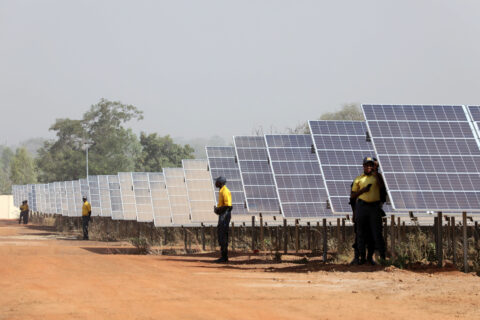
That partly reflects progress to rapidly expand renewable energy capacity, with wind and solar supplying nearly 25% of the nation’s electricity in 2024, up from 9% in 2015.
The government said it wants to raise installed renewable energy capacity from the current 5 gigawatts (GW) to over 15 GW by 2030 in line with a COP28 pledge to triple renewables, which Morocco backed. The country’s 2021 NDC had aimed to reach 52% of installed electricity capacity from renewables by 2030.
Is “hard-to-abate” really that hard – or is it a justification for delay?
The new more ambitious goal “confirms [the country’s] leadership efforts in the global energy transition”, said Iskander Erzini Vernoit, co-founder of the Morocco-based think tank Imal Initiative for Climate and Development.
Renewables are rapidly becoming the least-costly alternative in many countries. A recent report by energy think-tank Ember found that renewables overtook coal as the biggest source of electricity generation in the first half of this year, slightly driving down power sector emissions globally.
The clean energy boom has gathered speed in Africa, in particular, with solar panel imports from China jumping 60% in 12 months and providing about 15 GW of electricity capacity to the continent.
Reducing reliance on US coal
Morocco’s plan to end coal use puts it “on a path from a heavy dependence on costly fossil fuel imports to a future powered by home-produced renewable energy”, said Julia Skorupska, head of secretariat at the Powering Past Coal Alliance (PPCA).
Currently, Morocco imports large amounts of thermal coal from the United States. In 2024, African countries imported a record 6.1 million metric tons of thermal coal from the US during the first eight months of 2024 – Morocco accounted for half of that.
First carbon credit scheme for early coal plant closures unveiled
Skorupska said the PPCA will help Morocco achieve its new phase-out target, adding that “setting a coal phase-out date is a crucial step that paves the way for cleaner air, good quality jobs, and cheaper energy”.
A PPCA spokesperson told Climate Home News the body will ensure this support by connecting Moroccan policymakers with technical resources tailored to the country’s needs.
Accelerating shift from coal
At COP30, the alliance also plans to host a Coal Transition Commission, co-chaired by France and Indonesia, which will publish two technical reports outlining practical actions to accelerate on-the-ground delivery of the coal transition.
-
US withdraws from coal-to-clean JETP deals for developing nations
Just Energy Transition Partnerships for South Africa, Indonesia and Vietnam will have to move forward without US backing as Trump walks away from international climate funding -
Coal-reliant South African provinces falling behind on just transition
South Africa has a national strategy for a fair shift to cleaner energy – but regional plans and those of multinationals and cities remain patchy -
Boom in solar panel imports boosts hopes for clean energy take-off in Africa
Africa’s solar imports from China jumped 60% in the 12 months to June 2025, reaching an all-time high


With international support needed to achieve this goal, Vernoit believes the International Court of Justice ruling on polluting countries’ obligations for damages caused has made it not only expected but mandatory for developed countries to provide the necessary public finance to help realise developing countries’ climate change mitigation ambitions.
This includes providing finance “to ensure a timely phaseout of coal and other fossil fuels, as well as to accelerate deployment of renewable energy and energy efficiency and other solutions,” he added.
The post Morocco sets date for coal phase-out for the first time in climate plan appeared first on Climate Home News.
https://www.climatechangenews.com/2025/10/23/morocco-sets-date-for-coal-phase-out-for-the-first-time-in-climate-plan/

Three countries have been named by the Paris Agreement’s compliance committee for failing to submit a nationally determined contribution (NDC) and repeatedly snubbing offers of help with their climate plans.
After months of internal debate over whether to identify serial non-responders, the Paris Agreement’s Implementation and Compliance Committee (PAICC) named the three countries which have failed to engage with it over their NDCs on Friday.
It named Democratic Republic of Congo, Senegal and North Korea in a footnote of its annual report, adding that it decided to name them “with a view to facilitating engagement”, adding that representatives of the three nations had been invited to its meeting in early 2027 “with the purpose of identifying any challenges and constraints”.
“The Committee noted the importance of Parties engaging with the Committee in a timely manner, while noting that some delays may be due to the national capabilities and circumstances of the Parties”, the report said.
-
Under US pressure, World Bank says it will back gas “where appropriate”
The US wants the World Bank to expand its gas support while climate campaigners are pushing for it to end – its head spoke this week of limited backing for the fossil fuel -
IPCC scientists vow to press on with climate reports despite political deadlock
After governments again failed to agree a timeline, nearly 120 IPCC authors pledged to complete their assessment on time and with full scientific rigour -
Paris Agreement committee snubbed over missing NDC climate plans
Many governments have still not submitted a nationally determined contribution to the UN, breaching a key requirement of the Paris Agreement

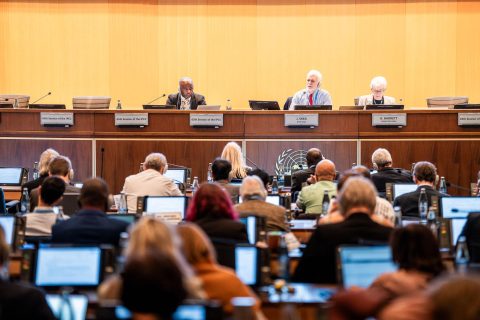

In July, PAICC said 12 countries had ignored its repeated attempts to discuss why they had not published an NDC as required every five years under the 2015 Paris accord.
Members of the committee had been divided over whether to name them, but at a September meeting decided to do so in their annual report to the annual climate COP summit.
By the time the report was published on Friday, only Congo, Senegal and North Korea “had not communicated an NDC or submitted a [Biennial Transparency Report] and had not yet responded to any of the Committee’s notifications, despite several reminders issued by the Committee in this regard”.
Rainforest and renewable energy ambitions
The silence from Congo and Senegal is notable because the former is home to much of the Congo Basin rainforest while the latter has sought billions of dollars in climate finance to support its renewable energy ambitions.
After Brazil, Congo has more rainforest than any country in the world. This forest, and the country’s peatlands, absorb huge amounts of greenhouse gas but are fast being lost to expanding farmland, charcoal production, logging and mining.
Senegal signed a Just Energy Transition Partnership with Canada and wealthy European nations in 2023, to help it meet its renewable energy targets under the-then government of Macky Sall. It was chair of the Least Developed Countries group between January 2022 and December 2023.

Tejas Rao, who is researching the PAICC as part of a doctoral thesis at Cambridge University, said the governments of the three countries should engage with the committee.
“Engagement costs these governments very little and the committee has shown it will listen,” he said.
“Silence leaves the committee with no basis to help, and it leaves the [governments] exposed to the narrative that they are simply disengaged,” he told Climate Home News.
Paris Agreement requirement
The 2015 Paris Agreement requires all parties to publish an NDC every five years outlining their emissions reduction targets, with each plan meant to be more ambitious than the country’s last NDC.
The latest set – the third round of plans, with new targets for 2035 – was due in February 2025. While most countries missed this deadline, all but around 30 – mostly small emitters but including Egypt, Vietnam and Argentina – have now submitted them.
Over the year, the PAICC – which is made up of government climate officials from developed and developing countries – has been communicating with governments that have not submitted NDCs and trying to overcome barriers to them doing so.
Some nations have cited exceptional circumstances as the reason for not submitting an NDC, a process that requires a significant amount of work in tracking emissions and consulting on how to curb them across the economy. For example, a letter from a Sudanese official to the PAICC, seen by Climate Home News, said that the country’s civil war had led to the suspension of its NDC preparation.
-
IPCC scientists vow to press on with climate reports despite political deadlock
After governments again failed to agree a timeline, nearly 120 IPCC authors pledged to complete their assessment on time and with full scientific rigour -
Under US pressure, World Bank says it will back gas “where appropriate”
The US wants the World Bank to expand its gas support while climate campaigners are pushing for it to end – its head spoke this week of limited backing for the fossil fuel -
Who shapes climate science? The equity question facing the IPCC
Early completion of the next global climate science assessment reports risks excluding research from the Global South, which is key to ensuring the findings are fair
The US and Iran are not signed up to the Paris Agreement and so do not have active NDCs, nor does Taiwan, which is not a UN member state.
Rao said that because the PAICC is “facilitative and non-punitive”, naming the countries “is meant to open a door, not close one – the invited consultation is the point”.
“In recent months, governments that explained their constraints, whether capacity, finance or domestic process, have been met with follow-up and support rather than sanction, and the number of silent governments has fallen sharply,” Rao said.
The post Paris Agreement committee names three countries snubbing it over NDCs appeared first on Climate Home News.
Paris Agreement committee names three countries snubbing it over NDCs