

Living on a floating island off the Gulf, Samuele Landi advises a little-known company with big plans to shake up the carbon offsetting market.
Blue Carbon plans to take over forested areas the size of the United Kingdom and sell carbon credits from their conservation under a mechanism established by the UN. The UAE firm, chaired by a member of Dubai’s royal family, has been on a deal-making spree with African governments to make that happen.
The 58-year-old Italian is no forestry expert, but – he says – he was tapped by the company right after its launch a year ago because of his decades-long technology experience. In Dubai, Landi is known as the owner of a cybersecurity firm devising fully encrypted phones.
In his native country, Landi is a wanted man. He was convicted in two separate trials for a bankruptcy fraud that sank one of Italy’s largest telecommunications companies and left over 2,200 people without a job nearly 15 years ago.
Landi’s advisory role in Blue Carbon is likely to fuel concerns over the integrity of a company bidding to become a large player in a sector already plagued by environmental and social risks.
Blue Carbon did not respond to emailed questions. After Climate Home contacted the company, Landi emailed the reporter in a personal capacity and agreed to a video call. He rejected the legitimacy of the court judgments against him, alleging that Italian judges ruling over his case were corrupt.
Bankruptcy fraud
Samuele Landi was the founder and chief executive of Eutelia, an Italian company providing landline and internet services to millions of users across the country in the early 2000s.
The firm, which had ballooned in size through acquisitions, seemed set on a meteoric rise. But in 2008 cracks started to appear. Drowning in debt, Eutelia asked the government to place most of its workers in a state-funded job retention scheme while trying to restructure its activities.
But at the same time, according to court records, Samuele Landi and other senior executives illicitly moved funds worth dozens of millions of euros outside of Eutelia and into shell companies mainly based outside of Italy.
Shades of green hydrogen: EU demand set to transform Namibia
Eutelia went bankrupt. By the time Italian police moved in to arrest Landi in mid-2010, he had relocated to Dubai. At the time Italy had no extradition treaty with the UAE. Landi told Climate Home News he did not move to Dubai out of fear of being arrested but because he was looking for more freedom.
Landi never returned to Italy. Two separate trials against him and other executives went ahead in his absence. In one Samuele Landi was handed an 8-year prison sentence on bankruptcy fraud charges in 2020. In a second one, stemming from the bankruptcy of a company linked to Eutelia, the court of appeal in Rome sentenced him to 6 years and six months in prison at the end of October.
Landi said he had referred the first case to the European Court of Human Rights, claiming it was an unfair trial. He said he is going to appeal against the second sentence to the Italian Supreme Court. “There is no evidence. I did not steal one single euro”, he told Climate Home.
Liberian diplomat
While his legal troubles rumbled on in Italy, Landi started a new life in Dubai. He set up a cybersecurity company and became a diplomat, after being appointed as consul general in the UAE for the African state of Liberia.
Landi told Climate Home he “developed the diplomatic relations between the Liberian and the UAE governments”, which resulted in the construction of roads, hospitals and sports centers in the African nation over the last few years.
It is through this role that he first came in contact with people from Blue Carbon. Landi said he accompanied a delegation from Liberia to a meeting with Sheikh Ahmed Dalmook Al Maktoum, a member of the Dubai royal family and chairman of Blue Carbon. “When they formed the company a year ago they asked me to be their advisor”, Landi said. “I help them with information technology. Sometimes they call me to make evaluations on IT solutions.”

A screenshot from the Blue Carbon website
Liberia is one of the African countries that have signed a raft of memorandums of understanding with Blue Carbon in the run-up to Cop28, alongside the governments of Kenya, Angola, Zimbabwe, Zambia and Tanzania. Landi said he was not directly involved in the negotiations between Blue Carbon and Liberia.
Blue Carbon’s African scramble
The deals, which are not yet definitive, could see the UAE firm gain control over more than 30 million hectares of forests across the countries. In Zimbabwe alone, it is set to secure rights over a fifth of its total landmass.
Blue Carbon plans to set up forestry protection schemes, produce carbon offsets on a never-seen-before scale and sell them to polluting governments and companies.
The firm is looking to operate under a new mechanism established by Article 6 of the Paris Agreement, which is set to transform carbon markets. Blue Carbon wants to trade a specific type of credit, internationally transferred mitigation outcomes (ITMOs), that can be used by governments to achieve emission reduction goals set out in their nationally determined contributions.
View this post on Instagram
Blue Carbon’s foray into Africa has prompted numerous concerns.
Civil society and indigenous groups fear communities will be forced to make way for the projects, losing control over land that constitutes their primary livelihoods. A number of forest protection offsetting projects – unrelated to Blue Carbon – have been suspended recently following allegations of abuse and forced evictions.
Exposed: carbon offsets linked to high forest loss still on sale
The second concern is that little money would actually end up in the hands of African governments and local communities, contrary to what the mechanism is set up to achieve.
Finally, there are worries that the unprecedented volume of credits created could end up greenwashing oil and gas operations without providing any meaningful emission reductions. Forestry offsetting programs have been hotly debated after a series of articles and scientific studies cast doubts over their climate integrity.
COP28 plans
Blue Carbon has said the deals will bring “vital environmental impacts” and “a transformative wave of economic opportunities” for the African countries signing on. Sheik Dalmook Al Maktoum told the Zimbabwean government the programme could bring $1.5 billion of climate finance into the country.
“Beyond the immediate goal of carbon emissions reduction, the heart of these carbon projects pulsates with the intent to bring about tangible improvements at the grassroots level,” the company added when announcing the agreement in Harare.
The company has indicated that more details about its carbon credit plans will be revealed at Cop28 in Dubai. It told CNN that it would present its deals at the climate summit as a “blueprint” for carbon trading.
Landi said he has no intention to take part in Cop28. Nearly a year ago he moved to a barge moored in the international waters off the Arabian coast with the goal to set up a so-called decentralized autonomous organisation.
“The idea is to create a place where people can stay without being subjected to the matrix,” he told Climate Home. “No one can say which kind of insects or fake meat you have to eat, which kind of injections you have to get. A libertarian state is very important.”
The post Meet the Italian fugitive advising Emirati start-up Blue Carbon appeared first on Climate Home News.
https://www.climatechangenews.com/2023/11/23/meet-the-italian-fugitive-advising-emirati-start-up-blue-carbon/
This is a republication of November’s edition of The Climate Agenda – a subscriber-only newsletter designed to keep you informed of the key events, negotiations and announcements happening every month. If you want to receive The Climate Agenda straight to your inbox at the start of each month, sign up as a subscriber today.
COP31 begins in one week, and we’ll have five specialist reporters on the ground in Antalya, Türkiye, bringing you every development as it happens. From the negotiations to leaders’ speeches and side events, we’ll be there to dissect what it all means for international climate policy on electrification, just transition, adaptation finance and much more.
Here’s what you need to know for November, why it matters and what to expect.
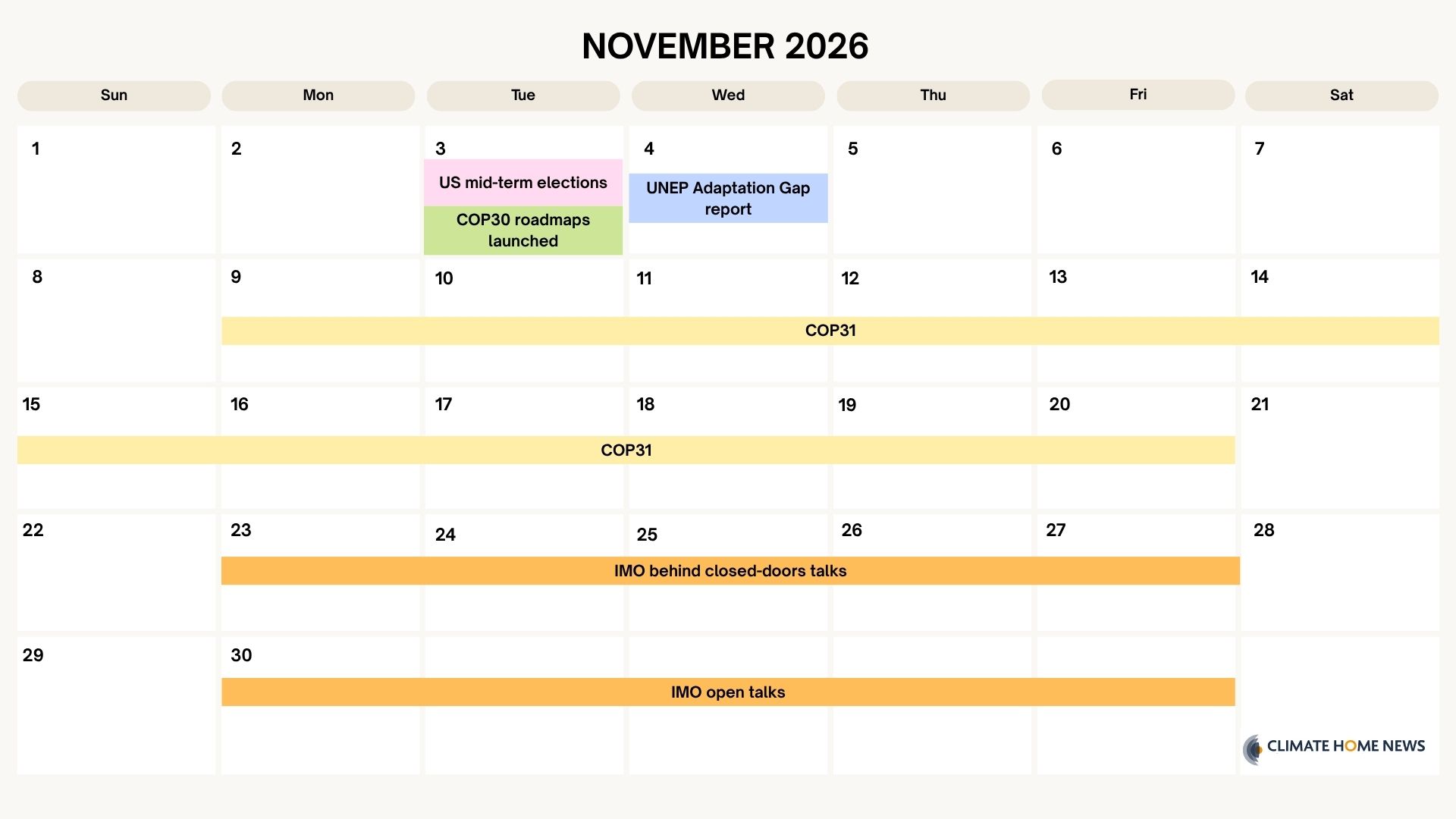
US midterm elections
Tuesday 3 November – United States
The geopolitical highlight for the first week of November is the US midterm elections, which will show whether American voters are in any mood to forgive President Donald Trump for failing to bring down the cost of living. From an energy perspective, his pro-oil and gas stance hasn’t led to cheaper prices for consumers, pushed up by the US-instigated Iran conflict. And his diesel deal with Russia won’t yet have made a difference at the pump.
The key issue for climate and energy policy is whether the Republicans hold onto their governing trifecta. If so, then expect continued dismantling of regulations that protect the environment, as well as strong backing for fossil fuel production. If the Democrats regain control of Congress, which polls suggest is possible, it could trigger a push to restore Biden-era clean energy tax credits, and support states wanting to restart mothballed wind and solar projects.
Data centres have been a hot-wire issue, with growing community opposition to their expansion – partly due to concerns over rising utility bills as the facilities gobble power. Whether Republicans or Democrats win Congress, both are likely to make tech firms pay for the extra electricity production they need, with the latter favouring renewable sources.
Governor races are also taking place in key states for climate issues, including Democrat-run California, which has used the courts to fight Trump’s attacks on clean energy.
Read more: National climate plans now promise half the emission cuts expected by UN
Read more: The more Europe relies on the US for energy, the more it’s vulnerable to pressure by Trump

COP30 Deforestation and Fossil Fuel Transition Roadmaps
Tuesday 3 November – Brazil
Brazil is set to unveil two global roadmaps: one for transitioning away from fossil fuels, the other for ending deforestation.
The COP30 presidency promised them in the dying hours of the Belém summit last November as a last-minute fix to break a political impasse. Since then, it has been consulting with countries, experts and campaigners around the world to gather ideas and sketch out the elements to include in these blueprints.
Don’t expect the roadmaps to offer any new global targets or give direct instructions on what countries must do, either to cut fossil fuel production and consumption or better protect forests. Rather, Brazil has said the documents will identify barriers and priority actions, highlight existing mechanisms and present a range of options that can be adapted to different national contexts.
It remains unclear what will happen with the reports once they are delivered on Tuesday. At the Bonn talks last June, a group of European and small island nations called for the roadmaps to be brought into the official negotiations, warning that a one-off report won’t cut it. But such efforts would undoubtedly face stiff opposition from fossil fuel-producing nations that objected to drafting the energy transition roadmap within the formal UN process last year.
Read more: European, island states seek clear future for global roadmap to cut fossil fuels
Read more: COP30 roadmap to end deforestation will invite countries to draft domestic plans
Read more: What we need to see in the roadmap to transition away from fossil fuels
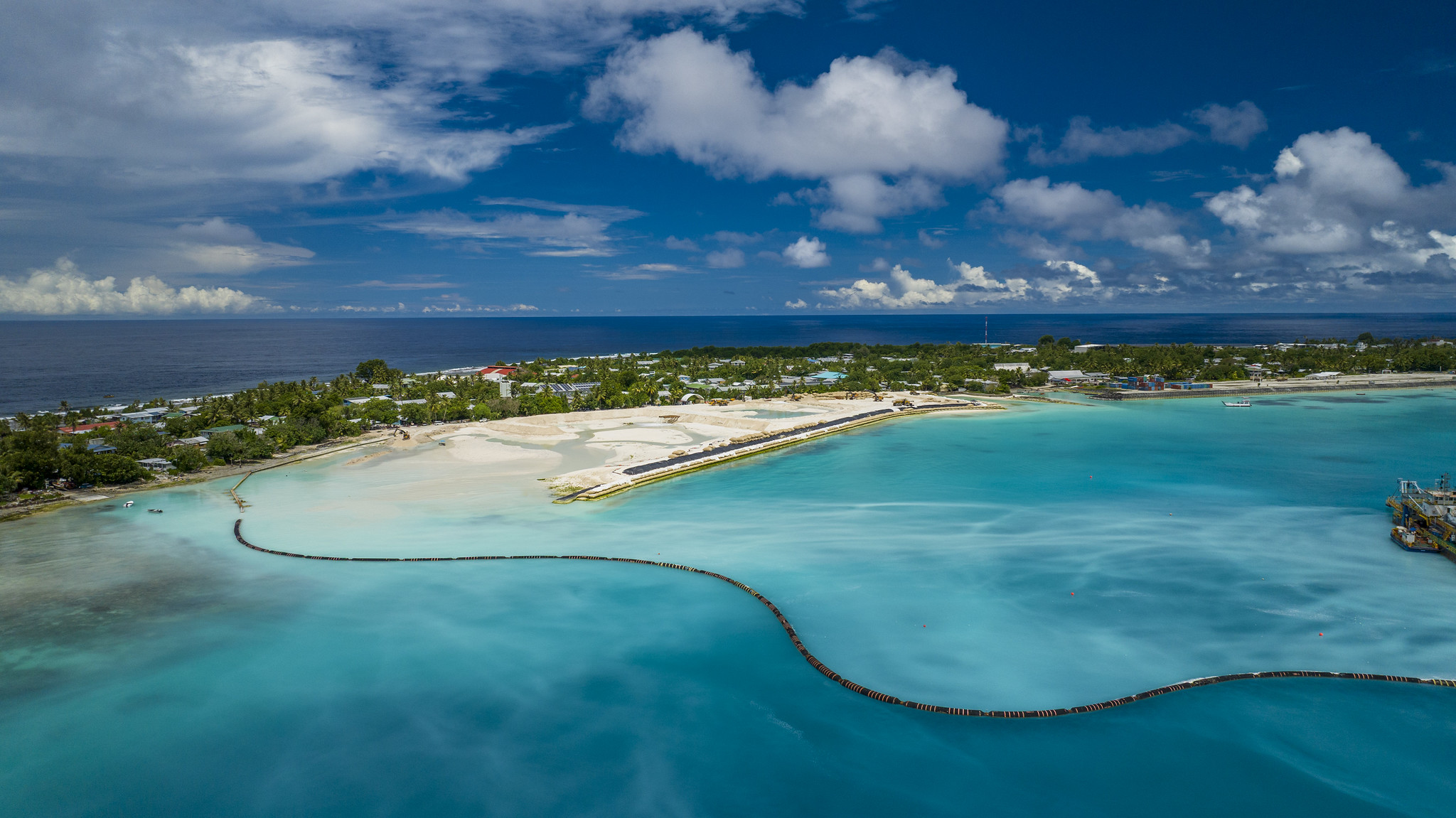
UNEP Adaptation Gap Report
Wednesday 4 November – Nairobi, Kenya
The UN Environment Programme (UNEP) will publish its annual assessment of how well the world is planning, implementing and – crucially – financing measures to cope with worsening climate impacts.
Past editions have made for grim reading. Last year’s report warned of a widening gap between what developing countries need for adaptation and what they can access. It estimated they will need $310–365 billion a year by 2035, which is 12 to 14 times current international flows. The report also found that a goal of doubling international public adaptation finance by 2025 was likely to have been missed.
This year’s edition will be closely watched with adaptation expected to be a big-ticket item at COP31. Governments are likely to discuss the specifics of a commitment to triple adaptation finance for developing nations by 2035, agreed at COP30 last year – particularly what the baseline for that pledge is. Negotiators will be debating how to track progress against the 59 indicators of the Global Goal on Adaptation.
Read more: Editor’s Desk: Nepal’s disaster has laid bare the world’s adaptation accountability gap
Read more: Bonn climate talks end in “gridlock” on adaptation and emissions-cutting
Read more: New data shows rich nations likely missed 2025 goal to double adaptation finance
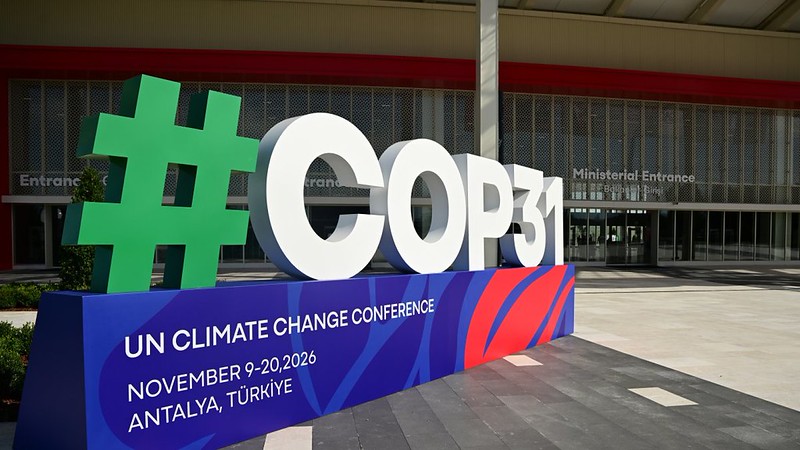
COP31 Climate Conference
Monday 9 November – Friday 20 November – Antalya, Türkiye
The climate community’s attention turns this month to Antalya for the annual UN climate summit. From the outset, COP31 will have an unprecedented, and potentially explosive, set-up: Türkiye is COP president overseeing the non-negotiated Action Agenda, while Australia runs the negotiations.
Billed, once again, as an “implementation COP”, the talks come amid a global energy crisis largely sparked by the actions of the US government, which is not expected to show up on the Turkish Riviera. It is also the first COP in the era of climate overshoot, coming just weeks after the UN officially confirmed the 1.5C warming limit will be breached and set out a narrow pathway to bring temperatures back down to the most ambitious Paris goal.
Unlike most recent COPs, the formal negotiations lack a clear headline item. Countries are due to establish and define the scope of the Just Transition Mechanism agreed in Belém last year, including its rules, governance and possible funding arrangements. On adaptation, vulnerable countries want a clearer path to delivering last year’s pledge to triple finance by 2035 and to putting the new progress indicators to work on the ground.
Governments are also likely to clash over next steps on the transition away from fossil fuels, and especially over whether the mitigation work programme – the forum dedicated to emission-cutting measures – has any future beyond this year.
Notable events to look out for in Antalya:
Opening session (9 November): The summit kicks off with the customary first-morning plenary. After the usual pageantry from the host nation, negotiating blocs and individual countries will deliver statements setting out their stall for the next two weeks. Watch out for a potential fight over the summit’s agenda – perhaps on issues relating to finance and trade following submissions requesting additional items – also a COP tradition.
Electrification (10 November): On Energy Day, the Turkish presidency is expected to formally launch its flagship electrification pledge, revealing which countries have signed up. Signatories will voluntarily commit to raising electricity’s share of global final energy consumption to 35% by 2035, though the current text does not require that power to come from clean sources. There is also a question mark over whether and how this can be included in the political cover decision the COP co-hosts have said they will aim to produce.
Leaders Summit (11-12 November): Heads of state and governments will jet into town for the traditional high-level segment in the middle of the first week, where world leaders typically talk up their climate record, air their grievances and call for more action.
Relatively few powerful leaders are on the list this time. Brazil’s Lula is set for another star turn this year, fresh from his surprise election win in October. The UK’s Andy Burnham, Spain’s Pedro Sanchez and China’s vice-premier Ding Xuexiang are expected, alongside Türkiye’s Recep Tayyip Erdogan and Australia’s Anthony Albanese. In addition, African and small island nations will feature prominently.
Our COP31 Briefing newsletter will offer a more in-depth preview of the talks later this week.
Read more: Early speakers’ list suggests few powerful leaders will attend COP31
Read more: COP31 electrification pledge leaves out clean power commitment
Read more: From Belém to Antalya – gains, gaps and challenges for a new Just Transition Mechanism
International Maritime Organization (IMO) Shipping Talks
Monday 23 November – Friday 4 December – London, United Kingdom
One year on from explosive talks in which Trump’s officials teamed up with Saudi Arabia to delay a deal to make the shipping industry greener, governments will gather on the banks of the Thames for another attempt to reach agreement.
The Net Zero Framework, provisionally agreed in October 2025, includes a series of emissions reduction targets for the owners of large ships along with penalties for not meeting them, rewards for doing so and measures to make the maritime transition fair.
The framework is likely to be either tweaked or radically rewritten so that it’s more acceptable to the US and Saudis. Brazil and Japan have submitted compromise proposals. Analysts find those will move shipping further away from being able to meet its climate goals.
There will be closed-door talks between November 23-27 and a second week of talks open to accredited media from November 30 to December 4. Agreement on a proposal, perhaps decided through a vote, is expected after long and technical negotiations. The shipping industry’s 3% share of the world’s emissions is at stake.
Read more: London talks raise hopes for green shipping deal
The post What’s on the climate calendar for November 2026? appeared first on Climate Home News.