

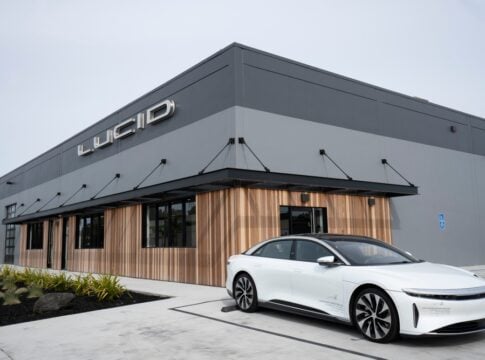
Uber Technologies has taken a deeper financial and strategic position in Lucid Group, signaling strong confidence in the future of autonomous mobility. However, despite a billion-dollar capital boost and a major robotaxi expansion plan, market sentiment around Lucid remains cautious. The latest developments highlight a widening gap between long-term vision and near-term execution risks.
Uber now holds 37.7 million shares, representing an 11.5% stake, following an additional $200 million investment in April 2026. This brings its total investment in Lucid to $500 million, making it one of the largest shareholders outside Saudi Arabia.
The controlling stake still lies with the Public Investment Fund (PIF), which owns more than 54% of Lucid. The fund also injected another $550 million into the EV maker through its affiliate Ayar Third Investment Co., reinforcing its long-term commitment.
Together, these investments form a $1.05 billion capital raise, strengthening Lucid’s balance sheet at a critical time. The funding will support production expansion, technology development, and liquidity needs.
- At the core of this partnership is a major commercial agreement. Uber has committed to purchasing at least 35,000 Lucid vehicles for its planned global robotaxi network. This marks a significant increase from its earlier commitment of 20,000 vehicles announced in 2025.
The scale of this deal is notable. Lucid delivered 15,841 vehicles in 2025, meaning the Uber order alone could double or even triple its annual production over the coming years.
Robotaxi Strategy Gains Momentum with Nuro Partnership
The collaboration goes beyond capital and vehicle supply. It forms a three-way ecosystem involving Nuro, which will provide the Level 4 autonomous driving system known as the Nuro Driver.
Each partner has a clear role. Lucid supplies premium electric vehicles, starting with the Lucid Gravity SUV. Nuro delivers the autonomous driving technology, while Uber integrates the system into its ride-hailing platform and manages fleet operations.
The first commercial deployment is targeted for later in 2026 in the San Francisco Bay Area.
Testing is already underway. Nuro has deployed nearly 100 Lucid Gravity vehicles across multiple U.S. cities to gather real-world data. Early pilot programs have also begun offering test rides to Uber employees, although safety drivers are still present.
Lucid’s upcoming midsize vehicle platform is expected to play a key role in scaling the robotaxi fleet. The company aims to deliver a competitive range using smaller battery packs while improving cost efficiency, interior space, and charging performance. The platform is expected to start below $50,000, making it suitable for both consumer and fleet markets.
Financial Backing Strong, but Execution Challenges Persist
Despite strong investor backing, Lucid continues to face operational hurdles.
For Q1 2026, the company pre-reported revenue between $280 million and $284 million, well below the market expectation of $433.8 million. At the same time, it posted an operating loss close to $1 billion and ended the quarter with roughly $700 million in cash.
Production and delivery numbers remain modest. The company produced 5,500 vehicles and delivered 3,093 units during the quarter, highlighting ongoing challenges in efficiently scaling operations.
Lucid also faced a 29-day disruption in deliveries of its Gravity SUV due to a supplier issue with second-row seating. This incident underscores supply chain fragility and the risks associated with ramping production.
While the company reported strong revenue growth of $1.35 billion in 2025, up 68% year over year, profitability remains out of reach due to high costs and continued investment.
Market Reaction: LUCID Stock Slides Despite Big News
Despite the strategic significance of the deal, market reaction has been negative.
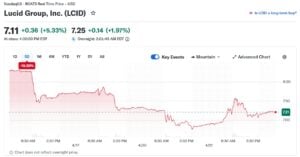
Lucid’s stock fell sharply from $9.96 on April 2, 2026, to around $6.75 by April 20, marking a decline of roughly 32% in less than three weeks. Over the past 12 months, the stock has lost about 71% of its value.
Analysts, including TD Cowen and Baird, have lowered their price targets, citing concerns over dilution, continued cash burn, and execution risks.
In contrast, Uber’s stock has shown relative resilience, gaining about 6% over the same period, according to Stocktwits. This divergence reflects stronger investor confidence in Uber’s diversified business model compared to Lucid’s ongoing operational challenges.
The Bigger Picture: High Stakes, High Risk
Uber’s 11.5% stake represents more than a financial investment. It signals a deep strategic alignment with Lucid’s future and a strong bet on autonomous mobility.
For Uber, the partnership provides access to a dedicated EV supply tailored for robotaxi operations, along with greater influence over vehicle design and platform integration. For Lucid, the deal ensures demand, strengthens its financial position, and creates a pathway beyond the luxury EV segment.
However, risks remain significant. Autonomous driving technology still faces regulatory uncertainty, and execution challenges persist. Nuro’s Level 4 system must prove its safety and scalability in real-world conditions. At the same time, Lucid must ramp up production while addressing operational inefficiencies and relatively limited consumer demand.
The recent decline in Lucid’s stock reflects investor skepticism about the company’s ability to execute its ambitious plans.
Looking ahead, the focus will remain on consistent production growth, improved financial performance, and successful deployment of robotaxi services. Until then, even billion-dollar partnerships may not be enough to restore investor confidence.
In short, Uber is making a bold bet on the future of mobility, with Lucid at the center of that strategy. The outcome will ultimately depend on one key factor: execution at scale.
The post Lucid (LCID) Stock Slides Despite $500M Uber Bet and 35,000-Vehicle Robotaxi Deal appeared first on Carbon Credits.

The post Promoting Improved Cooking Practices in Nigeria appeared first on Terrapass.
For most companies, the largest figure in the carbon inventory is not the office, the vehicle fleet, or the electricity bill. It sits upstream, in the goods and materials a business buys to make and sell its products. These purchased inputs form the bulk of a company’s Scope 3 emissions, which routinely exceeds everything the business controls directly, and can add up to 90% of their global footprint.




-
Climate Change1 year ago
Guest post: Why China is still building new coal – and when it might stop
-

 Greenhouse Gases2 years ago
嘉宾来稿:满足中国增长的用电需求 光伏加储能“比新建煤电更实惠”
-
Greenhouse Gases1 year ago
Guest post: Why China is still building new coal – and when it might stop
-

 Climate Change2 years ago
嘉宾来稿:满足中国增长的用电需求 光伏加储能“比新建煤电更实惠”
-

 Renewable Energy12 months ago
Sending Progressive Philanthropist George Soros to Prison?
-
Climate Change2 years ago
Bill Discounting Climate Change in Florida’s Energy Policy Awaits DeSantis’ Approval
-
Greenhouse Gases1 year ago
嘉宾来稿:探究火山喷发如何影响气候预测
-

 Climate Change2 years ago
Analysis: China’s CO2 falls 1% in Q2 2024 in first quarterly drop since Covid-19