
Connect with us

Published

on

National Atomic Company Kazatomprom JSC, the world’s largest uranium producer, has moved closer to sealing a massive long-term supply deal with India. The Kazakh state miner announced that it plans to sell a significant portion of its natural uranium concentrates to India’s Department of Atomic Energy (DAE).

However, the transaction is so large that it requires shareholder approval under Kazakhstan’s Joint Stock Companies law. As a result, the company has called an Extraordinary General Meeting (EGM) at the initiative of its Board of Directors.

If approved, the agreement could tighten an already strained global uranium market.

A Deal That Could Reshape Uranium Supply

The proposed contract signed with the Directorate of Purchase & Stores (DPS) under India’s DAE, covers the long-term sale of natural uranium concentrates (U₃O₈) for physical delivery to India.

The value of the transaction equals or exceeds 50% of Kazatomprom’s total book asset value. Under Kazakh law, such a major transaction must go before shareholders for approval.

While pricing, volumes, and delivery schedules remain confidential due to commercial sensitivity, the scale alone signals its strategic weight.

Kazatomprom’s Q4 2025 Fourth-Quarter Uranium Output

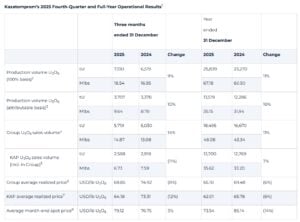
Kazatomprom currently accounts for about 20% of global uranium production. In 2025, it produced 25,839 tonnes of uranium (around 67.2 million pounds U₃O₈) on a 100% basis. That marked a 10–11% increase from 2024, driven largely by ramp-up at JV Budenovskoye.

  • Meanwhile, spot transactions increased sharply. Spot volumes rose 50% year-over-year to 55.3 million pounds U₃O₈ (around 21,270 tonnes), with an average price of $72.75 per pound.
  • Group sales volumes reached 5,719 tonnes (14.87 million pounds U₃O₈), up 14% from the previous year.
Kazatomprom uranium
Source: Kazatomprom

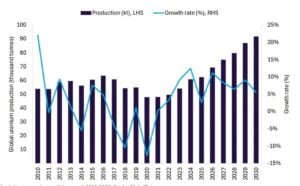
At the same time, global uranium mine production for 2025 was projected at 62.2 kilotonnes (ktU), according to industry estimates. Reactor demand stands higher at 68.9 ktU. This gap highlights a persistent supply deficit. Therefore, removing a sizeable share of Kazakh output under long-term contracts with India could tighten spot availability even further.
global uranium output
Source: Mining.com, data from Global Data

Fueling India’s Nuclear Ambitions: Why Uranium Imports Matter

India’s nuclear expansion explains the urgency behind this deal.

The country’s domestic uranium production currently meets only about 36% of its needs. Between 2025 and 2033, imports were projected to reach roughly 9,000 tonnes of uranium (tU) to support new reactor capacity.

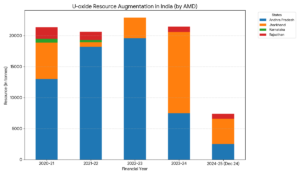
India holds recoverable reserves estimated at 252,500 tU below $260/kgU. In addition, the Atomic Minerals Directorate for Exploration and Research (AMD), a unit of the Department of Atomic Energy, has identified 433,800 tonnes of in-situ U₃O₈ resources across 47 deposits in states including Andhra Pradesh, Jharkhand, Rajasthan, and Telangana.

Mining at Jaduguda began in 1967 under Uranium Corporation of India Limited (UCIL). Recently, AMD discovered 26,437 tonnes of additional in-situ uranium oxide resources at the Jaduguda North–Baglasai–Mechua deposit in Jharkhand. This discovery is expected to extend the mine’s life significantly.

Still, domestic output alone cannot support India’s long-term reactor fleet expansion. Hence, securing a stable overseas supply has become a strategic priority.

The DPS, which handles procurement and inventory for India’s nuclear industry, accepted Kazatomprom’s commercial offer within its validity period. That move now awaits shareholder approval in Kazakhstan.
uranium output india
Source: Atomic Minerals Directorate for Exploration and Research (AMD)

Uranium Supply in a Shifting Geopolitical Landscape

The uranium market remains highly concentrated in 2025, and this proposed deal reflects a broader shift in global nuclear geopolitics.

  • Looking ahead, Kazatomprom’s 2026 production guidance stands at 27,500–29,000 tonnes on a 100% basis, slightly below nominal capacity due to sulphuric acid supply constraints. Group sales are expected at 19,500–20,500 tonnes.

If the India contract absorbs a major portion of future output, the free market could feel the impact quickly, especially given the structural supply gap.

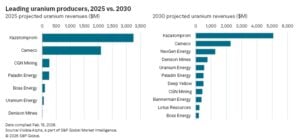
Reports say that by 2050, Kazakhstan and Canada are expected to dominate uranium exports. And in this market, uranium giants like Kazatomprom and Canada’s Cameco Corp. will dominate global revenue and production. Yet pricing trends have shown volatility. As demand for nuclear energy grows, countries are likely to form tighter supply alliances to secure fuel.
global uranium output

Balancing Strategy and Market Risk

At present, we can perceive that political tensions and energy security concerns are reshaping trade routes in oil and gas. And uranium may follow a similar path. Significantly, the IAEA has repeatedly noted that primary mining will remain the main source of uranium supply. Secondary sources, such as stockpiles and recycled materials, can only play a limited role.

Therefore, policymakers must rethink production and export strategies. Uranium-rich nations may reassess how much supply they allocate to long-term bilateral deals versus the open market.

For importing nations like India, long-term contracts provide stability. They reduce exposure to spot price volatility. They also strengthen diplomatic and economic ties. However, for the broader market, such agreements may reduce liquidity and amplify price swings during supply shocks.

The post Kazatomprom Deepens Strategic Ties with India in Major Long-Term Uranium Supply Deal appeared first on Carbon Credits.

Continue Reading

Carbon Footprint

ENGIE’s Brazil Solar Plant Explores Energy Storage and Bitcoin to Solve Grid Curtailment

Published

on

ENGIE has officially brought its Assú Sol photovoltaic complex into full commercial operation. The French utility secured final approval from Brazilian authorities on February 13, 2026, after completing construction in December 2025. With a total investment of BRL 3.3 billion, the project now stands as ENGIE’s largest operational solar asset worldwide.

Located in Rio Grande do Norte in northeast Brazil, Assú Sol has an installed capacity of 895 MWp. The complex spans 2,344 hectares and consists of 16 solar plants. At full output, it can generate enough electricity to meet the annual demand of roughly 850,000 people.

  • In 2025, Brazil added 7.4 GW of new large-scale electricity generation capacity, driven primarily by over 2.81 GW of solar PV, according to the energy regulator Agência Nacional de Energia Elétrica (ANEEL).
  • In August 2025, ABSOLAR reported Brazil’s solar capacity hit 60 GW and forecasted strong distributed generation growth through 2030.

By January 1, 2026, the country’s total large-scale power generation capacity reached 215.9 GW, with renewables accounting for 84.6% of the mix. ANEEL projects a 23.4% increase in renewable capacity in 2026, equivalent to an additional 9.14 GW.

However, while the scale is impressive, the project also reflects a deeper shift underway in Brazil’s renewable energy market.

BRAZIL SOLAR

Assú Sol Delivers at Scale: Advanced Tech Powers Brazil’s Largest Solar Plant

ENGIE completed the project over 30 months, keeping it on schedule and within budget. More than 4,500 direct jobs were created during construction. The development required over 1.5 million solar modules, extensive cabling, and new internal road infrastructure.

Importantly, the company adopted advanced construction technologies. Drone-based aerial mapping improved site planning. Automated graders linked to 3D models enhanced precision. In addition, ENGIE deployed Brazil’s first dedicated automatic pile-driving machine for a solar project.

As a result, execution was faster, safer, and more efficient. Assú Sol demonstrates that large-scale renewables can be delivered with industrial discipline. Yet commissioning marked only the beginning of a more complex challenge.

Assú Sol photovoltaic complex

Assú Sol photovoltaic complex engie
Source: Engie

Curtailment Pressures Test Solar Profitability

Despite reaching full operations, Assú Sol faces curtailment — a structural issue affecting Brazil’s clean energy sector since 2023. Curtailment occurs when renewable plants must reduce output because the grid cannot absorb all available electricity.

Brazil has added wind and solar capacity at record speed. At the same time, electricity demand has grown slowly. Distributed generation, especially rooftop solar, has also expanded rapidly. Consequently, supply often exceeds transmission capacity and real-time demand.

According to Reuters, ENGIE’s Brazil country manager Eduardo Sattamini confirmed that Assú Sol’s production has already been curtailed to balance the grid. Although specific volumes were not disclosed, the impact is material enough to prompt strategic adjustments.

In other words, renewable abundance does not automatically translate into revenue. Infrastructure constraints now shape project economics as much as generation capacity does.

How ENGIE Plans to Use Storage and Bitcoin

Reuters further revealed that to address this imbalance, ENGIE is evaluating two parallel strategies: battery storage and localized demand solutions such as bitcoin mining data centers.

Battery storage provides the most direct fix. By storing excess midday solar output and discharging it during peak demand hours, batteries reduce curtailment and improve grid stability. They also open access to ancillary service markets, strengthening revenue streams.

However, ENGIE is also studying a more unconventional model — using surplus electricity to power bitcoin mining operations. At first glance, the combination may seem unusual. Yet, from an energy economics perspective, it offers several compelling advantages.

Solar farms often produce maximum output during midday, precisely when grid demand can soften. Instead of shutting down generation, operators can redirect excess electricity to mining operations that can scale consumption up or down in real time.

This model delivers multiple strategic benefits.

  • Lower carbon intensity: Solar-powered mining sharply reduces emissions compared to fossil-fuel-based operations, helping reposition crypto infrastructure within a cleaner energy framework.

  • Flexible demand response: Mining facilities can quickly ramp power usage up or down, absorbing excess electricity during peak solar hours and easing pressure during grid stress.

  • Stable long-term energy costs: Solar generation offers predictable operating expenses after initial capital deployment, protecting operators from volatile power markets.

  • Improved asset utilization: Co-locating data centers with large solar plants maximizes land use and monetizes electricity that might otherwise be curtailed.

  • Diversified revenue streams: Developers gain an additional income channel beyond wholesale power sales, strengthening overall project economics.

Of course, integration comes with challenges. Both solar infrastructure and mining facilities require significant upfront investment. Moreover, energy supply must remain balanced to avoid operational disruptions. Smart-grid systems and, ideally, battery storage will play a critical role in stabilizing performance.

Sattamini made clear that such initiatives would take time to implement. Nonetheless, the strategy signals an evolution in renewable business models — from pure generation toward integrated energy ecosystems.

Community Development and Long-Term Strategy

The company has also invested in the Assú region’s social infrastructure. It supported the construction of a school, a health center, and sports facilities. It improved access to water and provided agricultural equipment to local communities. Such initiatives enhance local acceptance and reinforce the long-term sustainability of the project.

ENGIE’s Renewable and Storage Capacity Goal

Looking ahead, it aims to reach 95 GW of renewable and storage capacity globally by 2030. More than 80% of its planned capital expenditure aligns with the European Taxonomy framework, focusing on low-carbon generation, infrastructure modernization, green gas, and storage technologies.

The company currently operates 15.7 GW of fully renewable installed capacity across hydropower, wind, and solar assets. It also manages 3,200 kilometers of transmission lines and 22 substations.

Some significant achievements include:

  • In late 2025, ENGIE commissioned the Serra do Assuruá wind complex in Bahia, adding 846 MW of onshore wind capacity.
  • Meanwhile, the Asa Branca transmission project continues to expand grid infrastructure across several states, with more than 1,000 kilometers planned upon completion.
  • Another initiative, the Graúna transmission project, will further strengthen interconnections in southern Brazil.
engie decarbonization
Source: Engie

These investments are critical. Without stronger transmission networks, renewable curtailment will persist. Therefore, grid expansion and flexibility solutions must advance alongside generation growth.

As renewable penetration rises, profitability depends not only on installed megawatts but also on flexibility, storage, and innovative demand-side solutions. In that context, combining solar power with storage or even bitcoin mining may redefine how excess clean energy is valued.

And Assú Sol is part of ENGIE’s broader renewable expansion in Brazil, setting an example for renewable markets facing maturity challenges.

The post ENGIE’s Brazil Solar Plant Explores Energy Storage and Bitcoin to Solve Grid Curtailment appeared first on Carbon Credits.

Continue Reading

Carbon Footprint

Why Grade Matters More Than Ever in Lithium Clay Projects

Published

on

Disseminated on behalf of Surge Battery Metals Inc.

Grade matters because it affects how much lithium a project can produce and how costly it is to operate. Higher grades generally mean more lithium can be recovered with lower costs. This matters for projects that want to compete in the fast‑growing electric vehicle (EV) and energy storage markets.

Let’s explore why grade is essential for lithium clay projects and learn how it affects economics, operations, and investor interest. More notably, we highlight how Surge Battery Metals’ Nevada North Lithium Project (NNLP) stands out in this context. 

What “Grade” Means in Lithium Projects

In mining, “grade” refers to how much lithium is present in a deposit. It is usually reported in parts per million (ppm) or as lithium carbonate equivalent (LCE). A higher grade means there is more lithium per tonne of rock.

For lithium clay, grades can vary widely. Some clay deposits have grades below 1,000 ppm. Others reach several thousand ppm. The higher the grade, the more lithium metal is available to extract.

U.S. lithium clay peers usually range from 800 to 2,540 ppm Li. Some areas are lower, at 120 to 766 ppm, like American Lithium’s Tonopah claims. Others can reach 1,690 to 2,900 ppm in drilling. Common cutoffs start at 1,000–1,250 ppm for economic viability, far above the <500 ppm in some global clays like Australia’s Kaolin resources.

Grade affects several key project factors:

  • Revenue potential – Higher grade means more lithium output per tonne of material moved.
  • Cost efficiency – Projects with a higher grade may spend less on mining and processing per unit of lithium produced.
  • Product quality – Higher-grade feedstock can result in higher‑purity lithium products, which are valuable in battery markets. 

Investors and developers pay close attention to grade because it is a strong indicator of future project performance.

Why Grade Matters More Than Ever

The global lithium market is changing fast. EV production is growing quickly. Energy storage systems are expanding. Demand for lithium is outpacing supply in many markets. This puts pressure on producers and developers to find the most competitive resources.

In this environment, grade has become a key differentiator among lithium clay projects. Several market trends explain why grade now matters more than ever:

  • Rising Demand for Battery‑Grade Lithium

Battery manufacturers require consistent, high‑purity lithium feedstock. Higher-grade deposits can deliver more lithium for refining into battery materials. They can also reduce the amount of waste material that needs to be processed. 

Global lithium demand is forecast to reach 2.4–3.1 Mt LCE by 2030 (from ~0.7 Mt in 2022), with batteries driving >90% growth. High-grade clays minimize waste in refining to meet this.

lithium demand by use 2030

  • Cost Pressures in Battery Supply Chains

Global competition in battery manufacturing pushes producers to lower costs. Projects with higher grades can reduce lithium production costs. This improves project economics and makes supply chains more resilient.

Higher grades cut opex by reducing tonnage processed. For instance, >3,000 ppm clays enable <US$6,000/t LCE vs. lower-grade brine equivalents >US$10,000/t.

  • Shift Toward Domestic Supply Security

Countries like the United States are prioritizing domestic lithium production. This is part of a broader energy and industrial policy. 

U.S. holds ~115 Mt lithium resources, per USGS 2025 data, up from 98 Mt in 2024. However, production is <1% global. IRA mandates 80% domestic or allied sourcing by 2027, favoring high-grade projects for faster permitting/offtakes.

Projects with strong grades are more likely to secure investment, permit approvals, and supply agreements. They offer clearer pathways to sustainable production.

In this landscape, projects with both good size and high grade stand out. They can produce more lithium with fewer inputs. They also attract stronger interest from investors and manufacturers looking for reliable sources of battery metals.

Nevada North: High-Grade Lithium in Action

Among lithium clay projects in the United States, Surge Battery Metals’ (TSX-V: NILI | OTCQX: NILIF) Nevada North Lithium Project (NNLP) is a standout example of why grade matters. NNLP hosts one of the highest‑grade lithium clay resources in the country. It also shows strong potential for expansion and future development.

According to the 2024 resource estimate, NNLP now has an inferred resource of 11.24 million tonnes (Mt) of LCE at an average grade of 3,010 ppm lithium using a 1,250 ppm cutoff. This represents a significant increase in both size and quality compared to earlier estimates. It also positions NNLP as one of the highest‑grade lithium clay deposits in the United States.

NNLP 2024 resource estimate

Within that total resource, a core portion of 7.43 Mt of LCE grades 3,843 ppm lithium at a higher cutoff level. Higher cutoffs generally indicate more concentrated lithium zones, which are especially valuable for economic studies and future mine planning.

NNLP’s strong grades have grown progressively through drilling campaigns. In 2023, early drilling returned exceptionally high lithium values, including intervals that ranged up to 8,070 ppm lithium in specific clay horizons. These high grades were encountered close to the surface, which could simplify mining logistics.

Surge Nevada lithium clay comparison

Surge recently reinforced this grade advantage with new drilling results at NNLP. The company reported a 31-meter intercept grading 4,196 ppm lithium from surface in a 640-meter step-out hole to the southeast. This intercept is nearly 40% higher than the project’s current average grade of 3,010 ppm lithium. 

The 640-meter extension also confirms that high-grade mineralization continues well beyond the existing resource boundary. Near-surface grades above 4,000 ppm further support low stripping ratios and efficient future development.

Surge Battery Metals North Nevada drilling results

Mr. Greg Reimer, CEO, President, and Director of Surge, said,

“These drill holes materially enhance the scale of the Nevada North Lithium Project. Intersecting nearly 4,200 ppm lithium in a 640‑meter step-out to the southeast in NNL‑037 is a significant achievement. Not only is the system continuous, but we are encountering some of our highest grades at the very edges of the known footprint. It is increasingly clear that we have only begun to tap the true potential size of this premier lithium asset.”

NNLP’s resource is also shallow and laterally extensive. The deposit extends over kilometers of strike and remains open for expansion in several directions. This suggests that further drilling could add more tonnes or improve the average grade even further.

These characteristics give NNLP a competitive advantage. High grades can translate into lower production costs per tonne of lithium. They can also support strong economic outcomes as the project progresses toward prefeasibility and eventual development.

Economics Speak for Itself

High lithium grades help improve the economic profile of a project. For developers like Surge Battery Metals, this means stronger project metrics in studies such as preliminary economic assessments (PEAs).

In the case of NNLP, the high-grade and large resource support robust economic results. A recent PEA shows an after‑tax net present value (NPV) of US$9.21 billion and an internal rate of return (IRR) of 22.8% at a lithium price of US$24,000 per tonne LCE. These figures reflect the project’s ability to generate strong cash flows over its lifespan.

Surge-NNLP-Preliminary-Economic-Assessment-PEA

High grade also means that a project can produce significant lithium volumes without requiring excessively large mining operations. This can reduce environmental footprint, capital cost, and permitting complexity. The Nevada North deposit’s grades help make future processing and extraction more efficient.

For investors, grade is a key signal of potential project strength. Projects with grades well above the global average often trade at premium valuations relative to peers with lower grades. 

NNLP’s resource quality has attracted notable attention from analysts and market observers because it combines a strong grade with domestic location in a mining‑friendly jurisdiction.

The Strategic Edge in a Competitive Market

The lithium market will continue to evolve over the next decade. Global EV adoption and energy storage deployment are expected to drive demand for lithium to new highs. This will require reliable supply sources that can deliver consistent volume and quality.

In this context, grade will remain a core metric for comparing lithium clay projects. Deposits with higher grades are more likely to attract the capital, partnerships, and offtake agreements needed to advance through development phases. They also offer clearer economic paths compared to lower‑grade alternatives.

For Surge Battery Metals and its Nevada North Project, high grade is more than a number on a chart. It is a core advantage that differentiates NNLP from many peer projects. It supports strong resource economics, efficient processing potential, and a compelling narrative for domestic supply chain relevance in electric vehicle and battery markets.

As global competition for lithium intensifies, projects with both size and quality will stand out. NNLP’s high‑grade resource positions it as a leading example of how grade can influence outcomes in modern lithium clay development.


DISCLAIMER 

New Era Publishing Inc. and/or CarbonCredits.com (“We” or “Us”) are not securities dealers or brokers, investment advisers, or financial advisers, and you should not rely on the information herein as investment advice. Surge Battery Metals Inc. (“Company”) made a one-time payment of $75,000 to provide marketing services for a term of three months. None of the owners, members, directors, or employees of New Era Publishing Inc. and/or CarbonCredits.com currently hold, or have any beneficial ownership in, any shares, stocks, or options of the companies mentioned.

This article is informational only and is solely for use by prospective investors in determining whether to seek additional information. It does not constitute an offer to sell or a solicitation of an offer to buy any securities. Examples that we provide of share price increases pertaining to a particular issuer from one referenced date to another represent arbitrarily chosen time periods and are no indication whatsoever of future stock prices for that issuer and are of no predictive value.

Our stock profiles are intended to highlight certain companies for your further investigation; they are not stock recommendations or an offer or sale of the referenced securities. The securities issued by the companies we profile should be considered high-risk; if you do invest despite these warnings, you may lose your entire investment. Please do your own research before investing, including reviewing the companies’ SEDAR+ and SEC filings, press releases, and risk disclosures.

It is our policy that information contained in this profile was provided by the company, extracted from SEDAR+ and SEC filings, company websites, and other publicly available sources. We believe the sources and information are accurate and reliable but we cannot guarantee them.


CAUTIONARY STATEMENT AND FORWARD-LOOKING INFORMATION


Certain statements contained in this news release may constitute “forward-looking information” within the meaning of applicable securities laws. Forward-looking information generally can be identified by words such as “anticipate,” “expect,” “estimate,” “forecast,” “plan,” and similar expressions suggesting future outcomes or events. Forward-looking information is based on current expectations of management; however, it is subject to known and unknown risks, uncertainties, and other factors that may cause actual results to differ materially from those anticipated.

These factors include, without limitation, statements relating to the Company’s exploration and development plans, the potential of its mineral projects, financing activities, regulatory approvals, market conditions, and future objectives. Forward-looking information involves numerous risks and uncertainties and actual results might differ materially from results suggested in any forward-looking information. These risks and uncertainties include, among other things, market volatility, the state of financial markets for the Company’s securities, fluctuations in commodity prices, operational challenges, and changes in business plans.

Forward-looking information is based on several key expectations and assumptions, including, without limitation, that the Company will continue with its stated business objectives and will be able to raise additional capital as required. Although management of the Company has attempted to identify important factors that could cause actual results to differ materially, there may be other factors that cause results not to be as anticipated, estimated, or intended.

There can be no assurance that such forward-looking information will prove to be accurate, as actual results and future events could differ materially. Accordingly, readers should not place undue reliance on forward-looking information. Additional information about risks and uncertainties is contained in the Company’s management’s discussion and analysis and annual information form for the year ended December 31, 2025, copies of which are available on SEDAR+ at www.sedarplus.ca.

The forward-looking information contained herein is expressly qualified in its entirety by this cautionary statement. Forward-looking information reflects management’s current beliefs and is based on information currently available to the Company. The forward-looking information is made as of the date of this news release, and the Company assumes no obligation to update or revise such information to reflect new events or circumstances except as may be required by applicable law.

Carboncredits.com receives compensation for this publication and has a business relationship with any company whose stock(s) is/are mentioned in this article.

Additional disclosure: This communication serves the sole purpose of adding value to the research process and is for information only. Please do your own due diligence. Every investment in securities mentioned in publications of carboncredits.com involves risks that could lead to a total loss of the invested capital.

Please read our Full RISKS and DISCLOSURE here.

The post Why Grade Matters More Than Ever in Lithium Clay Projects appeared first on Carbon Credits.

Continue Reading

Carbon Footprint

Microsoft Hits 100% Renewable Electricity Milestone With 40GW Clean Energy Portfolio

Published

on

Microsoft Hits 100% Renewable Electricity Milestone With 40GW Clean Energy Portfolio

Microsoft has achieved a major sustainability milestone by matching 100% of its global electricity use with renewable energy. The target, set in 2020, was part of the company’s wider climate goals and originally slated for completion by 2025.

The company bought enough clean power to meet all its electricity needs. This covers the total use at its data centers, offices, campuses, and facilities around the world for the year.

It is one of the largest corporate clean energy achievements ever recorded. The milestone shows how major energy buyers can boost renewable infrastructure and cut emissions.

Microsoft’s Chief Sustainability Officer, Melanie Nakagawa, said:

“This is an important step on our path to carbon negativity. Electricity is a major source of emissions for Microsoft – and for many organizations. Microsoft’s experience building our clean energy portfolio has served as an important catalyst in driving commercial demand for infrastructure and innovation across the power sector.”

The Scale of Microsoft’s Renewable Energy Portfolio

Microsoft’s renewable matching does not mean every kilowatt-hour it uses comes directly from clean sources every hour of the day. Instead, the company matched its total annual electricity use with clean energy it helped finance.

The tech giant’s renewable energy portfolio is extensive and global in scale. Since 2013, when the company signed its first 110 MW power purchase agreement in Texas, it has grown its clean energy commitments. As of 2025, Microsoft has contracted about 40 gigawatts (GW) of new renewable energy supply across 26 countries.

Microsoft clean energy potfolio
Source: Microsoft

Of this total, roughly 19 GW is already online and delivering electricity to the grid. The remaining 21 GW are expected to become operational during the next five years.

  • To help put this scale into context, 40 GW of renewable capacity is roughly enough electricity to power 10 million U.S. homes.

The big tech company quickly grew its renewable energy contracts. It went from about 1.8 gigawatts in 2020 to 40 gigawatts by 2025, showing an increase of around 2,100% in just five years. This sharp rise reflects the company’s accelerated clean energy procurement strategy.

Microsoft Clean Energy Capacity (2020 vs. 2025)

The scale of growth shows how quickly large technology firms are securing long-term clean power contracts to support expanding data center and AI operations while reducing emissions.

Microsoft’s clean energy contracts include solar, wind, hydro, and other renewables. These projects are built under long-term agreements called power purchase agreements (PPAs). These PPAs usually last 10 to 15 years, which gives renewable energy developers steady revenue. It also helps them fund new clean energy plants.

How Renewable Matching Works

Matching 100% of electricity use with renewables means Microsoft buys as much renewable energy as it uses each year.

The company achieves this mainly through long-term PPAs, which finance new generation capacity. PPAs occur when Microsoft contracts with renewable energy developers to buy power at a set price over many years.

Microsoft buys renewable energy in key U.S. markets like PJM Interconnection, MISO, and ERCOT. It also invests in renewable capacity in Europe, the Asia Pacific, and Latin America.

Renewables from grid programs and clean tariffs count toward the matching goal. This is true when they have long-term contracts, not short-term “spot” credits.

This approach helps ensure that Microsoft’s demand supports new renewable capacity, not just transfers ownership of existing clean power. Long-term contracts allow developers to build new projects.

SEE MORE on Microsoft: 

Powering the Path to Carbon Negative by 2030

Matching 100% of electricity use with renewable energy is a central step in Microsoft’s broader climate strategy. In 2020, Microsoft announced a “moonshot” goal to become carbon negative by 2030. This means removing more carbon than it emits.

Microsoft 2030 carbon negative goal
Source: Microsoft

The renewable matching effort also helps reduce Scope 2 emissions, which are those associated with purchased electricity. Microsoft estimates it has cut its Scope 2 CO₂ emissions by around 25 million metric tons since starting its clean energy journey.

Microsoft’s renewable electricity commitment is part of a larger climate plan. This plan includes investing in carbon removal, improving efficiency, and exploring new technologies.

Microsoft carbon removals by the numbers 2025

The tech giant created a Climate Innovation Fund. It has invested hundreds of millions in energy systems, storage, and grid innovation.

The company closely tracks Scope 2 progress. It also tracks how fast artificial intelligence (AI) and cloud computing grow. This growth impacts total energy demand and emissions.

From Texas to India: A Global Procurement Strategy

Microsoft’s renewable energy contracts span many countries and energy markets.

In the United States, Microsoft has focused on major grid regions like PJM Interconnection (about 8,089 MW contracted), MISO (7,897 MW), and ERCOT (4,696 MW).

In Europe, the UK leads with about 1,666 MW of renewable capacity contracted, followed by Spain (1,496 MW) and Germany (1,425 MW).

Renewable capacity is also growing in the Asia Pacific. India leads with 1,011 MW, while Australia follows with 868 MW. This geographic diversity spreads investment. It also boosts renewable capacity in markets at different stages of energy transition.

Microsoft is exploring new procurement models and agreements. They are tailoring solutions for local markets and regulations.

Big Tech’s Expanding Role in Grid Decarbonization

Microsoft’s renewable energy milestone reflects a wider shift in corporate clean energy demand. Bloomberg New Energy Finance reports that over 200 global companies have bought almost 200 GW of clean energy since 2008. Microsoft’s efforts are part of this broader trend.

Big tech companies like Google, Amazon, and Meta have pledged to use renewable energy for their data centers and operations. These companies typically use PPAs to finance new wind and solar projects around the world.

corporate clean energy purchases BNEF 2025

The renewable energy demand from major corporations helps mobilize capital, lower financing costs, and accelerate the deployment of clean infrastructure.

This market signal can boost investor confidence. It also encourages utilities to adopt cleaner generation plans. These plans align with long-term decarbonization goals.

Analysts say that matching yearly renewable energy use with clean electricity doesn’t mean all power use is emissions-free at every moment. Balancing electricity supply with demand each hour, known as 24/7 carbon-free electricity, is a tough task.

Microsoft’s milestone is a big win for corporate climate action. This is true even with the challenges faced.

Beyond Annual Matching: The 24/7 Clean Power Challenge

Microsoft says it will continue to conduct renewable energy contracting to support future growth and climate goals.

Through 2030, the company plans to maintain 100% annual renewable matching and expand into emerging markets. This includes looking into more carbon-free sources like nuclear power. It also covers grid-enabling technologies to meet clean energy needs anytime.

The company is also scaling partnerships to extend its clean energy footprint. It has several contracts with global energy partners that each provide more than 1 GW of capacity.

As energy demand from cloud and AI services continues to grow, Microsoft’s renewable portfolio and innovation efforts will be central to balancing electrification with climate commitments.

The post Microsoft Hits 100% Renewable Electricity Milestone With 40GW Clean Energy Portfolio appeared first on Carbon Credits.

Continue Reading

Trending

Copyright © 2022 BreakingClimateChange.com

