

The “undervaluing” of nature by businesses is fuelling its decline and putting the global economy at risk, according to a major new report.
An assessment from the Intergovernmental Science-Policy Platform on Biodiversity and Ecosystem Services (IPBES) outlines more than 100 actions for measuring and reducing impacts on nature across business, government, financial institutions and civil society.
A co-chair of the assessment says that nature loss is one of the most “serious threats” to businesses, but the “twisted reality is that it often seems more profitable to businesses to degrade biodiversity than to protect it”.
The “business and biodiversity” report says that global “finance flows” of more than $7tn (£5.1tn) had “direct negative impacts on nature” in 2023.
The new findings were put together by 79 experts from around the world over the course of three years, in what IPBES described as a “fast-track” assessment.
IPBES is an independent body that gives scientific advice to policymakers about biodiversity and ecosystems.
This is the “first report of its kind” to provide guidance on how businesses can contribute to 2030 nature goals, says IPBES executive secretary Dr Luthando Dziba in a statement.
Below, Carbon Brief explains four key findings from the “summary for policymakers” (SPM), which outlines the main messages of the report.
The full report is due to be released in the coming months after final edits are made.
- Businesses both depend on, and harm, nature
- Current practices ‘do not support’ efforts to halt and reverse biodiversity loss
- Businesses can act now to address their impacts on nature
- Government policies can drive a ‘just and sustainable future’ for nature and people
1. Businesses both depend on, and harm, nature
Businesses of all sizes rely on nature in one way or another, says the report.
The SPM outlines that biodiversity provides many of the goods and services businesses need, such as raw materials from the environment or controlled water flows to reduce flooding during wet seasons and provide water in dry seasons.
Biodiversity also “underpins genetic diversity” that informs the development of products in many industries, including pharmaceuticals and cosmetics.
Individual businesses often do not address their impacts and dependencies on nature, “in part due to their lack of awareness”, the SPM says.
They also often do not have the data or knowledge to “quantify their impacts on dependencies on biodiversity and much of the relevant scientific literature is not written for a business audience”, the report claims. It adds:
“Lack of transparency across value chains, including of the risks and opportunities related to the sustainability of resource extraction, use, reuse and waste management, is a further barrier to action.”
The report says it is well established that businesses depend on biodiversity, but also that the actions of businesses “continue to drive declines in biodiversity and nature’s contributions to people”.
It adds that the size of a business “does not always reflect the magnitude of its impacts”, with companies in sectors such as agriculture, forestry, fishing, electricity, energy and mining having “relatively high” direct impacts on nature.
A “failure” to account for nature as the economy has expanded over the past two centuries has “led to its degradation and unprecedented rates of biodiversity loss”, the SPM says. It adds:
“The decline in biodiversity and nature’s contributions to people has become a critical systemic risk threatening the economy, financial stability and human wellbeing with implications for human rights.”
It is well established that nature loss as a result of “unsustainable use” threatens the “ability of businesses, local economies and whole sectors to function”, the report details.
These risks and others – such as extreme weather events and critical changes to Earth systems – are “among the highest-ranked global risks over the next 10 years”, it adds.
The SPM notes further that it is well established that risks around climate change and biodiversity loss “may interact to amplify social and economic impacts”.
These risks have “disproportionate impacts on developing countries whose economies are more reliant on biodiversity and have more limited technical and financial capacity to absorb shocks”, the report adds.
2. Current practices ‘do not support’ efforts to halt and reverse biodiversity loss
The SPM says that it is well established that current political and economic practices “perpetuate business as usual and do not support the transformative change required to halt and reverse biodiversity loss”.
These practices have “commonly ignored or undervalued biodiversity, creating tension between business actions and the conservation and sustainable use of biodiversity”, the report continues.
For example, the report says there is established but incomplete evidence that “time pressures on decision-making and timescales for investment returns and reporting by businesses – with an emphasis on quarterly earnings or annual reporting – are shorter than many ecological cycles”.
This prevents businesses from “adequately” considering nature loss in decision-making, says the SPM.
There is well established evidence that businesses fail to assign adequate value to “biodiversity and many of nature’s contributions to people, such as filtration of pollutants, climate regulation and pollination”, it continues.
As a result, “businesses bear little or no financial cost for negative impacts and may not generate revenue from positive impacts on biodiversity”, leading to “insufficient incentives for businesses to act to conserve, restore or sustainably use biodiversity”.
Prof Stephen Polasky, co-chair of the assessment and a professor of ecological and environmental economics at the University of Minnesota, said in a statement:
“The loss of biodiversity is among the most serious threats to business. Yet the twisted reality is that it often seems more profitable to businesses to degrade biodiversity than to protect it. Business as usual may once have seemed profitable in the short term, but impacts across multiple businesses can have cumulative effects, aggregating to global impacts, which can cross ecological tipping points.”
It is well established that policies from governments can “further accelerate biodiversity decline”, the SPM says.
It notes that, in 2023, global public and private financial spending with direct negative impacts on nature was estimated at $7.3tn.
This figure includes public subsidies that are harmful to nature (around $2.4tn) and private investment in high-impact sectors ($4.9tn), says the report.
Industries harmful to nature include fossil-fuel extraction, mining, deforestation and large-scale meat farming and fishing.
In contrast, just $220bn in public and private finance was directed to activities that contribute to protecting and sustainably using nature in 2023, adds the report.
(In recognition of the need to address public spending on activities that are destructive to nature, countries agreed to reduce biodiversity-harming subsidies by at least $500bn by 2030 as part of a global pact made in 2022.)
There are additional “barriers to action” facing businesses, ranging from challenging social norms to a lack of capacity, data or technology. These are summarised in the table below.
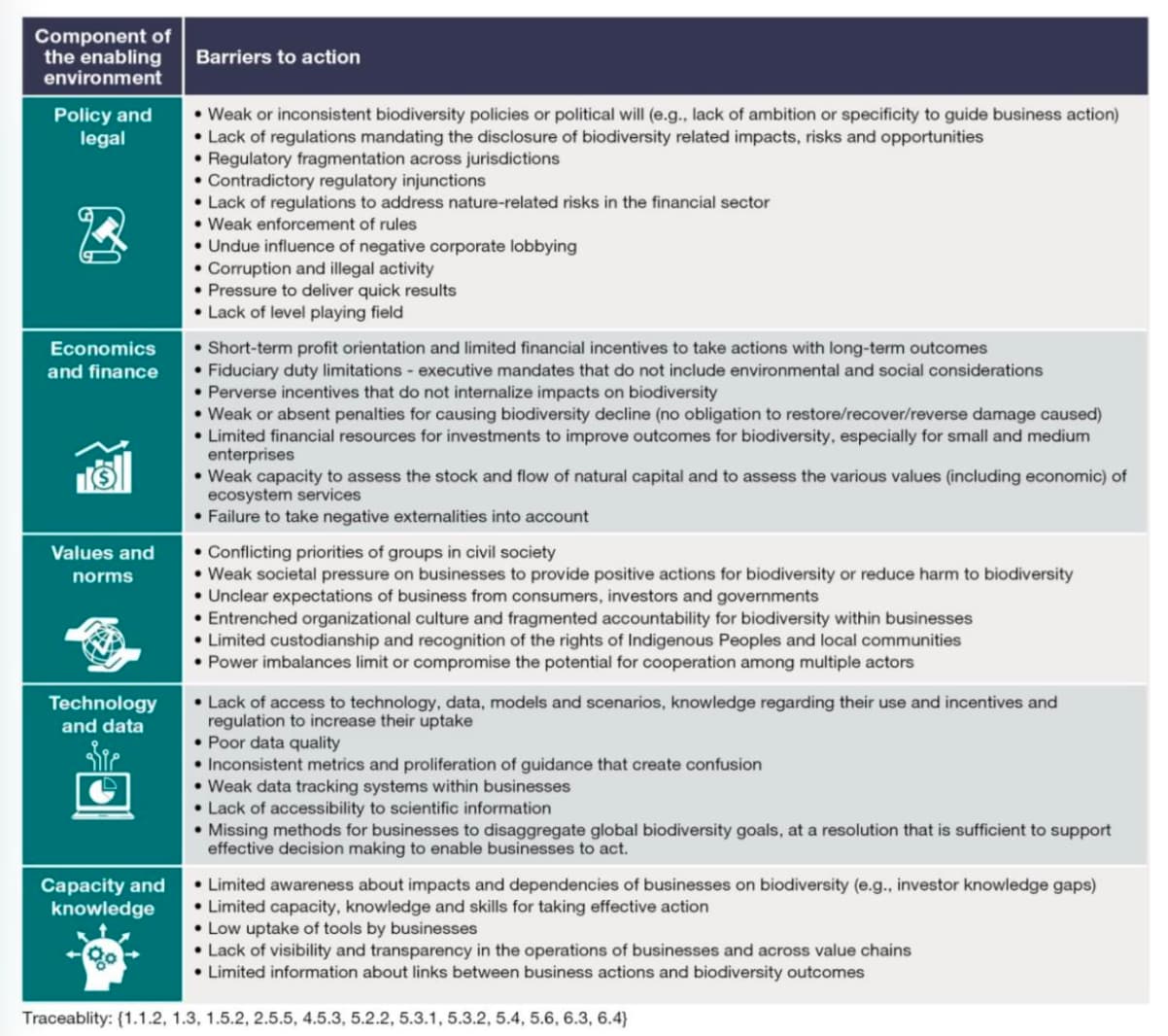
“These barriers do not affect all actors equally and may disproportionately affect small and medium-sized businesses and financial institutions in developing countries,” adds the report.
3. Businesses can act now to address their impacts on nature
The SPM says it is well established that the “transformative change” required to halt and reverse biodiversity loss requires action from “all businesses”.
However, the report continues that it is also well established that the current level of business action is “insufficient” to deliver this “transformative change”. This is, in part, because the “enabling environment is missing”, it says.
IPBES says all businesses have a responsibility to act, even if this responsibility is not shared “evenly”.
“Priority actions” that businesses should take differ depending on the size of the firm, the sector in which it operates in, as well as the company structure and its “relationship with biodiversity”, the report notes.
The exact actions businesses should pursue also depends on companies’ “degree of control and influence over stakeholders”, it says.
According to the report, firms can act across four “decision-making levels” – corporate, operations, value chain and portfolio – to measure and address impacts on biodiversity.
(“Corporate” refers to decisions focused on overarching strategy, governance and direction of the business; “operations” to day-to-day activities; “value chain” to the system and resources required to move a product or service from supplier to customer; and “portfolio” to investments and business assets).
The SPM sets out a series of examples for how businesses can act across all four levels. These are summarised in the table below.
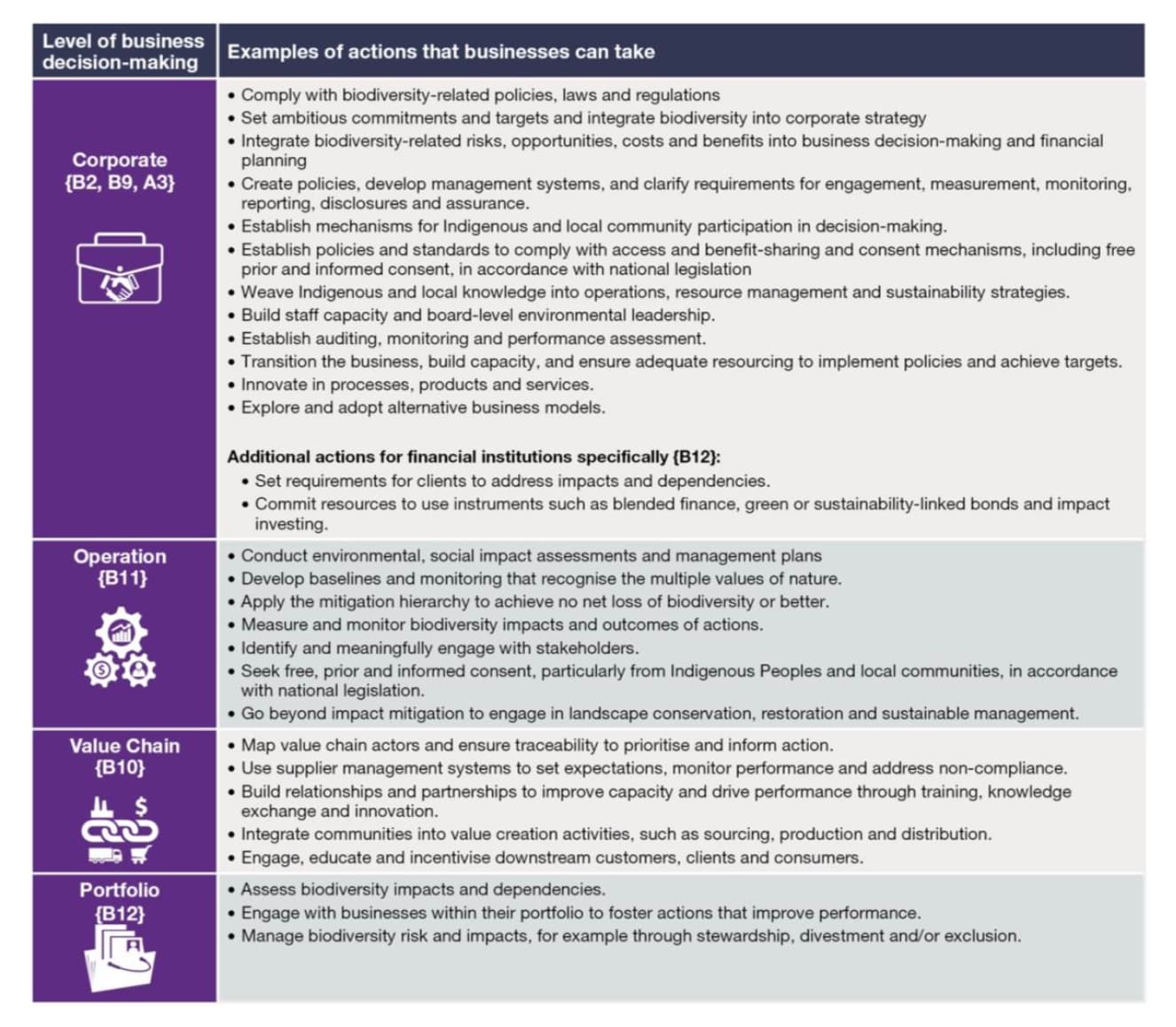
At a corporate level, the report notes that firms can establish ambitious governance and frameworks that can then have a ripple effect across the other levels, according to the report. This includes the integration of biodiversity commitments and targets into corporate strategy.
The SPM says that corporate biodiversity targets are “most effective” when they are aligned with “national and global biodiversity objectives” and “take into consideration a business’s impacts and dependencies on biodiversity and nature’s contributions to people”.
At an operations level, businesses should focus on ensuring that their operations are located and managed in a way that benefits biodiversity, IPBES says. Environmental and social impact assessments and management plans that are supported by “credible monitoring of both actions and biodiversity outcomes” can underpin this effort, the SPM notes.
It says it is well established that using the “mitigation hierarchy” framework can help businesses deliver “lasting outcomes on the ground”. (The framework guides users towards limiting as far as possible the negative impacts on biodiversity from development projects by first avoiding, then minimising, restoring and offsetting impacts.)
Next, the report notes there are actions businesses can take to drive change within its broader spheres of influence, including suppliers, retailers, consumers and peers within industry. This is important, the SPM notes, as significant impacts and dependencies on biodiversity and nature “accrue” across the lifecycle of products or services, especially those that rely on raw materials.
The report notes there is established but incomplete evidence that efforts to “map” company value chains and improve traceability by linking products and materials to suppliers, locations and impacts can help “identify risks and prioritise actions”.
While noting that “mapping” beyond direct suppliers “often remains challenging” for businesses, the report adds:
“Examples at the corporate and value chain levels exist, such as companies in the chocolate industry that have made advances in recording biodiversity dependencies to improve business decisions through full traceability of materials and improved supplier control mechanisms.”
Elsewhere, the SPM notes that there is also established but incomplete evidence that consumer-focused measures – such as product labelling, education and incentives – can “shape behaviour and improve transparency”. However, it cautions that the effectiveness of these strategies is “constrained by consumer scepticism, certification costs and business models reliant on unsustainable consumption”.
The SPM also highlights that, at a “portfolio” level, financial institutions can shift finance away from harmful activities – for instance, companies whose products drive deforestation – and towards business activities with positive impacts for biodiversity and nature.
Speaking to Carbon Brief, Matt Jones, co-chair of the report, explains the rationale behind including options for how businesses can address biodiversity impacts in the document:
“Businesses and governments in different countries are coming at this from a very different perspective. So we can’t present a set of really prescriptive ‘how tos’…but we can present a huge number of options for action that businesses, governments, financial institutions and civil society and other actors can all take.”
Elsewhere, the report says it is well established that “robust, transparent and credible reporting of actions and outcomes” is required to “inspire others”.
4. Government policies can drive a ‘just and sustainable future’ for nature and people
Both governments and financial institutions can set policies and create incentives to protect biodiversity and stem its decline, says the SPM.
According to the report, the types of policies that governments can put in place that have an influence over business include:
- Fiscal policies, such as subsidies and taxes.
- Land use or marine spatial planning and zoning, such as designating new national parks or areas protected for nature.
- Permitting for business activities that affect nature – for example, by requiring environmental impact assessments.
- Public procurement policy (rules for how governments purchase goods and services).
- Controls on advertising and the creation of standards to prevent “greenwashing”.
Governments can also promote action through paying for ecosystem services, creating environmental markets and through “multilateral benefit-sharing mechanisms”, which set out rules for ensuring profits from nature are shared equally, says the SPM.
It says this includes the Cali Fund, a fund that businesses can voluntarily pay into after reaping benefits from genetic resources found in biodiverse countries.
(The fund was agreed in 2024 with expectations that it could generate up to billions of dollars for conservation, but it has so far only attracted $1,000.)
Governments could also promote action by phasing out or reforming subsidies that are harmful for nature, as well as fostering positive incentives, according to the report.
Overall, governments can work with other actors to create an “enabling environment” to “incentivise actions that are beneficial for businesses, biodiversity and society for a just and sustainable future”, says the SPM. It adds:
“Creation of an enabling environment that provides incentives for the conservation and sustainable use of biodiversity and nature’s contributions to people could align what is profitable with what is good for biodiversity and society.
“Creating this enabling environment would result in businesses and financial institutions being positive agents of change in transforming to a just and sustainable economic system, by addressing their impacts on biodiversity loss, climate change and pollution, which are all interconnected.”
The post IPBES: Four key takeaways on how nature loss threatens the global economy appeared first on Carbon Brief.
IPBES: Four key takeaways on how nature loss threatens the global economy

Fifty-six years after the first one rallied 20 million people across America, “we need to do things that make us feel more powerful.”
From our collaborating partner Living on Earth, public radio’s environmental news magazine, an interview by host Steve Curwood with environmental historian Adam Rome.
It was the second defeat for the Trump administration’s unusual litigation to stop states from acting on climate change.
In a setback to the Trump administration’s extraordinary legal campaign against state climate action, a federal judge threw out the Justice Department’s lawsuit seeking to prevent the state of Hawaii from suing oil companies for damages.
Judge Dismisses Trump Administration’s Bid to Block Hawaii Climate Lawsuit
Climate Change
DeBriefed 17 April 2026: Fossil-fuel power slumps | ‘Super’ El Niño warning | Afghanistan’s climate struggle
Welcome to Carbon Brief’s DeBriefed.
An essential guide to the week’s key developments relating to climate change.
This week
Oil prices rebound
OIL UP AGAIN: Oil prices surged by more than 7% and back above $100 a barrel on Monday after US-Iran peace talks faltered and US president Donald Trump ordered the blockading of Iranian ports, reported BBC News. The jump came after prices fell last week in the wake of the announcement of a conditional two-week ceasefire, it said.
RESCUE PLANS: European countries unveiled plans to protect citizens and businesses from rising energy prices. Ireland announced a support package worth €505m, reported BBC News, while Germany agreed on measures worth €1.6bn, said Bloomberg. Meanwhile, Reuters reported on a draft EU proposal due to be unveiled next week that would see the bloc reduce electricity prices and roll out clean energy more quickly in response to the crisis.
UNSOLICITED ADVICE: Trump renewed his criticism of UK energy policy and called on the government to “drill, baby drill”, reported the Independent. Via social media, the president said: “Europe is desperate for energy, and yet the United Kingdom refuses to open North Sea oil, one of the greatest fields in the world. Tragic!!!” (See Carbon Brief’s recent factcheck of various false claims about the North Sea.)
Around the world
- C-WORD: Faced with pressure from the US, countries attending spring meetings of the International Monetary Fund and World Bank were urged to “not mention the climate”, reported the Guardian. It added that plans to agree a new “climate change action plan” for the World Bank “may be shelved, along with substantive discussion of the climate crisis”.
- NEW DIRECTION: Péter Magyar’s landslide victory over Victor Orbán in Hungary’s elections “presents new opportunities for the country to reduce emissions and invest in clean energy”, reported Time. Carbon Brief explored what it means for European climate action.
- ‘FURNACE’ SUMMER: There was widespread coverage – including in the Boston Globe, ABC News, CNN, Euro Weekly News, Guardian and New Scientist – of warnings from meteorologists of the development of a “super” El Niño phenomenon that could ramp up temperatures and drive extreme weather.
- ANTALYA COP: The Turkish government unveiled the dates and venues for the “leaders’ summit” segment of November’s COP31 conference, according to Climate Home News.
- PACIFIC PRE-COP: Meanwhile, the Guardian reported that Tuvalu will host a special meeting of world leaders before the climate summit in Antalya.
€10bn a year
The amount of state support that French prime minister Sébastien Lecornu has pledged for electrification through to 2030 in a bid to reduce the country’s dependence on fossil fuels. In a speech late on Friday 10 April, Lecornu noted the figure amounted to a “doubling” of existing support.
Latest climate research
- Over a four-month period of 2023, more than 70% of editorials discussing net-zero in four right-leaning UK newspapers included “at least one misleading statement” | Climate Policy
- Air pollution from global transport currently has a net cooling effect that offsets 80% of the warming impact of the sector’s CO2 emissions | npj Climate and Atmospheric Science
- The incorporation of “observational constraints” into climate-model projections suggests that the Atlantic Meridional Overturning Circulation could weaken by 50% by 2100 in a medium-emissions scenario | Science Advances
(For more, see Carbon Brief’s in-depth daily summaries of the top climate news stories on Monday, Tuesday, Wednesday, Thursday and Friday.)
Captured
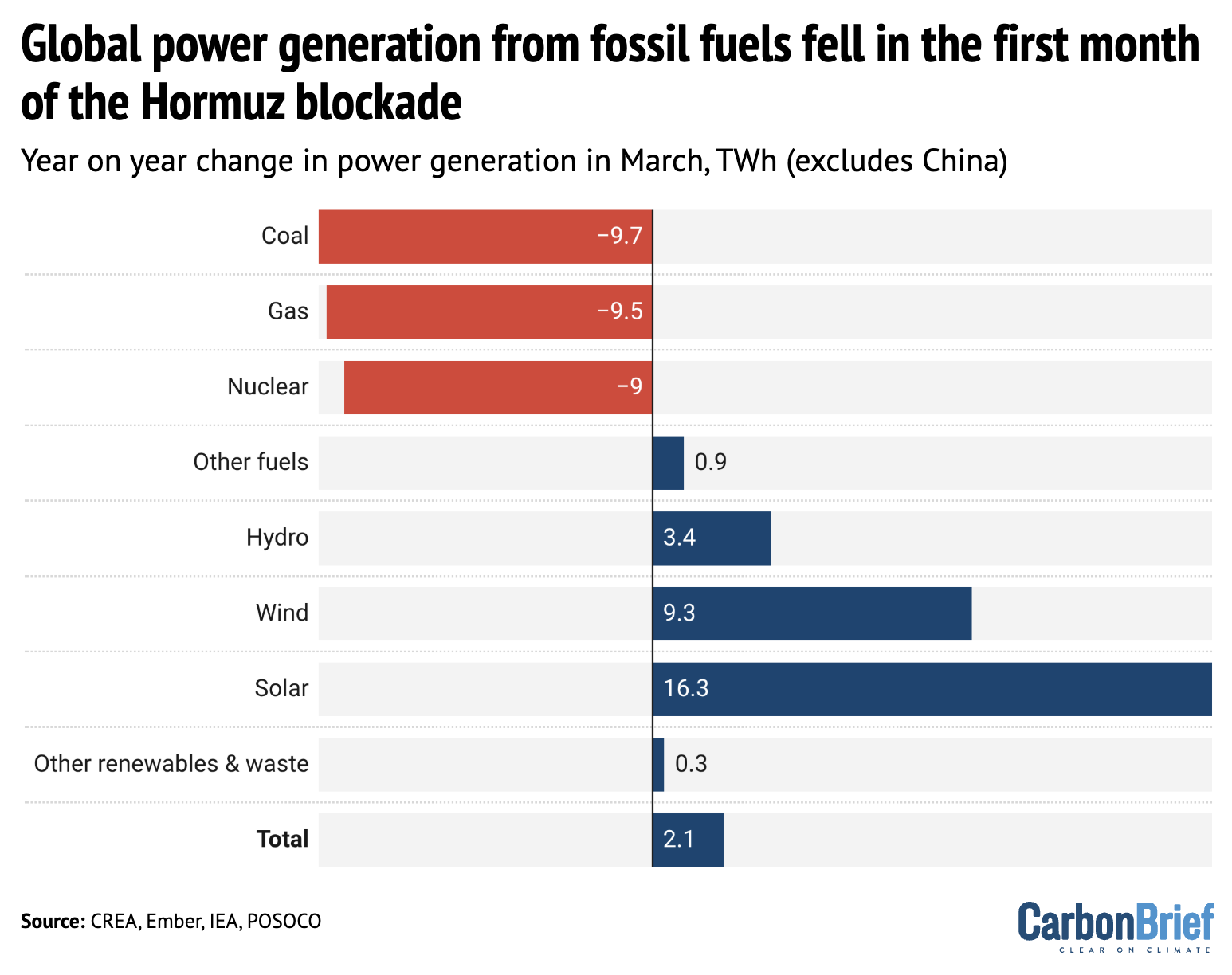
Analysis by the Centre for Research on Energy and Clean Air (CREA) found that global electricity generation from fossil fuels fell in the first month of the closure of the Strait of Hormuz. Across all countries with real-time electricity data outside of China, coal-fired power generation fell 3.5% and gas-fired power generation fell 4.0%, according to CREA. This was offset by a rise in solar power and wind generation, which increased by 14% and 8%, respectively. Hydropower generation also saw a small increase, the analysis showed, but this was “more than offset” by a drop in nuclear power generation.
Spotlight
How climate change affects Afghan lives
This week, Carbon Brief reports on the impact of climate change in Afghanistan, following deadly floods this year.
Earlier this month, heavy rains, flash floods and landslides struck large parts of Afghanistan, damaging thousands of homes, destroying crops, bridges and roads and taking nearly 100 lives.
The flooding – reported to have affected 74,000 people in 31 of 34 provinces – is the latest weather-related catastrophe to afflict the nation, whose communities have suffered the brunt of repeated flash floods, droughts and landslides in recent years.
Hameed Hakimi, non-resident senior fellow at the Atlantic Council’s South Asia Center, told Carbon Brief the recent floods would hurt livelihoods and food security, noting reports of destroyed wheat and rice crops in the most affected eastern parts of the country. He said:
“This is common. For at least a decade now, [we have seen] these flash floodings and the damage that happens to rural life, farming, the disruption to crops…Flash flooding physically eats up the land. So, it not only damages where people live, but also people’s livelihoods, based on what they grow.”
The damage to crops will be felt acutely, he explained, given that food security in the landlocked nation is already strained by the blockage of its main transit trade artery through Pakistan and international sanctions that have frozen long-term development aid.
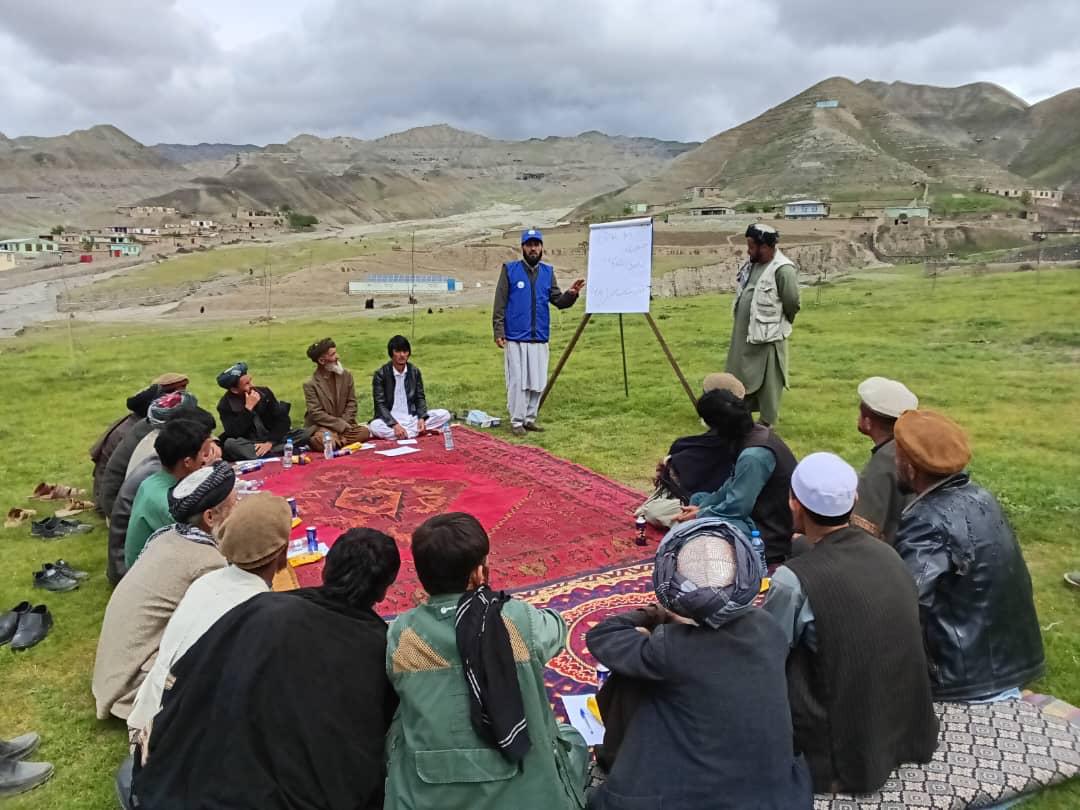
Speaking to Carbon Brief, Abdulhadi Achakzai, founding CEO of the Environmental Protection Trainings and Development Organization (EPTDO), an Afghan NGO, described flooding in Afghanistan as a “chronic situation”.
Achakzai, whose organisation runs projects that help urban and rural communities adapt to climate impacts, says climate change hurts the country in four key ways: extreme drought; extreme temperature; “natural hazards”, including landslides and dust storms; and, finally, flash flooding. He said:
“Climate change is a serious matter in Afghanistan. Every nation and every corner within this country is severely affected.”
Ranked 176 of 187 on the University of Notre Dame “global adaptation index”, Afghanistan is among the countries most vulnerable to climate change.
Average temperature across the country has increased from 12.2C in 1960 to 14.2C in 2024, according to the World Bank’s climate change knowledge portal. Drought is widespread, severe and persistent – harming food and water security in a nation of subsistence farmers.
Meanwhile, extreme weather events are the leading driver of internal displacement in the country. More than three-quarters of the 710,000 people who relocated within Afghanistan in 2024 did so driven by “environmental hazards”, such as drought and flood, according to a recent climate vulnerability assessment from the International Organization for Migration.
Finance struggles
Despite feeling the impacts of extreme weather, Afghanistan has been barred from UN climate negotiations and had limited access to climate finance since 2021. (The government attended COP29 in Baku as guests of the Azerbaijan hosts, but did not take part in formal negotiations.)
This is because the international community does not recognise the Taliban government, which resumed power in 2021, due to its record on human rights and its repression of women and girls in particular.
Almost all financing from key climate funds has been suspended, with the exception of a few projects where UN agencies and NGOs act simultaneously as a “requesting” and “implementation” partner.
Aid from UN climate funds fell from $5.9m annually over 2014-20 to $3.9m annually over 2021-24, according to recent analysis by the Berghof Foundation. Multilateral development banks provided a further $337m of funds badged as “climate finance” over 2021-23, it said.
By comparison, Afghanistan’s national climate plan, submitted to the UN Framework Convention on Climate Change (UNFCCC) in 2016, requested $17.4bn in climate finance over 2020-30. An updated national climate plan seen by Carbon Brief – completed in 2021 and later endorsed by the Taliban government, but not accepted by member governments of the UNFCCC – called for $20.6bn through to 2030.
Achakzai, whose organisation attends the COP climate summit each year in an observer capacity, has in the past been the sole delegate from Afghanistan to the conference.
He is calling on the UNFCCC to accept the country’s latest climate plan – and to find an “alternative solution” that would give the people of the country a voice in negotiations. He said:
“Every year we are losing hundreds, thousands of people because of climate change-related matters. Every year we are losing hundreds, thousands of hectares of crops. We are affected by [the decisions of] other countries. Why are we not part of this process?”
Watch, read, listen
BLOSSOM WATCHER: The Guardian reported on the successful search to find a researcher to continue Japan’s 1,200-year cherry blossom record.
COP OUT: Deutsche Welle spoke to experts to understand why India walked away from its bid to host COP33 in 2028.
‘BOMBS AND PORN’: The New Republic looked at who is set to benefit from the rapid build-out of energy-intensive AI datacentres.
Coming up
- 20-24 April: Intergovernmental Panel on Climate Change (IPCC) working group one report author meeting, Santiago, Chile
- 22 April: Earth day
- 22 April: Launch of third edition of the Lancet Countdown’s Europe report
- 24-29 April: First conference on transitioning away from fossil fuels, Santa Marta, Colombia
Pick of the jobs
- International Organization for Migration, senior thematic associate (climate action) | Salary: UN G-6 salary grade | Location: Dakar, Senegal
- Climate Action Network UK, several board member roles | Salary: Unknown. Location: Unknown
- UK Department for Energy, Food and Rural Affairs, G7 science lead | Salary: £56,375. Location: Bristol, London, Newcastle-upon-Tyne or York, UK
- Save the Children UK, senior climate change advisor | Salary: £62,000-£65,000. Location: London
DeBriefed is edited by Daisy Dunne. Please send any tips or feedback to debriefed@carbonbrief.org.
This is an online version of Carbon Brief’s weekly DeBriefed email newsletter. Subscribe for free here.


The post DeBriefed 17 April 2026: Fossil-fuel power slumps | ‘Super’ El Niño warning | Afghanistan’s climate struggle appeared first on Carbon Brief.


-
Climate Change8 months ago
Guest post: Why China is still building new coal – and when it might stop
-
Greenhouse Gases8 months ago
Guest post: Why China is still building new coal – and when it might stop
-

 Greenhouse Gases2 years ago
嘉宾来稿:满足中国增长的用电需求 光伏加储能“比新建煤电更实惠”
-
Climate Change2 years ago
Bill Discounting Climate Change in Florida’s Energy Policy Awaits DeSantis’ Approval
-

 Climate Change2 years ago
嘉宾来稿:满足中国增长的用电需求 光伏加储能“比新建煤电更实惠”
-
Climate Change Videos2 years ago
The toxic gas flares fuelling Nigeria’s climate change – BBC News
-

 Renewable Energy6 months ago
Sending Progressive Philanthropist George Soros to Prison?
-

 Carbon Footprint2 years ago
US SEC’s Climate Disclosure Rules Spur Renewed Interest in Carbon Credits