

The UK government’s “high-risk” research funding agency last week announced that it will invest £57m ($76m) in a new solar geoengineering research programme.
“Solar geoengineering” refers to methods that aim to address some of the impacts of a warming climate by reflecting away more sunlight from the Earth.
The programme, spearheaded by the Advanced Research and Invention Agency (Aria), will fund 21 projects globally.
This includes small-scale outdoor experiments, involving attempts to thicken Arctic sea ice and brighten clouds above Australia’s Great Barrier Reef to reflect away sunlight.
The news was reported breathlessly by the UK media, with some outlets conjuring images of the government one day “dimming the sun” or trying to modify the weather and others focusing on the “secretive” nature of Aria and its research.
The reaction was even more exaggerated on social media, where anonymous accounts seized upon the news to spread misinformation about existing “secret” government schemes to “control” the weather.
At the same time, the programme – first reported last year – has sparked legitimate debate among climate scientists, who have long held diverging views on whether more research funding should be channelled into solar geoengineering.
Below, Carbon Brief explains what the new solar geoengineering research programme consists of and explores the social and ethical concerns surrounding the technology.
- What is the UK’s new solar geoengineering research programme?
- How does this compare to past solar geoengineering efforts in the UK and globally?
- Why do some scientists say solar geoengineering research is needed?
- Why are there social and ethical concerns around solar geoengineering?
What is the UK’s new solar geoengineering research programme?
Solar geoengineering is a term used to describe a group of hypothetical technologies that could, in theory, counteract temperature rise by reflecting more sunlight away from the Earth’s surface. (It is also sometimes called “solar radiation modification”.)
The most commonly proposed idea is to introduce reflective aerosols high up into the stratosphere, which would lower global temperatures in a similar way to a volcanic eruption.
Other ideas include deliberately modifying clouds to make them more reflective or sending giant mirrors into space.
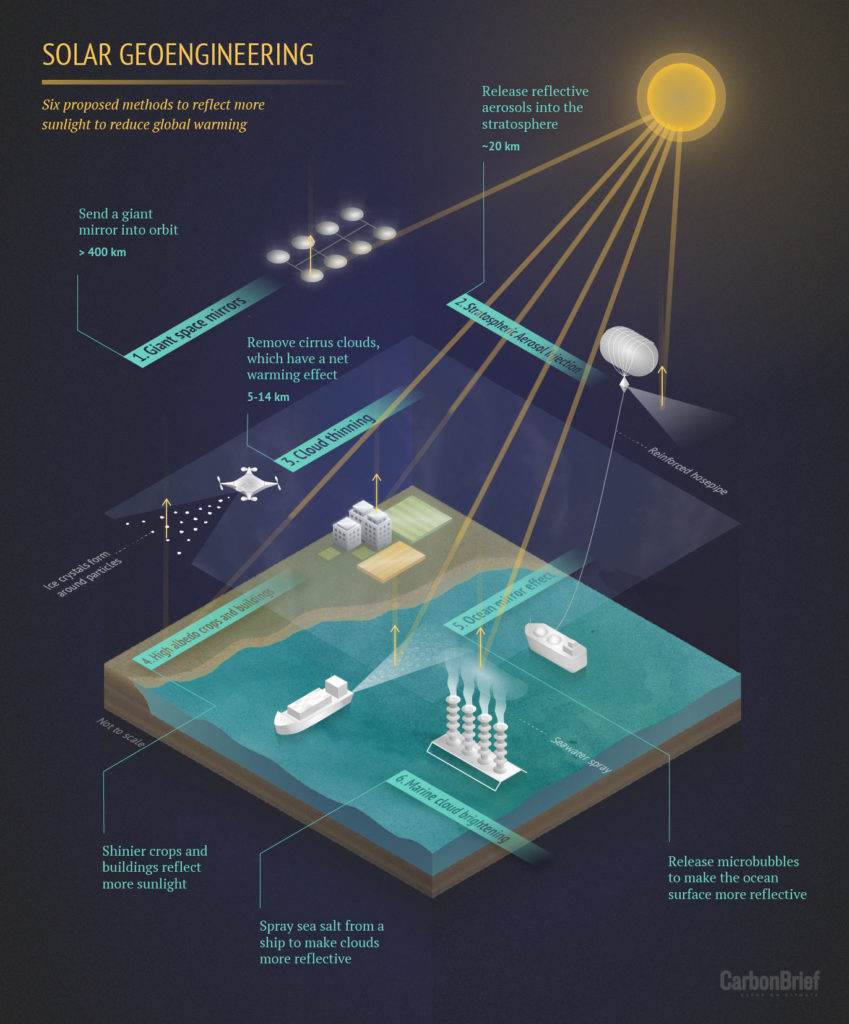
The proposals may sound futuristic, but the notion of engineering the climate in order to limit sunlight has been debated by scientists and politicians for more than 50 years.
However, these debates have always proved controversial, meaning – apart from studies based on computer simulations – little field research into solar geoengineering has been carried out. (See: How does this compare to past solar geoengineering efforts in the UK and globally?)
Aria’s new research programme aims to invest £57m in 21 solar geoengineering research projects globally.
This – along with a separate £10m scheme from the UK Research and Innovation body – means the UK is now one of the world’s biggest funders of solar geoengineering research.
Announcing the details of the scheme, Aria said its motivation for launching the research programme was “the possibility of encountering damaging climate tipping points”.
Out of the £57m, around £24.5m ($33m) will be spent on “controlled, small-scale outdoor experiments”, according to Aria.
These include attempts to thicken Arctic sea ice, brighten clouds above Australia’s Great Barrier Reef and to float weather balloons containing natural minerals high in the stratosphere, which will be retrieved after “hours or weeks”.
All outdoor experiments will be “scrutinised” by an oversight committee chaired by Prof Piers Forster, a leading climate scientist who is the founding director of the Priestley Centre for Climate Futures at the University of Leeds.
In a note released alongside news of the research funding, the oversight committee said it does “not exist to legitimise this programme”, adding:
“We advise Aria on the risks and benefits of supporting proposed creator projects and how best to work with and across creator teams to support learning and to help ensure that findings are contextualised and communicated appropriately alongside [climate] mitigation and adaptation options.”
Aria is a “high-risk, high-reward” government research agency that was formally established through an act of parliament in 2023.
It was originally conceptualised by Dominic Cummings, a controversial former adviser of then prime minister Boris Johnson.
According to Nature, Aria was modelled on the “famed US Defense Advanced Research Projects Agency, or DARPA, which helped to pioneer some of the world’s most consequential technologies, including the internet and personal computers”.
In its recent coverage, the Daily Telegraph described Aria as a “secretive government unit”.
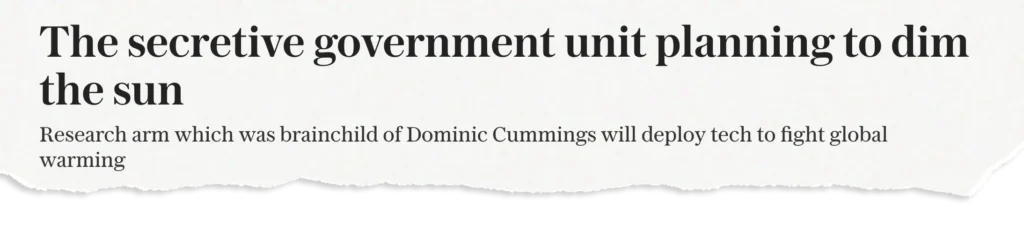
Aria itself has said that it aims to be fully transparent about its solar geoengineering programme, which was its motivation for publicly announcing its spending on the 21 projects involved.
How does this compare to past solar geoengineering efforts in the UK and globally?
As mentioned above, the idea of solar geoengineering has been debated for more than 50 years. However, its controversial nature has meant that, until now, very few field experiments have been carried out.
In 2010, there was an attempt to carry out field research in the UK by the Stratospheric Particle Injection for Climate Engineering (SPICE) project, which was headed by Dr Matthew Watson at the University of Bristol and involved scientists from the University of Oxford, the University of Cambridge and the University of Edinburgh.
The project aimed to “investigate the effectiveness” of solar geoengineering, in part by releasing the equivalent of a bathtub of water high into the atmosphere above Norfolk.
However, it was met with fierce opposition by some campaign groups. In 2012, the team ended the project, citing issues with intellectual property and discomfort with the current lack of regulation and governance of solar geoengineering research.
(Watson is one of the recipients of Aria’s new research programme. His team has been awarded £4.3m ($5.7m) to build specialised drones to study emissions from regularly erupting volcanoes in Guatemala, Montserrat and Chile.)
Outside of the UK, another high-profile solar geoengineering experiment headed by researchers at Harvard University, called the Stratospheric Controlled Perturbation Experiment (Scopex), was also forced to disband following public disapproval.
In the private sector, a US start-up called Make Sunsets has begun releasing high-altitude balloons containing sulphur dioxide into the stratosphere, in an attempt to geoengineer the planet. It funds its activities by selling “cooling credits”.
The company has been banned in Mexico, where it previously launched balloons, and is currently being investigated by the US Environmental Protection Agency.
According to the online publication SRM360, funding for solar geoengineering has increased from $34.9m in 2010-14 to $112.1m in 2020-24. The vast majority of funding is concentrated in global-north countries and about half of all funding comes from philanthropic sources.
This week, scientists and policymakers are meeting in Cape Town, South Africa for the largest summit to date on the scientific, social and political implications of solar geoengineering.
Countries have agreed to a de facto moratorium on large-scale solar geoengineering under the Convention on Biological Diversity, a UN treaty that aims to protect biodiversity. (However, it is not legally binding.)
Why do some scientists say solar geoengineering research is needed?
Scientists agree that cutting global greenhouse emissions as soon as possible is key to tackling climate change.
But global emissions are still rising – and the prospect of limiting global warming to 1.5C above pre-industrial levels, the ambition of the landmark Paris Agreement, without first “overshooting” the target is fast vanishing.
This has led some scientists to call for more research into solar geoengineering ideas, including through small-scale experiments and trials.
Research based on computer modelling indicates that artificially cooling the planet by releasing reflective aerosols into the stratosphere using specialised planes could be effective at offsetting a range of climate impacts, such as more intense heatwaves and flooding, melting sea ice and higher tropical storm risk.
(One solar geoengineering scientist has estimated that halving global warming with reflective aerosols would involve a specialised fleet of about 100 planes releasing 1m tonnes of sulfuric acid each year by 2070.)
However, this type of solar geoengineering would not address rising CO2 levels, which are causing oceans to become more acidic and crops to become less nutritious, among other issues.
Some scientists have raised concerns that, if aerosols were used to address global warming, the world could be left at risk of a “termination shock”. That is, if aerosols were released and then suddenly stopped – as a result of political disagreement or a terrorist attack, for example – global temperatures could rapidly rebound.
This sharp temperature change could be “catastrophic” for wildlife, modelling studies have suggested. However, other research argues that the likelihood of a termination shock has been “overplayed” and that measures could be put in place to ensure that the risk is minimised.
There is also a risk that deploying aerosols from just one spot on Earth could cause uneven impacts for people. One research paper based on modelling found that releasing aerosols in just the northern hemisphere could lead to a decrease in rainfall – and, therefore, an enhanced drought risk – in India and the African Sahel.
Ultimately, advocates of solar geoengineering research tend to argue that the only way to understand more about the efficacy and risks of the technology is to study it further, whereas opponents say more research could be a “slippery slope” towards deployment.
Why are there social and ethical concerns around solar geoengineering?
As well as scientific uncertainties, experts have long warned that solar geoengineering poses large social, ethical and governance challenges.
Some scientists and campaigners are fundamentally opposed to the idea of manipulating the climate further in order to try to repair some of the damage caused by fossil-fuel emissions.
Writing in the Guardian, climate scientists Prof Raymond Pierrehumbert and Dr Michael Mann described Aria’s research programme as “like using aspirin for cancer”.
Indigenous groups have strongly opposed the idea of solar geoengineering and its research, often arguing it goes against their beliefs about living in harmony with nature.
Some scientists and campaign groups also believe that solar geoengineering could be viewed by politicians and the public as a quick “technofix” to climate change. If more research and development is channelled into these techniques, they argue, people may start to backpedal on their promises to cut their emissions.
This is often referred to as the “moral hazard” dilemma.
But other researchers have urged caution on this idea. One reason for this is that social experiments conducted with members of the public have found little evidence of the moral hazard problem existing in practice.
Advocates of solar geoengineering research say it should be viewed as a “supplement” to climate mitigation efforts rather than a “substitute” or “quick fix”.
However, many experts and commentators have pointed out that the technology presents a very large global governance challenge.
A fair and just deployment of solar geoengineering would require agreement between countries, experts have reasoned. At present, it is difficult to picture a global forum that could garner such collaboration, they say.
Prof Alan Robock, a professor in the department of environmental sciences at Rutgers University, summarised this issue neatly in a conversation with Carbon Brief in 2018, when he said:
“You’re asking if the world can come together and agree on geoengineering without agreeing on mitigation. I think the answer is for us to agree on mitigation. Paris is the first step, the pledges made there aren’t enough but have got to increase.”
Another concern is the “free-driver problem”, an idea that refers to the potential for a single country, group or even individual to unilaterally deploy solar geoengineering, even if it might cause negative impacts for others. This concern arises from the fact that solar geoengineering would be relatively cheap to carry out.
It has been argued that the free-driver problem poses a larger concern than ever in today’s increasingly polarised world, where lone politicians and billionaires hold large amounts of power.
These serious social and governance issues prompt some experts to say solar geoengineering should not be researched at all, but others to say it should be researched to try to address concerns.
Out of Aria’s £57m for solar geoengineering research, around £2.8m ($3.7m) is earmarked for governance and ethics projects.
In its latest assessment for how the world can address climate change, the world’s authority on climate science, the Intergovernmental Panel on Climate Change (IPCC), notes that there is “high agreement” among research papers that solar geoengineering “cannot be the main policy response to climate change and is, at best, a supplement to achieving sustained net-zero”.
The assessment also notes that solar geoengineering “may introduce novel risks for international collaboration and peace”.


The post Factcheck: How the UK is – and is not – studying solar geoengineering appeared first on Carbon Brief.
Factcheck: How the UK is – and is not – studying solar geoengineering

The launch of the Africa Energy Bank (AEB) has been put back yet again, raising doubts about the institution’s future ability to finance fossil fuel projects – its main objective – as global lenders retreat from such investments over climate concerns, experts told Climate Home News.
The bank, which had been billed to launch in September after a series of delays, is now scheduled to begin operations in November, according to the head of the African Energy Chamber, an advocacy body for the continent’s oil and gas sector.
Even as the world aims to transition away from fossil fuels, many African leaders have made clear they want to continue exploring and extracting the continent’s large oil and gas deposits – estimated at around 125 billion barrels of crude and over 600 trillion cubic feet of gas – to boost economic development.
As a group, Africa sided with a number of powerful oil-and-gas producing nations in blocking progress on negotiations to craft a global roadmap to transition away from fossil fuels at last year’s UN COP30 climate talks, although some countries did individually support the proposal.
-
Campaigners oppose Dangote’s planned Kenya refinery over climate and ecological risks
Plans to build Africa’s second largest oil refinery in ecologically sensitive region criticised as “environmental recklessness” -
Tanzania pushed African nations to oppose fossil fuel transition at COP30
While chairing the African group at the summit, the gas-dependent nation advised the continent’s ministers to block language on transitioning away from fossil fuels


Meanwhile, major projects under development across the continent – including the 1,443-km East African Crude Oil Pipeline (EACOP) and Dangote’s 700,000-barrel-per-day Kenyan refinery – show that African governments see oil and gas as playing a significant role in meeting their energy and economic needs for many years to come.
In 2022, at a gathering of the African Petroleum Producers’ Organization (APPO) in oil-rich Angola, ministers from its member states adopted a resolution to create the Africa Energy Bank to finance projects for the production, use and trade of oil, gas and broader energy sources.
African control over energy resources
An article on the APPO website explains that the bank was conceived as a way to overcome “disenchantment” with fossil fuels among “the international community” which it said had crystallised around the “energy transition” concept.
“If Western countries, after having long taken advantage of the energy sources they now revile to develop, can afford the luxury of abandoning them, this is not the case in Africa,” it adds, noting that many of the continent’s economies are still largely dependent on oil and gas revenues.
A separate web page about the bank, also hosted on APPO’s website, says its objectives include financing the exploration, production and refining of oil and gas, as well as supporting member states in transitioning from fossil fuels to cleaner energy sources “while ensuring energy security”.
Said Addi, a former executive with Shell and energy commodities trading house Gunvor, said the new bank was judged necessary because financing for hydrocarbons from many traditional international lenders has become constrained.
In trying to fill this financing gap, Africa is not simply setting up another fund to support oil and gas, he added. “It is also an attempt to give African countries greater control over how their energy resources and infrastructure are financed,” he explained.
Nigeria to host the AEB
The energy bank – a joint initiative of APPO and the African Export–Import Bank (Afreximbank) – has so far suffered several delays and is almost two years behind schedule. The initial plan was to start operations in January 2025, with Nigeria as the host country, but the bank’s opening was delayed to June of that year to allow Nigeria time to finalise the construction of the bank’s headquarters in Abuja.
After the government announced the completion of the offices in late November 2025, a new launch date was set for January 2026, which was moved back to April, June and then September. Now it has shifted again to November, raising concerns that the institution may be losing momentum.
Former Shell executive Addi said that if the capital is eventually paid in, the bank becomes operational and its first projects are commercially credible, then the delays will be regarded as normal teething troubles in setting up a multilateral institution. But, he added, scepticism will be justified if it continues to stall.
Uganda may see lower oil revenues than expected as costs rise and demand falls
Baron Lamarré, an oil and gas expert and former Petronas oil trader, said that missing “three deadlines in a row is not normal”, and warned that if the timeline slips again, “the story flips from ‘ambitious institution finding its footing’ to ‘good idea that lost momentum before it found any’.”
The Nigerian government, APPO and Afreximbank did not respond to requests for comment by the time of publication.
The funding challenge
The Africa Energy Bank is targeting base capital of $5 billion, with plans to scale up to $120 billion within five years by mobilising private-sector funds. However, it is expected to start operations with initial seed capital of $500 million.
The funding plan is to have the 18 member countries of the APPO contribute $83 million each to the bank as equity for a combined $1.5 billion. Afreximbank, other non-APPO African countries and investors outside the continent are expected to provide the remaining $3.5 billion.
But even the initial $500 million has not been easy to mobilise. In May, APPO Secretary-General Farid Ghezali called on members to deliver on their pledges towards the startup goal before the end of June. But the delays suggest this may not have been met, with experts saying Africa may be finding it difficult to self-fund its oil and gas projects in the absence of international capital.
Lamarré said every extension of the deadline points to the fact that “raising fossil fuel capital in Africa without the majors and their financing networks is brutally hard”.
Why the global electrification agenda misses the point on Africa’s energy crisis
Since 2020, Western lenders, export credit agencies and insurers have been in steady retreat from African hydrocarbons, he said, while oil majors are divesting their African assets, handing over fields to smaller local operators whose credit ratings are not high enough to borrow cheaply.
Even capital from China and the Gulf, which has partially filled the gap, cannot match the volume, tenor or pricing that Western investors once offered, Lamarré argued.
“If mobilising the first $500 million of seed capital [for the AEB] has taken this long, that’s the clearest signal yet of how steep the climb to $120 billion looks,” he said, noting that the continent’s energy financing gap is as large as $30 billion-$45 billion per year.
Africa’s investment landscape, meanwhile, has been shifting. While foreign direct investment dropped from a 2024 peak, inflows remained roughly one-third above the continent’s long-term average in 2025, according to the 2026 World Investment Report from UN Trade and Development (UNCTAD). They are concentrated in a few sectors including critical minerals needed for renewable energy technologies, battery manufacturing and advanced industrial production.
At the same time, data on global energy investment from the International Energy Agency (IEA) shows that fossil fuel investment in Africa has declined over the last decade.

“Trojan horse” for fossil fuels
While the Africa Energy Bank struggles to get off the ground, climate campaigners have criticised its primary aim of financing oil and gas on the continent at a time when the world is starting to move away from high-carbon fuels to cleaner alternatives.
Bhekumuzi Dean Bhebhe, founder of Africa Change Lab, described the bank as a “Trojan horse”, arguing that its focus on fossil fuel financing runs counter to the global energy transition and the African Union’s Agenda 2063 goals of sustainable development and inclusive growth.
The energy bank, he warned, “risks locking Africa into a new cycle of debt, dependency and fossil fuel entrenchment”, adding that its financing blueprint does not pave the way for a climate-resilient future. “In truth, it is to deepen the same extractive, carbon-heavy pathways that the continent should be moving away from,” he added.
Ugandan farmers use British court to try to stop East Africa oil pipeline
Kenya-based climate and energy expert Joab Okanda said the AEB’s plan to finance oil and gas is “a misplaced priority” and it should instead back clean energy in line with the policies of some of Africa’s major export markets like Europe.
In addition, the new bank could struggle to mobilise enough resources to advance large-scale oil and gas projects, he added, noting that its proposed $5-billion initial capital is equivalent to the cost of the East African Crude Oil Pipeline alone.
The AEB’s aim of backing more fossil fuels should be flipped “to support countries that are oil-dependent to start working on their transition plans”, Okanda said.
The post Launch of Africa Energy Bank delayed again in blow to oil and gas hopes appeared first on Climate Home News.
Launch of Africa Energy Bank delayed again in blow to oil and gas hopes
A booklet published by the UK’s opposition Conservative party includes a “cost of net-zero” that appears to have been doubled by a spreadsheet error.
The “common sense” policy document argues that “what people ultimately want is a government competent enough to solve the problems for which it takes responsibility”.
In a section that says “sophisticat[ed]…modelling” should not be a substitute for “political judgement”, the “Right Way” document disparages various estimates of the cost of net-zero.
The Conservative document then claims – incorrectly – that the government’s official adviser, the Climate Change Committee (CCC), had put the cost of net-zero at close to £1tn. It says:
“In 2020, the CCC estimated that its route to net-zero would cost £957bn.”
In fact, the CCC’s 2020 estimate was exactly half this amount – £478bn – and last year it published a revised figure of £108bn, largely as a result of the falling cost of electric vehicles (EVs).
Spreadsheet error
The Conservative party’s erroneous claim appears to stem from another report that had accidentally added up numbers twice, using a spreadsheet published by the CCC in 2020.
The 2020 spreadsheet contains a table listing the additional investments that would be needed to build a net-zero economy, from low-carbon electricity generation through to heat pumps and EVs.
These extra capital expenditur