

Welcome to Carbon Brief’s China Briefing.
China Briefing handpicks and explains the most important climate and energy stories from China over the past fortnight. Subscribe for free here.
Key developments
China’s CO2 emissions down
STRUCTURAL DECLINE: China’s clean power generation growth has, for the “first time”, been the driver of a fall in the nation’s carbon dioxide (CO2) emissions levels, new analysis for Carbon Brief found. CO2 emissions were down 1.6% year-on-year in the first quarter of 2025 and have fallen 1% over the last 12 months, it added, driven by decreasing power sector emissions – all despite rapid electricity demand growth. This could mark a “potentially significant turning point” in China’s emissions trajectory, the analysis said.
BOOMING INDUSTRIES: China’s clean-energy sectors have been “developing rapidly”, China’s tax bureau said, with the sectors’ sales revenue growing 13.6% year-on-year – “11.5 percentage points higher than the national average”, according to industry news outlet China Energy News. Analysis by the Oxford Institute for Energy Studies noted “production of the ‘three new’ industries was strong” in the first quarter of 2025. More than 3m workers were employed in the “ecological and environmental protection sector” in China in 2024, Chinese financial news outlet Yicai said. Meanwhile, Chinese finance news outlet Caixin reported on Shandong and Guangdong becoming the first two provinces in China to issue “market-based pricing rules for wind and solar power”, in a policy push that is expected to create short-term uncertainty for clean-energy industries.
COAL ASSETS: China’s fossil fuel sector emitted “nearly 25m tonnes of methane” in 2024 – the vast majority of which came from coal mines, including abandoned mines, a new report by the International Energy Agency said. It added that fossil-fuel methane emissions in China are set to fall by nearly 15% by 2030 and by around 30% by 2035. Elsewhere, carbon offsetting company Verra has developed a new methodology that could “channel more private capital toward the early phase out of coal-fired power plants” in Asia, Bloomberg said. However, Yan Qin, principal analyst at ClearBlue Markets, told Carbon Brief that Chinese stakeholders are “unlikely” to use the credits as they are not recognised in China’s voluntary carbon market. The state-run newspaper China Daily reported that China developed a “deep-sea vault” for greenhouse gases in the South China Sea, designed to store 1.5m tonnes of CO2 annually.
Drought hit China’s breadbasket

DROUGHT: Severe drought has hit several provinces across China, including Henan, Jiangsu and Shaanxi, with high temperatures and low rainfall “affecting local farming and water resources”, Yicai reported. Bloomberg noted that the “hot and dry weather is threatening wheat production, potentially disrupting output”. One trading firm has trimmed its forecast of China’s wheat production for 2025, Reuters reported. Upcoming summer monsoonal rains, known as meiyu (梅雨), “could help ease concerns over crop development”, Bloomberg said, although it added that global warming appeared to be driving “wild swings” in rainfall patterns during the season.
PESTS: A new study from Peking University, covered by the Hong Kong-based South China Morning Post (SCMP), found that migratory pests from southeast Asia are “partially driving rice yield losses in southern China”. The researchers added that “continued global warming” will likely increase how often issues with crop pests arise, “posing a major obstacle to stabilising food production”. China has released a plan for disaster prevention during 2025’s flood season in order to ensure a “bumper harvest”, which includes measures to prevent damage from floods, drought, heat, typhoons and pests, the state-run newspaper China Daily said.
POLLEN: Meanwhile, Beijing’s forestation drive has led to a rise in cases of hay fever, Bloomberg reported, noting that trees commonly used in the programme, such as “willows and poplar trees”, have high pollen output. It added that, according to environmental experts, China “didn’t have a better choice of plants when it started the forestation campaign” – quoting one saying that the country’s goal was to “get green first, and then to consider other things”.
Global south policymakers in Beijing
RENEWABLES TO AFRICA: New research by UK-based thinktank ODI Global has found that solar and wind power projects accounted for 59% of China’s energy investments in Africa in 2024, SCMP said. South African policymakers travelled to China to discuss “large-scale renewable energy”, “clean coal” and “grid management” with Chinese counterparts and industry representatives, according to the Communist party-affiliated newspaper People’s Daily. Elsewhere, Nigeria “recently floated, and then quickly walked back, a proposed ban on imported solar panels” as the country tries to develop its own local solar industry, the China Global South Project reported.
-
Sign up to Carbon Brief’s free “China Briefing” email newsletter. All you need to know about the latest developments relating to China and climate change. Sent to your inbox every Thursday.
MONEY TO CELAC: Meanwhile, representatives of Latin American and Caribbean countries travelled to Beijing for a forum hosted by China, in which President Xi Jinping pledged to provide “66bn yuan ($9bn) in credit” and expand cooperation in “clean energy” with the region, SCMP reported. The “Beijing declaration” issued after the forum emphasised the need for “all parties to consider acceding to international instruments on climate change…and avoiding the creation of new trade barriers”.
LULA TO CHINA: Brazilian president Luiz Inácio Lula da Silva was also in China on a state visit, the New York Times said, noting that Lula was seeking “gains in new technologies, including…green energy”. His visit culminated in Chinese companies announcing $5bn in investments in Brazil, Brazilian newspaper Folha de S.Paulo reported, including in “sustainable aviation fuel”, “electric and hybrid cars” and other energy-related projects. A joint statement issued by the two countries stated that they will “deepen cooperation” on the energy transition and stated China will “send a high-level delegation” to COP30.
XI TO RUSSIA: Earlier, Xi made a state visit to Russia, during which Chinese and Russian policymakers discussed “Chinese companies’ involvement in Russian liquefied natural gas (LNG) projects”, Reuters reported. A joint statement, published by China’s Ministry of Foreign Affairs, pledged to implement projects “in the fields of oil, gas, LNG, civilian nuclear energy, coal, electricity [and] renewable energy”. State broadcaster CGTN called the China-Russia east-route gas pipeline, which began operating last December, a “landmark” in energy cooperation “benefiting about 450m people along its route”. Oleg Deripaska, chairman of the ecological committee of the China-Russia Friendship Committee for Peace and Development, told the People’s Daily: “Russia can learn from China’s experience of supply-side structural reforms to promote the creation of a mature green energy market.”
Captured
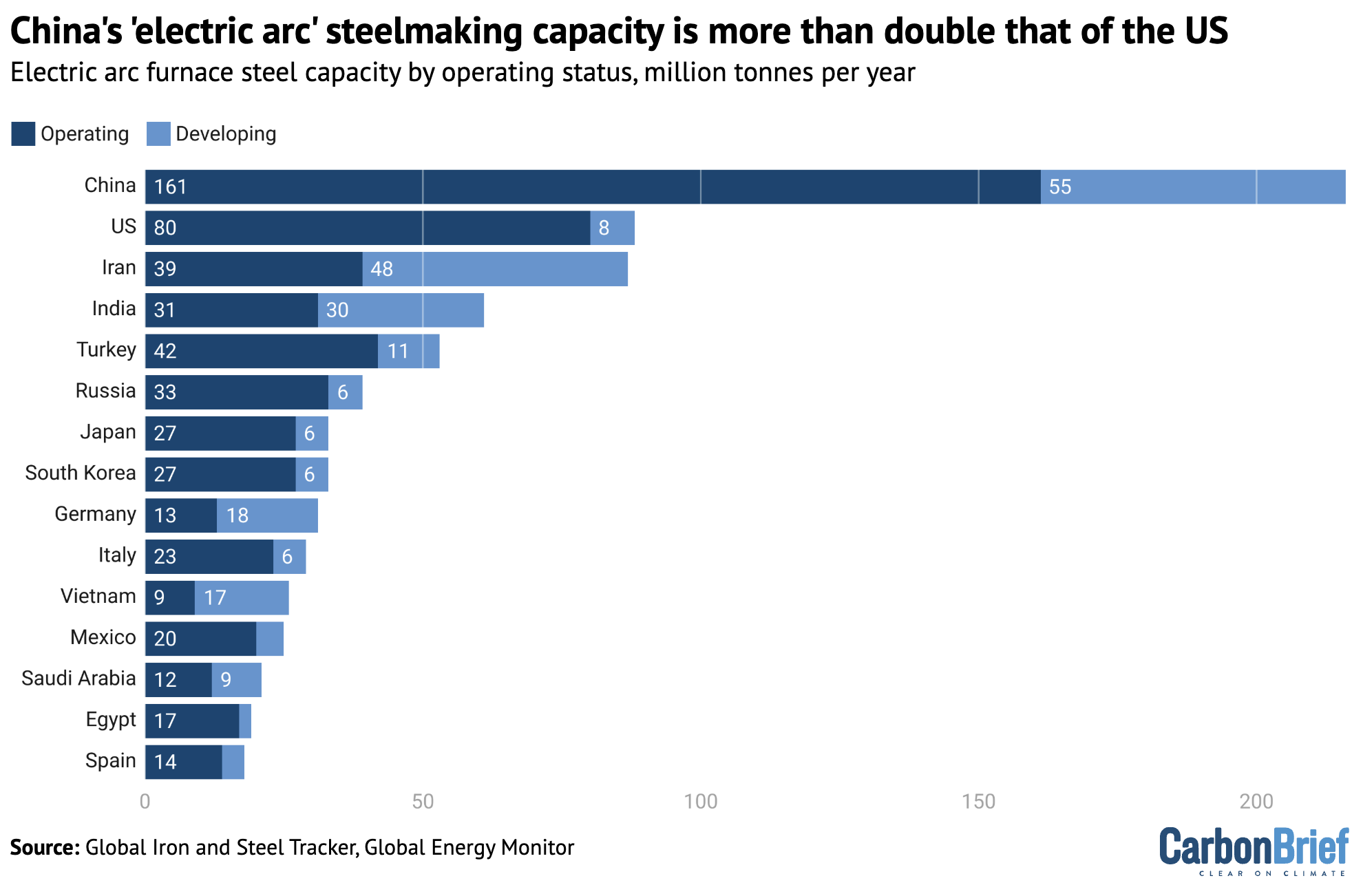
China currently has 161m tonnes (Mt) per year of electric arc furnace (EAF) steelmaking capacity and is building another 55Mt, according to a new data analysis tool developed by energy thinktank Global Energy Monitor. However, it noted, China “exhibits substantial gaps in data availability”, with feedstock information available for less than 8% of its EAF capacity.
Spotlight
What China’s coal country thinks about climate change
A new survey of Shanxi residents, exploring attitudes to climate change and “just transition”, offers a rare insight into the views of Chinese people on the frontline of the energy transition in the country’s largest coal-producing province.
In this issue, Carbon Brief interviews Tom Wang, one of the organisers of the survey, about its key findings. Wang is executive director of People of Asia for Climate Solutions, a climate advocacy group.
This interview was edited for length and clarity. A full version is available on Carbon Brief’s website.
Carbon Brief: Why did you want to conduct this survey?
Tom Wang: I’m from Shanxi province. I grew up thinking that coal was a necessary part of life. But I also lost quite a lot of people in my family to coal-mine accidents or air pollution.
Shanxi province is the world’s largest coal producer. [Note: The province’s coal output reached 1.3bn tonnes in 2024.] We contribute around one-third of [China’s] coal. Millions of people rely on coal-related jobs.
[But China’s climate policies mean] Shanxi cannot depend on the coal economy. Shanxi province’s own policies have also covered the energy transition. These policies [are not] being translated into something more tangible to people’s lives. People are not prepared.
That is why we wanted to do this survey. We ask two simple questions: do you know about and support the energy transition – and are you prepared?
CB: What do people in Shanxi think about the energy transition, climate change and climate policy?
TW: When it comes to climate change, awareness levels are very different between different demographic groups. For example, government workers and people with higher income or education levels know about climate change.
Some could identify things happening around them, such as warmer temperatures every year, longer drought periods and not having any snow last winter. Some even mentioned extreme weather, including heatwaves and a week-long rainstorm that ruined a lot of Shanxi’s ancient temples.
However, the most vulnerable communities, by which I basically mean the coal community, don’t really know about climate change. They know about [climate] buzzwords, but they don’t really understand them.
CB: Why is that?
TW: Most state-owned media talk a lot about climate change. However, they do not explain what that means for people’s everyday lives.
When we explain the energy transition means we are going to use less coal, they can understand…and feel the impact on their lives quite sharply.
CB: The survey also asked people what they would like to see prioritised in a just transition away from coal. What did respondents say was important to them?
TW: We all know JET-P, the Just Energy Transition Partnership. However, in Shanxi province, what we really need is the JET-B, a Just Energy Transition Brotherhood.
Rich provinces in China relied heavily on Shanxi’s coal to develop their economies. [The JET-B calls on them to] support Shanxi with its energy transition. Many [respondents] agreed with this!
Also, the people of Shanxi are actually willing to change or improve their own skill-sets. They know how dangerous it is to work in the coal industry. There is a high awareness of the lack of a future for the coal industry among respondents. People are quite happy to move on, if they are provided with good training and strong support to help that transition go smoothly.
CB: According to the survey, just over a quarter of Shanxi’s young people felt they did not have the skills they needed for a clean-energy economy. Around half were worried about the closure of coal mines and coal-power plants. What can be done to address their concerns?
TW: In Shanxi province we have universities that are dedicated to the coal industry. We have spent so much energy and resources on preparing our young people for the coal industry, instead of preparing them for the transition away from coal.
Young people don’t know how to prepare for the energy transition. And then there’s the current job market. Shanxi’s economy is so weak – in 2024, our province had the lowest economic growth rate in China.
Shanxi is not very good at setting up new industries. We have all of this potential but we are not really translating it into jobs. That’s why the young generation doesn’t feel confident.
CB: What lessons should be taken away from the survey?
TW: We need to prepare…the coal community and the young generation today. We cannot afford to wait any longer. We need to tangibly start to train people and raise new sectors.
Communications are also critical. We need to inspire people. Young people and the coal community are feeling lost.
We need to highlight that all these [possibilities] are out there. That’s what I would like our policymakers, investors and NGOs to tell people. And richer provinces should step up and say: “Now it’s time for us to help you.”
Watch, read, listen
CLIMATE SCIENCE: The Science and Technology Daily interviewed Prof Liu Congqiang, founding dean of the School of Geosystem Science of Tianjin University, on how the earth systems discipline emerged in China and how it contributes to researching climate change.
NEW STRATEGIES: The Diplomat examined how ambitious climate diplomacy can be sustained without high-level climate cooperation between the US and China.
CLIMATE LEADER: Global Solutions published an article by Henry Huiyao Wang, founder and president of the influential thinktank Center for China and Globalization, on how China can “leverage” its energy transition successes to advance “global climate mitigation”.
ELECTROSTATE: The Financial Times explored how China’s growing electrification helps it overcome a number of geopolitical, security and supply chain “vulnerabilit[ies]”.
New science
Nature Food
China’s agricultural machinery emissions have increased nearly sevenfold since 1985, new research has shown, adding that if they continue to grow they could “hinder” the country’s ability to reach its carbon-neutrality targets. The study, covered by Carbon Brief, used data from the China “statistical yearbook” to calculate the emissions of four types of farm equipment. Prof Zhangcai Qin, a professor at Sun Yat-sen University who was not involved in the new study, told Carbon Brief that disaggregating the emissions of agricultural machinery from food systems more broadly “allow[s] policymakers to design targeted interventions without compromising agricultural productivity”.
Communications Earth & Environment
A new study found that China’s “young natural forests” currently store more above-ground carbon than comparable “young planted forests” – mainly due to differences in tree density. The authors mapped the “aboveground carbon accumulation rates” for China’s young “natural” and “planted” forests in 2020. They found that planted forests sequester carbon more quickly than natural forests. However, they projected that by 2060, natural forests will still hold more above-ground carbon than planted forests.
A new study used machine learning to calculate a possible carbon emissions trajectory for China through to 2030. It mapped China’s carbon
China Briefing is compiled by Wanyuan Song and Anika Patel. It is edited by Wanyuan Song and Dr Simon Evans. Please send tips and feedback to china@carbonbrief.org

The post China Briefing 15 May 2025: CO2 emissions fall; Drought affects food production; Climate diplomacy at CELAC appeared first on Carbon Brief.

The launch of the Africa Energy Bank (AEB) has been put back yet again, raising doubts about the institution’s future ability to finance fossil fuel projects – its main objective – as global lenders retreat from such investments over climate concerns, experts told Climate Home News.
The bank, which had been billed to launch in September after a series of delays, is now scheduled to begin operations in November, according to the head of the African Energy Chamber, an advocacy body for the continent’s oil and gas sector.
Even as the world aims to transition away from fossil fuels, many African leaders have made clear they want to continue exploring and extracting the continent’s large oil and gas deposits – estimated at around 125 billion barrels of crude and over 600 trillion cubic feet of gas – to boost economic development.
As a group, Africa sided with a number of powerful oil-and-gas producing nations in blocking progress on negotiations to craft a global roadmap to transition away from fossil fuels at last year’s UN COP30 climate talks, although some countries did individually support the proposal.
-
Campaigners oppose Dangote’s planned Kenya refinery over climate and ecological risks
Plans to build Africa’s second largest oil refinery in ecologically sensitive region criticised as “environmental recklessness” -
Tanzania pushed African nations to oppose fossil fuel transition at COP30
While chairing the African group at the summit, the gas-dependent nation advised the continent’s ministers to block language on transitioning away from fossil fuels


Meanwhile, major projects under development across the continent – including the 1,443-km East African Crude Oil Pipeline (EACOP) and Dangote’s 700,000-barrel-per-day Kenyan refinery – show that African governments see oil and gas as playing a significant role in meeting their energy and economic needs for many years to come.
In 2022, at a gathering of the African Petroleum Producers’ Organization (APPO) in oil-rich Angola, ministers from its member states adopted a resolution to create the Africa Energy Bank to finance projects for the production, use and trade of oil, gas and broader energy sources.
African control over energy resources
An article on the APPO website explains that the bank was conceived as a way to overcome “disenchantment” with fossil fuels among “the international community” which it said had crystallised around the “energy transition” concept.
“If Western countries, after having long taken advantage of the energy sources they now revile to develop, can afford the luxury of abandoning them, this is not the case in Africa,” it adds, noting that many of the continent’s economies are still largely dependent on oil and gas revenues.
A separate web page about the bank, also hosted on APPO’s website, says its objectives include financing the exploration, production and refining of oil and gas, as well as supporting member states in transitioning from fossil fuels to cleaner energy sources “while ensuring energy security”.
Said Addi, a former executive with Shell and energy commodities trading house Gunvor, said the new bank was judged necessary because financing for hydrocarbons from many traditional international lenders has become constrained.
In trying to fill this financing gap, Africa is not simply setting up another fund to support oil and gas, he added. “It is also an attempt to give African countries greater control over how their energy resources and infrastructure are financed,” he explained.
Nigeria to host the AEB
The energy bank – a joint initiative of APPO and the African Export–Import Bank (Afreximbank) – has so far suffered several delays and is almost two years behind schedule. The initial plan was to start operations in January 2025, with Nigeria as the host country, but the bank’s opening was delayed to June of that year to allow Nigeria time to finalise the construction of the bank’s headquarters in Abuja.
After the government announced the completion of the offices in late November 2025, a new launch date was set for January 2026, which was moved back to April, June and then September. Now it has shifted again to November, raising concerns that the institution may be losing momentum.
Former Shell executive Addi said that if the capital is eventually paid in, the bank becomes operational and its first projects are commercially credible, then the delays will be regarded as normal teething troubles in setting up a multilateral institution. But, he added, scepticism will be justified if it continues to stall.
Uganda may see lower oil revenues than expected as costs rise and demand falls
Baron Lamarré, an oil and gas expert and former Petronas oil trader, said that missing “three deadlines in a row is not normal”, and warned that if the timeline slips again, “the story flips from ‘ambitious institution finding its footing’ to ‘good idea that lost momentum before it found any’.”
The Nigerian government, APPO and Afreximbank did not respond to requests for comment by the time of publication.
The funding challenge
The Africa Energy Bank is targeting base capital of $5 billion, with plans to scale up to $120 billion within five years by mobilising private-sector funds. However, it is expected to start operations with initial seed capital of $500 million.
The funding plan is to have the 18 member countries of the APPO contribute $83 million each to the bank as equity for a combined $1.5 billion. Afreximbank, other non-APPO African countries and investors outside the continent are expected to provide the remaining $3.5 billion.
But even the initial $500 million has not been easy to mobilise. In May, APPO Secretary-General Farid Ghezali called on members to deliver on their pledges towards the startup goal before the end of June. But the delays suggest this may not have been met, with experts saying Africa may be finding it difficult to self-fund its oil and gas projects in the absence of international capital.
Lamarré said every extension of the deadline points to the fact that “raising fossil fuel capital in Africa without the majors and their financing networks is brutally hard”.
Why the global electrification agenda misses the point on Africa’s energy crisis
Since 2020, Western lenders, export credit agencies and insurers have been in steady retreat from African hydrocarbons, he said, while oil majors are divesting their African assets, handing over fields to smaller local operators whose credit ratings are not high enough to borrow cheaply.
Even capital from China and the Gulf, which has partially filled the gap, cannot match the volume, tenor or pricing that Western investors once offered, Lamarré argued.
“If mobilising the first $500 million of seed capital [for the AEB] has taken this long, that’s the clearest signal yet of how steep the climb to $120 billion looks,” he said, noting that the continent’s energy financing gap is as large as $30 billion-$45 billion per year.
Africa’s investment landscape, meanwhile, has been shifting. While foreign direct investment dropped from a 2024 peak, inflows remained roughly one-third above the continent’s long-term average in 2025, according to the 2026 World Investment Report from UN Trade and Development (UNCTAD). They are concentrated in a few sectors including critical minerals needed for renewable energy technologies, battery manufacturing and advanced industrial production.
At the same time, data on global energy investment from the International Energy Agency (IEA) shows that fossil fuel investment in Africa has declined over the last decade.

“Trojan horse” for fossil fuels
While the Africa Energy Bank struggles to get off the ground, climate campaigners have criticised its primary aim of financing oil and gas on the continent at a time when the world is starting to move away from high-carbon fuels to cleaner alternatives.
Bhekumuzi Dean Bhebhe, founder of Africa Change Lab, described the bank as a “Trojan horse”, arguing that its focus on fossil fuel financing runs counter to the global energy transition and the African Union’s Agenda 2063 goals of sustainable development and inclusive growth.
The energy bank, he warned, “risks locking Africa into a new cycle of debt, dependency and fossil fuel entrenchment”, adding that its financing blueprint does not pave the way for a climate-resilient future. “In truth, it is to deepen the same extractive, carbon-heavy pathways that the continent should be moving away from,” he added.
Ugandan farmers use British court to try to stop East Africa oil pipeline
Kenya-based climate and energy expert Joab Okanda said the AEB’s plan to finance oil and gas is “a misplaced priority” and it should instead back clean energy in line with the policies of some of Africa’s major export markets like Europe.
In addition, the new bank could struggle to mobilise enough resources to advance large-scale oil and gas projects, he added, noting that its proposed $5-billion initial capital is equivalent to the cost of the East African Crude Oil Pipeline alone.
The AEB’s aim of backing more fossil fuels should be flipped “to support countries that are oil-dependent to start working on their transition plans”, Okanda said.
The post Launch of Africa Energy Bank delayed again in blow to oil and gas hopes appeared first on Climate Home News.
Launch of Africa Energy Bank delayed again in blow to oil and gas hopes