

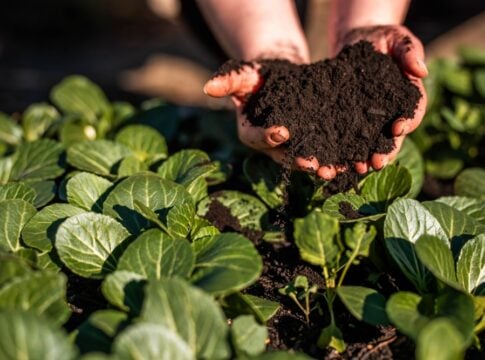
Indigo Carbon announced it has now passed 2 million metric tons of verified climate impact from U.S. croplands. The company reached the milestone after issuing its fifth U.S. “carbon crop.” The new issuance includes 1.1 million independently verified carbon credits issued through the Climate Action Reserve (CAR).
Indigo describes the milestone in its announcement as a sign that soil-based carbon programs can scale. It also points to rising corporate demand for credits that meet stricter quality rules.
Indigo’s latest issuance is important because it is linked to a major registry method that now carries an additional integrity label. Max DuBuisson, Head of Impact & Integrity, Indigo, remarked:
“Indigo continues to set the standard for high-integrity soil carbon removals that corporate buyers can trust. Soil carbon is uniquely positioned to scale as a climate solution because it captures and stores carbon while also improving water conservation and crop resilience. By combining world-class science and technology with farmer-driven practice change, we’re proving that agricultural soil carbon is an immediate, durable, high-integrity solution capable of helping global companies meet their climate commitments.”
Inside the 1.1M Credit Issuance and CCP Label
Indigo says its fifth issuance includes 1.1 million carbon credits verified and issued through CAR. These credits come from Indigo’s U.S. soil carbon project, listed on the Climate Action Reserve under the Soil Enrichment Protocol (SEP) Version 1.1.
CAR’s SEP is designed to quantify and verify farm practices that increase soil carbon and reduce net emissions. It covers changes in soil carbon storage and also includes reductions in certain greenhouse gases tied to farm management.
CAR’s SEP Version 1.1 has the ICVCM Core Carbon Principles (CCP) label. This means the method meets the standards set by the CCP framework.
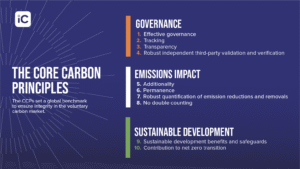
Indigo’s disclosures also describe long-term monitoring rules. The company reports that its U.S. project includes 100 years of project-level monitoring after credit issuance, in line with CAR requirements. This mix of independent verification, registry issuance, and long monitoring periods is central to the case Indigo makes for credit quality.
Breaking Down the 2 Million Ton Milestone
Indigo says its total verified impact now exceeds 2 million metric tons of carbon removals and reductions across U.S. croplands.
In carbon markets, one credit equals one metric ton of CO₂ equivalent. Indigo’s latest issuance is very large by soil carbon standards. It also builds on earlier “carbon crop” issuances.
Indigo’s project disclosures include a quantified impact figure for its U.S. project. The company reports 927,367 tCO₂e reduced or removed through Dec. 31, 2023, for the project listed as CAR1459.
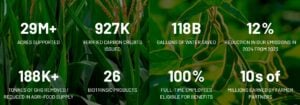
Indigo announced it has saved 118 billion gallons of water. It has also paid farmers $40 million through its programs so far. These points matter because many buyers now look beyond carbon totals. They also want evidence of farmer payments, monitoring rules, and co-benefits like water conservation.
Corporate Demand Shifts Toward Verified Removals
One reason soil carbon is getting more attention is the growing demand from buyers for removals. Many companies now focus more on carbon removal credits, not only avoidance credits.
Indigo’s largest recent buyer example is Microsoft. In January 2026, the carbon ag company announced a 12-year agreement under which Microsoft will purchase 2.85 million soil carbon removal credits from them.
- The soil carbon producer said this is Microsoft’s third transaction with the company, following purchases of 40,000 tonnes in 2024 and 60,000 tonnes in 2025.
The tech giant’s purchases show how corporate buyers may use long-term offtake deals to secure future supply of credits. This matters for soil carbon programs because credits are typically generated over multiple years. And they also depend on practice changes and verification cycles.
Indigo also says its program works across eight million acres, which signals how it is trying to scale participation across U.S. farms.
Soil Carbon Credits: Market Trends and Forecast
Soil carbon credits are gaining attention as buyers shift toward higher-quality credits and clearer verification rules. Ecosystem Marketplace reports that the voluntary carbon market is entering a new phase. This phase emphasizes integrity, even though trading activity has slowed down.
In its 2025 market update, Ecosystem Marketplace noted a 25% drop in transaction volumes. This decline shows lower liquidity as buyers are becoming more selective.
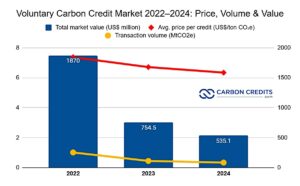
At the same time, demand for higher-quality credits is rising. Sylvera’s State of Carbon Credits 2025 reported that retirements dropped to 168 million credits in 2025, a 4.5% decrease.
Still, the market value climbed to US$1.04 billion due to rising prices. It also found that higher-rated credits (BBB+) made up 31% of retirements, and traded at higher average prices than lower-rated supply.
For soil carbon, buyers are also watching methodology quality. The ICVCM has approved two sustainable agriculture methods as CCP-approved. These are the Climate Action Reserve’s Soil Enrichment Protocol v1.1 and Verra’s VM0042. This can support stronger buyer confidence and may increase demand for soil credits that meet CCP rules.
Looking ahead, Sylvera projects compliance-linked demand will keep growing and could exceed voluntary demand by 2027. That trend may favor credits with stronger verification and compliance alignment, including higher-integrity soil carbon credits. However, integrity issues still occur, and this is where Indigo comes in.
Tackling Permanence and MRV Head-On
Soil carbon credits face a key challenge: carbon stored in soil can be reversed. A drought, land use change, or a shift in farm practices can reduce stored carbon.
This is why monitoring and reversal rules matter. CAR’s protocol is built to quantify, monitor, report, and verify practices that increase soil carbon storage.
Indigo’s project disclosure notes that projects are monitored for 100 years after they are issued. This shows the durability rules tied to their method and registry approach.
The company also positions its program as “outcome-based,” meaning it pays for verified carbon outcomes rather than paying only for adopting a practice. This messaging is designed to reassure buyers that credits are not only modeled. It stresses verification and the registry process.
A Scale Test for High-Integrity Soil Carbon
Indigo’s fifth issuance lands at a time when voluntary carbon markets are placing more weight on integrity labels and independent verification.
Two parts stand out:
- First, volume. An issuance of 1.1 million credits through a registry is large for an agricultural soil carbon program.
- Second, method approval. CAR’s SEP Version 1.1 carries the ICVCM CCP label, which is meant to signal alignment with a global integrity benchmark.
That combination may make it easier for corporate buyers to justify purchases internally. Many companies now face stronger scrutiny from auditors, regulators, investors, and civil society groups.
At the same time, more supply does not automatically mean market confidence rises. Buyers still assess risks such as permanence, additionality, and measurement uncertainty.
Even so, the milestone shows how fast some parts of the removals market are trying to scale. Large buyers are also helping drive this shift through multi-year offtake deals, like the Microsoft agreement for 2.85 million credits.
For Indigo, the new issuance supports its claim that soil carbon is moving from small pilot volumes toward larger, repeatable issuances. For the market, it adds another real-world data point: a major soil carbon program has now completed five issuance cycles and passed 2 million metric tons of verified climate impact.
The post Indigo Carbon Surpasses 2 Million Soil Carbon Credits in Landmark 1.1 Million Issuance appeared first on Carbon Credits.

The post Promoting Improved Cooking Practices in Nigeria appeared first on Terrapass.
For most companies, the largest figure in the carbon inventory is not the office, the vehicle fleet, or the electricity bill. It sits upstream, in the goods and materials a business buys to make and sell its products. These purchased inputs form the bulk of a company’s Scope 3 emissions, which routinely exceeds everything the business controls directly, and can add up to 90% of their global footprint.




-
Climate Change1 year ago
Guest post: Why China is still building new coal – and when it might stop
-

 Greenhouse Gases2 years ago
嘉宾来稿:满足中国增长的用电需求 光伏加储能“比新建煤电更实惠”
-
Greenhouse Gases1 year ago
Guest post: Why China is still building new coal – and when it might stop
-

 Climate Change2 years ago
嘉宾来稿:满足中国增长的用电需求 光伏加储能“比新建煤电更实惠”
-

 Renewable Energy12 months ago
Sending Progressive Philanthropist George Soros to Prison?
-
Climate Change2 years ago
Bill Discounting Climate Change in Florida’s Energy Policy Awaits DeSantis’ Approval
-
Greenhouse Gases1 year ago
嘉宾来稿:探究火山喷发如何影响气候预测
-

 Climate Change2 years ago
Analysis: China’s CO2 falls 1% in Q2 2024 in first quarterly drop since Covid-19