

After Cyclone Freddy ravaged the Malawian village of Mchenga last year, the Red Cross worked with Nigerian businessman Dozy Mmobuosi to rebuild homes for 45 of the victims, at the request of Malawi’s government.
A few months later, the US government accused Mmobuosi of fraud over his business dealings. Climate Home News visited Mchenga this month and found the new homes have cracks in the walls and floors, with residents scared they will collapse.
Emma Jeremia, a pregnant woman living in one house, said it would have been better to die in the storm than be killed by her house collapsing on her. Simon Mweyeli, who liaised with the Red Cross on behalf of Mchenga’s residents, said the homes can “fall anytime”.
This unsafe housing for cyclone survivors in Malawi, funded by a suspected fraudster, shows why governments need to get the new UN loss and damage fund up and running with decent resources and quality control, climate campaigners told Climate Home.

Cracks in the wall inside one of the homes in Mchenga, Malawi, pictured on May 8, 2024 (Photo: Raphael Mweninguwe)
International climate justice activists said the local testimonies show why funding for disaster victims should come from the governments that have predominantly caused the climate crisis rather than unaccountable benefactors – and recommended that affected people should be involved in designing and building their new homes.
After last year’s devastating cyclone – with the loss and damage fund not yet up and running – the cash-strapped Malawian government went looking for financial help around the world. According to national media, ex-president Bakili Muluzi recruited Nigerian businessman Dozy Mmobuosi.
The day after promising to build the homes – and the same day he was accused by short-selling firm Hindenburg Research of operating a scam company – Mmobuosi received a Malawian diplomatic passport, which is usually reserved for senior politicians, national media reported.
“Such instances highlight why we need a loss and damage fund that empowers affected communities to lead recovery and reconstruction efforts, and not allow politicians or corporations to further their own interests,” said Harjeet Singh, a climate activist who has long advocated for the fund.
In 2022, governments finally agreed at the COP27 climate talks to set up such a fund to channel money from wealthy nations to people in developing countries who have been harmed by climate change. The fund’s board hopes it can start distributing money next year.
Cyclone Freddy strikes
In March last year, Cyclone Freddy travelled from the west coast of Australia across the Indian Ocean over Madagascar and into southern Africa, where it caused floods and mudslides that killed more than 1,000 people in Malawi.
The village of Mchenga, in Malawi’s southern Phalombe district, was among the worst-hit. Its 72-year-old headman Laften Nangazi told Climate Home that 80 people died there in a single day.
He said he saw men, women and children being swept away in despair. “I cried when I saw children dying,” he said, “I saw about 40 people in a tree, and they were there for three days waiting for the water levels to go down.”
When the waters eventually receded, 176 of the village’s families were left homeless – a problem repeated across the country’s south.

Hendry Keinga reacts after he lost a family member during the Mtauchira village mudslide in the aftermath of Cyclone Freddy in Blantyre, Malawi, March 16, 2023. (REUTERS/Esa Alexander)
Looking for funds
Malawi is the world’s tenth poorest country, so government money to rebuild housing was scarce. The international fund for loss and damage, meant to address disasters like this, had just been agreed at COP27 but was not yet up and running.
President Lazarus Chakwera invited his three living predecessors for a meeting. Two of them – Bakili Muluzi and Joyce Banda – showed up and were made “Goodwill Ambassadors of Tropical Cyclone Freddy”, national media reported.
Muluzi’s son Atupele told Climate Home that his father and Banda tried to access finance “to support the very real costs to the country for housing, social infrastructure, agriculture and industry as we try to rebuild in a resilient manner”.
“Of course, the global economy and international politics means that this is a challenging task in the midst of the chaos, conflict and climate impact everywhere in the world,” he added.
To meet this challenge, Bakili Muluzi turned to Mmobuosi, a Nigerian businessman and founder of mobile banking company Tingo Group, who was then in the news for trying to take over English football club Sheffield United.
Controversial Nigerian tech entrepreneur Dozy Mmobuosi recently visited the country to participate in the launch of a Cyclone Freddy relief project in Phalombe, an event supported by former Presidents Bakili Muluzi and Joyce Banda. pic.twitter.com/w1WlzANAKM
— Platform for Investigative Journalism – Malawi (@PlatformMalawi) June 15, 2023
On June 6, Mmobuosi, Muluzi and Banda travelled to Mchenga to launch construction work on new houses, posing with a foundation stone bearing their names. On Facebook, Banda said the houses “will be made possible because of a generous contribution” from Mmobuosi, who she called “a distinguished son of Africa” and “good friend” of Muluzi.
The next day, according to the Platform for Investigative Journalism, Mmobuosi met with Muluzi and President Chakwera at the president’s home. The Nigerian was unusually quickly granted a diplomatic passport, usually reserved for top Malawian politicians and their spouses.
“Exceptionally obvious scam”
But on the same day Mmobusi was in Mchenga, Hindenburg Research, which specialises in “forensic financial research”, accused his Tingo Group – which says it provides mobile banking to farmers – of being “an exceptionally obvious scam with completely fabricated financials”.
Hindenburg was short-selling Tingo Group shares, so it stood to profit if the share price of the firm – listed on the Nasdaq stock exchange in the US – went down.
Hindenburg accused Mmobuosi of inventing much of his backstory, of settling out of court with Nigerian authorities over alleged bad cheques in 2017, of photo-shopping Tingo logos onto planes to claim the company had an airline, and generally exaggerating the company’s assets.
While Muluzi stood by him, in December 2023 the US Securities and Exchange Commission (SEC) sided with Hindenburg. They accused Mmobuosi of a “staggering” fraud against Tingo’s investors.
In Nagorno-Karabakh, Azerbaijan’s net zero vision clashes with legacy of war
The SEC’s 72-page complaint included images of what it said was a real and an edited Tingo bank statement. The edited one had several zeros added to the balance.
US authorities charged Mmobuosi with security fraud and froze his assets. His whereabouts are reportedly unknown. If found guilty, he faces up to 20 years in prison.
On October 6 – after Hindenburg’s complaint but before the SEC’s – Muluzi and Mmobuosi went back to Mchenga village in Malawi to hand over the first batch of 17 houses.
Muluzi thanked Mmobuosi for the funding and said he had “committed to buy beds, mattresses and furniture for the households and also to bring solar electricity to the area”. In December, another 28 houses were handed over.
@MalawiRedCross has today handed over 45 houses to beneficiaries of T/A Phweremwe in Phalombe, that have been constructed with funding from The Dozy Mmobuosi Foundation through Goodwill Ambassador on TC Freddy Former President Dr Bakili Muluzi. pic.twitter.com/hVhOYdScjS
— Malawi Red Cross Society (@MalawiRedCross) December 19, 2023
Cracks and missing crockery
But five months on, when Climate Home visited the village, residents complained the homes were too few, dangerous and small, adding they had not yet received the promised furniture or solar power.
Jeremia said her father was given one of the houses but she sleeps in it instead. “He and my mother and my other siblings are living in a rented house. They cannot stay in a house that is threatening their lives. After all, it’s also a very small house to accommodate all of us,” she said.
Mweyeli, the chair of the village civil protection committee, said most new homes are “showing cracks – a sign that these houses are of sub-standard”. He said the first 17 homes were built with 45 bags of cement, but the later 28 were built with just 28 bags, making them weak and liable to fall down.
He demonstrated how the floors were made of sand covered by plastic with a “thin layer of cement which is now showing cracks all over”.

Simon Mweyeli shows cracks in the floor of one of the houses, which he said were sand covered by plastic and a thin cement layer
Charles Macheso, who climbed a mango tree to save himself from the cyclone but lost all his possessions, said village coordinators told the Malawi Red Cross that more cement was needed. But, he said, the Red Cross officers “were so defensive”. Mweyeli said he called the Red Cross to report the cracks and the aid organisation came to take pictures.

Charles Macheso in Mchenga village on May 8, 2024 (Photo: Raphael Mweninguwe)
Asked about these houses, the Malawi Red Cross’s communications specialist in the capital Lilongwe, Felix Washon, initially told Climate Home to go see them, and then hung up the phone without answering further questions.
“Not aware”
After a two-day journey from Lilongwe to the village, Climate Home contacted Washon again and was told by email that “we are not aware of any report about cracking of houses in Phalombe [the district that covers Mchenga]”.
Washon said the Red Cross had a contract to build the homes with Muluzi rather than Mmobuosi. “We never received any money from Dozy [Mmobuosi] – direct from Dozy,” he said by phone. “Malawi Red Cross Society has no other links or contracts with Dozy,” he added.
Climate Home News emailed the contact address listed on the Dozy Mmobuosi Foundation’s website, but the email bounced.
Mmobuosi told Arise News in February that he was “taken aback” and “shocked” by the SEC’s allegations about Tingo Group. He said he had not run Tingo directly for seven years, adding that his lawyers were “on top of” responding to the SEC charges and that Tingo was conducting its own internal investigation. Mmobuosi is not currently listed as a member of the company’s board of directors.
In Mchenga, village headman Nangazi told Climate Home that 131 families are still without a home and called on national organisations like the Catholic Development Commission – that has provided iron sheets – to help build more accommodation.
Ida Mayilosi, 75, is one of those who missed out. “I wished I had also been assisted,” she said. “This house I am living in was built by some relatives but it took time.”

Ida Mayilosi, whose house was destroyed by Cyclone Freddy, sits in Mchenga village, May 8, 2024 (Photo: Raphael Mweninguwe)
Mattias Söderberg, climate lead for Danish charity DanChurchAid, which is currently building homes in Nepal after landslides there, said support for communities to rebuild after extreme weather that causes loss and damage “should be done so that they are more secure and robust to face the next climate-related disaster”. “Investments which are not adapted risk being lost,” he added.
Singh – who fought to solve similar problems in India’s Andaman and Nicobar islands following the Indian Ocean tsunami in 2006 – said he had seen “firsthand how involving communities not only places them in the driving seat but also ensures accountability”.
(Reporting from Raphael Mweninguwe in Mchenga and Joe Lo in London; editing by Sebastian Rodriguez and Megan Rowling)
The post In Malawi, dubious cyclone aid highlights need for loss and damage fund appeared first on Climate Home News.
In Malawi, dubious cyclone aid highlights need for loss and damage fund

Casting doubt on the determination that greenhouse gas emissions endanger public health and welfare, he said, “we’re not accepting all of the narrative of the left without any question or pushback.”
WASHINGTON—Addressing a conference of scientists and other experts skeptical of climate change, Environmental Protection Agency Administrator Lee Zeldin on Wednesday celebrated his decision to repeal what is known as the “endangerment finding,” which provided the backbone for federal regulation of greenhouse gas emissions.
Zeldin Celebrates Endangerment Finding Repeal With Climate Skeptics
With the U.S. bombing Iran and the Strait of Hormuz closed, energy experts say countries transitioning to renewables will be more resilient in the “face of the shock.”
The United States’ war on Iran could fundamentally alter how countries consume and generate energy and hamper international progress in combating climate change, a panel of energy experts said today.
The Global Energy Supply in a Decade ‘Is Not a World We’re Going to Recognize’
One month into the US and Israel’s war on Iran, at least 60 countries have taken emergency measures in response to the subsequent global energy crisis, according to analysis by Carbon Brief.
So far, these countries have announced nearly 200 policies to save fuel, support consumers and boost domestic energy supplies.
Carbon Brief has drawn on tracking by the International Energy Agency (IEA) and other sources to assess the global policy response, just as a temporary ceasefire is declared.
Since the start of the war in late February, both sides have bombed vital energy infrastructure across the region as Iran has blocked the Strait of Hormuz – a key waterway through which around a fifth of global oil and liquified natural gas (LNG) trade passes.
This has made it impossible to export the usual volumes of fossil fuels from the region and, as a result, sent prices soaring.
Around 30 nations, from Norway to Zambia, have cut fuel taxes to help people struggling with rising costs, making this by far the most common domestic policy response to the crisis.
Some countries have stressed the need to boost domestic renewable-energy construction, while others – including Japan, Italy and South Korea – have opted to lean more on coal, at least in the short term.
The most wide-ranging responses have been in Asia, where countries that rely heavily on fossil fuels from the Middle East have implemented driving bans, fuel rationing and school closures in order to reduce demand.
‘Largest disruption’
On 28 February, the US and Israel launched a surprise attack on Iran, triggering conflict across the Middle East and sending shockwaves around the world.
There have been numerous assaults on energy infrastructure, including an Iranian attack on the world’s largest LNG facility in Qatar and an Israeli bombing of Iran’s gas sites.
Iran’s blockade of the Strait of Hormuz, a chokepoint in the Persian Gulf, is causing what the IEA has called the “largest supply disruption in the history of the global oil market”.
A fifth of the world’s oil and LNG is normally shipped through this region, with 90% of those supplies going to destinations in Asia. Without these supplies, fuel prices have surged.
Governments around the world have taken emergency actions in response to this new energy crisis, shielding their citizens from price spikes, conserving energy where possible and considering longer-term energy policies.
Even with a two-week ceasefire announced, the energy crisis is expected to continue, given the extensive damage to infrastructure and continuing uncertainties.
Asian crunch
Carbon Brief has used tracking by the IEA, news reports, government announcements and internal monitoring by the thinktank E3G to assess the range of national responses to the energy crisis roughly one month into the Iran war.
In total, Carbon Brief has identified 185 relevant policies, announcements and campaigns from 60 national governments.
As the map below shows, these measures are concentrated in east and south Asia. These regions are facing the most extreme disruption, largely due to their reliance on oil and gas supplies from the Middle East.
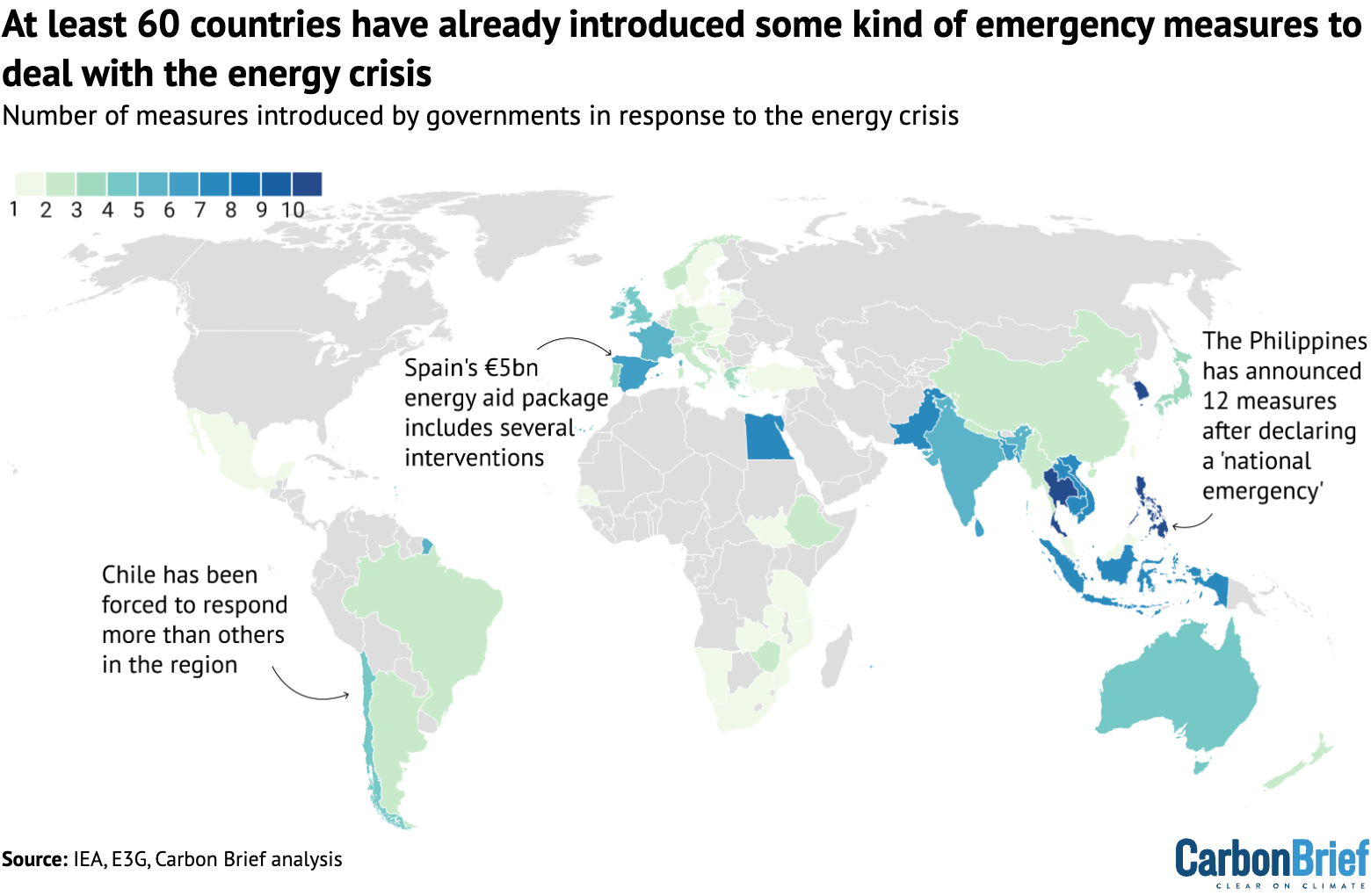
Nations including Indonesia, Japan, South Korea and India are already spending billions of dollars on fuel subsidies to protect people from rising costs.
At least 16 Asian countries are also taking drastic measures to reduce fuel consumption. For example, the Philippines has declared a “state of national emergency”, which includes limiting air conditioning in public buildings and subsidising public transport.
Other examples from the region include the government in Bangladesh asking the public and businesses to avoid unnecessary lighting, Pakistan reducing the speed limit on highways and Laos encouraging people to work from home.
Europe – which was hit hard by the 2022 energy crisis due to its reliance on Russian gas – is less immediately exposed to the current crisis than Asia. However, many nations are still heavily reliant on gas, including supplies from Qatar.
The continent is already feeling the effects of higher global energy prices as countries compete for more limited resources.
At least 18 European nations have introduced measures to help people with rising costs. Spain, which is relatively insulated from the crisis due to the high share of renewables in its electricity supply, nevertheless announced a €5bn aid package, with at least six measures to support consumers.
Many African countries, while also less reliant on direct fossil-fuel supplies via the Strait of Hormuz than Asia, are still facing the strain of higher import bills. Some, including Ethiopia, Kenya and Zambia, are also facing severe fuel shortages.
There have been fewer new policies across the Americas, which have been comparatively insulated from the energy crisis so far. One outlier is Chile, which is among the region’s biggest fuel importers and is, therefore, more exposed to global price increases.
Tax cuts
The most common types of policy response to the energy crisis so far have been efforts to protect people and businesses from the surge in fuel prices.
At least 28 nations, including Italy, Brazil and Australia, have introduced a total of 31 measures to cut taxes – and, therefore, prices – on fuel.
Even across Africa, where state revenues are already stretched, some nations – including Namibia and South Africa – are cutting fuel levies in a bid to stabilise prices.
Another 17 countries, including Mexico and Poland, have directly capped the price of fuel. Others, such as France and the UK, have opted for more targeted fuel subsidies, designed to support specific vulnerable groups and industries.
These measures are all shown in the dark blue “consumer support” bars in the chart below.
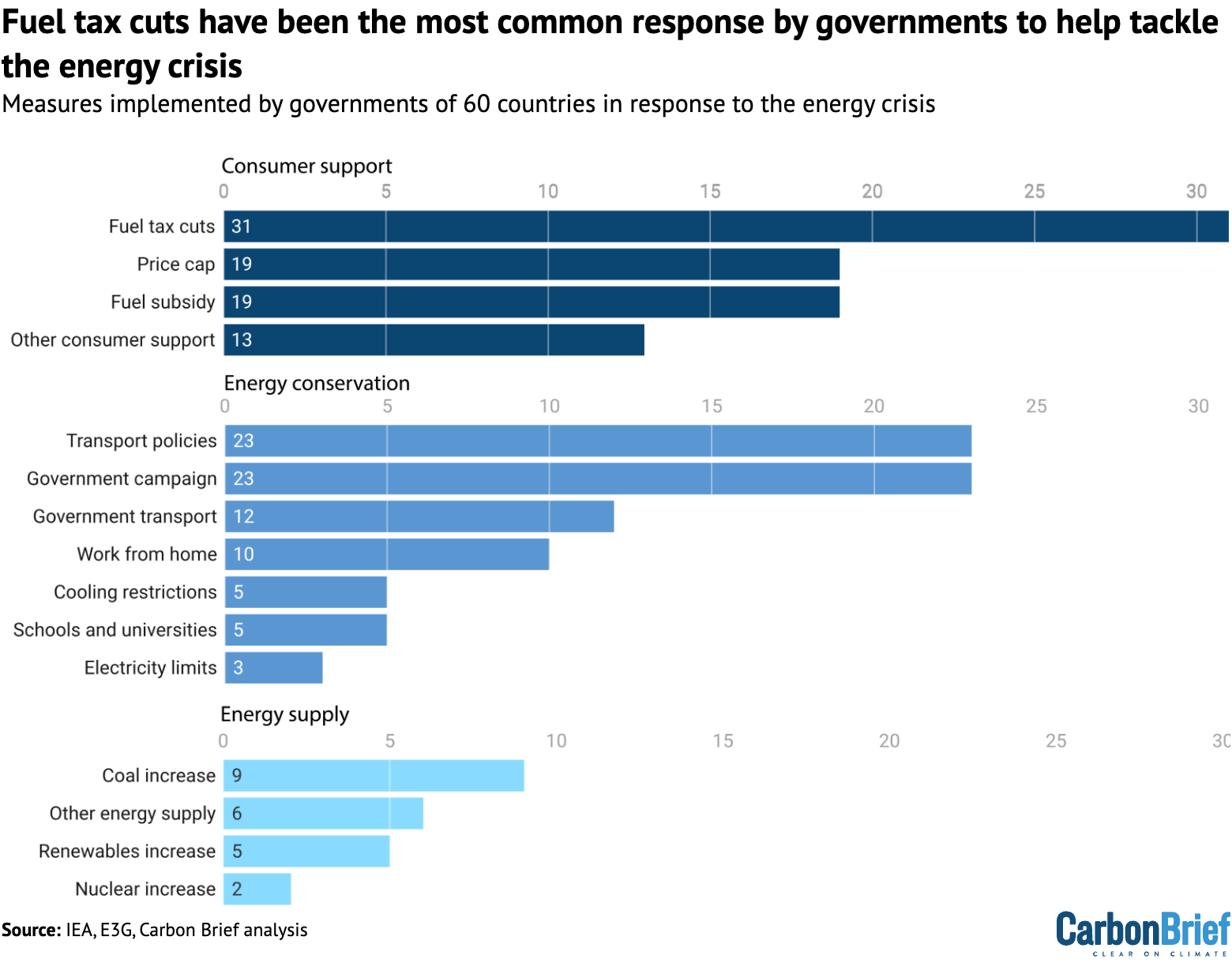
Such measures can directly help consumers, but some leaders, NGOs and financial experts have noted that there is also the risk of them driving inflation and reinforcing reliance on the existing fossil fuel-based system.
Christine Lagarde, president of the European Central Bank, spoke in favour of short-term measures to “smooth the shock”, but noted that “broad-based and open-ended measures may add excessively to demand”.
Measures to conserve energy, of the type that many developing countries in Asia have implemented extensively, have been described by the IEA as “more effective and fiscally sustainable than broad-based subsidies”.
So far, there have been at least 23 such measures introduced to limit the use of transport, particularly private cars.
These include Lithuania cutting train fares, two Australian states making public transport free and Myanmar and South Korea asking people to only drive their cars on certain days.
Clean vs coal
At least eight countries have announced plans to either increase their use of coal or review existing plans to transition away from coal, according to Carbon Brief’s analysis. These include Japan, South Korea, Bangladesh, the Philippines, Thailand, Pakistan, Germany and Italy.
These measures broadly involve delaying coal-plant closure, as in Italy, or allowing older sites to operate at higher rates, as in Japan – rather than building more coal plants.
There has been extensive coverage of how the energy crisis is “driving Asia back to coal”. However, as Bloomberg columnist David Fickling has noted, this shift is relatively small and likely to be offset by a move to cheap solar power in the longer term.
Indeed, some countries have begun to consider changes to the way they use energy going forward, amid a crisis driven by the spiralling costs of fossil-fuel imports.
Leaders in India, Barbados and the UK have explicitly stressed the importance of a structural shift to using clean power. Governments in France and the Philippines are among those linking new renewable-energy announcements with the unfolding crisis.
New renewable-energy capacity will take time to come online, albeit substantially less time than developing new fossil-fuel generation. In the meantime, some nations are also taking short-term measures to make their road transport less reliant on fossil fuels.
For example, the Chilean government has enabled taxi drivers to access preferential credit for purchasing electric vehicles (EVs). Cambodia has cut import taxes on EVs and Laos has lowered excise taxes on them.
Finally, there have been some signs that countries are reconsidering their future exposure to imported fossil fuels, given the current economics of oil and gas.
The New Zealand government has indicated that a plan to build a new LNG terminal by 2027 now faces uncertainty. Reuters reported that Vietnamese conglomerate Vingroup has told the government it wanted to abandon a plan to build a new LNG-fired power plant in Vietnam, in favour of renewables.


The post Iran war analysis: How 60 nations have responded to the global energy crisis appeared first on Carbon Brief.
Iran war analysis: How 60 nations have responded to the global energy crisis



-
Climate Change8 months ago
Guest post: Why China is still building new coal – and when it might stop
-
Greenhouse Gases8 months ago
Guest post: Why China is still building new coal – and when it might stop
-

 Greenhouse Gases2 years ago
嘉宾来稿:满足中国增长的用电需求 光伏加储能“比新建煤电更实惠”
-
Climate Change2 years ago
Bill Discounting Climate Change in Florida’s Energy Policy Awaits DeSantis’ Approval
-

 Climate Change2 years ago
嘉宾来稿:满足中国增长的用电需求 光伏加储能“比新建煤电更实惠”
-
Climate Change Videos2 years ago
The toxic gas flares fuelling Nigeria’s climate change – BBC News
-

 Renewable Energy6 months ago
Sending Progressive Philanthropist George Soros to Prison?
-

 Carbon Footprint2 years ago
US SEC’s Climate Disclosure Rules Spur Renewed Interest in Carbon Credits