


HSBC, Europe’s largest bank, has taken another step toward achieving its net zero goals. The bank set a new interim target to reduce emissions from its financed activities, aiming for net zero by 2050. That’s 20 years later than the bank’s first net zero goal. But is it making real progress—or just delaying action?
Banking on Change: HSBC’s Net Zero Shift
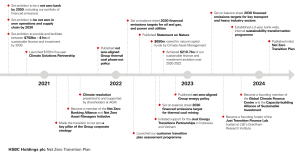
Originally, HSBC pledged in 2020 to achieve net-zero emissions in its operations by 2030. In its latest annual report, the bank said it was reducing emissions in its supply chain more slowly than expected.
- HSBC now expects only a 40% reduction in emissions by 2030, requiring heavy reliance on carbon offsets to bridge the gap.
HSBC said,
“As such, we have revisited our ambition, taking into account the latest best practice on carbon offsets. We are now focused on achieving net zero in our operations, travel, and supply chain by 2050.”
Also, HSBC will review its 2030 targets for emissions from its financing activities. Results from this review are expected later this year.
Challenges in Meeting Climate Goals
HSBC made its decision based on several factors it couldn’t control. These include new technology, demand for sustainable solutions, and policy changes. Julian Wentzel, HSBC’s new Chief Sustainability Officer, said the bank needed a “more measured approach.” This is because clients face real challenges when moving to lower-carbon operations.
The bank also highlighted that its original plan relied on the ability to use carbon credits to offset supply chain emissions. Recent guidance from the Science Based Targets Initiative (SBTi) advised against using offsets. As a result, HSBC changed its strategy.
The European bank has dropped its plan to start a carbon credits trading desk. This decision reflects a larger trend. Many big companies are reducing their use of carbon offsets. Instead, they are concentrating on cutting emissions directly.
Companies like Google, Delta Air Lines, and EasyJet are rethinking their carbon credit use. They worry about the integrity of the credits they buy to compensate for their carbon pollution. Some offsets may be issued too much and don’t provide real climate benefits.
HSBC’s decision comes after Shell, which just revealed plans to sell most of its nature-based carbon projects. Other banks, including Bank of America, have also been cautious about engaging in the carbon market due to its lack of liquidity and declining participation.
Following the Leaders or Falling Behind?
HSBC has stepped back from carbon credit trading, but it still supports climate finance. The bank has launched several initiatives to support low-carbon technologies and businesses.
In July, HSBC launched the HSBC Infrastructure Finance (HIF) unit. This unit aims to finance and advise on infrastructure projects for the low-carbon transition. But just four months later, this unit stopped working. This showed the difficulties in managing large-scale climate finance programs.
HSBC has also invested in key climate technologies. The bank promised $1 billion last year. This money will boost progress in:
- Carbon dioxide removal
- EV charging
- Battery storage
- Sustainable agriculture
- Carbon capture solutions
HSBC has also invested $100 million in Bill Gates’ Breakthrough Energy Catalyst Fund. This fund backs green projects and helps scale climate innovations.
In another strategic move, HSBC partnered with Google Cloud to back companies developing climate-focused technologies. Through the Google Cloud Ready-Sustainability (GCR-Sustainability) program, HSBC provides financial support to businesses working on carbon reduction, supply chain sustainability, and ESG data management.
Climate Critics Push Back
HSBC’s move has sparked backlash from environmental groups. Reclaim Finance, a climate advocacy group, said the delay hurts the fight against climate change. Christophe Etienne from Reclaim Finance noted that:
“HSBC has opted to weaken its climate target rather than showing the ambition needed to drive the economy toward net zero.”
Joanna Warrington of Fossil Free London was even more direct. She remarked that HSBC is just putting its feet up and watching the world burn, rather than owning its responsibility for the climate crisis.

Critics also noted that HSBC has played a major role in financing fossil fuel projects over the years. The chart above shows that the bank is among the top 12 banks that financed fossil fuels globally.
Opponents say moving the net-zero deadline to 2050 goes against their earlier promise. This promise was to align their financial activities with the Paris Agreement’s goals.
The Bigger Banking Picture
The announcement comes amid a broader retreat from climate commitments by major banks. Many U.S. banks, like Morgan Stanley, Citigroup, and Bank of America, have lowered their emissions goals or left the UN-supported Net-Zero Banking Alliance (NZBA). HSBC is still part of NZBA, but Elhedery did not promise to stay involved when asked by reporters.
Meanwhile, the Net-Zero Asset Owner Alliance mandates members to disclose financed emissions. These are GHG emissions attributed to financial institutions through their lending and investment activities.
In 2021, emissions peaked at 278 million tons but fell to 254 million tons by 2023, despite growing membership. This decline reflects shifts toward sustainable investments. By 2023, alliance members committed $555 billion to climate solutions, up $175 billion from 2022.

Key investment areas include bonds ($148 billion), real estate ($132 billion), equities ($99 billion), and infrastructure ($75 billion). Of 81 members with mid-term goals, 80 set climate investment targets, reinforcing the alliance’s push for net-zero progress through portfolio adjustments and sustainable financing.
Looking Ahead: Will HSBC Step Up or Step Back?
Despite the climate policy revision, HSBC reported strong financial results, with pre-tax profits rising 6.6% to $32.3 billion in 2024. The bank is cutting costs to save $1.5 billion by 2026.
HSBC maintains that it remains committed to net zero by 2050. However, its revised strategy raises questions about the role of banks in climate action. The institution claims that policy and market factors slow the transition. However, critics argue that financial leaders should lead the decarbonization effort, not just follow it.
With a review of its financed emissions targets set for later in the year, the banking sector will be watching closely to see whether HSBC introduces stronger policies—or continues to take a step back from its climate responsibilities.
The post HSBC Scales Back Net Zero Plans by 20 Years: A Climate Setback or Realistic Strategy? appeared first on Carbon Credits.


Most businesses that decide to act on their net-zero targets reach the same point of friction. Buying carbon credits has meant tracking down brokers, sitting through sales calls, and requesting a quote just to learn a price, sometimes with limited proof of what you are buying.

The earnings calls that quietly reframed climate from sustainability question to operating risk.
Three earnings calls in the last 18 months tell the story without any help from a press release.
Hershey, May 2024: cocoa price exposure compresses margin, and the company attributes part of the cost shock to West African weather. Olam, July 2024: coffee climate exposure quantified in the annual report. JBS, January 2025: supply chain climate disclosures expanded materially in response to investor pressure and regulatory expectation. None of these companies issued the announcement as climate news. They issued it as financial news. The climate-linked supply chain risk did not arrive with a sustainability framing; it arrived as a P&L line.
You are probably reading this article because you suspect the same thing is happening to your business. This piece walks through what is showing up on which earnings calls, how procurement and finance leaders are quantifying the exposure, and what serious corporates are doing about it before the regulator asks.
Where climate risk has already appeared in earnings
The pattern is consistent across resource-intensive sectors. A weather event compresses supply, the price spikes, the cost flows through the income statement, and the analyst on the call asks whether the event is anomalous or structural. Increasingly, the honest answer is the second one.
Cocoa is the cleanest example. The 2023 to 2024 West African harvest fell sharply on the back of erratic rainfall and disease. Cocoa futures more than tripled. Companies with concentrated West African sourcing absorbed the cost; companies with diversified sourcing absorbed less. The exposure was not climate as ESG topic. It was climate as cost of goods.
Coffee follows the same pattern. Brazilian and Vietnamese harvests have moved on weather more sharply across the last several seasons. Roasters with long-tenor supplier relationships and origin diversification have managed the volatility; roasters with spot-market exposure have not. Wheat, sugar, palm oil, beef: the same dynamic in different commodities, a pattern the IPCC AR6 Working Group II report projects will intensify across agricultural systems through mid-century.
What this means: climate risk is no longer a footnote in the 10-K. It is a line item the CFO has to explain on the call.
The three commodity exposures that hit margin first
For most companies with material Scope 3 exposure, three exposures dominate the near-term P&L risk.
- Concentrated single-origin sourcing in a climate-vulnerable region. If your tier-one supply for any material commodity sits in one geography, you have a concentration risk that climate amplifies. Diversification across origins is the obvious hedge, but it takes years to build and requires relationships you cannot acquire by tender.
- Supplier financial fragility under climate stress. Smallholder farmers, who supply a large share of the global cocoa, coffee, and palm oil market, do not carry the balance sheets to absorb yield shocks. When yields collapse, they exit. When they exit, your supply base shrinks, and the surviving suppliers raise prices. The risk is structural, not cyclical.
- Logistics and storage exposure to extreme weather. Hurricane disruptions to Gulf shipping, drought-driven Panama Canal restrictions, flooding in European inland waterways: each of these has moved input costs in the last three years, a pattern documented in Munich Re’s natural catastrophe data. The exposure shows up as a one-quarter event in the financial press but accumulates over time on the cost line.
TCFD and ISSB disclosure changes
The disclosure architecture has now caught up with the risk. The Task Force on Climate-related Financial Disclosures, whose recommendations are now embedded in the ISSB’s IFRS S2 climate standard, requires companies to disclose climate-related risks across physical and transition categories, with quantification where possible.
For physical risk specifically (the climate-linked supply chain risk you are reading about), the disclosure must address both acute exposures (extreme weather events) and chronic exposures (gradual changes in temperature, precipitation, and growing seasons). The disclosure must address the time horizon over which the risk is material, the parts of the value chain exposed, and the financial impact under different scenarios.
The CSRD imposes similar requirements under European law, with double materiality (both financial and impact materiality) embedded in the assessment. The practical effect: your auditors and your investor relations team now need a defensible answer to the climate-linked supply chain risk question, and the answer needs to be quantified.
What procurement and finance can do now
Three actions matter near-term.
Map your exposure. Most companies do not have a clear view of which tier-one and tier-two suppliers sit in which climate-vulnerable geographies. Without the map, you cannot quantify the risk, and without the quantification, you cannot disclose it credibly. The map is the foundation, and World Resources Institute climate risk research provides useful public tooling to start.
Diversify and deepen, in that order. Diversification across origins reduces concentration risk, but the deeper move is to invest in the resilience of the suppliers you already have. Regenerative practices, agroforestry, soil health interventions: these reduce yield volatility under climate stress and protect your input cost trajectory.
Embed the climate spend inside procurement, not outside it. Treating climate risk as a sustainability cost line subordinates it to the ESG budget. Treating it as a procurement and resilience investment puts it in the budget that matters, which is the cost-of-goods budget that the CFO defends quarterly.
Nature-based supply chain investments are the asset class designed for exactly this purpose. They sit inside the value chain, they reduce climate-linked supply risk, they generate verifiable Scope 3 reductions, and they produce the documentation an auditor and a regulator can both test.
If you are quantifying climate-linked supply chain risk in advance of the next earnings cycle or the next disclosure period, the carbon and sustainability experts at Carbon Credit Capital can help you map your exposure and structure a Dual-Value Model response that addresses reduction, resilience, and disclosure-readiness in a single program. Schedule a consultation.

More and more small and medium-sized businesses are hearing the same question from their larger customers: What is your carbon footprint? That question now travels down entire supply chains, and it arrives next to tender requirements, certification criteria, and rising customer expectations.




-
Climate Change1 year ago
Guest post: Why China is still building new coal – and when it might stop
-

 Greenhouse Gases2 years ago
嘉宾来稿:满足中国增长的用电需求 光伏加储能“比新建煤电更实惠”
-
Greenhouse Gases1 year ago
Guest post: Why China is still building new coal – and when it might stop
-

 Climate Change2 years ago
嘉宾来稿:满足中国增长的用电需求 光伏加储能“比新建煤电更实惠”
-

 Renewable Energy11 months ago
Sending Progressive Philanthropist George Soros to Prison?
-
Climate Change2 years ago
Bill Discounting Climate Change in Florida’s Energy Policy Awaits DeSantis’ Approval
-
Greenhouse Gases1 year ago
嘉宾来稿:探究火山喷发如何影响气候预测
-

 Carbon Footprint2 years ago
US SEC’s Climate Disclosure Rules Spur Renewed Interest in Carbon Credits