

Extreme weather events around the world, such as wildfires and storms, were the major driver behind $107bn in insured losses in 2025, according to industry data.
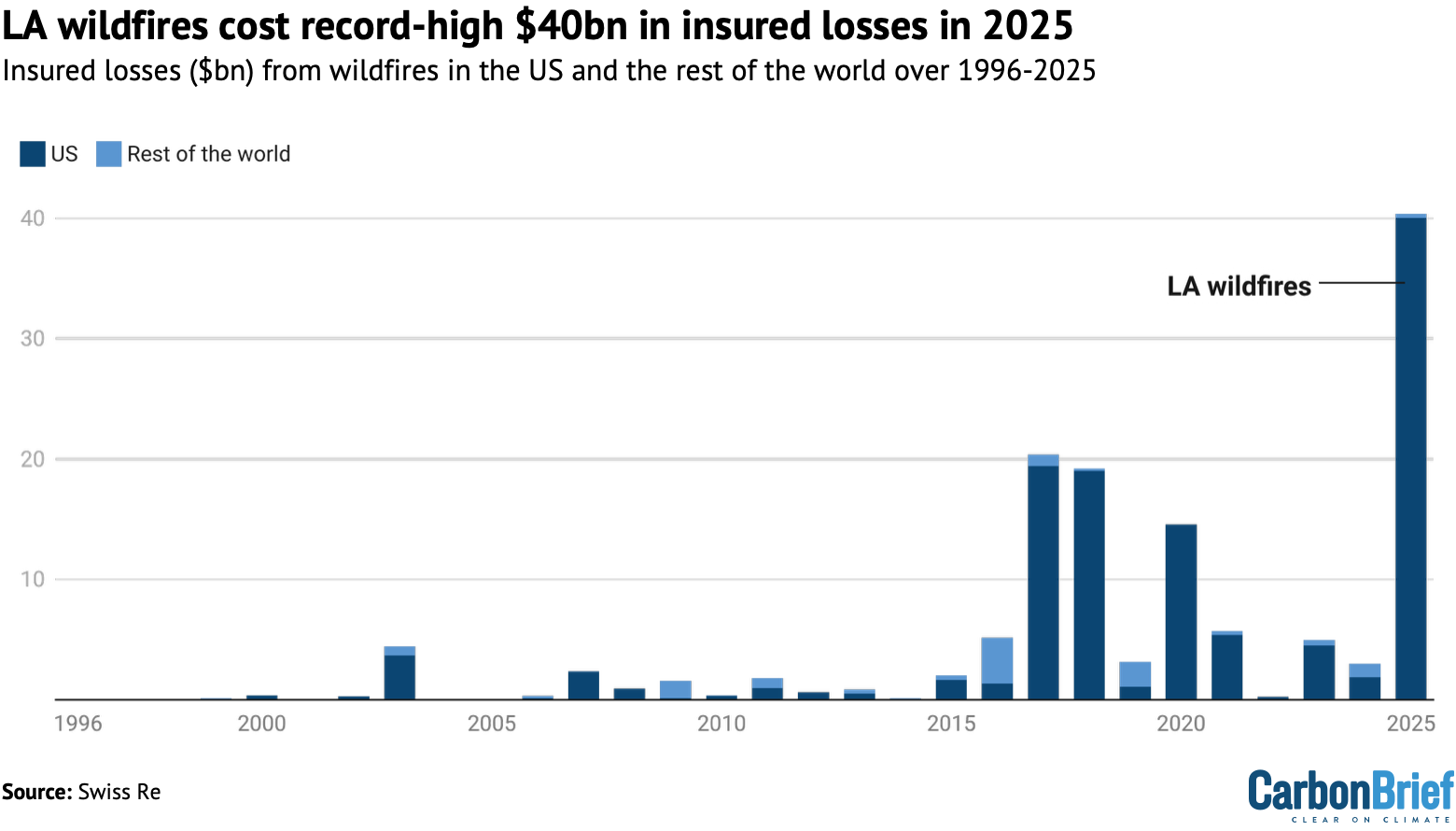
The Los Angeles wildfires alone caused record-high $40bn in insured losses from fires, says a new report from reinsurance company Swiss Re.
The report notes that, while overall insured losses in 2025 were lower than previous years, this was due to a “[luck] rather than a reduction in risk”, partly due to no major hurricanes hitting the US.
Insured losses refer to damages that are compensated for by insurance companies.
Despite lower losses in 2025 than the trend over recent years, they are still rising by an average of 5-7% each year since 1996, accounting for inflation, says Swiss Re.
The report itself does not explicitly discuss the role of human-caused climate change in the events driving these losses.
But the extensive ways in which climate change exacerbates and drives extreme weather are well established in scientific literature.
Other reports and media coverage also show how some parts of the world hit by frequent and intense extreme weather now face the possibility of becoming “uninsurable” due to unaffordable premiums or insurers pulling out of the market.
Below, Carbon Brief outlines three charts from the new Swiss Re report that highlight the role climate extremes had on insured economic losses in 2025.
- Most insured losses came from wildfires, storms and floods
- Wildfire losses soared to record-highs in 2025 due to the Los Angeles fires
- Losses are rising from thunderstorms – partly due to cost of replacing damaged rooftop solar panels
Most insured losses came from wildfires, storms and floods
The report finds that wildfires, floods and other “secondary perils” accounted for 92% of the $107bn in insured losses from “natural catastrophes” in 2025.
This is an all-time high for “secondary peril” losses and an increase from 56% over 2015-24 on average.
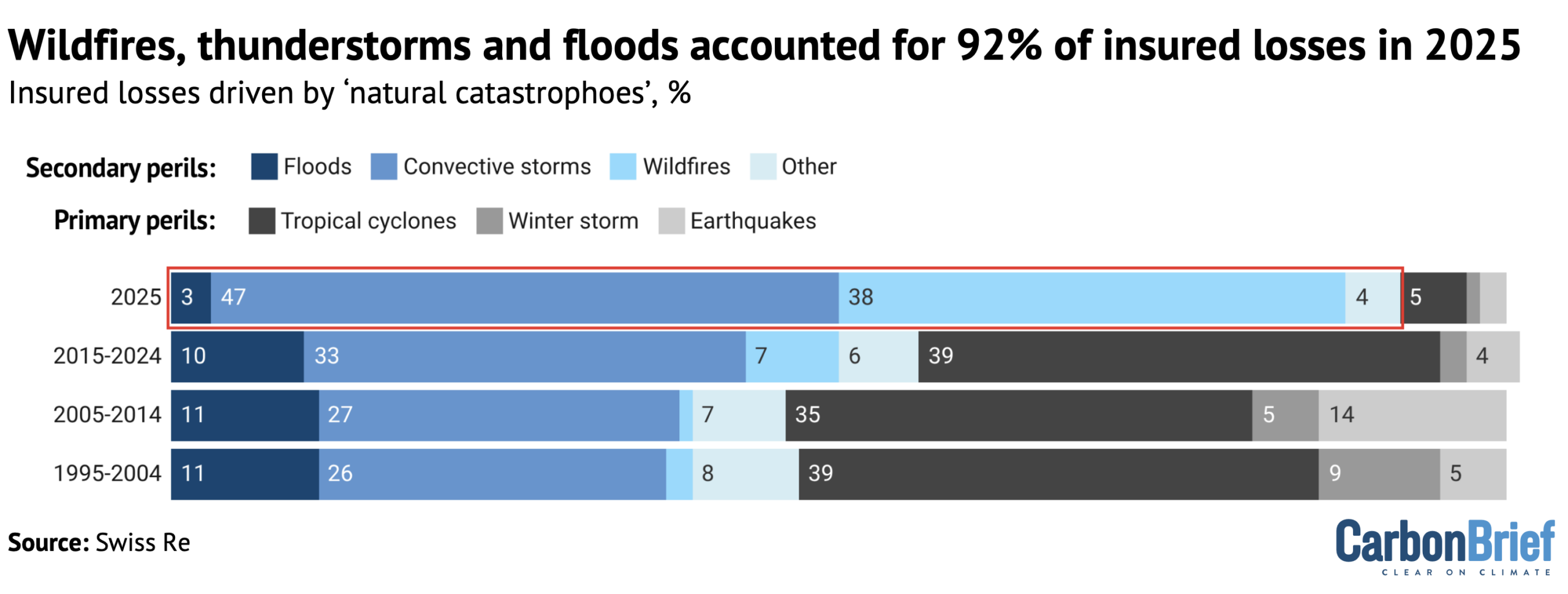
Secondary perils refer to more frequent, but typically less-damaging events, such as thunderstorms, floods, droughts, wildfires and snow. “Primary perils” are less frequent, but highly-damaging events, such as earthquakes and tropical cyclones.
Secondary events have been the fastest-growing category of insured losses from “natural” catastrophes over the past 55 years, according to the report.
The scientific field of “attribution” shows how global warming is making many of these events occur more frequently and/or with greater severity.
Thunderstorms, wildfires and floods are causing “rapidly growing insured losses with widely varying drivers worldwide”, says the Swiss Re report.
Although overall insured losses decreased to $107bn in 2025 from $137bn in 2024, the report forecasts that they could increase to $148bn in 2026, if the year aligns with long-term trends – or $320bn, if major events occur.
Insured losses only account for part of the wider economic losses from weather events, however, with less than half of losses being covered by insurance, the report says.
It adds that emerging economies have the largest gaps in insurance protection.
One contributing factor to the drop in insured losses between 2024 and 2025 was that no major hurricane made landfall in the US, where many people have insurance coverage for their homes or businesses.
Tropical cyclones accounted for 39% of these losses on average over 2015-24, compared to just 5% in 2025.
Hurricanes did cause destruction in other countries with lower insurance protection in 2025, however, such as Hurricane Melissa in Jamaica.
The US has the largest insurance market in the world, in part due to the predominance of high-value assets when compared to other countries. As such, a hurricane not making landfall in the US brings down the overall total insurance losses more significantly than it would in other countries.
Globally, “growth in exposure” contributes to more than 80% of the increase in weather-related insurance losses since 1970, says Swiss Re. This is the term used by the insurance industry to refer to increasing vulnerability to losses amid rising risks.
The report adds that better modelling and improved adaptation and mitigation measures are “crucial” to reduce losses and maintain insurability in vulnerable areas.
Dr Balz Grollimund, who leads the company’s catastrophe model development, told a press briefing:
“We need to continue reviewing our models, our risk views and updating them so they are not anchored in the past. We want them to be anchored in the present day [and] the next couple of years, so we can really anticipate the risk that we are facing.”
Despite the known link between increasing extreme weather and climate change, the new Swiss Re report only mentions climate change in footnotes or in reference to climate modelling.
In contrast, the company’s 2025 “natural catastrophes” report explicitly mentioned climate change compounding losses and heightening extreme weather events at least six times.
Wildfire losses soared to record-highs in 2025 due to the Los Angeles fires
The Palisades and Eaton wildfires that ripped through parts of Los Angeles in January 2025 resulted in almost $40bn of insured losses – “by far the largest global insured wildfire loss events to date”.
The majority of insured losses from wildfires almost always come from the US, as the chart above shows.
Globally, wildfires burned at least 3.7m square kilometres of land – an area larger than India – over 2024-25, Carbon Brief previously reported.
Extreme events occurred in South American and African rainforests during this time, but these would not rank in insurance industry figures due to low or non-existent insurance cover.
The report notes that “high hazard intersects with high-value assets” in many parts of California, which contributed to the record-high losses in the state.
Typically, extreme weather events in global north countries cost more for insurance companies due to higher levels of insurance protection.
Insurance company Mapfre estimated that around 17% of losses from “natural” disasters are covered by insurance in Asia and 19% in Latin America. This compares to almost 57% in North America.
The total economic losses from the Los Angeles fires were estimated to cost $250bn-275bn, said the UN Office for Disaster Risk Reduction. Other impacts from the fires include job losses, health impacts from the smoke and damage to ecosystems, they noted.
The weather conditions that drove the Los Angeles fires were estimated to be 6% more intense and 35% more likely as a result of human-caused climate change, according to World Weather Attribution.
Losses from wildfires have risen “markedly” over the past decade, notes Swiss Re. Global insured losses from fires are increasing by around 12% each year.
The report adds that wildfires have accounted for an average of 10% of global annual “natural” catastrophe insured losses since 2015, compared to just 2% before 2015.
It also finds that the risk of wildfire losses in the US has been heightened by patterns of population growth. The increase in population in high-risk wildfire zones has been three times higher than the wider US since 1975, says the report.
Losses are rising from thunderstorms – partly due to cost of replacing damaged rooftop solar panels
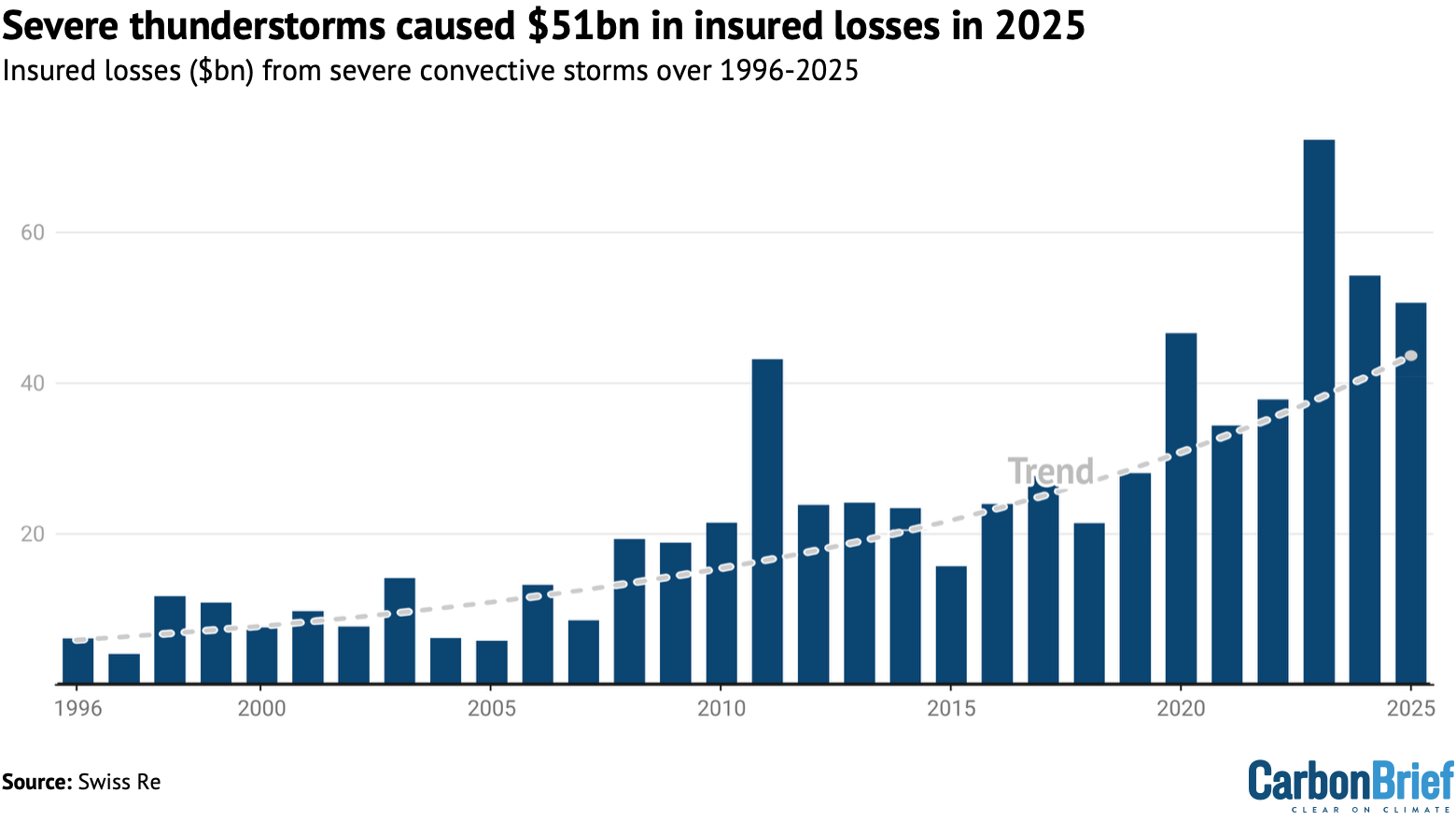
Severe convective storms – also known as thunderstorms – resulted in $51bn of insured losses in 2025, Swiss Re finds, which is above the long-term trend.
These storms are severe events that can bring thunder, lightning, heavy rainfall, hailstones, strong winds and sudden temperature changes, according to the Royal Meteorological Society.
The rain from these storms tends to be very intense and localised in one area, the organisation notes, which can lead to “devastating” floods.
Climate attribution studies have shown that storms have often been made more severe or likely to occur due to climate change, as Carbon Brief’s interactive map reveals.
However, attribution of highly localised convective storms is “extremely difficult”, notes the Intergovernmental Panel on Climate Change. It adds that there is “limited evidence” that extreme rainfall associated with these storms has increased “in some cases” as a result of climate change.
This type of storm has caused up to €50bn ($58bn) in economic losses in the EU since 2000, with Germany, France and Ireland worst-affected, according to a recent report from property data company Cotality.
Globally, 2025 was the third-costliest year for these storms, says Swiss Re, after 2023 ($72bn) and 2024 ($54bn).
One notable contributing factor to this $51bn cost is repairing damage to rooftop solar panels after hailstorms, the report says.
In 2024, the Guardian reported that large hailstones threaten solar infrastructure, with hail in Italy and Germany up to 10cm in size – large enough to “dent a car, smash greenhouses and break a solar panel”.
Grollimund from Swiss Re said that major hail incidents with “tennis ball-sized” hailstones appear to be increasing.
The report says that hail events with stones larger than 5cm are increasing most intensely in Europe, especially in northern Italy. This is driven by “rising low-level moisture and increasing atmospheric instability”, it says.
Hailstones can crack the front glass on a solar panel and cause other damage that can reduce its lifespan and yield, according to a 2019 report from researchers at VU Amsterdam.



The post How wildfires and storms drove insurance losses in 2025 – in three charts appeared first on Carbon Brief.
How wildfires and storms drove insurance losses in 2025 – in three charts

For the first time, new-energy vehicles (NEVs) made up 67% of new car sales in China in September, according to the latest data from the China Passenger Car Association (CPCA).
The figures show that NEVs, which include battery electric cars and plug-in hybrids, captured a record share of sales, even though fewer were sold than last year.
This is because sales of combustion-engine cars are falling steeply, a trend that the CPCA has attributed to rising petrol prices following the start of the Hormuz crisis.
Indeed, sales of fuel-only cars were down 31% year-on-year in the first nine months of 2026, with plug-in hybrid sales down 26% – whereas battery EV sales were only down 4%.
One analyst tells Carbon Brief that China’s rapidly growing EV fleet has offset demand for 143m barrels of oil since the start of the Hormuz crisis.
Another says that the crisis is “reinforcing China’s electrification of road transport”.
Meanwhile, amid slowing domestic sales, Chinese carmakers’ exports of NEVs more than doubled [in 2026 to date / in September] from a year earlier.
NEV record
A record two out of every three cars sold in September in China were NEVs, according to CPCA data, as shown in the figure below.
(NEVs predominantly include battery electric vehicles – BEVs – and plug-in hybrids – PHEVs. BEVs only run on electricity, whereas PHEVs also have a combustion engine.)
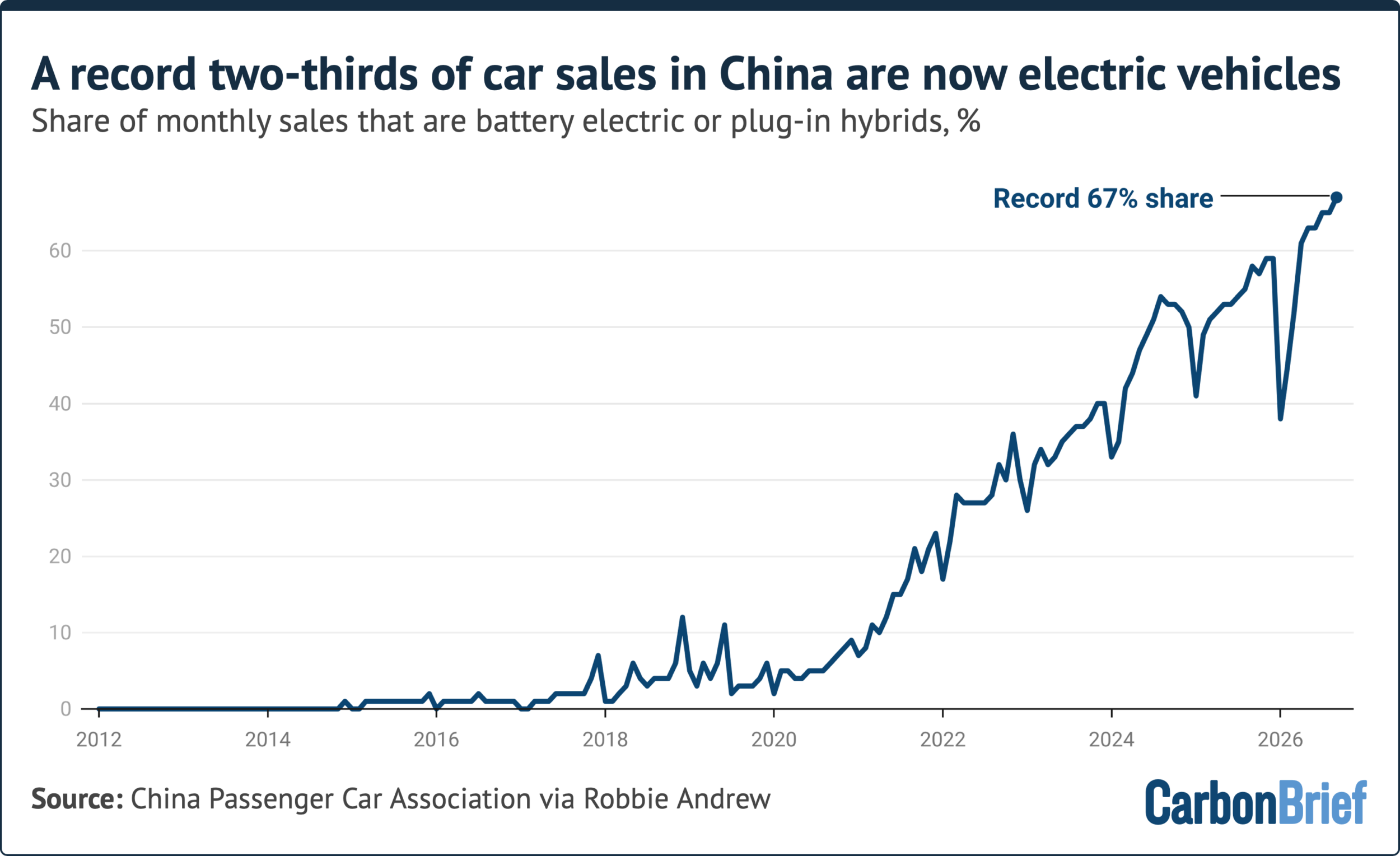
This marks a rapid rise for NEVs from just 6% of new car sales in 2020 up to 58% in 2026 to date – and a record 67% in the month of September.
This year, NEVs’ share of sales has also bounced back from a low of 39% in January, after the full purchase tax exemption that had been in place for more than a decade came to an end in December 2025.
The gain in NEV share in 2026 has come amid a slowdown across the wider domestic passenger-car market, which has hit sales of combustion-engine vehicles particularly hard.
This September, passenger-car retail sales across all categories declined, with overall sales volumes falling 28% year-on-year.
The contraction was led by combustion-engine vehicles, which saw sales fall 43% year-on-year in September and 31% in 2026 to date.
However, sales of PHEVs also fell by 36% year-on-year in September and by 26% in 2026 to date. By comparison, BEVs performed better, although sales still declined 8.5% from a year earlier in September and 4% in 2026 to date.
As a result, NEV sales overall fell by 17% in September and 13% in 2026 to date.
While the market changes in 2026 to date were particularly dramatic, they reflect a broad continuation of trends seen over the past decade.
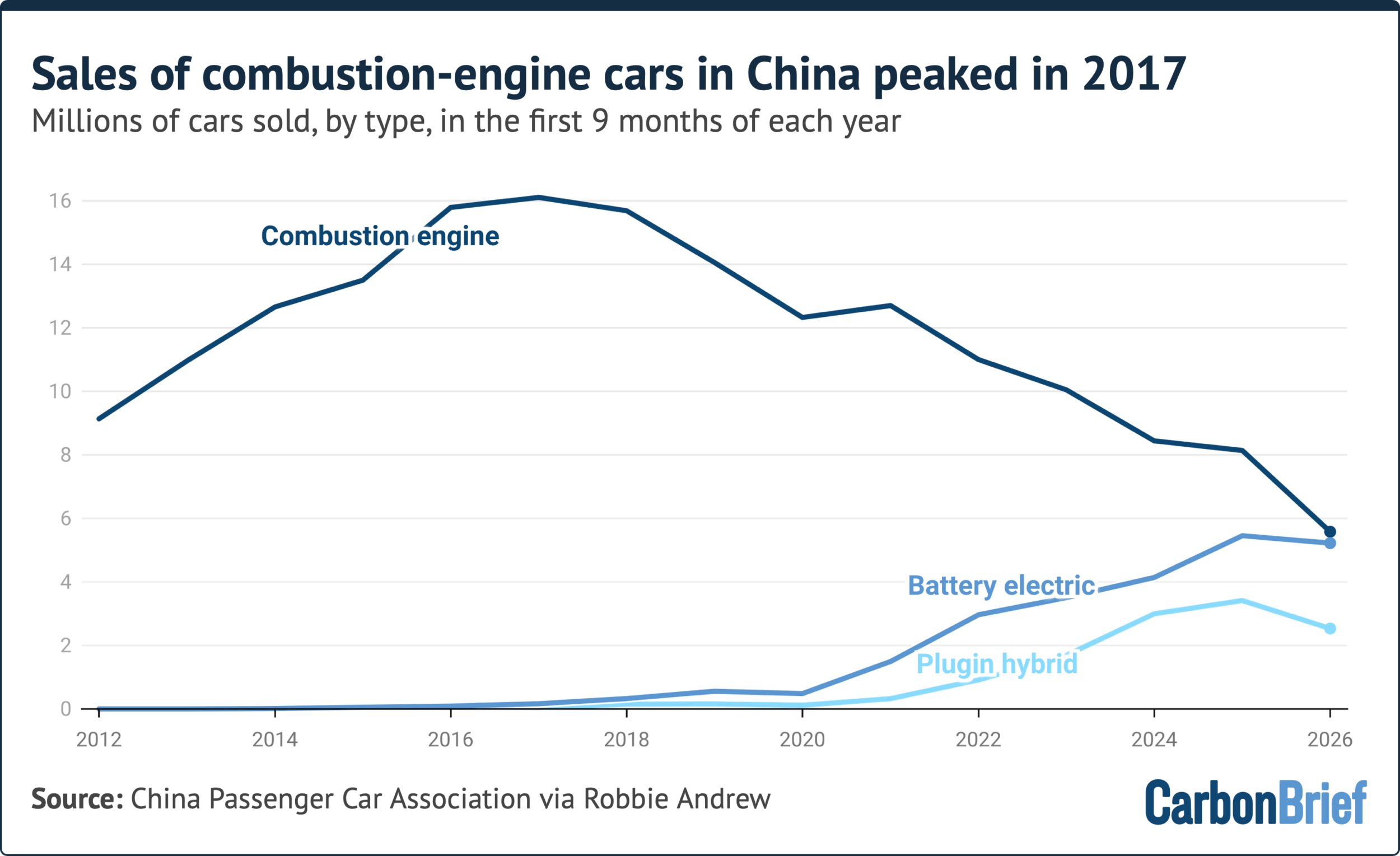
Indeed, sales of combustion-engine cars in China peaked in 2017 and they have been declining ever since, shown in the figure below.
Impact of Hormuz
Part of the reason for the advance of NEVs in 2026, said Chinese technology news outlet OFweek, was petrol cars “giving up market share” as they were outperformed by electric alternatives.
Cui Dongshu, secretary-general of the CPCA, cited higher petrol prices as an explanation for September’s weak combustion-car sales, in comments to financial news outlet National Business Daily.
Imports of oil into China in January-September have fallen 15% compared to 2025, equivalent to 470m barrels, as ongoing conflict tightened supply and drove up prices.
China’s passenger-car NEV fleet has displaced 143m barrels of oil so far during the strait of Hormuz crisis, Euan Graham, senior energy analyst at thinktank Ember, tells Carbon Brief.
EVs “accounted for 12% of the decrease in China’s oil use post-Hormuz”, according to an estimate provided to thinktank the Brookings Institute by an unnamed analyst.