

Climate change is not only a physical or scientific crisis but also a spiritual and emotional one. As forests burn, waters rise, and species vanish, people around the world are experiencing a deep, often overwhelming sorrow known as climate grief. For Indigenous Peoples, this grief is profoundly layered. It is grief for the land, for sacred places lost or polluted, for ancestral foods no longer harvested, and for cultural practices threatened by environmental destruction.
Yet in the face of this grief, Indigenous communities are turning to ceremony, not as a retreat from reality, but as a powerful form of response, resistance, and renewal. Ceremony offers a space for collective mourning, connection to ancestors and land, and healing across generations.
What Is Climate Grief in Indigenous Contexts?
Climate grief among Indigenous Peoples often encompasses:
- The disappearance of animal relatives and medicinal plants is integral to cultural identity.
- The loss of seasonal rhythms that guide ceremony, harvesting, and kinship practices.
- The disruption of sacred responsibilities to care for water, land, and future generations.
- The emotional toll of witnessing ongoing ecological injustice tied to colonialism and extractive industry.
This grief is not abstract—it is experienced viscerally and communally, and it is inseparable from histories of land dispossession, forced relocation, and cultural suppression.
But where colonial systems pathologize grief, Indigenous knowledge systems validate and honour it. Grief is a necessary process that can reconnect us to responsibilities, reawaken our relationships with the land, and inspire transformative action.
Ceremony as Climate Healing
Across Turtle Island, Indigenous-led ceremonies are emerging—or re-emerging—as sacred responses to ecological loss and planetary crisis. These ceremonies do not attempt to “fix” grief or offer quick closure. Instead, they create sacred space to sit with the pain, acknowledge intergenerational trauma, and begin the process of relational repair with Mother Earth.
Some powerful examples include:
- Grassroots Indigenous communities across the Great Lakes, Prairies, and West Coast organize land-based grieving circles. These gatherings often involve fire keeping, songs, and shared storytelling, honouring ecological loss and cultural resurgence.
- Fasting ceremonies, long used for spiritual clarity and prayer, are now undertaken by youth and Elders alike in response to climate emergencies, including pipeline resistance, biodiversity loss, and drought. These fasts are often held on the land and accompanied by teachings, songs, and tobacco offerings.
Healing as Collective and Relational
Indigenous ceremonial responses to climate grief are profoundly relational. They are not individual acts of self-care, but collective acts of care for land, ancestors, and future generations. They reassert Indigenous sovereignty by centring traditional governance, gender roles, and spiritual protocols, while inviting emotional honesty and humility into spaces of climate discourse often dominated by technical language.
Recommendations for Readers
- Support Indigenous-Led Healing Events and Ceremonies
- Attend public ceremonies where invited, donate to ceremony organizers, and share their events. Respect protocols and follow the lead of Indigenous organizers—these are sacred spaces, not spectacles.
- Create Space for Grief in Your Climate Work
- Make room for emotional truth in your activism. Whether through storytelling, group reflection, or spiritual practice, recognize grief as a valid and necessary part of climate justice.
- Read Indigenous Voices on Climate and Loss
- Works like All Our Relations by Tanya Talaga explore the intersections of grief, cultural resurgence, and land-based healing. Reading Indigenous authors is one way to understand the emotional dimensions of climate change from lived experience.
- Practice Relational Accountability
- Ask yourself: Whose land am I on? What ceremonies have been practiced here? What responsibilities do I hold to this place and its people? Learning and acting from this position of relationship helps turn grief into grounded action.
Blog by Rye Karonhiowanen Barberstock
(Image Credit: Patrick Hendry, Unsplash)
The post Healing the Land, Healing Ourselves: Climate Grief and Indigenous Ceremonial Practices appeared first on Indigenous Climate Hub.
Healing the Land, Healing Ourselves: Climate Grief and Indigenous Ceremonial Practices

The World Bank president said on Friday his organisation will continue to support some gas projects in developing countries alongside renewables, nuclear and hydropower, despite criticism from climate campaigners who say fossil gas is expensive and polluting.
“Homes, mines, factories, farms, and growing cities – what do they need? Reliable, affordable baseload power,” Ajay Banga told the bank’s annual meeting in Bangkok on Friday. “Our approach is balanced by design – a full mix of renewables, hydro, gas where appropriate, nuclear when it makes sense, transmission, grids, storage – the whole thing.”
His comments come in a week during which he faced pressure from the US to finance more gas projects and from climate campaigners to stop funding fossil fuels altogether, part of a tightrope he has walked on the bank’s climate policy since Donald Trump’s re-election in 2025.
The bank ended its support for coal around ten years ago and last year, for the first time, funded no oil projects. It has ended support for gas exploration but still backs some projects to do with transporting and using gas, such as a $140-million project to help Benin, Côte d’Ivoire and Togo in West Africa to import liquefied natural gas (LNG).
While its overall support for fossil fuels wanes, the bank’s support for clean energy has been at historic highs over the last few years, with funding of just under $10 billion a year in 2023, 2024 and 2025 – compared to under $1.5 billion a year for fossil fuels.
On Monday, the head of Pakistan’s Indus Consortium, Hussain Jarwar, asked Banga at a civil society townhall meeting why the bank is supporting a “volatile” energy source like LNG, which is pushing economies and consumers into debt “when real renewable energy solutions like solar [are] available and supporting communities and industries for clean, accessible and affordable energy source”. Global LNG prices hit record highs earlier this year as the Iran war squeezed supplies.
Banga replied that the bank is working with countries to source “baseload productive power” and that “if Pakistan wants to build an energy system that is more self-reliant by going further on different forms of baseload plus top-up energy, we’re more than happy to work with it”. “We’ve got no biases in the system – our job is that electricity and water are human rights,” he added.
His answer did not satisfy climate campaigners. Sunil Acharya, just transition lead at Recourse, an NGO that works on sustainable development finance, said in a statement that the bank is moving in the wrong direction and Banga’s “framing of wind and solar as a ‘top-up’ to nuclear, hydropower and gas misses the opportunity to transform energy systems”.
“Fossil gas is bad economics – it exposes countries to volatile global markets and debt while locking public resources into costly infrastructure,” the Nepali campaigner said. “The World Bank must stop reproducing the extractive development model of the fossil fuel era and redirect public finance towards 100% renewable economies that deliver energy for all, protect people and nature, and put people’s priorities before private profit.”
US pressure from Scott Bessent
On Wednesday, however, Banga was pressured from the other direction. US Treasury Secretary Scott Bessent, who skipped the Bangkok meeting, issued a statement praising the bank for “beginning to refocus on its core mission of reducing poverty and raising economic growth” after what he called “years of mission creep”.
He said the bank should “formally retire its prohibition on financing” gas and oil exploration and production as it “cannot credibly invoke country ownership while categorically excluding upstream projects before their development merits are even assessed”. He argued that supporting gas projects would help extend electricity access in Africa.
The US is a major gas exporter and analysts are warning its gas companies will struggle to sell their product abroad in the coming years, as US LNG production expands while buyers in Europe and Asia move away from gas to cleaner sources of electricity.
-
World Bank’s climate work can endure without finance target, experts say
Even though the global lender has ditched a headline goal for its financing with climate benefits, it has decided to continue its climate action plan in the face of US pressure -
In a major reversal, the World Bank is backing mega dams
Despite opposition, the bank has approved the first of five big dam projects expected to get its support in the coming months -
Countries urged to ramp up “insufficient” nature policies at COP17
A major UN report that will inform biodiversity negotiations in Armenia shows countries have made some progress but are still off track for a landmark goal to protect 30% of land and oceans by 2030
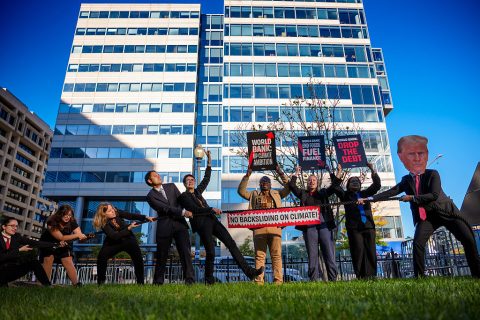


In July, under US pressure, the World Bank scrapped its target for 45% of its finance to go to climate projects. But, with support from a broad majority of countries, it renewed its climate change action plan. The compromise “could have been a lot worse”, E3G climate policy advisor Danny Scull said at the time.
Other multilateral development banks that have the US as a major shareholder, like the Inter-American Development Bank and Asian Development Bank, are now expected to face pressure to scrap their climate finance targets too.
In June 2025, the World Bank ended its ban on support for nuclear power – a move that was welcomed by the US. In his speech on Friday, Banga said the bank would support nuclear retrofits – the modernisation of existing nuclear power stations – alongside the International Atomic Energy Agency, noting that this was “the first such work in 50 years for the bank”.
The post Under US pressure, World Bank says it will back gas “where appropriate” appeared first on Climate Home News.
Under US pressure, World Bank says it will back gas “where appropriate”
Meena Raman is deputy director at Third World Network (TWN), a public interest lawyer and an expert on international climate negotiations. Leon Sealey-Huggins is senior campaigner in global climate justice and just transition at War on Want. Both organisations are members of the Global Campaign to Demand Climate Justice (DCJ).
The world urgently needs the next assessment of climate science. But speed cannot be the only consideration. Equally important is whose research informs it, whether scientists from developing countries can participate meaningfully, and how its findings shape global climate policy.
The timeline of the IPCC’s Seventh Assessment Report (AR7) is a major point of contention at its sixty-fifth meeting in Addis Ababa this week. Since early 2024, it has been contested principally between developed countries and Small Island Developing States (SIDS) seeking earlier completion, and many developing countries calling for more time.
-
Global deforestation slowed in 2025 but Brazil’s election could undo “fragile” gains
Countries remain 70% off track to meet a goal to end deforestation by 2030, as progress in Latin America offset by failures in Africa

Many developed countries, SIDS and some Least Developed Countries (LDCs) want the AR7 Working Group reports completed by 2028, to inform the second Global Stocktake (GST2) of the Paris Agreement. IPCC assessment cycles have generally taken five to seven years.
But the IPCC’s findings would remain relevant after 2028. Reports completed in 2029 could inform countries’ next nationally determined contributions (NDCs) in 2030. The stocktake assesses collective progress, rather than prescribing individual emissions targets.
More time needed for input from developing countries
Between IPCC60 and IPCC65, developing countries – including Algeria, Burundi, Burkina Faso, Bolivia, China, Egypt, Ghana, Guinea, India, Iran, Iraq, Indonesia, Jordan, Kenya, Libya, Malaysia, Morocco, Mozambique, Saudi Arabia, South Africa, Syria, Tanzania, Tunisia, Turkmenistan, Venezuela, Yemen and Zimbabwe – have raised concerns over an earlier AR7 timetable and its impact on inclusivity. Russia and Belarus have expressed similar concerns. An earlier completion date could also affect the scientific integrity and robustness of the AR7 assessments, they argue.
Developing countries have emphasised equity in the IPCC’s work, both in process and substance. Their emphasis on a six-to-seven-year assessment cycle is linked to ensuring that the reports reflect scientific literature from the Global South, including research led and funded by institutions in developing countries.
Who funds research, where institutions are based, which questions receive attention and whose work is assessed shape the IPCC’s evidence base. Scientists in developing countries face unequal access to funding, institutional support and international collaboration.
Extending a deadline alone cannot resolve these inequalities. The timetable must be designed alongside measures to strengthen research capacity and enable meaningful participation, otherwise existing inequalities risk being reproduced in successive assessments.
Timeliness doesn’t guarantee political action
Equity is not only about who participates. It also concerns the assumptions behind scientific models, the development pathways they describe and how their findings are subsequently used. Consider mitigation scenarios assessed in the IPCC’s Sixth Assessment Report (AR6). The IPCC itself acknowledges that most do not explicitly incorporate assumptions about global equity, environmental justice or income distribution within regions.
These scenarios draw on assumptions about development, technology and mitigation, and can shape climate policies. The IPCC calls them projections, not predictions or forecasts. Yet when global emissions pathways become reference points in UN climate decisions, the distinction between projected outcomes and an equitable distribution of responsibilities can blur.
Timely science does not guarantee political action. The IPCC’s Fourth Assessment Report in 2007 identified emissions reductions of 25–40% below 1990 levels by 2020 for developed countries as a group, under a particular scenario. Yet Canada withdrew from the Kyoto Protocol, while Japan and Russia declined new commitments under its second period.
Comment: Governments that support climate science must stand firm against naysayers
The first Global Stocktake in 2023 recognised the need to reduce global greenhouse gas emissions by 43% by 2030 and 60% by 2035 relative to 2019, and reach net-zero carbon dioxide emissions around 2050 to limit warming to 1.5°C with no or limited overshoot.
These benchmarks were highlighted in AR6’s mitigation report. However, the report had an important caveat, that most modelled pathways do not explicitly account for global equity and are projections, not forecasts. But when the 43% figure entered the Global Stocktake decision, it did so without this caveat. This was a fatal omission, given that Article 14 of the Paris Agreement requires Global Stocktake be conducted in the light of equity and the best available science.
Including findings from such models in international climate decisions without their caveats is problematic. Such assumptions affect how future energy use, emissions reductions and development opportunities are distributed across regions.
Emissions-cutting pathways put burden on Global South
A 2024 peer-reviewed study by Indian scientists, published in Climate Policy, examined 556 mitigation scenarios. The researchers found that global inequalities in income, energy use and emissions were projected to persist until 2050, raising questions about whether these pathways reflect equity.
In the scenarios underlying the 43% global reduction figure, sub-Saharan Africa is projected to reduce emissions by 80% by 2030, against 50% in North America and Europe. Developed countries are projected to retain higher per-capita fossil fuel consumption in 2050, while developing countries reduce consumption from already low levels. These pathways place a disproportionate mitigation burden on developing countries, despite developed countries’ historical responsibility.
As science comes under attack at UN talks, climate movement splits over how to respond
Some of the severest projected restrictions on energy use are in sub-Saharan Africa and South Asia, home to many Least Developed Countries (LDCs), where essential infrastructure is yet to be built, even as climate impacts worsen. Yet these scenarios constrain energy consumption and development prospects.
The scenarios also rely on large amounts of land-based carbon dioxide removal, with more than 70% projected in Latin America and the Caribbean, Asia and Africa. This has implications for food security, livelihoods and biodiversity, placing burdens on communities most vulnerable to climate change and least responsible for it.
The IPCC’s findings carry considerable scientific and political weight. Its assessments must uphold the highest standards of scientific integrity, inclusiveness and equity, both in process and substance. There must be no shortcuts for political expediency.
The post Who shapes climate science? The equity question facing the IPCC appeared first on Climate Home News.
Who shapes climate science? The equity question facing the IPCC
A first set of biodiversity plans filed by countries to reverse nature loss are “insufficient” to meet this decade’s global targets, including a landmark goal to protect at least 30% of the world’s land and marine ecosystems by 2030, a landmark UN report warned on Thursday.
The State of Biodiversity Action, put together by a panel of technical experts for the UN Convention on Biological Diversity (CBD), was released in Yerevan, ahead of the COP17 nature talks starting on Monday in the Armenian capital.
Over the next two weeks, governments will for the first time take stock of progress towards the Global Biodiversity Framework (GBF) agreed in 2022 – a set of 23 targets also known as the “Paris Agreement for nature” – and will decide on policy guidelines for ramping up ambition before the 2030 deadline. The UN report will be the main basis for these negotiations.
At a press conference in Armenia, UN Secretary-General António Guterres highlighted that, while there has been some progress on the GBF, the “bad news” is that less than half of country plans are on track to meet its targets.
If current commitments are met by the end of the decade, only 26% of land ecosystems and 12% of marine ecosystems will be protected – falling “real short” of the 30% target agreed in Montreal in 2022, Guterres said. “The war on nature has not yet ended,” he added.
UN Environment chief Inger Andersen said the report “sets the tone for the focus, ambition and urgent action we need to deliver” in Armenia, including by reducing subsidies that harm nature and mobilising new finance for biodiversity. “All leaders and all negotiators must respond to these findings,” she emphasised.
Andersen added that climate change amplifies threats to biodiversity, which makes protection all the more important as global warming is now almost certain to rise above a key threshold. “Exceedence of 1.5C increases the likelihood of forest diebacks, phenological shifts, warming oceans that become more inhospitable to species, irreversible tipping points and so much more,” she said.