

Scientists have long known that fires release substantial amounts of greenhouse gases and pollutants into the atmosphere.
However, estimating the total climate impact of fires is challenging.
Now, new satellite data has shed fresh light on the complex interplay between the climate and fires in different landscapes around the world.
It suggests that global emissions from fires are much higher than previously assumed.
In this article, we unpack the latest update to the Global Fire Emissions Database (GFED) – a resource that combines satellite information on fire activity and vegetation to estimate how fires impact the land and atmosphere.
The latest update to the database – explored in new research published in journal Scientific Data – includes data up to and including the year 2024.
It reveals that, once the data from smaller fires is included, fire emissions sit at roughly 3.4bn tonnes of carbon (GtC) annually – significantly higher than previous estimates.
It also shows that carbon emissions from fires have remained stable over the past two to three decades, as rising emissions from forest fires have been offset by a decline in grassland fire emissions.
The database update also illustrates how the amount of area burned around the world each year is falling as expanding agriculture has created a fragmented landscape and new restrictions on crop residue burning have come into force.
Landscape fires
Fire events vary widely in cause, size and intensity. They take place across the globe in many types of landscapes – deserts and ice sheets are the only biomes that are immune to fire.
When vegetation burns, it releases greenhouse gas emissions, which contribute to global warming. It also releases pollutants that cause local air pollution and, on a global scale, have a cooling effect on the climate.
Forest fires often generate considerable media attention, especially when they threaten places where people live.
However, the forest fires that make the news represent just a small fraction of all fires globally.
More than 95% of the world’s burned area occurs in landscapes with few trees, such as savannahs and grasslands.
Fires have helped maintain tropical savannah ecosystems for millions of years. Savannahs have the perfect conditions for fire: a wet season which allows grasses and other “fuels” to grow, followed by an extended dry season where these fuels become flammable.
Historically, these fires were ignited by lightning. Today, they are mostly caused – intentionally or accidentally – by humans.
And yet, despite their prevalence, these fires receive relatively little media attention. This is not surprising, as they have been part of the landscape for so long and rarely threaten humans, except for their impact on air quality.
Fires also occur in croplands. For example, farmers may use fire to clear agricultural residues after harvest, or during deforestation to clear land for cultivation.
The term “landscape fires” is increasingly used to describe all fires that burn on land – both planned and unplanned.
(The term “wildfire”, on the other hand, covers a subset of landscape fires which are unplanned and typically burn in underdeveloped and underinhabited land.)
Calculating the carbon emissions of landscape fires is important to better understand their impact on local air quality and the global climate.
New data
In principle, calculating carbon emissions from fires is straightforward. The amount of vegetation consumed by fire – or “fuel consumption” – in one representative “unit” of burned area has to be multiplied by the total area burned.
Fuel consumption can be determined through field measurements and satellite analysis.
For example, the burned area of a relatively small fire can be measured by walking around the perimeter with a GPS device. Fuel consumption, meanwhile, can be derived by measuring the difference in amount of vegetation before and after a fire, something that is usually only feasible with planned fires.
In practice, however, fires are unpredictable and highly variable, making accurate measurement difficult.
To track where and when fires occur, researchers rely on satellite observations.
For two decades, NASA’s MODIS satellite sensors have provided a continuous, global record of fire activity. To avoid too many false alarms, the algorithms these satellites use are built in a way so fires are flagged only when they burn an entire 500-metre grid cell.
However, this approach misses many smaller fires – resulting in conservative estimates of total burned area.
The latest update to the GFED includes, for the first time, finer-resolution satellite data, including from the European Space Agency’s “sentinel missions”.
This data shows that fires too small to be picked up by a satellite with a 500-metre spatial resolution are extremely common. So common, in fact, that they nearly double previous estimates of global burned area.
The data shows that, on average, 800 hectares of land – an area roughly the size of Australia – has burned annually over the past two decades.
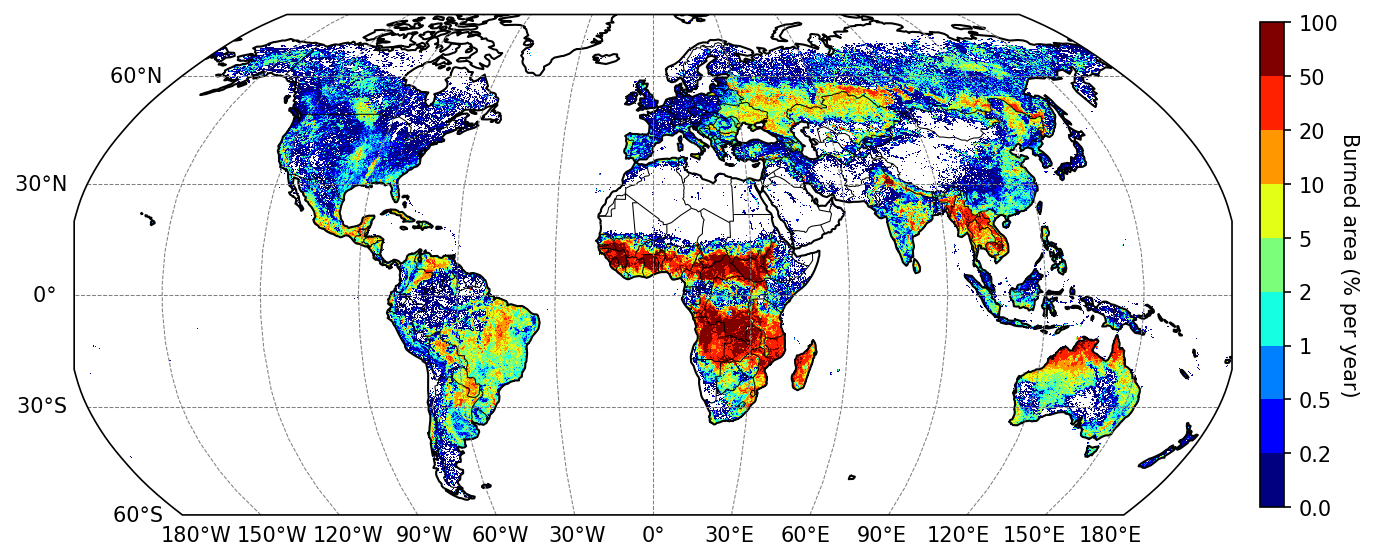
The map below shows the frequency of fires around the world. Regions shaded in dark red burn, on average, 50-100% each year. In other words, fires occur annually or biannually. Regions in dark blue, on the other hand, are those where fires occur, but are very infrequent. Most regions fall in between these extremes.
The map shows that the areas most prone to fire are largely found in the world’s savannah and agricultural regions.
Falling burned area
Over recent decades, the total burned area globally each year has been declining.
This is largely due to land-use change in regions which used to have frequent fires.
For example, savannah is being converted to croplands in Africa. This transforms a frequently burning land-use type to one that does not burn – and creates a more fragmented landscape with new firebreaks which limit the spread of fire.
The decline in burned area is also due to the introduction of more stringent air quality regulations limiting crop residue burning in much of the world, including the European Union.
The amount of “fuel” – or biomass – in a unit area of land varies greatly. Arid grasslands are biomass-poor and, therefore, produce less carbon emissions when burned, whereas fuel consumption in tropical forests with peat soils is extremely high.
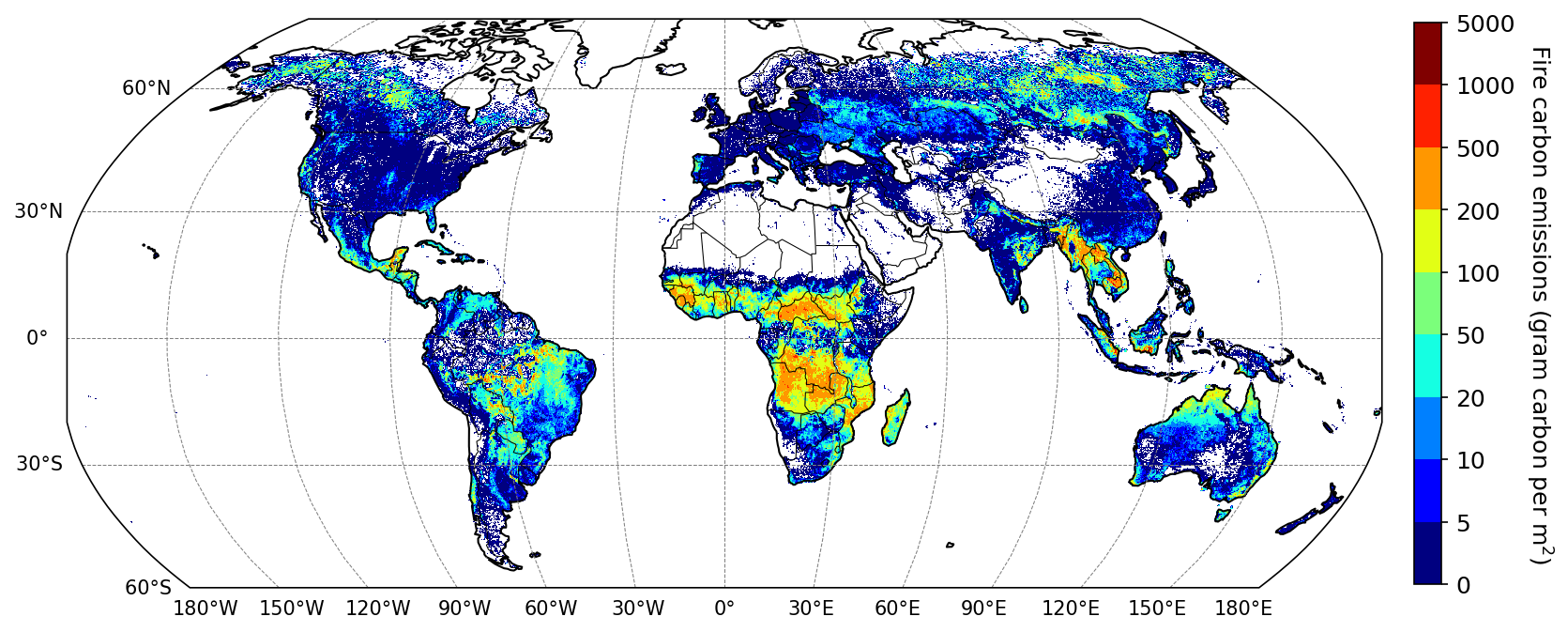
Maps of carbon emissions from fires closely resemble maps of burned area. However, they typically highlight biomass-rich areas, such as dense forests.
This is illustrated in the map below, which shows how fires in regions coloured dark red on the map produce, on average, 1,000-5,000 grams of carbon per square metre. In these places, much more carbon is lost during fires than gained through photosynthesis.
Meanwhile, much of the world’s savannah regions are coloured in yellow and orange on the map, indicating that fires here produce between 100-500 grams of carbon per square metre.
Rising forest fire carbon emissions
The boost in fire emissions captured by the latest version of the GFED is most pronounced in open landscapes, including savannahs, grasslands and shrublands.
Forest fire emissions, on the other hand, have barely changed in the updated version of the database. This is because most forest fires are relatively large and were already well captured by the coarse resolution satellite data used previously.
However, the trend in forest fire emissions is sloping upwards over the study period.
Overall, current estimates – which take into account the new data from smaller fires – suggest that, over 2002-22, global fire emissions averaged 3.4GtC per year.
This is roughly 65% higher than estimates set out in the previous update to the GFED, which was published in 2017.
For comparison, today’s fossil fuel emissions are around 10GtC per year.
Comparisons between fire and fossil fuel carbon emissions are somewhat flawed, as much of the carbon released by fires is eventually reabsorbed when vegetation regrows.
However, this is not the case for fires linked to deforestation or the burning of tropical peatlands, where regrowth is either much slower – or non-existent, if forests are converted to agriculture. These fires account for roughly 0.4GtC each year – just less than 12% of total fire emissions – and contribute directly to the long-term rise in atmospheric carbon dioxide (CO2).
The traditional view of forest fires as “carbon-neutral” is increasingly uncertain as the climate changes due to human activity. Longer fire seasons, drier vegetation and more lightning-induced ignitions are increasing fire frequency in many forested regions.
This is most apparent in the rapidly-warming boreal forests of the far-northern latitudes. The year 2023 saw the highest emissions ever recorded by satellites in boreal forests, breaking a record set just two years before.
Moreover, the fires in boreal forests are becoming more intense – meaning they burn hotter and consume a larger fraction of vegetation. This, in turn, jeopardises the recovery of forests.
In cold areas, fires also cause permafrost to break down faster. This happens because fires remove an organic soil layer that has an insulating effect which prevents permafrost thaw.
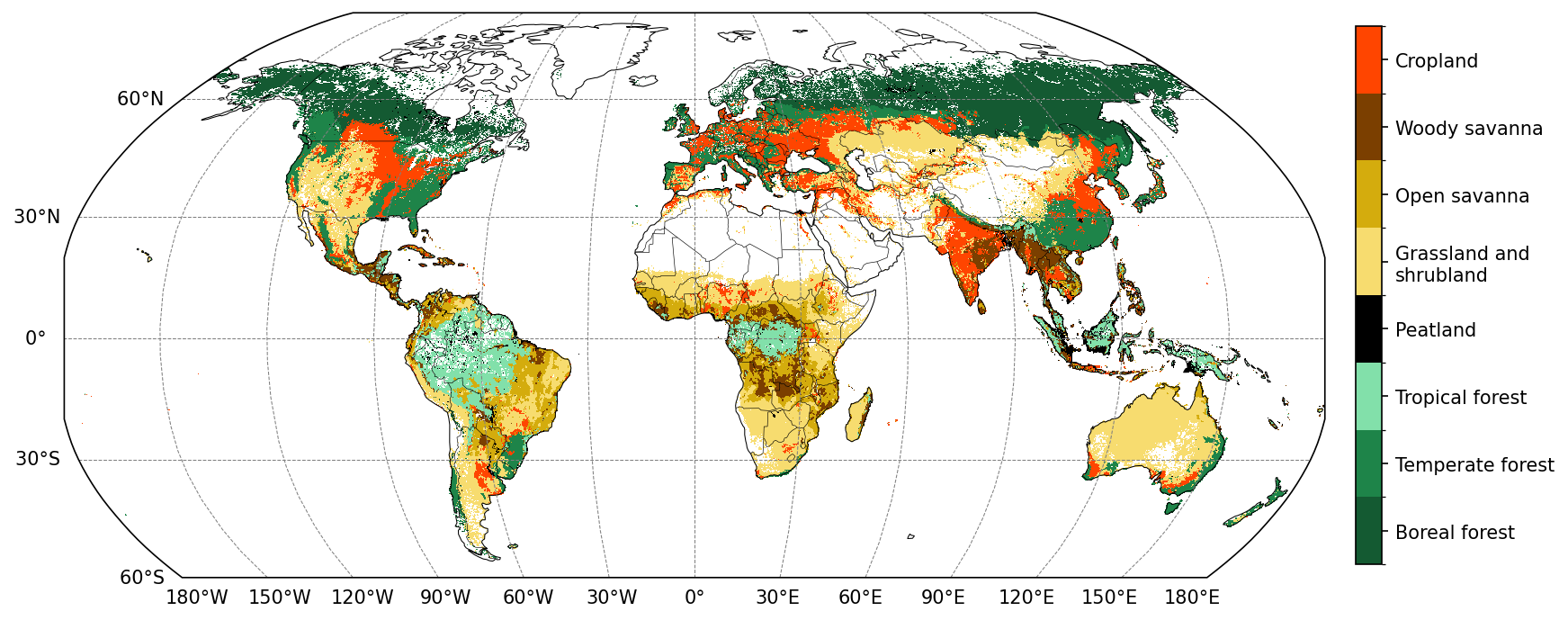
The map below shows the dominant fire type in different regions of the world, including boreal forest fires (dark green), cropland fires (red), open savannah (darker yellow) and woody savannah (brown).
Changing ‘pyrogeography’
Thanks to more precise satellite data we now know that fire emissions are higher than we thought previously, with the new version of GFED having 65% higher overall fire emissions than its predecessor.
However, all evidence suggests that emissions from fires have been stable over the past two to three decades. This is because an increase in forest fire emissions is being offset by a decline in grassland fire emissions.
The world’s changing “pyrogeography” is illustrated in the bar chart below, which breaks down annual fire emissions across different types of biome.
It shows how low-intensity grassland fires with modest fuel consumption – represented in yellow and brown – have declined over time, while high-intensity forest fires – illustrated in green colours – are becoming more prominent, albeit with substantial variability in emissions year-on-year.



The post Guest post: Why carbon emissions from fires are significantly higher than thought appeared first on Carbon Brief.
Guest post: Why carbon emissions from fires are significantly higher than thought

Climate Change
Summit Sold Its Midwest Pipeline as a Carbon Solution. Now, It’ll Be Used for Fossil Fuels.
The pivot reveals a company adapting to Trump’s “drill, baby, drill” agenda and looking to cash in on recently boosted tax incentives for enhanced oil recovery.
For four years, battles over private property rights have gridlocked state legislatures across the Midwest and stalled plans for a pipeline to transport liquified carbon dioxide from ethanol plants in the region.
Summit Sold Its Midwest Pipeline as a Carbon Solution. Now, It’ll Be Used for Fossil Fuels.
“Today, as in the beginning, life is still made out of carbon dioxide, and the world’s problems are made out of carbon dioxide as well.”
From our collaborating partner Living on Earth, public radio’s environmental news magazine, an interview by Jenni Doering with Peter Brannen, the author of “The Story of CO2 Is the Story of Everything.”
The 4-Billion-Year Perspective to Understanding Earth’s Current Climate Crisis
Climate Change
Trump’s ‘God Squad’ Will Weigh Gulf Oil Drilling Against the Survival of Endangered Whales and Turtles
Citing national security, the Trump administration wants to exempt all federally regulated offshore oil from protections for endangered animals—even if it could cause their extinction.
The Trump administration is turning to the nuclear option on endangered-species protections in the name of national security.


-
Greenhouse Gases8 months ago
Guest post: Why China is still building new coal – and when it might stop
-
Climate Change8 months ago
Guest post: Why China is still building new coal – and when it might stop
-

 Greenhouse Gases2 years ago
嘉宾来稿:满足中国增长的用电需求 光伏加储能“比新建煤电更实惠”
-
Climate Change2 years ago
Bill Discounting Climate Change in Florida’s Energy Policy Awaits DeSantis’ Approval
-

 Climate Change2 years ago
嘉宾来稿:满足中国增长的用电需求 光伏加储能“比新建煤电更实惠”
-
Climate Change Videos2 years ago
The toxic gas flares fuelling Nigeria’s climate change – BBC News
-

 Carbon Footprint2 years ago
US SEC’s Climate Disclosure Rules Spur Renewed Interest in Carbon Credits
-

 Renewable Energy5 months ago
Sending Progressive Philanthropist George Soros to Prison?