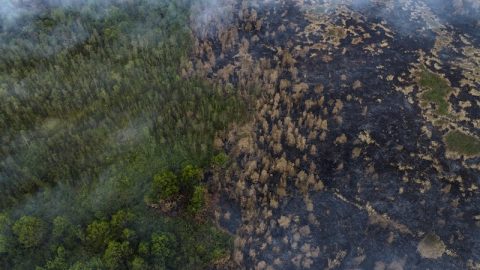
Removing CO2 from the atmosphere using land-based mitigation strategies is central to nearly every country’s net-zero target.
To mitigate global climate change, land-use and land-management sectors need to reduce greenhouse gas emissions and remove carbon from the atmosphere.
Protecting ecosystems and dedicating more land to nature-based solutions and climate-smart agricultural practices are promising ways to do so.
To date, there has been little work looking at where, specifically, these strategies may be in conflict with one another.
Our research, published in Global Change Biology, assesses opportunity costs among 19 different land-use strategies for climate mitigation.
We find that roughly 8.5bn hectares of land around the globe are suitable for at least one land-based mitigation strategy – representing about 60% of the Earth’s land surface.
However, almost 40% of this land is suitable for more than one mitigation strategy, presenting decisionmakers with a choice as to which strategy or strategies they should deploy.
Land-based mitigation
To achieve global climate targets in a timely manner, some studies call for up to 10% of Earth’s terrestrial surface to undergo a land-cover change.
But is there actually enough land to make this happen? And if there is, how can projects be scaled up strategically to maximise the mitigation benefits while minimising negative impacts on humans and biodiversity?
Disciplinary silos and practical uncertainties have previously made these questions hard to answer.
For instance, nature-based solutions, including habitat conservation and restoration, are often differentiated from other climate-motivated land-use practices, such as bioenergy cropping and afforestation. Yet, both types of practices can have significant trade-offs for biodiversity and for agriculture.
Although controversial, these types of climate-specific land-use changes are proposed in many national climate mitigation plans. As these plans are put in motion, the trade-offs that could result from increasing the land dedicated to certain strategies over others need careful consideration.
In our study, we assess land-use opportunity costs across a portfolio of 19 different strategies for climate mitigation.
Broadly speaking, these strategies can be classified into four main approaches to mitigation: maintaining or protecting ecosystems, modifying forestry or agricultural management practices, restoring ecosystems and converting land to increase biomass.
Of these, certain approaches and strategies can be used to avoid emissions, while others can be used to sequester carbon.
Among the strategies we studied are the protection and restoration of forest, wetland, peatland and grassland habitats, various approaches to climate-smart cropland and forestry management (including biochar and silvopasture), bioenergy cropping with carbon capture and storage and afforestation.
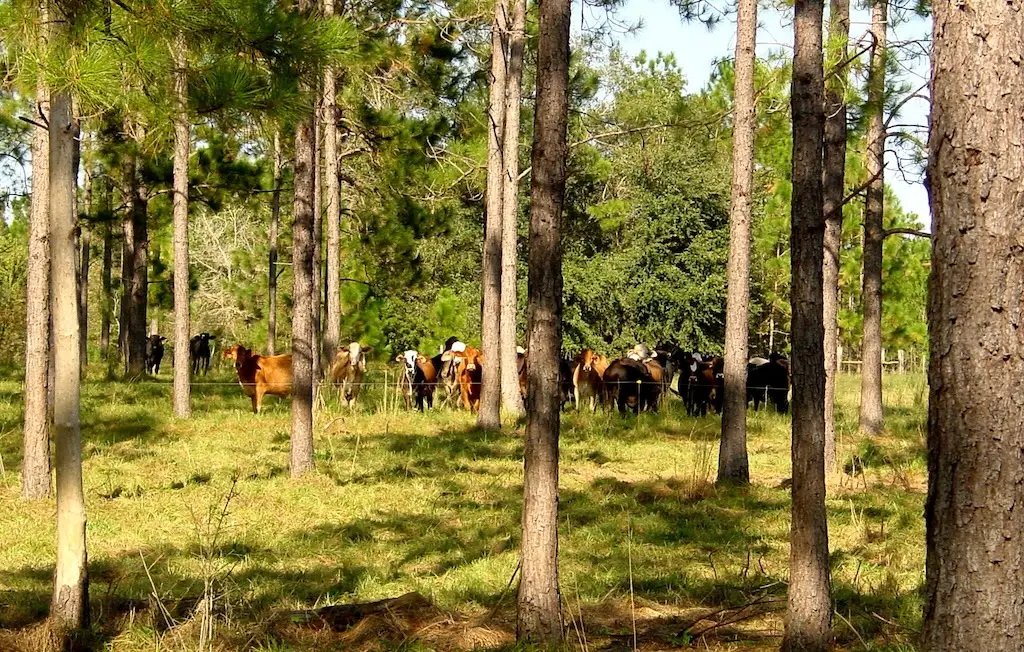
We used global datasets on forests, croplands and other habitat types alongside data on environmental conditions such as temperature to estimate how much of the global land area is suitable for each strategy.
Then, we created global maps at a one kilometre resolution that identify areas that could be considered for these measures.
Land potentials
We find that some strategies had large regions of suitability.
For example, deforestation and other types of habitat loss are a large contributor to greenhouse gas emissions from the land-use sector. Maintaining grassland and forest habitat types to prevent losses can be done anywhere that such loss is occurring.
Maintaining the carbon stored in ecosystems that are currently unprotected accounts for more than 3bn hectares of the land we estimate as suitable for land-based climate mitigation – equal to about 20% of the Earth’s land surface.
Other strategies, including peatland restoration and silvopasture, had much more restricted areas of suitability across the globe.
For peatland restoration, priority areas are primarily distributed in the boreal zone – the high-latitude northern hemisphere, just south of the Arctic. Cropland expansion has led to widespread peatland loss in this region over the past several decades.
For silvopasture – a type of livestock farming that integrates tree cover with grazing – suitability is primarily constrained by environmental limits on tree growth. Here, factors such as water availability determine in which regions traditional pastoral systems could be converted to silvopasture.
The figure below shows the 19 mitigation strategies we studied and the area of the Earth that is suitable for each, in millions of hectares. The three maps on the right show example distributions for (from top to bottom) enhanced chemical weathering, bioenergy with carbon capture and storage (BECCS) and integrating trees into croplands.

Conflict potential
When summing the suitable area across all the 19 strategies we examined, we find that a huge area of Earth – almost 60% of its land surface – is theoretically suitable for land-based climate mitigation.
However, the majority of this area captures regions where more than one mitigation strategy is suitable.
In some cases, these overlapping land potentials involve mitigation strategies that can be deployed jointly, such as increasing the carbon stored in soils at the same time as increasing the carbon stored in aboveground biomass.
One example of this is the potential to collectively implement enhanced chemical weathering and improved plantation management, which have a combined land suitability of 348m hectares.
(Enhanced chemical weathering involves spreading ground-up silicate rocks onto farms or other land. This speeds up natural chemical processes and removes CO2 from the atmosphere, while also improving crop yields.)
However, suitable areas for compatible strategies were rare, compared to the area where conflicts between strategies could occur.
For instance, large portions of the US, Europe and China are suitable for both ecosystem restoration and climate-smart agriculture.
In these regions, societies face a choice between restoring grassland, forest and wetland habitats, or continuing to manage the land for agriculture, where climate-smart practices could still be implemented to decrease greenhouse gas emissions or sequester more carbon.
Because the choice between large-scale restoration and climate-smart agriculture may involve a trade-off between restoring habitat for biodiversity or maintaining land use for people, we avoid making any recommendations about which land-use practices to implement.
Rather, our paper highlights areas where these trade-offs could occur – places in which large-scale top-down planning could conflict with local priorities for land-use.
More research is needed to map local constraints and management costs so that the choice between mitigation strategies aligns local needs with national and global targets for climate mitigation.
Opportunity costs
So, with these potential overlaps and conflicts, is there enough land to meet climate targets?
The answer is yes, in theory – the summed area we estimate as suitable for climate mitigation is more than double the amount of land that has been pledged for transformation by UN member countries in their pledges to meet the goals of the Paris Agreement.
However, the pace of on-the-ground implementation lags far behind the degree of land-use change needed to limit warming by 2050. And high-level constraints, such as meagre financing or a lack of political incentives, will continue to stall progress.
Given these choices and constraints, land-use opportunity costs should be considered when planning policies that may incentivise certain types of mitigation practices that could inadvertently displace opportunities for others.
As plans to reach net-zero continue to develop, the atlas of maps for mitigation practices – and the exploration of opportunity costs – can guide pathways for scaling up land-based mitigation to address climate change.




The post Guest post: The conflicting practices in using land to tackle climate change appeared first on Carbon Brief.
Guest post: The conflicting practices in using land to tackle climate change

Climate Change
“Sink or swim”: WA Gov hugely underestimating decline in regional gas demand while sleeping on green exports, new report finds
PERTH, Tuesday 13 October 2026 — A new report from Greenpeace Australia Pacific and Springmount Advisory reveals green commodity exports are an untapped economic opportunity for Western Australia in a declining Asian gas market, while offering a genuine solution for decarbonising Asia.
From Gas to Green: Building Western Australia’s Future State is a comprehensive analysis of the declining gas market in Asia, and the untapped economic opportunity for WA to become a global leader in green commodity exports while driving the regional shift away from fossil fuels.
The report offers key recommendations for the WA Government to support regional decarbonisation through an orderly phase out of gas exports in favour of green iron and other green exports. It comes as global climate leaders from across business, politics and advocacy prepare to meet for the Global Citizen Now: Perth event focused on decarbonising WA.
Key findings:
- Gas demand is falling across WA’s core markets in Asia: Gas demand fell in 2025 and is projected to continue to decline, driven by a combination of global geopolitical factors and domestic concerns.
- Policy shifts in key markets since the war on Iran now prioritise renewables and nuclear over gas: Japan, South Korea and China have legislated energy plans that prioritise renewables and nuclear over gas.
- New WA gas would arrive in a saturated, uncertain Asian market filled with cheaper gas: The US is now the world’s largest liquefied gas producer and plans to double its capacity as it also targets Asian markets.
- Green commodities offer a real solution to sustain WA’s economy: WA can lead Australia’s green commodity exports, which by 2060 could be worth almost a trillion dollars.
- Exporting more WA gas is likely to delay or impede Asia decarbonisation: Despite claims by the gas industry, there is no evidence that WA gas is displacing coal in Asia, and in fact diverts resources from genuine decarbonisation options.
Geoff Bice, WA Campaign Lead at Greenpeace Australia Pacific said: “As our export partners in Asia shift away from expensive and polluting gas, the WA Government has a golden opportunity to pivot our economy to green exports, like green iron, which is the most effective way to help our region to decarbonise.
“The writing is on the wall: gas is in decline, renewables are our future. In this context, it makes zero sense for the government to encourage high risk projects like Woodside’s reckless Browse gas proposal at Scott Reef.
“This report clearly shows that the WA Government faces a choice: sink or swim. They can either allow the gas industry to keep ripping off West Australians and continue propping up its decline, or choose the path that will deliver enormous benefits to the state and the world by becoming a leader in the rapidly expanding green economy.”
Tom Quinn, Managing Director of Springmount Advisory: “Western Australia prospers when it looks to the future and builds for future demand. Twenty years from now, what the world needs is green commodities made using WAs abundant renewable resources. Just like it did with iron ore in the 1950s and gas in the 1970s, WA should look to the future and build what the world will need, not sunsetting industries like gas that are already past their peak.”
-ENDS-
Media contact
Kate O’Callaghan on 0406 231 892 or kate.ocallaghan@greenpeace.org
Lucy Keller on 0491 135 308 or lucy.keller@greenpeace.org
A report from Greenpeace Australia Pacific and Springmount Advisory reveals the untapped green economic opportunity for Western Australia in a declining Asian gas market, which also offers a genuine solution for decarbonisation in Asia.
Is Western Australia clinging to a fading gas industry while a thriving green future passes it by? As major Asian trading partners rapidly pivot away from volatile gas imports toward cheap solar and battery storage, this report exposes a high-stakes choice: risk becoming stranded in an oversupplied fossil fuel market, or harness WA’s unmatched sun and wind to lead the global clean energy transition.
Summary
From Gas to Green: Building Western Australia’s Future State reveals that Western Australia (WA) faces a critical juncture as falling Asian gas demand, geopolitical gas supply volatility and accelerating renewable energy deployment undermine the long-term economic viability of gas exports. By harnessing its world-class wind and solar resources, the report demonstrates that WA can execute an orderly phase-out of gas and pioneer a green commodity export economy that could generate $987 billion in economic value by 2060, create 24,000 ongoing jobs, and drive a 9.6% reduction in global greenhouse gas emissions.
Key Findings
- Gas demand is falling in Asia – WA can no longer rely on gas exports: Gas demand in core Asian markets fell in 2025 and is projected to continue to decline in 2026. Legislated energy plans in Japan, South Korea, and China now prioritise renewables and nuclear over gas.
- Asia is increasing renewables, importing gas just gets in the way: Evidence from markets like Thailand suggests that gas imports are increasingly crowding out cheaper renewable energy investments and battery storage rather than displacing coal, locking in more emissions over time.
- Green commodities offer a real solution to decarbonise Asia – this is a major win for WA: With world-class renewables, WA can lead Australia’s green commodity exports, which by 2060 could be worth almost a trillion dollars ($987 billion) and support a genuine 9.6% reduction in global emissions.
Recommendations to WA government
Recommendation 1: Plan an orderly gas phase-out aligned with a trading partner pivot plan
Implement a managed, orderly phase-out of gas exports aligned with trading partners’ decarbonisation pathways, rather than waiting for demand to collapse, by:
- Developing and implementing a staged phase-out of gas facilities aligned with feedstock supply expiry or typical end of facility lifespans.
- Committing to no new gas development for gas expansion, including Browse and Kimberley fields.
- Developing new, reciprocal trade relationships with existing gas trade partners, structured to progressively replace gas exports with green commodities – integrated with recommendation 2.
Recommendation 2: Develop an integrated green commodity export strategy, positioning WA as a global green iron manufacturing hub
Establish an integrated green commodity export strategy that immediately prioritises green iron development, positioning WA as a global green iron manufacturing hub, by:
- Committing to green commodity export targets to give industry and investors a clear demand signal.
- Prioritising green iron as the lead sector within the broader green commodity strategy, given WA’s iron ore endowment and first-mover potential.
Recommendation 3: Reject false solutions such as carbon dumping (CCS) and blue hydrogen
Reject carbon dumping (also described as carbon capture and storage, or CCS) and blue hydrogen as viable decarbonisation technologies, and prioritise green hydrogen and proven renewables for clean energy and fuel production by:
- Excluding blue hydrogen projects (and CCS-dependent projects) from all government support programs.
- Requiring existing hydrogen-based production (including ammonia, methanol, synthetic fuels) to have clear, near-term transition timelines to switch to green hydrogen production.

What you can do
Together, we can push for a prosperous green future.
You can help by:
- Sending an email to Environment Minister Murray Watt and Prime Minister Anthony Albanese, calling on them to reject Browse.
- Sharing this story to help more Australians understand what’s at stake.
- Encouraging your friends and family to take action.
REPORT: “From Gas to Green” Building Western Australia’s Future State
Cleaner cooking projects in the UN carbon market will have to set aside a share of their credits to insure against the risk that the trees they save are lost to fire, drought or logging, after the market’s regulator rejected calls to exempt the sector.
The requirement is part of a new rulebook that the Paris Agreement carbon market regulator – the Article 6.4 Supervisory Body – approved last Friday for programmes that aim to cut emissions by distributing new and cleaner cookstoves in regions that still burn wood or charcoal for cooking.
These are the UN mechanism’s first rulebooks for cookstoves, one of the carbon market’s most popular credit types and also one of its most criticised for overstating climate benefits.
They consist of two methodologies: one for programmes that aim to cut greenhouse gas emissions by distributing more efficient cookstoves that burn less wood or charcoal, and a separate methodology for projects shifting households to lower-emissions cookers running on electricity or liquid petroleum gas (LPG).
Mkhuthazi Steleki, the South African chair of the Supervisory Body, said “this decision gives cleaner cooking projects a new pathway under the UN carbon market, with clear rules to ensure that each credit represents a real and credible emission reduction”.
Industry and NGOs lobby to weaken UN carbon credit rules in “coordinated” push
In copycat submissions and a private briefing to government officials, the groups have opposed a proposal to tighten safeguards for emissions offsets