

England will soon introduce one of the world’s most ambitious biodiversity policies in “Biodiversity Net Gain”.
This policy effectively mandates that any new development leaves biodiversity in a better state than before it was constructed. It was initially meant to go into effect in November, but the government has pushed back its implementation until 2024.
In order to understand the potential impacts of the Biodiversity Net Gain, our team has been tracking development projects approved over the last three years in six councils across England that were early adopters of the policy.
Our latest paper, published this month, reveals several fundamental challenges that threaten the integrity of the policy’s environmental and economic outcomes.
We find that the oversight, monitoring and enforcement of biodiversity improvements supposedly delivered under the policy need urgent attention.
For example, there is a clear “governance gap”, where the system for monitoring biodiversity gains delivered on the site of new developments is weaker than for gains purchased from elsewhere. The process is overseen by local planning departments, which are typically lacking in capacity and ecological expertise.
Biodiversity Net Gain is an essential pillar of the country’s plans for attracting private finance into nature conservation to achieve its overarching environmental objectives.
Ultimately, the challenges we identify threaten the integrity of one of England’s most important environmental markets – and with it, the environmental outcomes of the government’s nature markets strategy.
Biodiversity Net Gain
Under the Biodiversity Net Gain policy, developers have three ways to offset their “biodiversity liability” – the damage their project does to nature. Biodiversity Net Gain applies to most developments, such as housing and smaller infrastructure projects. The policy will apply to major infrastructure projects from 2025 onwards.
First, they can enhance biodiversity somewhere within the development – so-called “on-site” gains. These on-site gains can take the form of, for example, sowing wildflowers along road verges or managing some of the grassland within a housing development to promote wildlife, rather than for traditional landscaping.
If developers can’t meet their liabilities on-site, their second option is to use biodiversity “units” from ecological improvements elsewhere. Under the policy, these units are supposed to mirror the habitat that is impacted by the development, so that when developers damage habitats, they must replace them with habitats that are at least as valuable, from a conservation perspective, as those lost.
Some of these units might come from the new “net-gain market”. Land managers create these units by implementing conservation actions on their land, such as converting low-productivity pasture into a field managed for wildflowers. Then, they sell these units to developers.
Alternatively, some developers are developing their own habitat banks, creating biodiversity units in one place to offset the impacts of their developments elsewhere.
Last, if no units are available through either of these pathways, developers can buy “statutory biodiversity credits” directly from the national government.
These credits loosely resemble the units sold via the market. The government holds a stock of these units as a last resort for developers who cannot offset their damage in other ways. For example, they may offset damage to particularly rare types of habitat for which there may not be suitable credits available on the standard market.
Importantly, the price levels for these statutory units have been set deliberately high, in an attempt to disincentivise developers from relying on these credits.
The ‘governance gap’
Our dataset spans around 1,600 hectares of development footprint that have been submitted or approved for development over the last three years in these six early-adopter councils: West and South Oxfordshire, Vale of White Horse, Cornwall, Leeds City and Tunbridge Wells.

Our team has been collating and analysing the biodiversity assessments submitted to these authorities for each project.
We’ve analysed the trades occurring under the policy and the rules that govern them. Additionally, we have quantified any errors embedded in the developers’ biodiversity assessments. Our research has identified several shortfalls that need addressing for this nature market to be able to deliver on its goals.
Our first key finding is that around one-quarter of all the biodiversity units delivered under the policy so far fall within a “governance gap” – meaning that they are likely to go unmonitored, and may even be legally unenforceable.
As a result, there is a very high probability that regulators will not be able to take any action if these promised gains are not delivered.
This will likely translate into a large chunk of these units not materialising in reality, as there is little incentive for developers to deliver these units in full if there is no credible enforcement mechanism.
The problem is that the standards and regulations of the three offset pathways vary considerably.
There is reasonably stringent governance to ensure that biodiversity units purchased on the offsetting market are delivered in reality. Sellers will have to submit their offsets to a national database, monitor biodiversity changes and report on the ecological development of the site at regular intervals.
Contrary to these standards, the system for monitoring, reporting and enforcing units delivered “on-site” is much weaker. The government has suggested that the existing planning enforcement system can be used to oversee on-site units.
The planning enforcement system was never designed for such a task, and in its current form, is unsuitable for fulfilling this role.
Under the current system, local authorities are explicitly advised to only take enforcement action, such as warnings or fines, if a developer’s violation of a planning condition results in “serious harm to a local public amenity”. Although it is unclear how this will apply to the Biodiversity Net Gain policy, the failure to deliver a habitat that a developer promised in a planning application a few years prior is extremely unlikely to trigger this threshold.
Developers also do not have to log their on-site gains on the national Biodiversity Net Gain register, which means that many of these projects are likely to go unmonitored. Even if they underperform relative to the original promise in the planning application, there is no credible system in place to hold developers to account for such non-delivery.
Risk of non-delivery
In our research, we have found that around one-quarter of all the units delivered under the policy are at a high risk of non-delivery because of this governance gap.
While the regulation of a specific kind of biodiversity unit within a single policy might sound unimportant, this actually has serious implications for how England’s nature markets function.
The core pillar of England’s ambitions for drawing private finance into nature conservation is the Biodiversity Net Gain market. Any biodiversity units that are delivered on-site by developers are units they will not need to purchase from the off-site market. So the less stringent the standards in the on-site system, the more this will drain demand for units from the off-site market, which is relatively more ecologically robust.
Although we recognise our data is preliminary, we estimate that if these under-regulated biodiversity units were to be delivered via the off-site market instead, the demand for biodiversity units could rise by a factor of four.
This could significantly increase the amount of conservation implemented on private land and, therefore, the amount of private finance flowing into conservation projects on private land.

There is precedent for this. The English scheme was partially informed by the US wetland mitigation markets. In 2008, those markets underwent reform to address a similar governance gap.
In the US case, the standards applied to developer-led and third-party projects diverged enormously, meaning a range of low-quality mitigation projects were being implemented by developers. The 2008 compensation rule in the US wetland mitigation system addressed this disparity by ensuring that the same standards were applied across all forms of compensation.
Lacking capacity
Our research also reveals other interesting, consequential patterns. Perhaps the most important to the integrity of this emerging market is the current lack of capacity in local authorities to be able to deliver on the Biodiversity Net Gain policy.
Local authorities do the best they can with the resources they have, but they have undergone stringent funding cuts since 2008.
At the last count, around 60% of local planning authorities have no in-house ecological expertise – which is essential for delivering biodiversity gains effectively.
In our study, we evaluated how many of the applications contained a basic error in their calculations: we checked to see if the area of the site before and after development added up to the same amount.
We found that the areas did not add up in around one-fifth of all projects. Of these, around half had already been accepted by the local planning authorities. One explanation for this oversight could be that planners were so rushed they did not have time to examine the calculations included with the application.
This suggests we have not yet addressed the serious capacity shortages in the councils – who are ultimately going to be the public bodies overseeing the delivery of Biodiversity Net Gain at local scales. This is clear evidence that further investment in local planning capacity is required.
Environmental markets have the potential to be powerful mechanisms for improving nature, but one of the fundamental features of biodiversity compensation markets is that they deliver biodiversity gains that make up for an equal and opposite loss elsewhere.
This means that every biodiversity unit that is promised by developers in order to secure planning permission, but then not delivered in reality, has legitimised the loss of biodiversity elsewhere.
Making sure that these policies lead to direct, robust gains in the quality of nature is therefore absolutely essential to ensure that the markets-focused approach to drawing private finance into nature recovery in England leaves the environment better, rather than worse, off.


The post Guest post: Fixing the gaps in England’s ‘biodiversity net-gain’ policy appeared first on Carbon Brief.
Guest post: Fixing the gaps in England’s ‘biodiversity net-gain’ policy

Continue Reading
A surge in wholesale costs driven by expensive gas is responsible for nearly 90% of the rise in UK household electricity bills since 2020, reveals new analysis.
The figures, shared with Carbon Brief by thinktank Nesta, show that wholesale gas costs are also behind the vast majority (77%) of the increase in household gas bills.
The analysis firmly contradicts the idea, which has become embedded in UK media and political narratives, that the UK’s net-zero target is to blame for high energy bills.
Andrew Sissons, director for sustainable future at Nesta, tells Carbon Brief that net-zero is, in fact, “helping to shelter Britain from the impact of expensive gas”. He adds:
“Rising gas prices, not net-zero, have driven most of the recent surge in Britain’s energy bills. Britain is particularly exposed, with over 80% of households connected to gas mains, while our electricity system still relies too much on gas as the marginal unit.”
The analysis comes after the UK government gave its approval for the Jackdaw gas field to be developed in the North Sea, despite stating that it “would not…affect prices”.
Another gas crisis
In January 2026, Carbon Brief reported that two-thirds of the rise in electricity bills since before the 2022 global energy crisis was due to high gas prices.
Now, amid ongoing conflict in the Middle East, wholesale gas prices are at their highest levels since Russia’s 2022 invasion of Ukraine.
Indeed, as of 19 October, UK wholesale gas prices stood at 220p per therm (£75 per megawatt hour, MWh), above the average for 2022 of 210p/therm (£72/MWh).
The figure below shows that, after accounting for inflation, typical UK annual household electricity bills had risen £180 by the fourth quarter of 2026, relative to the same period in 2020.
Some 90% of this increase (£161) is due to wholesale costs, driven by the price of gas.
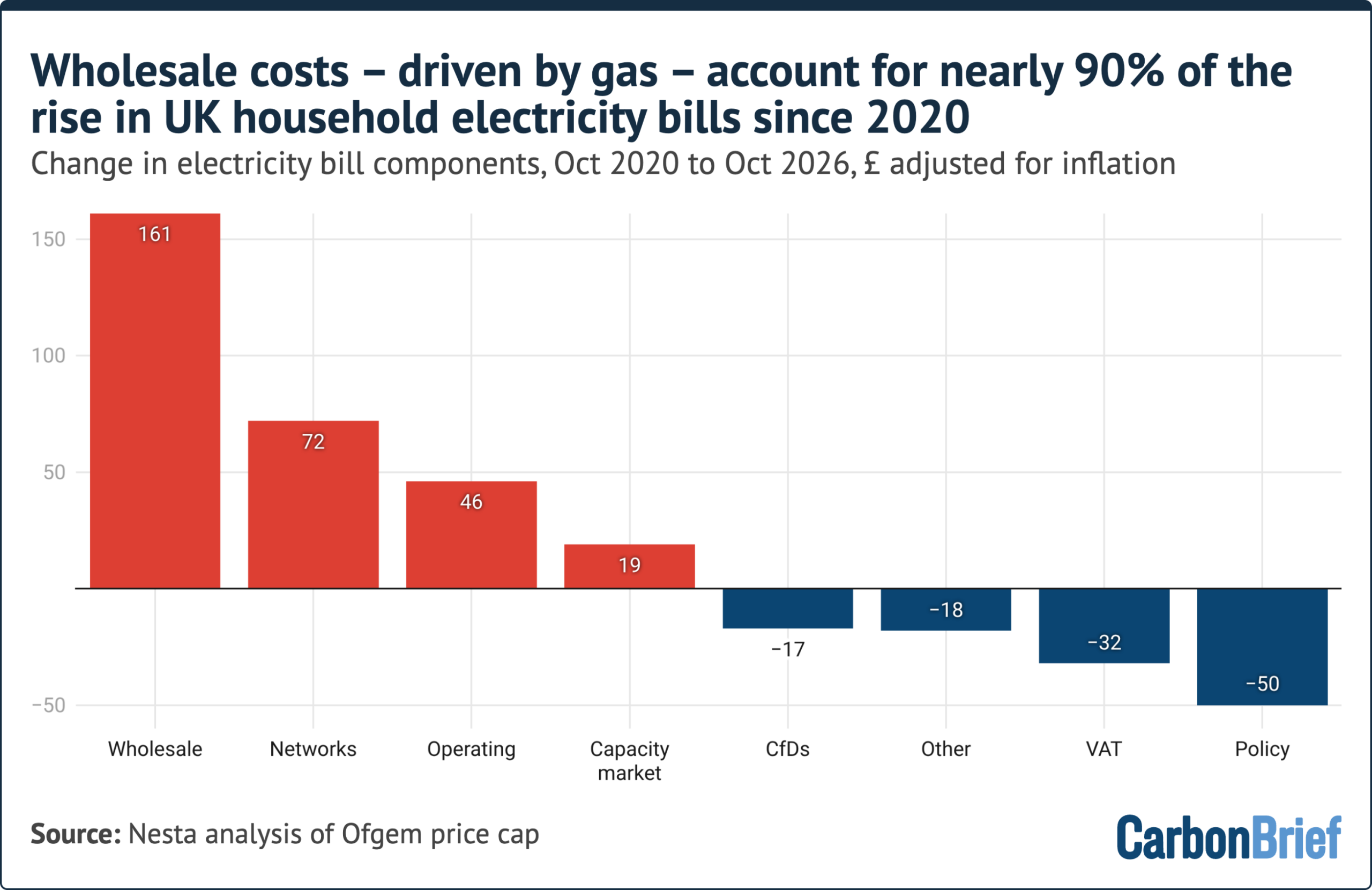
In contrast – and contrary to widespread perceptions – renewable “contracts for difference” (CfDs) are reducing electricity bills by £17 under the current price cap, according to the Nesta analysis.
In addition, the government has cut policy costs for electricity by moving 75% of legacy renewable support onto general taxation, ending the “ECO” efficiency scheme and temporarily removing VAT.
Network costs have added £72 to typical bills since 2020, according to Nesta. Most of this (£46) is for investment in the electricity transmission network, known as the “motorways” of the grid.
Only £21 of the rise in network costs relates to balancing the system, including “constraint payments” for turning off windfarms – and turning on gas plants – due to insufficient grid capacity.
Wind constraint payments regularly receive extensive news coverage, despite balancing costs – in total – making up just £35 (4%) of a typical £858 annual household electricity bill.
The Nesta figures show energy supplier operating costs have gone up by £46 since 2020. These costs are not broken down in the underlying Ofgem figures, but the increase is thought to be driven by the cost of rising household energy debt. Supplier profits are capped at 2.5% of bills.
Breaking the link
Notably, household electricity prices have increased far less rapidly since the Hormuz crisis than gas bills, with higher clean-energy generation helping break the link between the two.
Since 2020, household gas bills have increased by £368 in real terms, according to Nesta’s analysis. Some 77% of this (£283) is due to wholesale gas costs.
After accounting for inflation, total dual-fuel bills for a typical household have increased from £1,175 per year in October 2020 to £1,723 per year in October 2026, a rise of 47%.
The rise in wholesale costs driven by high gas prices accounts for £444 (81%) of this increase in real terms, as shown in the figure below.
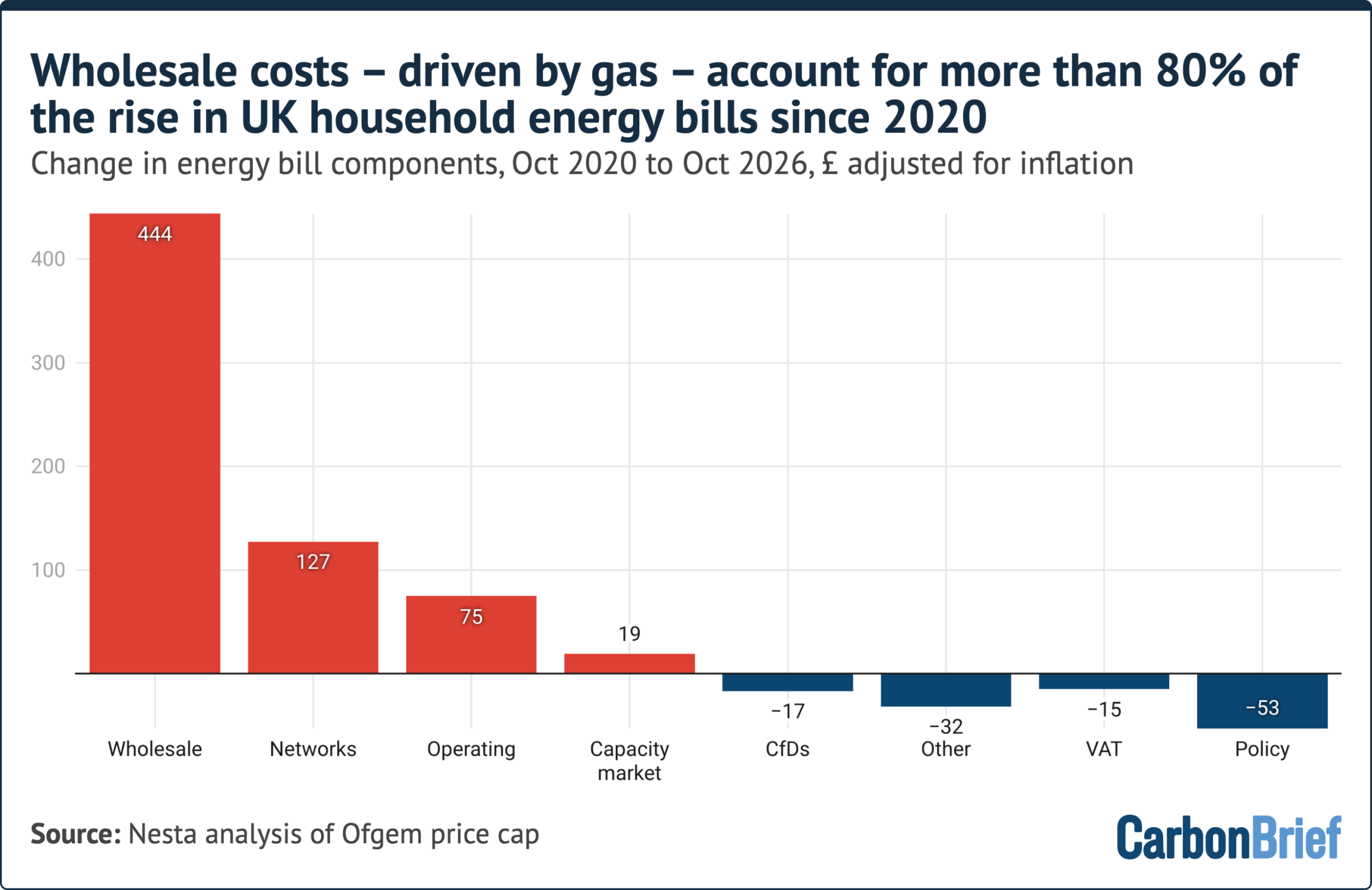
The £127 real-terms rise in network costs includes £72 for electricity transmission, distribution and balancing, as well as £55 for investment in the gas grid.
(According to the Energy Networks Association, up to 80% of the investment in electricity grids is required to maintain existing assets, with the remainder going towards expansion for net-zero.)
In total, the cost of government social and climate policies made up £183 (16%) of typical dual-fuel bills in October 2020. This had fallen to £114 (7%) as of the current October 2026 price cap.
Wholesale costs make up the largest share of the current cap, at £757 (44%). Network costs are the second-largest component of bills, at £417 (24%), followed by operating costs at £291 (17%).
Sissons tells Carbon Brief:
“Upgrading the grid is not cost-neutral, but that price tag is dwarfed by the impact of rising gas prices. In fact, net-zero is helping to shelter Britain from the impact of expensive gas. Since the start of the Iran war, electricity bills have begun to decouple from gas bills, thanks to the UK’s increased renewable power and support from contracts for difference.”
“Going further will require British households to have clean electricity, electric vehicles and heat pumps over fossil-fuel cars and boilers. By focusing on growing electricity demand, the government can spread upgrade costs more widely. This can lock in the consistent investment in electrification that is Britain’s best path to stop global turmoil showing up on winter energy bills.”
Related

Factcheck: UK Conservatives double the ‘cost of net-zero’ after spreadsheet blunder

Analysis: Wind and solar save UK from gas imports worth £5.9bn during Hormuz crisis

Analysis: EVs are now nine times cheaper than petrol or diesel to drive in the UK

CCC: Heathrow expansion could push flights to ‘80% of UK emissions by 2050’
The post Revealed: Expensive gas behind ‘nearly 90%’ of rise in UK electricity bills appeared first on Carbon Brief.
Revealed: Expensive gas behind ‘nearly 90%’ of rise in UK electricity bills
A temporary breach of the 1.5C global-warming limit is now “inevitable” following “decades of insufficient climate action”, says the UN Environment Programme (UNEP).
In its “sobering” annual assessment of the global “emissions gap”, UNEP says that exceeding the Paris Agreement’s 1.5C limit is “imminent and unavoidable”.
This year’s report, titled “The point of return”, says the “task now” is to minimise the size and scale of a temperature “overshoot” and to “establish a credible return path to 1.5C by the end of the century”.
Even the “lowest possible” overshoot scenario for 1.5C would first see global warming peak at around 1.7-1.8C in the middle of the century before declining, says the report.
This scenario – which is “still aligned with the long-term temperature goal of the Paris Agreement” – would require global emissions cuts of 18% by 2030 and 45% by 2035, while ramping up “removals” of carbon dioxide (CO2) from the atmosphere, says UNEP.
In contrast, it notes that the current climate pledges by countries around the world – even if fully implemented – would only reduce emissions by 5-8% by 2030 and 11-15 % by 2035, relative to 2025 levels.
Nonetheless, the report identifies “ample opportunity to accelerate action”, concluding that “countries can still limit peak warming, shorten the duration of overshoot and keep the goals of the Paris Agreement within reach”.
(See Carbon Brief’s detailed coverage of previous reports in 2014, 2015, 2016, 2017, 2018, 2019, 2020, 2021, 2022, 2023, 2024 and 2025.)