

The new year began with a barrage of negative EV headlines. But beneath the headlines lie stories of continued market growth for electric cars, trucks, and buses. While some legacy automakers are struggling to adapt to designing, manufacturing, and selling electric vehicles, and some start-up electric vehicle makers are going out of business, such turmoil is natural in a technological transition of this magnitude and should be expected, not sensational.
Still, in 2023, consumers bought over 1.4 million new passenger EVs, which averages nearly 1 out of every 10 new cars sold nationwide. Charging infrastructure deployment has been growing steadily, from around 90,000 plugs at the beginning of 2020 to over 180,000 at the end of 2023. Investments in electric vehicle manufacturing, battery production, and supply chain in the Southeast U.S. alone were up 45% in 2023, bringing the total to $70.8 billion and 70,000 anticipated jobs.
To get a true sense of how the transition to electric cars, trucks, and buses is going, pay attention to the stories of the people buying and driving EVs, long-term adoption trends, and where private sector investments and public funds are flowing. Below are a few examples.
The Cold Hard Facts: EVs in Winter Weather
Despite recent icy headlines, new data actually show that EVs outshine gasoline vehicles in extreme cold. In fact, Havre, Montana—a rural frontier community just south of the Canadian border— has been operating their electric school buses in as low as minus 44 degrees without fail, sometimes better than their diesel buses. And they’re doing so at a much lower price tag—Havre’s electric school buses cost 50%-75% less to operate than the diesel alternatives. Read more.

Photo courtesy of Havre Daily News/Patrick Johnston
On A Roll: EV Sales More Than Quadruple
EV sales continue to charge ahead, having more than quadrupled between 2020 to 2023. This period of rapid growth has seen Americans purchase 4.7 million EVs, illustrating the continued satisfaction among early EV adopters, despite a lack of model availability and reliable EV charging. I’ll wager that, as NEVI-funded fast chargers pop up every 50 miles along America’s highways, and new and used EV tax credit confusion settles, the next million EVs will be sold before the end of Q2 of this year. Read more.

Graphic courtesy of energy.gov
Swapping Yellow for Green: Electric School Bus Funding
Another $1 billion in clean school buses has been awarded with funding from the Bipartisan Infrastructure Law. These grants will allow 280 school districts to purchase 2,700 clean school buses, primarily electric, to replace dirty diesel buses. Clean school buses save school districts money long-term through reduced fuel and maintenance costs, improve public health, boost resilience by having the potential to provide backup power to buildings and the grid, address the climate crisis, and enhance energy security. Read more.

Photo courtesy of The Washington Post
Want to join the EV conversation? Let’s connect on LinkedIn!
SACE’s Electrify the South program leverages research, advocacy, and outreach to accelerate the equitable transition to electric transportation across the Southeast. Visit ElectrifytheSouth.org to learn more and connect with us.
The post Greening Our Roads: Talking EVs appeared first on SACE | Southern Alliance for Clean Energy.

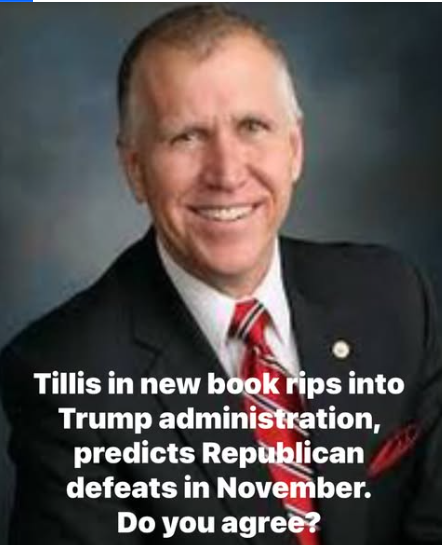 Maybe, as they say, “Hell has a special place reserved in it” for people like Thom Tillis, Republican Senator from North Carolina, who enabled Trump to rape and destroy the United States.
That was until it became clear to Tillis that he could jump ship, write a scathing book about the president, get all over mainstream news promoting it, and go on to enjoy another chapter of political success.
That we Americans are so stupid that we accept this blatant hypocrisy and criminality is sad proof that we’re not the people we were 20 years ago. Maybe what many people are saying are correct: we deserved what we got.
Here’s a short video from Elle Cordova that reminds us that science is something of a rarity in human history.
The great tyrants of history have done their best to cause the people they ruled to reject science, simply to ensure the masses are ignorant, terrified, superstitious, and thus easily controlled.
The current political administration is particularly engrossed in the rejection of science. I wonder why.
 Are you saying that the ascendency of a criminal sociopath made Western Civilization great?
Not sure how credible that is to people with the IQ of an artichoke.



-
Climate Change1 year ago
Guest post: Why China is still building new coal – and when it might stop
-

 Greenhouse Gases2 years ago
嘉宾来稿:满足中国增长的用电需求 光伏加储能“比新建煤电更实惠”
-
Greenhouse Gases1 year ago
Guest post: Why China is still building new coal – and when it might stop
-

 Climate Change2 years ago
嘉宾来稿:满足中国增长的用电需求 光伏加储能“比新建煤电更实惠”
-

 Renewable Energy12 months ago
Sending Progressive Philanthropist George Soros to Prison?
-
Climate Change2 years ago
Bill Discounting Climate Change in Florida’s Energy Policy Awaits DeSantis’ Approval
-
Greenhouse Gases1 year ago
嘉宾来稿:探究火山喷发如何影响气候预测
-

 Climate Change2 years ago
Analysis: China’s CO2 falls 1% in Q2 2024 in first quarterly drop since Covid-19