

There are days when the sulphur-like, toxic smell coming from the nearby oil facilities is so potent that Azuh Chinenye struggles to go outside her house early in the morning. “When you inhale, you as a person, your body system, and every other thing will change… you can’t stand the odour,” she said.
Chinenye lives in Oyigbo, a town less than 20 miles (32 km) from Port Harcourt, in the Niger Delta, the heart of Nigeria’s main oil-producing region.
Signs of the industry are everywhere in Oyigbo. Active flare stacks stand just metres from homes and businesses, whose walls are caked in soot. Close to a primary school, Climate Home News saw oil spilling from a corroded underground pipe.
The local oil field here was for many years owned and operated by Shell, until it was sold to a Nigerian firm for $533 million in early 2021. Since the sale, gas flaring has increased dramatically at Oyigbo, despite the new operator’s promise to “protect our planet” and the health of communities.
A local doctor and residents told Climate Home News that the opposite is happening in reality, as people struggle with the effects of noxious pollutants released by flaring at production facilities close to their homes.
Flaring worsens climate crisis
Fifteen times more gas was burned at the Oyigbo field in 2024 compared to 2020, according to an analysis of satellite data prepared for Climate Home News by SkyTruth, an environmental watchdog. This pattern is repeated at other fields previously owned by Shell across the Niger Delta, the data shows.
Flaring occurs when gas produced during oil drilling is burned off, instead of being utilised. The process releases vast amounts of carbon dioxide and methane, a potent planet-heating greenhouse gas, alongside toxic chemicals.
Failure to tackle gas flaring pushes global climate goals further out of reach, as cutting methane emissions from the oil and gas industry is widely seen by climate and energy experts as a quick win to slow global warming in the short term.
Shell claims to have significantly reduced its emissions and says it achieved zero routine flaring last year, but our analysis reveals that this was driven primarily by selling off high-emission assets – from the US to Nigeria – which are then free to continue polluting, albeit under different management.
After Shell divestments, flaring on the rise
A spokesperson for Shell told Climate Home News by email that, when the energy giant selects buyers for divestments, it assesses “a number of factors such as their financial strength, operating culture and environmental performance” and shares emissions reduction plans for the assets, where relevant.
But Shell does not monitor the performance of those assets once it has handed over control to the buyer, the spokesperson said, adding that regulation of operations by the new owner is carried out by governments.
After years of staying flat at the global level, flaring has risen again since 2023, including in Nigeria, where smaller home-grown firms have been ramping up production seeking to maximise oil revenues while lacking the expertise to prevent flaring, according to a World Bank report.
To understand more about how this wasteful and dangerous process continues to harm people’s lives, Climate Home News went to the Niger Delta, a part of the world unique for how many residents are forced to live in close proximity to flare stacks.
New owner promised sustainable production


“Gas flaring has increased in the years since Shell left,” said Chief Maduabuchi Felix Achiele, a community leader in Oyigbo. “In a week, we can observe two, three, four instances of flaring but when Shell was here, it was just once in a while.”
The field has been owned by Trans-Niger Oil and Gas (TNOG) since January 2021, along with the rest of the assets within the OML 17 oil block. The company that runs operations in the block – Lagos-based Heirs Energies – has boasted about turning an “underperforming asset” into an economic success after taking it over from Shell.
Heirs Energies said it has doubled production at OML 17 without that coming at the expense of environmental and climate integrity. “We can create a symmetry, a symbiotic relationship between oil and gas, the environment and people […] sustainability is infused in what we are doing,” its CEO Osayande Igiehon said in an interview late last year.
-
Africa records fastest-ever solar growth, as installations jump in 2025
Africa’s solar power installations have increased sharply, driven by utility-scale projects and privately financed rooftop and commercial systems -
Southern Africa floods intensified by warming highlight climate injustice, scientists say
Climate change is fuelling extreme rainfall in the region, while insufficient adaptation and aid cuts have left people highly exposed to floods


Heirs Energies announced an agreement with the Nigerian National Petroleum Corporation (NNPC) to capture and monetise gas from OML 17 in December, though the company did not give a timeframe for when this project would be completed. Heirs failed to respond to questions sent by Climate Home News for this story.
On its website, the company says it is “committed to eliminating routine flaring and greenhouse gas emissions by 2025”. But the emissions figures and experience of the local community tell a radically different story.
Jump in flaring volumes
In OML 17, the vast oil block that covers much of the urban area of Port Harcourt and its surrounding towns like Oyigbo, gas flaring volumes grew sevenfold between 2020 – the last year of Shell’s involvement – and 2024, according to data presented to Climate Home News by SkyTruth.
To conduct this analysis, we tracked sales of onshore Nigerian assets, determined the location of each site using open source data, and then worked with SkyTruth to monitor flaring from these locations using data from the Earth Observation Group at the Colorado School of Mines.
Within OML 17, at Agbada, about a 30-minute drive north of Port Harcourt city centre, flaring doubled immediately after the sale in 2021. The following year, it almost doubled again and has remained close to that mark since. In Nkali, another asset within OML 17, flaring was nearly four times higher in the year after the sale.
While SkyTruth’s analysis was only able to use figures up to 2024, flaring remained high at these oil blocks throughout 2025, according to publicly available data from the NNPC.
This pattern can be seen in other oil blocks. Shell lost its right to operate OML 11 in August 2021, a block that spans the Ogoniland region. This helped the company to record a drop in emissions from both greenhouse gases and volatile organic compounds, while flaring went up under the block’s new operator, a subsidiary of the government-owned NNPC.
“Catastrophic” for communities
Communities in Ogoniland are seeking reparations for the decades-long environmental devastation caused by oil drilling. When it took control of the assets in 2021, the NNPC said the firm’s operations would be driven by “a social contract that would put the people and environment of the Niger Delta above pecuniary considerations”. Nonetheless, gas flaring tripled between 2021 and 2024 across all OML 11 fields, according to the analysis prepared by SkyTruth.
It was a similar story at Nembe Creek, part of the OML 29 block sold by Shell to Nigerian firm Aiteo for $1.7bn in March 2015. That year, flaring rose by around a quarter and then doubled in 2016.
For blighted Niger Delta communities, oil spill clean-ups are another broken promise
Production at the facility fell dramatically following a huge oil spill in 2021 that dumped 20,000 barrels of oil per day into local creeks for a month. Gas flaring at Nembe Creek spiked again in 2024, to an annual volume 54% higher than in 2014, when Shell still ran the field. In June 2024, another spill forced Aiteo to halt production.
Andrew Baxter, senior director for business and energy transition at the Environmental Defense Fund (EDF), told Climate Home News: “Flaring and spills harm human health. Flaring is not just a climate menace, it’s catastrophic to the communities that live around these facilities.”
It also wastes energy, he said. “This is a depressing waste of resources when there are still significant challenges around energy access,” he added.
Q&A: “False” climate solutions help keep fossil fuel firms in business
Given the need to address climate change, it’s important that when majors sell fossil fuel assets, buyers have comparable green targets and operating standards, according to organisations like EDF.
Baxter argued that the way Shell managed its troubled oil operations in the Niger Delta over decades had limited its options when selling them on.
“When operators have a poor environmental record and substandard record of community engagement, it should come as little surprise when they cannot attract many interested buyers for those assets. This rule applies globally,” he said.
Big Oil’s “paper decarbonisation”
Between 2016 and 2023, more than 60% of Shell’s emissions reductions came from divestments. That matters because, despite these emissions no longer being Shell’s responsibility, they are still heating up the Earth’s climate.
Krista Halttunen, a visiting researcher at Imperial College London who focuses on the future of the oil industry, told Climate Home News that companies like Shell are practising “paper decarbonisation”, reducing emissions in their annual reports rather than the real world.
“This story shows the limits of company-driven emissions reduction,” she said. “Very few companies are reducing real-world emissions. Fossil fuel companies can’t meaningfully decarbonise without changing their business model, because their whole reason for being is digging up material that will add more carbon to the atmosphere.”
Shell did not reply to Climate Home News’ questions about how it had achieved its emission reductions.
It also appears that Shell’s achievement of reaching zero routine flaring in 2025 was achieved in large part through the sale of its Nigerian assets. In March of that year Shell sold its onshore Nigerian assets to a consortium of companies called Renaissance Africa. Earlier, in 2023, Shell had stated that its remaining Nigerian assets accounted for around half of total routine and non-routine flaring in its integrated gas and upstream facilities.
Removing Nigerian assets from its portfolio, whether in the Renaissance deal or earlier transactions, may have helped transform Shell’s flaring emissions, but for people living in the Niger Delta life has stayed the same.


“Flaring is not new in this community,” explained Theodore Ike Ogu, a 60-year-old smallholder farmer who lives in Oyigbo. “We are suffering and flaring is increasing.”
Here, temperatures regularly hover around 35 degrees Celsius during the day, with humidity often exceeding 50%. When the flares are going full blast, the heat for those living and working nearby can be unbearable, locals said. At night, when the town is quiet, the noise from the flares keeps people awake.
Chief Maduabuchi recalled that residents used to collect water during the rainy season to drink and wash. “You can’t even use it to wash because, as it comes down, it is dirty because of the smoke,” he complained.
Health risks from toxic chemicals
Gas flaring releases harmful chemicals, and numerous studies, including some conducted in the Niger Delta, have linked living close to flares with being more likely to contract forms of cancer and respiratory illnesses.
Complaints from local communities about health issues and unexplained deaths have been rising in oil-producing communities such as Oyigbo as gas flaring intensifies, according to Dr Bieye Renner Briggs, a Port Harcourt-based public health physician and environmental advocate.
While he cautions that a direct link has not yet been scientifically proven in the Niger Delta, Dr Briggs says the connection is “probable”, given similar findings in other oil regions worldwide. He recommended performing routine autopsies in the local communities to establish clear evidence of whether deaths are caused by gas flaring or oil pollution.

Dr Briggs warned that people living near flare sites face a wide range of serious health hazards, from hypertension and cardiomyopathy, which can increase the risk of heart failure, to asthma, chronic bronchitis and kidney disease.
Soot particles released by flaring represent a particularly acute health risk, he warned. These are small enough to bypass the body’s natural defences and enter the bloodstream, increasing the risk of cancers and other conditions, he told Climate Home News. “Everything a smoker will suffer and more is what somebody that is exposed to soot will suffer,” he said, noting that, unlike smokers, residents can do little to limit their constant exposure.
The oil companies contacted by Climate Home News for this article, including Shell, did not respond to requests for comment on the health effects of flaring.
“I have different health issues: incessant lung pains, at times a cough, all those things, catarrh,” said Theodore Ike Ogu, adding there are “so many things that we notice health-wise which we believe are due to flaring”.
Azuh Chinenye’s husband, Kelechi Prince Azuh, died in May last year after suffering from breathing difficulties and frequent asthma attacks. “He was 49 years old,” she said, fighting back tears. “You see his poster outside there and three of the children are in university. He didn’t even see them complete their first year.”


“Nowhere else to go”
Oil production, meanwhile, has increased at former Shell fields. Extracting oil from mature fields like those in Nigeria produces a significant amount of associated gas and, in the absence of funding and infrastructure to make use of this, it is often flared.
Last May, Heirs Energies CEO Igiehon told the Financial Times that Nigerian firms could build better relationships with locals, after years of tension with oil majors over frequent spills and the destruction of local livelihoods. “We’re able to move around unfettered because we have a robust relationship with the communities,” he argued.
The increase in flaring in blocks like OML 17 has tested that idea.
Colombia aims to launch fossil fuel transition platform at first global conference
“Shell was great,” said Chief Maduabuchi, who explained that the company provided healthcare and food to the local community. The new operator, he says, “only gives us a small amount of rice, unlike Shell which used to give us each 50kg”.
Asked why she has chosen to stay in Oyigbo after her husband’s death, Azuh Chinenye explains that it’s much cheaper to live here than in the centre of Port Harcourt. She uses her inhaler when she struggles to breathe and tries not to go outside when the soot gets bad.
“I can easily pack up, but this is my compound, this is my community, and there is nowhere else I will go,” she said.
Cover photo: A woman empties a plastic bowl filled with tapioca, which is derived from cassava paste, on sewn sacks laid on the ground close to a gas flaring furnace in Ughelli, Delta State, Nigeria September 17, 2020. (Photo: REUTERS/Afolabi Sotunde)
The post Gas flaring soars in Niger Delta post-Shell, afflicting communities appeared first on Climate Home News.
Gas flaring soars in Niger Delta post-Shell, afflicting communities

N.C. Gov. Josh Stein wants state lawmakers to rethink tax breaks for data centers. The industry’s opacity makes it difficult to evaluate costs and benefits.
Tax breaks for data centers in North Carolina keep as much as $57 million each year into from state and local government coffers, state figures show, an amount that could balloon to billions of dollars if all the proposed projects are built.
The Global Environment Facility (GEF), a multilateral fund that provides climate and nature finance to developing countries, has raised $3.9 billion from donor governments in its last pledging session ahead of a key fundraising deadline at the end of May.
The amount, which is meant to cover the fund’s activities for the next four years (July 2026-June 2030), falls significantly short of the previous four-year cycle for which the GEF managed to raise $5.3bn from governments. Since then, military and other political priorities have squeezed rich nations’ budgets for climate and development aid.
The facility said in a statement that it expects more pledges ahead of the final replenishment package, which is set for approval at the next GEF Council meeting from May 31 to June 3.
Claude Gascon, interim CEO of the GEF, said that “donor countries have risen to the challenge and made bold commitments towards a more positive future for the planet”. He added that the pledges send a message that “the world is not giving up on nature even in a time of competing priorities”.
-
UK imports of “green” jet fuel linked to Amazon deforestation
A Texas refinery shipping sustainable aviation fuel to Europe has sourced beef tallow with links to a meatpacking firm fined over illegal cattle purchases -
Italy pushes coal exit back after gas prices rise
Analysts say the move sends a negative signal, but its impact will be limited given coal’s marginal role in Italy’s energy mix


Donors under pressure
But Brian O’Donnell, director of the environmental non-profit Campaign for Nature, said the announcement shows “an alarming trend” of donor governments cutting public finance for climate and nature.
“Wealthy nations pledged to increase international nature finance, and yet we are seeing cuts and lower contributions. Investing in nature prevents extinctions and supports livelihoods, security, health, food, clean water and climate,” he said. “Failing to safeguard nature now will result in much larger costs later.”
At COP29 in Baku, developed countries pledged to mobilise $300bn a year in public climate finance by 2035, while at UN biodiversity talks they have also pledged to raise $30bn per year by 2030. Yet several wealthy governments have announced cuts to green finance to increase defense spending, among them most recently the UK.
As for the US, despite Trump’s cuts to international climate finance, Congress approved a $150 million increase in its contribution to the GEF after what was described as the organisation’s “refocus on non-climate priorities like biodiversity, plastics and ocean ecosystems, per US Treasury guidance”.
The facility will only reveal how much each country has pledged when its assembly of 186 member countries meets in early June. The last period’s largest donors were Germany ($575 million), Japan ($451 million), and the US ($425 million).
The GEF has also gone through a change in leadership halfway through its fundraising cycle. Last December, the GEF Council asked former CEO Carlos Manuel Rodriguez to step down effective immediately and appointed Gascon as interim CEO.
Santa Marta conference: fossil fuel transition in an unstable world
New guidelines
As part of the upcoming funding cycle, the GEF has approved a set of guidelines for spending the $3.9bn raised so far, which include allocating 35% of resources for least developed countries and small island states, as well as 20% of the money going to Indigenous people and communities.
Its programs will help countries shift five key systems – nature, food, urban, energy and health – from models that drive degradation to alternatives that protect the planet and support human well-being by integrating the value of nature into production and consumption systems.
The new priorities also include a target to allocate 25% of the GEF’s budget for mobilising private funds through blended finance. This aligns with efforts by wealthy countries to increase contributions from the private sector to international climate finance.
Niels Annen, Germany’s State Secretary for Economic Cooperation and Development, said in a statement that the country’s priorities are “very well reflected” in the GEF’s new spending guidelines, including on “innovative finance for nature and people, better cooperation with the private sector, and stable resources for the most vulnerable countries”.
Aliou Mustafa, of the GEF Indigenous Peoples Advisory Group (IPAG), also welcomed the announcement, adding that “the GEF is strengthening trust and meaningful partnerships with Indigenous Peoples and local communities” by placing them at the “centre of decision-making”.
The post GEF raises $3.9bn ahead of funding deadline, $1bn below previous budget appeared first on Climate Home News.
GEF raises $3.9bn ahead of funding deadline, $1bn below previous budget
Tropical cyclones that rapidly intensify when passing over marine heatwaves can become “supercharged”, increasing the likelihood of high economic losses, a new study finds.
Such storms also have higher rates of rainfall and higher maximum windspeeds, according to the research.
The study, published in Science Advances, looks at the economic damages caused by nearly 800 tropical cyclones that occurred around the world between 1981 and 2023.
It finds that rapidly intensifying tropical cyclones that pass near abnormally warm parts of the ocean produce nearly double – 93% – the economic damages as storms that do not, even when levels of coastal development are taken into account.
One researcher, who was not involved in the study, tells Carbon Brief that the new analysis is a “step forward in understanding how we can better refine our predictions of what might happen in the future” in an increasingly warm world.
As marine heatwaves are projected to become more frequent under future climate change, the authors say that the interactions between storms and these heatwaves “should be given greater consideration in future strategies for climate adaptation and climate preparedness”.
‘Rapid intensification’
Tropical cyclones are rapidly rotating storm systems that form over warm ocean waters, characterised by low pressure at their cores and sustained winds that can reach more than 120 kilometres per hour.
The term “tropical cyclones” encompasses hurricanes, cyclones and typhoons, which are named as such depending on which ocean basin they occur in.
When they make landfall, these storms can cause major damage. They accounted for six of the top 10 disasters between 1900 and 2024 in terms of economic loss, according to the insurance company Aon’s 2025 climate catastrophe insight report.
These economic losses are largely caused by high wind speeds, large amounts of rainfall and damaging storm surges.
Storms can become particularly dangerous through a process called “rapid intensification”.
Rapid intensification is when a storm strengthens considerably in a short period of time. It is defined as an increase in sustained wind speed of at least 30 knots (around 55 kilometres per hour) in a 24-hour period.
There are several factors that can lead to rapid intensification, including warm ocean temperatures, high humidity and low vertical “wind shear” – meaning that the wind speeds higher up in the atmosphere are very similar to the wind speeds near the surface.
Rapid intensification has become more common since the 1980s and is projected to become even more frequent in the future with continued warming. (Although there is uncertainty as to how climate change will impact the frequency of tropical cyclones, the increase in strength and intensification is more clear.)
Marine heatwaves are another type of extreme event that are becoming more frequent due to recent warming. Like their atmospheric counterparts, marine heatwaves are periods of abnormally high ocean temperatures.
Previous research has shown that these marine heatwaves can contribute to a cyclone undergoing rapid intensification. This is because the warm ocean water acts as a “fuel” for a storm, says Dr Hamed Moftakhari, an associate professor of civil engineering at the University of Alabama who was one of the authors of the new study. He explains:
“The entire strength of the tropical cyclone [depends on] how hot the [ocean] surface is. Marine heatwave means we have an abundance of hot water that is like a gas [petrol] station. As you move over that, it’s going to supercharge you.”
However, the authors say, there is no global assessment of how rapid intensification and marine heatwaves interact – or how they contribute to economic damages.
Using the International Best Track Archive for Climate Stewardship (IBTrACS) – a database of tropical cyclone paths and intensities – the researchers identify 1,600 storms that made landfall during the 1981-2023 period, out of a total of 3,464 events.
Of these 1,600 storms, they were able to match 789 individual, land-falling cyclones with economic loss data from the Emergency Events Database (EM-DAT) and other official sources.
Then, using the IBTrACS storm data and ocean-temperature data from the European Centre for Medium-Range Weather Forecasts, the researchers classify each cyclone by whether or not it underwent rapid intensification and if it passed near a recent marine heatwave event before making landfall.
The researchers find that there is a “modest” rise in the number of marine heatwave-influenced tropical cyclones globally since 1981, but with significant regional variations. In particular, they say, there are “clear” upward trends in the north Atlantic Ocean, the north Indian Ocean and the northern hemisphere basin of the eastern Pacific Ocean.
‘Storm characteristics’
The researchers find substantial differences in the characteristics of tropical cyclones that experience rapid intensification and those that do not, as well as between rapidly intensifying storms that occur with marine heatwaves and those that occur without them.
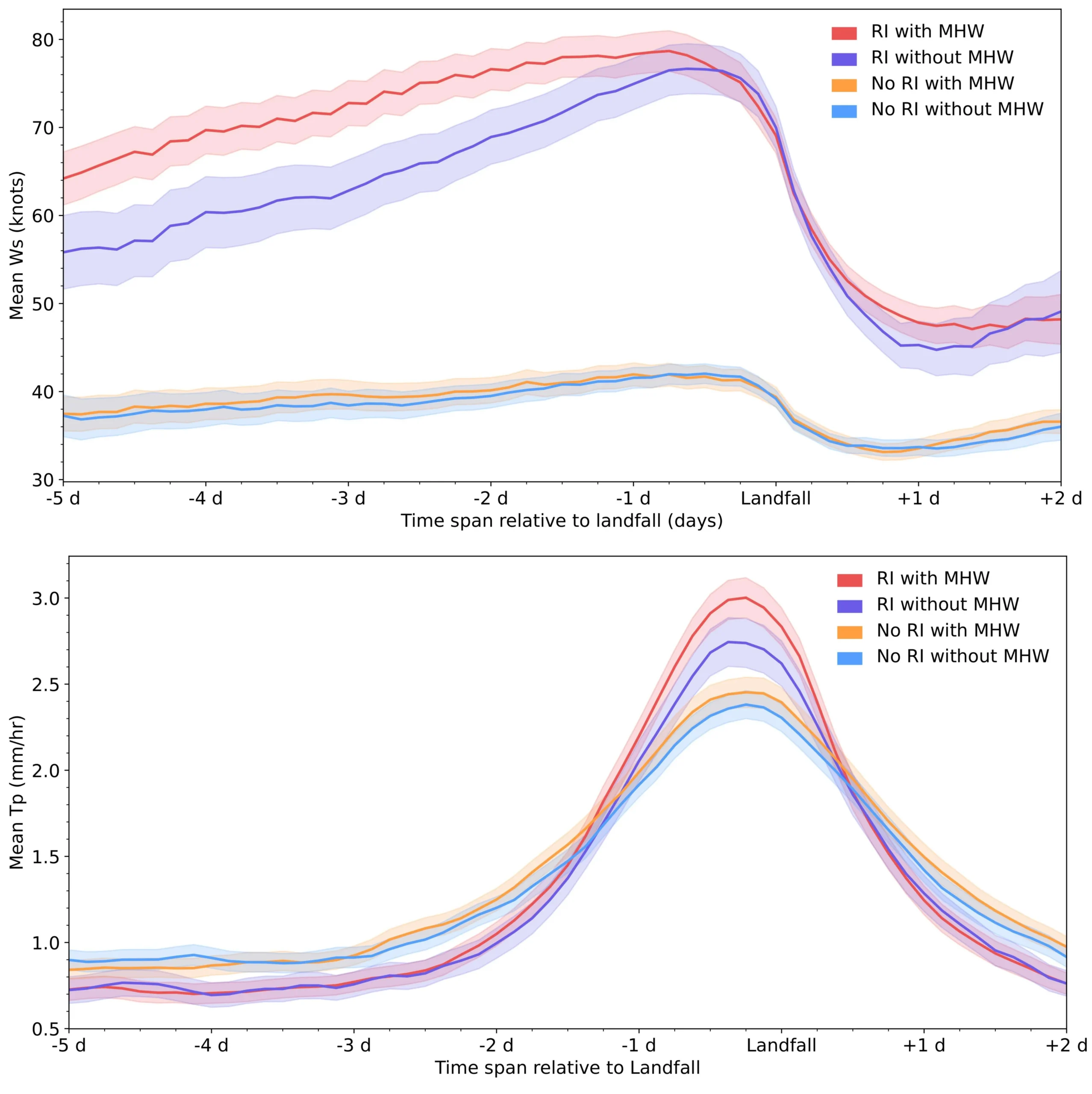
For example, tropical cyclones that do not experience rapid intensification have, on average, maximum wind speeds of around 40 knots (74km/hr), whereas storms that rapidly intensify have an average maximum wind speed of nearly 80 knots (148km/hr).
Of the rapidly intensifying storms, those that are influenced by marine heatwaves maintain higher wind speeds during the days leading up to landfall.
Although the wind speeds are very similar between the two groups once the storms make landfall, the pre-landfall difference still has an impact on a storm’s destructiveness, says Dr Soheil Radfar, a hurricane-hazard modeller at Princeton University. Radfar, who is the lead author of the new study, tells Carbon Brief:
“Hurricane damage starts days before the landfall…Four or five days before a hurricane making landfall, we expect to have high wind speeds and, because of that high wind speed, we expect to have storm surges that impact coastal communities.”
They also find that rapidly intensifying storms have higher peak rainfall than non-rapidly intensifying storms, with marine heatwave-influenced, rapidly intensifying storms exhibiting the highest average rainfall at landfall.
The charts below show the mean sustained wind speed in knots (top) and the mean rainfall in millimetres per hour (bottom) for the tropical cyclones analysed in the study in the five days leading up to and two days following a storm making landfall.
The four lines show storms that: rapidly intensified with the influence of marine heatwaves (red); those that rapidly intensified without marine heatwaves (purple); those that experienced marine heatwaves, but did not rapidly intensify (orange); and those that neither rapidly intensified nor experienced a marine heatwave (blue).
Dr Daneeja Mawren, an ocean and climate consultant at the Mauritius-based Mascarene Environmental Consulting who was not involved in the study, tells Carbon Brief that the new study “helps clarify how marine heatwaves amplify storm characteristics”, such as stronger winds and heavier rainfall. She notes that this “has not been done on a global scale before”.
However, Mawren adds that other factors not considered in the analysis can “make a huge difference” in the rapid intensification of tropical cyclones, including subsurface marine heatwaves and eddies – circular, spinning ocean currents that can trap warm water.
Dr Jonathan Lin, an atmospheric scientist at Cornell University who was also not involved in the study, tells Carbon Brief that, while the intensification found by the study “makes physical sense”, it is inherently limited by the relatively small number of storms that occur. He adds:
“There’s not that many storms, to tease out the physical mechanisms and observational data. So being able to reproduce this kind of work in a physical model would be really important.”
Economic costs
Storm intensity is not the only factor that determines how destructive a given cyclone can be – the economic damages also depend strongly on the population density and the amount of infrastructure development where a storm hits. The study explains:
“A high storm surge in a sparsely populated area may cause less economic damage than a smaller surge in a densely populated, economically important region.”
To account for the differences in development, the researchers use a type of data called “built-up volume”, from the Global Human Settlement Layer. Built-up volume is a quantity derived from satellite data and other high-resolution imagery that combines measurements of building area and average building height in a given area. This can be used as a proxy for the level of development, the authors explain.
By comparing different cyclones that impacted areas with similar built-up volumes, the researchers can analyse how rapid intensification and marine heatwaves contribute to the overall economic damages of a storm.
They find that, even when controlling for levels of coastal development, storms that pass through a marine heatwave during their rapid intensification cause 93% higher economic damages than storms that do not.
They identify 71 marine heatwave-influenced storms that cause more than $1bn (inflation-adjusted across the dataset) in damages, compared to 45 storms that cause those levels of damage without the influence of marine heatwaves.
This quantification of the cyclones’ economic impact is one of the study’s most “important contributions”, says Mawren.
The authors also note that the continued development in coastal regions may increase the likelihood of tropical cyclone damages over time.
Towards forecasting
The study notes that the increased damages caused by marine heatwave-influenced tropical cyclones, along with the projected increases in marine heatwaves, means such storms “should be given greater consideration” in planning for future climate change.
For Radfar and Moftakhari, the new study emphasises the importance of understanding the interactions between extreme events, such as tropical cyclones and marine heatwaves.
Moftakhari notes that extreme events in the future are expected to become both more intense and more complex. This becomes a problem for climate resilience because “we basically design in the future based on what we’ve observed in the past”, he says. This may lead to underestimating potential hazards, he adds.
Mawren agrees, telling Carbon Brief that, in order to “fully capture the intensification potential”, future forecasts and risk assessments must account for marine heatwaves and other ocean phenomena, such as subsurface heat.
Lin adds that the actions needed to reduce storm damages “take on the order of decades to do right”. He tells Carbon Brief:
“All these [planning] decisions have to come by understanding the future uncertainty and so this research is a step forward in understanding how we can better refine our predictions of what might happen in the future.”


The post Marine heatwaves ‘nearly double’ the economic damage caused by tropical cyclones appeared first on Carbon Brief.
Marine heatwaves ‘nearly double’ the economic damage caused by tropical cyclones



-
Climate Change8 months ago
Guest post: Why China is still building new coal – and when it might stop
-
Greenhouse Gases8 months ago
Guest post: Why China is still building new coal – and when it might stop
-

 Greenhouse Gases2 years ago
嘉宾来稿:满足中国增长的用电需求 光伏加储能“比新建煤电更实惠”
-
Climate Change2 years ago
Bill Discounting Climate Change in Florida’s Energy Policy Awaits DeSantis’ Approval
-

 Climate Change2 years ago
嘉宾来稿:满足中国增长的用电需求 光伏加储能“比新建煤电更实惠”
-
Climate Change Videos2 years ago
The toxic gas flares fuelling Nigeria’s climate change – BBC News
-

 Renewable Energy6 months ago
Sending Progressive Philanthropist George Soros to Prison?
-

 Carbon Footprint2 years ago
US SEC’s Climate Disclosure Rules Spur Renewed Interest in Carbon Credits