

The densely forested South American nation of Guyana is fast becoming the world’s newest petro-state, allowing fossil fuel giants like ExxonMobil to hunt for what researchers have referred to as “carbon bombs” on its seabed.
International oil companies, led by US firm ExxonMobil, plan to extract 11 billion barrels of oil from Guyana’s ocean floor and sell it abroad to be burned, thereby worsening global warming. The country pumped its first oil in 2020.
Despite this, late last month Guyanese president Irfaan Ali defended his country’s green credentials in a heated interview with the BBC’s Hardtalk programme, which went viral on social media. “Even with our greatest exploration of the oil and gas resources we have now, we will still be net zero,” he said, referring to the country’s greenhouse gas emissions.
“We have the lowest rate of deforestation in the world… Guyana will still be net zero”
President Irfaan Ali says Guyana won’t take lectures on climate change as it exploits its huge offshore oil and gas reserves
https://t.co/TKxhR6r3ur pic.twitter.com/xIJTgRsfZP
— BBC HARDtalk (@BBCHARDtalk) March 29, 2024
The case of Guyana shows how countries with large forests can use unclear rules on counting national carbon emissions to justify fossil fuel production.
Michael Lazarus, a scientist with the Stockholm Environment Institute (SEI), told Climate Home it is “absurd” to claim that capturing and storing carbon dioxide (CO2) in forests offsets the emissions impact of oil production, as “they have nothing to do with each other than geographic proximity”.
Official United Nations carbon accounting rules, drawn up nearly 20 years ago by the Intergovernmental Panel on Climate Change (IPCC), allow Guyana to claim net-zero status because they do not specify which types of forest governments can take credit for preserving – and also because the emissions from oil are counted in the country where it is used and burned, not where it is produced.
Experts said governments are taking advantage of having barely-touched forests on their land that suck up CO2, and argued that fossil fuel-rich nations like Guyana should bear part of the moral responsibility for the emissions of their polluting products.
“The problem is that within the country, you are allowing the emissions to continue or even to rise, and then you are trying to balance that out internally by saying that we have this forest,” said Souparna Lahiri from the Global Forest Coalition.
Carbon-negative club
Around 93% of Guyana is covered in forest – more than any other nation but its neighbour Suriname. The population numbers just 800,000, mostly clustered on its coastline, and those people on average emit slightly less than the global average per capita.
Although the country’s non-forestry emissions are growing steadily, CO2 absorption by its vast forests more than compensates for that.
In its emissions inventory sent to the United Nations, the government claimed: “Guyana is a net carbon sink, with its lush managed forest cover removing up to ten times more than the emissions produced in the country up to the year 2022”.
Other small, sparsely-populated forest-covered nations like Suriname, Panama and Bhutan assert they are carbon-negative too.
While not claiming the same accolade, leaders of bigger forest nations like Russia and Brazil have also used their forests to defend their climate record.
In 2021, Russian President Vladimir Putin told a US-hosted summit: “Russia makes a gigantic contribution to absorbing global emissions – both ours and from elsewhere – owing to the great absorption capacity of our ecosystems.”
Despite rising Brazilian deforestation under Jair Bolsonaro, the former president told the same summit that the Amazon’s carbon absorption was evidence that “Brazil is at the very forefront of efforts to tackle global warming”.
Managed vs unmanaged
International carbon accounting rules essentially leave it up to governments to decide how much credit they claim for CO2 absorption by national forests, with many opting to count it all.
In 2006, scientists working with the IPCC came up with a distinction between “managed” land – where greenhouse gas emissions and removals should be attributed to humans and nations – and “unmanaged” land where forests are natural and governments should neither be credited nor blamed for emissions levels.
The IPCC defined “managed” land as “land where human interventions and practices have been applied to perform production, ecological or social functions”. Those could include planting a commercial forest, protecting a forest from fire, or designating it for conservation.
In its national emissions inventory report, Guyana does not differentiate between “managed” and “unmanaged land” – and claims credit for CO2 sequestration by all of its forests.
Guyanese forestry expert Michelle Kalamandeen told Climate Home the government is doing well at protecting the rainforest but should not classify it all as managed by the state. Much of it – particularly in the south – is inaccessible, so “they’re just relying on remoteness for protection of it”, she explained.
The Global Forest Coalition’s Lahiri agreed, saying that most of Guyana’s forest seems to be intact old-growth forest “so it is not a plantation or managed forest in that sense”.
A global issue
From this perspective, Guyana is by no means the only country that appears to be over-counting its emission sinks. A 2018 study in the journal Carbon Balance and Management found that over fourth-fifths of the 101 countries analysed counted all their land as managed.
Even those countries that make a distinction often counted all of their forest – but not all their land – as managed. Australia is one example.
Even the rare few that consider some of their forests “unmanaged” have drawn the line in different places.
Russia counts most of its forests as managed with a few exceptions, the US counts everything outside of Alaska (and much inside it) as managed, and Canada counts everything it tries to protect from fires.

The USA’s “managed” land (blue) and “unmanaged” land (grey) (Photos: Carbon Balance and Management)
Brazil stands out as the exception, counting just under half of its huge forests as managed and foregoing a carbon accounting boost from the other half.
Oil emissions
The other carbon accounting orthodoxy Guyana relies on is attributing emissions from burning fossil fuels like oil to the countries where they are burned, not where they are produced.
The vast majority of Guyana’s oil will be exported to regions like Europe and Asia or to neighbouring Brazil, meaning that emissions from its use will be counted there.
This way of measuring emissions prevents them from being double-counted – but it lets extracting nations off the hook for the carbon pollution caused by the fossil fuels they sell abroad.
Kalamandeen said oil-producing countries have some responsibility for the emissions created by the consumption of their fossil fuels, while the home nations of fossil fuel companies should also step up. In Guyana’s case, that would be the US and China, as the oil extraction consortium is made up of ExxonMobil, Hess Corporation and the China National Offshore Oil Corporation.
SEI’s Lazarus described the current system as an “essential accountability framework for governments and civil society” – but agreed that producers should be held morally accountable too.
Without that, he said, “we’d turn a blind eye to… the lock-in effects of long-lived fossil fuel supply investments that impede the global clean energy transition”.
The post Forest carbon accounting allows Guyana to stay net zero while pumping oil appeared first on Climate Home News.
Forest carbon accounting allows Guyana to stay net zero while pumping oil

When the Turkish COP31 presidency presented its priorities to international business leaders for the first time in New York in September, among those invited to give the private sector’s first response was Ali Koç, scion of one of Türkiye’s wealthiest families.
On stage, the vice chair of the board of Koç Holding said the family company, which weeks earlier had been announced as one of the top sponsors for the UN climate summit, can be seen as “quite exemplary” for its climate record.
What Koç did not mention was that the group’s biggest money-making arm – Türkiye’s largest oil refiner Tüpraş – plans to keep running its refineries “at maximum potential”. Nor did he say that, in 2025, both parent company and subsidiary cut their 2030 climate targets to a level they had already nearly achieved, as Climate Home News’ analysis of company records reveals.
The decision to hand Koç Holding a prominent role at COP31 – the company is also the summit’s “Global Business Partner” – has reignited a long-running controversy over the platforming of fossil fuel interests at the annual UN climate conference.
It has also thrown into question how COP sponsors are chosen and screened. The hosting agreement between the Turkish government and the UN climate secretariat (UNFCCC) says that a partner company’s “climate integrity” should be taken into account.
COP31 electrification pledge leaves out clean power commitment
But how that test is applied is unclear and the process for picking sponsors remains largely opaque. The Turkish COP31 presidency has not published its selection criteria, nor the financial terms of any of its partnership agreements, including Koç’s. The UNFCCC declined to clarify how it advises on such deals.
Campaigners have long argued that accepting sponsorship from polluting companies is wrong because it gives them a global stage, visibility and access to policymakers at talks that are meant to move the world away from fossil fuels, and tarnishes the reputation of the COPs.
Koç’s energy division, which is dominated by oil refiner Tüpraş, accounted for three-quarters of the parent firm’s income in the first half of 2026.
“How was Koç Holding ever chosen as a COP31 sponsor? Any corporation that makes most of its money from oil refining should not qualify as sustainable,” said Pascoe Sabido, a campaigner at Corporate Europe Observatory, which exposes company lobbying. “This is hugely embarrassing for the UNFCCC and its climate integrity check, which doesn’t appear to be worth the paper it’s written on.”
Koç Holding “is not just standing still but walking backwards”, he told Climate Home News.
Koç Holding and Tüpraş did not reply to multiple requests for comment. The UNFCCC secretariat and the Turkish COP31 presidency declined to respond to questions from Climate Home News on the sponsorship agreement.
Oil refining windfall
Türkiye’s biggest industrial group, Koç Holding has stakes in several key sectors of the economy, spanning vehicle manufacturing in a joint venture with Ford to electronics, home appliances and banking.
But the conglomerate’s crown jewel is oil refiner Tüpraş, which Koç controls. Last year its four refineries turned crude oil into 26.8 million tonnes of petrol, diesel, jet fuel and other products, enough to fill about 36 Olympic swimming pools every day.
The company plans to raise its production to 29 million tonnes in 2026 – already a bumper year so far with soaring profits, thanks to sky-rocketing refining margins driven by a crunch in global oil processing capacity caused by the Middle East crisis.
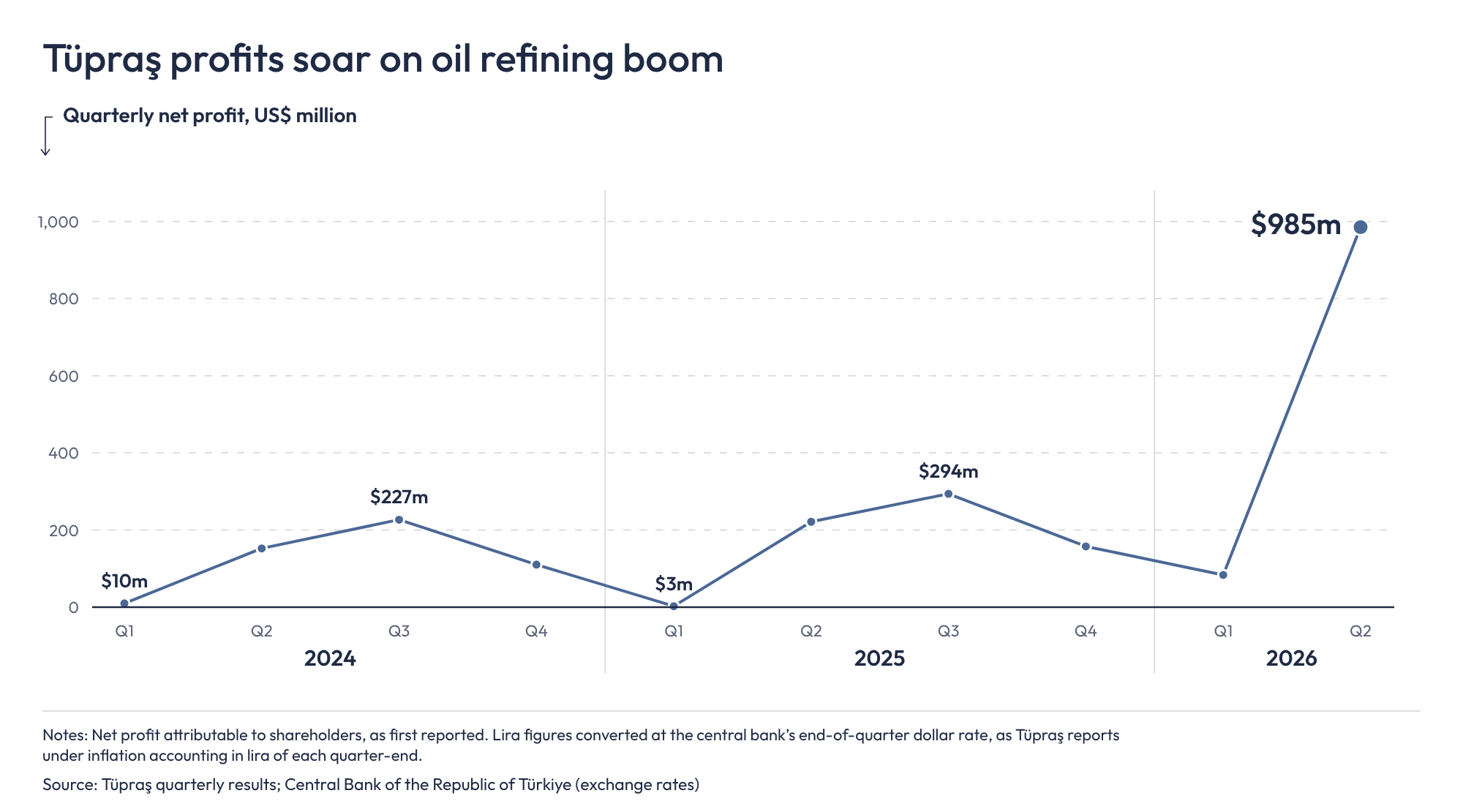
The oil business boom sits awkwardly with the climate and energy transition plans Koç and Tüpraş unveiled in 2021, when both pledged to become carbon neutral by 2050. Then, Tüpraş set out its aim to become “a leading carbon-neutral energy company”.
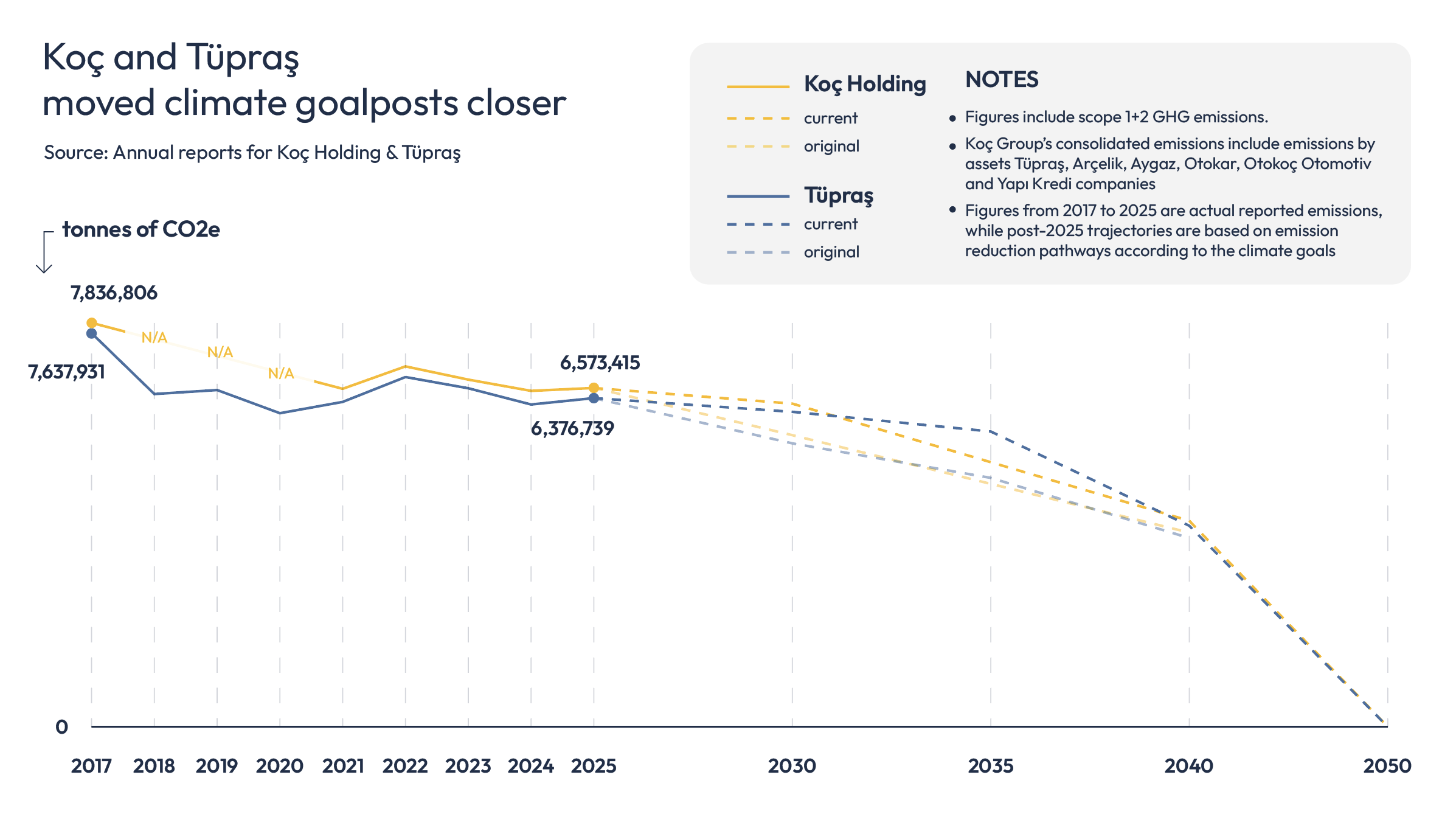
Despite these promises, in 2025, both companies lowered their targets for cutting emissions from their own operations by 2030, from 27% to 20% below 2017 levels. Tüpraş also cut its 2035 goal from 35% to 25%. The company still technically retains its long-term target of carbon neutrality by 2050, but the new plan will require much more drastic cuts after 2035.
Lowering the climate bar
Tüpraş blamed its weakening of climate ambition on “changing market dynamics, economic conditions and technological developments”. In a presentation announcing the revision to investors, the refiner said the energy outlook had changed since 2021.
The reasons it listed included elevated geopolitical tensions, increased investment in oil and gas extraction, which it said showed refined fuels remain vital for energy security – and even the depletion of the carbon budget to keep global warming to 1.5C.
Its parent company Koç pointed the finger at the slow pace of green hydrogen development, which the group said now had a “low feasibility” of transforming the energy sector after it had previously pinned much of its transition plan on the sustainable fuel.
The Turkish company’s new 2030 targets are certainly within reach. Tüpraş had already cut its operational emissions by 17% from 2017 levels by 2025, with nearly all of that progress achieved before the transition plan was unveiled, while Koç had reduced them by 16%.
The softer targets also exclude the bulk of the group’s climate impact. Most of its emissions come not from its own refineries and factories but from the products it sells: petrol, diesel and jet fuel burned in the engines of cars or planes.
These so-called Scope 3 emissions make up about 97% of Koç’s carbon footprint. They rose by around a sixth between 2019 and 2024, and neither Koç nor Tüpraş has set a target to cut them.
Efe Baysal, Türkiye team lead at campaign group 350.org, said there is a “clear contradiction” between talking about climate action while weakening emission targets and seeing emissions from the use of petroleum products keep rising.
“If the company is serious about the transition, it needs a clear plan to wind down fossil fuel operations, rather than relying on efficiency measures and technologies that let business as usual continue,” she told Climate Home News.
‘Sustainable refining’ push
Tüpraş’s updated transition plan rules out expanding its oil refineries, but commits to “maintaining the existing capacity” and running it “at maximum potential”. Oil refining is expected to remain its main source of earnings for years to come. Koç listed “growing oil demand and diesel deficit” in Türkiye as a competitive advantage for its energy business in a pitch to investors last month.
The biggest component of the Tüpraş transition plan is what the company calls “sustainable refining”. It plans to invest $3.9 billion between 2025 and 2035 in programmes to modernise its refineries, improve their energy efficiency and bring down the direct emissions they generate. The company is also shifting some of its production to petrochemicals, which it expects to reduce its Scope 3 emissions.
Australia says COP31 co-presidency will work on a cover decision
Alongside these “sustainable refining” efforts, Tüpraş is also investing in renewable power.
Four years ago, it bought Entek, which produces electricity primarily from six hydropower plants and one gas plant. Since the acquisition, Tüpraş has started building a utility-scale solar farm in Romania and a wind power plant with storage in Türkiye, alongside smaller solar energy installations at some of its refineries. A dozen more renewable energy projects are currently in the pipeline, according to its latest annual report.
In a self-declared bid to become “Türkiye’s leading producer of zero-carbon electricity”, Tüpraş wants to reach installed capacity of 1.6 gigawatts (GW) by 2030 – a target it raised in its updated plan – and 2.5GW by 2035. The Turkish government has committed to rolling out 120GW of wind and solar capacity nationwide by then.
Setback for green fuels
Tüpraş plans to supply most of its low-carbon electricity to run its future production plants for green hydrogen, an alternative fuel that can replace fossil fuels in some heavy industries and long-distance transport.
A few years ago, green hydrogen looked set to become a key pillar of the global energy transition, with companies pitching visionary projects and governments rolling out strategies for the fuel to decarbonise economies. But inflated forecasts, high costs and weak demand have led to a reality check for prospective producers like Tüpraş.
The Turkish refiner significantly scaled back its green hydrogen plans last year. While it originally hoped to start producing the clean fuel in 2025, it now targets a first pilot project by 2030 with commercial large-scale production not expected before 2035. That’s primarily because the cost of electrolysers, the machines that split water into hydrogen and oxygen, has risen fourfold since its original projections, the company said.
Is the world’s big idea for greener air travel a flight of fancy?
Tüpraş’s ambition to become Türkiye’s leading producer of sustainable aviation fuel (SAF) has also seen a partial rethink. The firm originally said it would convert by 2026 a unit in its sprawling oil refinery in the port city of Izmir into a plant that would produce SAF from waste cooking oil into “green” jet fuel.
But it is now planning to build a dedicated plant which is expected to be commissioned towards the end of 2028. That means its SAF output will be added to its existing fossil fuel refining capacity rather than replacing any of it.
Dividends dwarf green spending
Under its updated blueprint, Tüpraş plans to invest $4.35 billion in zero-carbon power, SAF and green hydrogen by 2035. Last year, it spent $137 million on activities that qualify as green under EU rules, leaving much ground to make up in the next 10 years. Most of its green investment in 2025 went on solar and wind farms, and a quarter on a unit making propylene, a refinery by-product used to produce plastic packaging and bottle caps.
Over the same year, it paid out about five times as much – roughly $740 million – to shareholders, under a policy of distributing around 80% of its profits. About half went to Koç Holding, which in turn paid its own shareholders some $460 million. The Koç family and companies it controls hold the majority of the group.
Kelly Trout, research director at energy think-tank Oil Change International, said a company like Koç should not be the face of the COP31 climate summit as it doesn’t pass the test of “climate integrity” the UN requires of a sponsor.
The hosting agreement struck between Türkiye and the UNFCCC says that the government has to consult the secretariat of the UN body to obtain advice on which “entities of concern” it should not conclude sponsorship or partnership agreements with. The document adds that the advice should give appropriate consideration to the partner’s climate integrity, but it does not specify how that should be judged.
‘Climate integrity’ mystery
Climate Home News asked the UNFCCC and the Turkish COP31 presidency if this process was followed for the Koç Holding sponsorship, but had not received a response at the time of publication.
The same provision featured in the host country agreement for COP29 in Azerbaijan, according to a leaked copy published by Human Rights Watch.
COP31 attendees told not to interfere in Türkiye’s “internal affairs”
The clean energy arm of state-owned oil and gas company SOCAR was named “Energy Transition Partner” for that summit, alongside other firms which an investigation from the Organized Crime and Corruption Project (OCCRP) found were owned by the country’s ruling family or people associated with them.
Koç is not the first fossil fuel-linked company to bankroll a UN climate summit. At COP24 in the Polish coal-mining city of Katowice in 2018, sponsors included the state coal power company PGE and the coking coal miner JSW.
‘A real story to tell’
COP sponsors typically get the right to promote themselves inside the conference venue and appear at official events. When it unveiled the agreement, the COP31 presidency called Koç Holding a “vital partner” in its efforts to unite the public and the private sector “to demonstrate Türkiye’s unwavering commitment to global climate action”.
The presidency declined to answer Climate Home News’ questions on how Koç Holding will be involved in the summit.
Koç itself has revealed little about its plans for the Antalya talks. When the deal was announced, the group said it would use the summit to share its experience of turning climate solutions into “concrete business results” and to forge new partnerships.
Speaking at a high-level roundtable on energy at UN headquarters in New York last month, Ali Koç said the industrial group has “a real story to tell”, having undertaken a “comprehensive transformation process in climate matters”.
Campaigners, however, want companies that retain their high-emitting businesses to be excluded from the COP climate summits and have long demanded an “accountability framework” to protect the negotiations from fossil fuel influence.
“If the UNFCCC and its secretariat wants to salvage a bit of credibility, the UNFCCC needs to urgently address conflicts of interest in the UN talks,” said Corporate Europe Observatory’s Sabido.
The post Turkish giant sponsoring COP31 cut climate goals then cashed in on oil boom appeared first on Climate Home News.
Turkish giant sponsoring COP31 cut climate goals then cashed in on oil boom
Three countries have been named by the Paris Agreement’s compliance committee for failing to submit a nationally determined contribution (NDC) and repeatedly snubbing offers of help with their climate plans.
After months of internal debate over whether to identify serial non-responders, the Paris Agreement’s Implementation and Compliance Committee (PAICC) named the three countries which have failed to engage with it over their NDCs on Friday.
It named Democratic Republic of Congo, Senegal and North Korea in a footnote of its annual report, adding that it decided to name them “with a view to facilitating engagement”, adding that representatives of the three nations had been invited to its meeting in early 2027 “with the purpose of identifying any challenges and constraints”.
“The Committee noted the importance of Parties engaging with the Committee in a timely manner, while noting that some delays may be due to the national capabilities and circumstances of the Parties”, the report said.
-
Under US pressure, World Bank says it will back gas “where appropriate”
The US wants the World Bank to expand its gas support while climate campaigners are pushing for it to end – its head spoke this week of limited backing for the fossil fuel
