

The European Union and the UK are not on track to meet their 2030 offshore wind targets.
At the same time, Chinese wind-turbine manufacturers – who account for more than half of global wind-turbine capacity – are looking to grow their footprint in the European market, where their presence is currently tiny.
To some, the solution seems clear: allowing Chinese manufacturers to invest in Europe could boost competition, alleviate supply chain bottlenecks and lower costs – not to mention bring climate targets within reach.
But the possibility of a growing role for Chinese wind-turbine manufacturers in the European market has sparked heated debate among European policymakers and industry participants.
In 2024, three of China’s top wind-turbine companies accounted for less than 1% of Europe’s installed wind capacity.
But their focus is increasingly shifting to the continent, which some are concerned could hollow out the one clean-energy industry in which Europe is still competitive.
Competition between European and Chinese manufacturers would be “unfair”, according to critics, because the discounts Chinese firms are offering seem to be at least in part due to state subsidies.
In a recent report published by the Oxford Institute for Energy Studies, we explore whether Chinese wind turbine companies are competitive in Europe and the real risks and benefits of Chinese participation in European offshore wind markets.
Our findings build on interviews with policymakers and industry experts, who have been granted anonymity to allow for candid discussion.
Cost advantages are less clear-cut than they appear
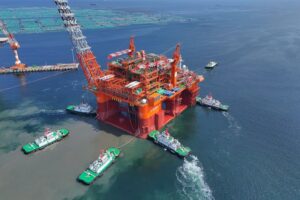
China ranks first for many of the global statistics for offshore wind. It has been by far the largest offshore wind market in the world for several years running.
China had 47 gigawatts (GW) of offshore wind installed, as of September 2025, more than all other countries combined. Furthermore, China also dominates several key fields critical to offshore wind globally, ranging from permanent magnets to offshore installation vessels.
This stands in firm contrast to Europe – where offshore development has experienced several years of slow growth – and the US, which faces an almost complete halt in new development under the Trump administration.
As happened before in solar and batteries, China’s offshore wind industry scale-up has brought about stunning declines in installation costs.
However, this cost advantage is not as straightforward as these headline numbers would suggest. Despite the vast difference in capacity cost, the electricity produced by Chinese offshore wind farms is only 30% cheaper.
A key reason for this is the lower overall capacity factor of China’s offshore wind sector, referring to the actual output of windfarms in China, compared to their maximum possible output. This can be partly explained by lower wind speeds at China’s offshore sites, but could also relate to lower performance of Chinese turbines, as well as power transmission issues.
Lower production costs in China also would not necessarily translate to the European market, as Chinese cost advantages would be partly offset by transport costs, as well as higher insurance and financing premiums.
Greater localisation of turbine production could mitigate against some of these premiums, but would be offset by higher input costs in Europe.
Nonetheless, as more European governments add local content requirements, Chinese manufacturers have announced plans to set up European factories for turbine blades and towers, with core components shipped from China.
These factories could also be costlier to finance than those back home if financing for investments also comes from Europe, further reducing the cost advantage enjoyed by China’s domestic offshore-energy infrastructure.
Issues beyond costs and bottlenecks
European offshore wind development plans have faced a number of hurdles, including rising costs, slow permitting processes, inefficient auction designs, lengthy grid connection times and limited availability of parts, port capacity and installation vessels.
The small number of players in Europe’s offshore wind sector is seen as part of the problem, according to our interviews.
Currently, there are only three major wind turbine manufacturers in the European offshore wind market: Vestas, Siemens Gamesa and GE Vernova.
The latter announced in 2024 that it is downsizing its offshore wind business and has not taken new offshore orders, although it remains active in onshore wind projects. This reduces competition and could hinder efforts to bring down the cost of offshore wind projects.
Bottlenecks, inadequate industry capacity and lack of competition cannot in themselves explain the current European predicament. Developers we interviewed also note that offshore wind auctions with price caps and stringent contractual terms, designed with an expectation of falling costs, have also been part of the problem.
When these auctions have failed – as in the UK in 2023 and Germany in 2025 – this led to capacity contraction, higher costs and industry consolidation, which have only made it more difficult to reach policy targets, according to a report by European offshore wind company Ørsted.
Even with improved European auction design, it may take years for Europe’s offshore wind installation numbers to recover. With or without Chinese participation, it will also take time to build domestic manufacturing bases and installation vessels.
Pathways to Chinese involvement
Meanwhile, Chinese developers benefit from a large and growing domestic market in China. At the same time, however, intense competition on price and quality is spurring them to seek opportunities overseas.
Throughout Europe’s supply chain, Chinese components and services are already helping alleviate shortages and bottlenecks.
Still, our report found there are divergent views on whether a greater Chinese presence in Europe’s wind markets represents a threat or an opportunity – or both.
Policymakers are expected to continue to emphasise concerns about technology dependence and cybersecurity risks, leading to more domestic content requirements and increased scrutiny of Chinese deals.
The case of the 300 megawatt (MW) Luxcara project in Germany highlights the difficulties for Chinese market entry. Chinese manufacturer Mingyang was initially selected by the project owner in 2024, but was later replaced by Siemens-Gamesa, reportedly due to concerns about security and political risks.
The recent announcement of a deal between the UK’s Octopus Energy and Mingyang may illustrate an emerging model. According to Octopus, Mingyang will supply the physical equipment, while Octopus will supply the software and manage the turbines.
Mingyang will still need access to operational data to support ongoing maintenance, but this can be provided periodically by Octopus without compromising security, the energy company told us.
Meanwhile, following policy signals such as the EU’s new pricing mechanism for electric vehicle imports from China, it seems likely that policymakers will continue to encourage Chinese players to establish production bases in Europe and to require technology licensing or technology transfer in exchange for market access. This would amount to applying the Chinese industrial development model in Europe.
This could allow for technological learning in Europe. In China, the largest players have deployed advanced automated manufacturing lines, including robotic blade bonding, modular stator assembly and real-time quality monitoring – although this may have implications for job creation, a stated aim in Europe’s clean-energy policy.
Despite pointing to some advantages, our interviews suggest that Chinese participation in Europe’s offshore wind market is not a panacea.
Its low costs are unlikely to be transferrable to the European context. But greater Chinese participation in auctions and in manufacturing, with local content requirements and other guardrails, could help spur competition in Europe.
At the same time, our report suggests that the focus on China distracts from deeper issues. Without a growing domestic market, it may be difficult for European players to reduce manufacturing costs and upgrade production, with or without Chinese partners.
Ultimately, industry participants tell us that the greatest determinant of success in Europe’s offshore wind market will be consistent policy support, rather than a decision to allow – or to block – Chinese participation.


The post Experts: Will Chinese wind power help or hinder Europe’s climate goals? appeared first on Carbon Brief.
Experts: Will Chinese wind power help or hinder Europe’s climate goals?

LIVE VIDEO WILL BE BROADCAST HERE ON APRIL 9
After a strong push at COP30 to deliver a process for a global transition away from fossil fuels, the First Conference on Transitioning Away from Fossil Fuels, in Santa Marta, Colombia, is set to be a key boost of momentum for renewed talks on phasing out coal, oil and gas.
At this online webinar hosted by Climate Home News in partnership with the Fossil Fuel Treaty Initiative, government representatives and civil society observers will discuss how the landmark conference co-hosted by Colombia and the Netherlands can deliver on the momentum away from fossil fuels, especially at a time of global instability.
Speakers:
- Minister Irene Vélez Torres, Minister of Environment and Sustainable Development, Colombia
- Hon. Dr Maina Vakafua Talia, Minister of Home Affairs, Climate Change and Environment, Tuvalu
- Cedric Dzelu, Technical Director of the Office of the Minister for Climate Change and Sustainability, Ghana
- Tzeporah Berman, Chair and Founder of the Fossil Fuel Treaty Initiative
Want to join more of our events? Register here for free!
The post <mark style="background-color:rgba(0, 0, 0, 0)" class="has-inline-color has-vivid-red-color">LIVE on April 9</mark> | Santa Marta: fossil fuel transition in an unstable world appeared first on Climate Home News.
LIVE on April 9 | Santa Marta: fossil fuel transition in an unstable world
High costs, crowding and less-than-ideal land conditions make geothermal installations in downstate New York difficult—but not impossible.
The Rev. Kurt Gerhard stood near the lectern in Christ Church Bronxville. Beneath him, a network of pipes stretched into a nearby parking lot, where boreholes have been drilled hundreds of feet into the ground.
A Church’s Geothermal Experiment Could Pave the Way for Projects Across New York
Dr Laura-Jane Nolan is a carbon consultant and operations director at BOM Systems.
War leaves destruction in its wake – cities levelled, economies disrupted, lives lost. But another cost rarely enters the conversation: carbon emissions.
As the conflict in the Middle East grinds on, the world’s attention remains fixed on geopolitics and the loss of life and infrastructure. Yet the climate impact of modern warfare is largely invisible in both reporting and policy.
Using UK government greenhouse gas accounting frameworks and publicly available expenditure data, it is possible to estimate the emissions generated and the far larger footprint likely to follow during reconstruction.
Iran war could boost fossil fuel phase-out push, says Colombian minister
According to researchers at Queen Mary University of London, in just the first 14 days, US-Israeli war with Iran generated more than 5 million tonnes of carbon dioxide equivalent (CO₂e). While this represents only part of the total, it provides a rare, quantified entry point into the scale of the environmental damage caused so far.
Let’s be clear, direct measurement is not simple. Military fuel use, logistics and procurement data are rarely disclosed in detail. Researchers therefore rely on spend-based estimates, that is, the amount of CO2 equivalent per pound or dollar spent.
Post-conflict reconstruction
According to Reuters, the United States alone spent at least $11.3 billion (around £8.5 billion) in the first six days of the conflict. Using a conservative estimate of around 0.4 kg CO₂e per pound spent, the first six days of documented operations correspond to roughly 3.4 million tonnes of CO₂e.
After another week of conflict, the conservative estimate of over 5 million tonnes of CO₂e is not a small amount of greenhouse gases. It is roughly equivalent to 1.1 million cars driven for a year – all the cars in a large European city. It is also comparable to a million transatlantic flights.
If this seems shocking, these estimates likely underplay the situation. We haven’t considered the rebuilding of the destroyed buildings and infrastructure yet. Evidence from past conflicts shows that emissions from rebuilding, through cement, steel, asphalt and heavy machinery, can exceed those generated during active combat.
UK government data indicates that every £1 billion spent on construction generates approximately 250,000 to 350,000 tonnes of CO₂e, before accounting for debris clearance and supply-chain disruption.
In policy terms, this should prompt critical questions about how reconstruction should be financed and delivered, as investing in the green economy for new infrastructure will positively shape long-term emissions trajectories. Rebuilding antiquated infrastructure will be good money thrown after bad.
Gap in climate policy governance
Despite this, the climate cost of war remains largely absent from international frameworks. A loophole in the Kyoto Protocol even allowed countries to exclude military emissions from their national reporting. While the Paris Agreement removed Kyoto’s limited, sector-specific reporting rules and its focus on only developed countries – which had enabled greenhouse gases from overseas military activity to be kept out of the equation – military emissions are still inconsistently reported and rarely disaggregated.
This creates a gap in climate governance at precisely the historical moment when the climate system is shifting from predictable, linear change to a regime in which self-reinforcing, potentially irreversible changes will likely occur.
-
Nigerians bet on solar as global oil shock hits wallets and power supplies
Fed up with an increase in outages and surging fuel prices, a growing number of homes and businesses are ditching their backup generators for solar systems -
Nepal’s EV revolution pays off as oil crisis causes pain at the pumps
Import subsidies, abundant hydropower and charging investments have spurred EV adoption, with electric vehicles now making up about three-quarters of new car sales


Systematic carbon accounting for conflict and reconstruction using internationally agreed-upon frameworks such as ISO 14064-1 could set a new precedent for environmental accountability. Following Iraq’s invasion of Kuwait, the United Nations Compensation Commission awarded billions of dollars for environmental damage, including oil fires and ecosystem loss. Carbon accounting could support post-conflict environmental assessments and contribute to just liability frameworks and reparations.
Assessing infrastructure finance
International institutions are already moving in this direction. Multilateral development banks increasingly apply climate conditions to infrastructure finance, and post-conflict reconstruction funding could follow similar principles. Embedding emissions accounting into these processes would align recovery efforts with existing climate commitments.
The economic case is also completely clear for most people. The £8.5 billion spent in the first six days of the Iran conflict could have financed large-scale clean energy deployment, solar, wind, electrified heating and transport, delivering long-term returns, reducing fossil fuel dependence and strengthening energy security.
Major oil producers among 46 nations joining fossil fuel phase-out summit
Unlike military expenditure, these investments generate ongoing economic value. Yet the absence of systematic accounting for all aspects of war means these trade-offs remain largely invisible to policymakers, markets and the public.
As debates grow around recognising ecocide as a crime under international law, the legal and institutional frameworks for addressing environmental harm are evolving. Integrating carbon accounting into conflict and reconstruction processes would be a pragmatic next step, reflecting both climate realities and existing policy trends.
The climate cost of war is not hypothetical. It is measurable, material and increasingly unavoidable. The question is whether it will continue to be ignored.
The post Carbon accounting can help tackle the hidden emissions of war appeared first on Climate Home News.
Carbon accounting can help tackle the hidden emissions of war

LIVE on April 9 | Santa Marta: fossil fuel transition in an unstable world
A Church’s Geothermal Experiment Could Pave the Way for Projects Across New York

Sustainability In Your Ear: Don Carli On Tuning What We See Online To Reduce eCommerce Returns
-
Greenhouse Gases8 months ago
Guest post: Why China is still building new coal – and when it might stop
-
Climate Change8 months ago
Guest post: Why China is still building new coal – and when it might stop
-

 Greenhouse Gases2 years ago
嘉宾来稿:满足中国增长的用电需求 光伏加储能“比新建煤电更实惠”
-
Climate Change2 years ago
Bill Discounting Climate Change in Florida’s Energy Policy Awaits DeSantis’ Approval
-

 Climate Change2 years ago
嘉宾来稿:满足中国增长的用电需求 光伏加储能“比新建煤电更实惠”
-
Climate Change Videos2 years ago
The toxic gas flares fuelling Nigeria’s climate change – BBC News
-

 Renewable Energy5 months ago
Sending Progressive Philanthropist George Soros to Prison?
-

 Carbon Footprint2 years ago
US SEC’s Climate Disclosure Rules Spur Renewed Interest in Carbon Credits