

The EU could be investing tens of billions of euros each year into activities that damage biodiversity, according to a new report from WWF.
With biodiversity declining at an unprecedented rate around the world, the EU intends to put nature on a “path to recovery” by 2030, in line with global goals.
Finance is a key part of this and the bloc has pledged to raise at least €20bn in nature funding each year by the end of the decade.
However, a new report estimates that EU countries could be spending between €34-48bn each year on projects that can end up damaging biodiversity in sectors such as agriculture, forestry and fisheries.
It is “pretty shocking” to see the potential scale of funding that EU countries are “pouring into harmful practices”, the lead author of the report tells Carbon Brief.
A policy expert, who was not involved in the report, says the findings may increase pressure on the EU to track its harmful subsidies, but criticised some of what the report counted as ‘“harmful”.
Tackling harmful subsidies
There is no standard definition for “biodiversity-harmful subsidies”, but, essentially, they are government incentives that supplement income or lower costs for certain activities that end up damaging biodiversity.
Agriculture, fishery and energy subsidies are most commonly termed “harmful”, but damage can also be caused by subsidies for other sectors, including forestry, infrastructure, transport, construction and water.
Subsidies that harm nature and the environment cost the world around $1.8tn each year, according to a 2022 report from two coalition industry groups – equivalent to the entire GDP of Canada.
There are a number of global goals in place to reduce these harmful subsidies.
The Kunming-Montreal Global Biodiversity Framework, the global deal for nature signed at the UN COP15 biodiversity summit in 2022, includes a target to cut biodiversity-harming incentives, including subsidies, by at least $500bn per year by 2030. The target also aims to identify such incentives by 2025, although the EU has so far not done so.
The new analysis finds that the EU is allocating between €34-48bn every year to subsidise activities that harm biodiversity. The table below shows the upper and lower estimates for each sector examined.
| Sector | Lower estimate of biodiversity harmful subsidies (€) | Upper estimate of biodiversity harmful subsidies (€) |
|---|---|---|
| Agriculture and forestry | 31.35bn | 32.57bn |
| Fisheries | 60m | 140m |
| Transport infrastructure | 1.69bn | 14.07bn |
| Water | 1.33bn | 2.09bn |
| Total | 34.43bn | 48.87bn |
This largest proportion of funding comes from the Common Agricultural Policy (CAP), the EU’s farming-subsidy programme, which accounts for almost one-third of the bloc’s total budget. (See “agricultural impact” below.)
The subsidies include funds that support “unsustainable” farming, land-use changes, river fragmentation and deforestation, according to the report. It adds that these activities can have knock-on effects on biodiversity, including habitat loss, ecosystem degradation and species extinction.
Prof Alan Matthews, a European agricultural policy expert at Trinity College Dublin, says the findings start a “good debate” about measuring these subsidies. He tells Carbon Brief:
“I see the report as contributing to the pressure on the EU…to actually come up with its own identification of what the subsidies are, so that they can begin then in the next few years to actually reduce them.”
Direct links
The study, conducted by the Netherlands-based economics consultancy Trinomics for WWF, looks at the biodiversity-harming elements of the EU’s long-term budget, the 2021-27 Multiannual Financial Framework.
It focuses on direct financing for the agricultural, forestry, fishery, transport and water sectors that may be damaging to biodiversity. This financing includes grants, loans and direct payments.
It does not look at indirect subsidies, such as tax breaks, or infrastructure investments that disproportionately benefit certain industries, such as tax reductions on fertilisers.
Tycho Vandermaesen, the policy and strategy director at WWF EU and lead author of the report, says there is an overlap between subsidies that damage biodiversity and those that exacerbate climate change, such as fossil fuel subsidies. But the climate impacts were not examined in the report. He says:
“We have taken a very conscious choice here to only look at biodiversity-harmful subsidies because this is one of the most under-highlighted environmentally harmful subsidies – in contrast to climate or fossil-fuel subsidies, which have by now been well researched.”
Matthews notes that the overall findings of the report are in line with previous research, but he criticises some parts of the methodology, such as including a very wide range of direct payments for farmers, as potentially harmful.
In response, Vandermaesen says the assumption on the harmful nature of direct payments for farmers is based on findings in existing studies.
On Monday, the EU Council approved a targeted review of the CAP to assess, among other things, plans to give farmers “greater flexibility” to comply with environmental terms for their direct payments.
The report is clear that there are uncertainties and a lack of up-to-date information on EU spending in some sectors. It says the findings are estimates and that more comprehensive analysis would be required to fully measure these subsidies.
Agricultural impact
Agriculture and forestry receive the most funding for biodiversity-damaging activities out of any sector examined in the report, as shown in the chart below.

The report notes that several EU funds “allocate money in a way that encourages large-scale unsustainable farming or forestry practices”.
These include direct farmer payments based on farm size, which can incentivise boosting industrial livestock numbers and expanding conventional crop production – “both of which harm the environment”, according to the report.
It estimates that around 60% of CAP funding – meaning more than €30bn each year – can be considered harmful to biodiversity.
The current CAP plan, which took effect in 2023 and will remain until 2027, included more environmental measures than previous iterations of the policy. But critics told Carbon Brief in 2021 that the plan was riddled with “loopholes” and unlikely to bring significant change to the sector.
Agriculture accounts for more than 10% of the EU’s greenhouse gas emissions. Globally, the sector is also a key driver of forest loss, causing 80% of deforestation as forest lands are cleared to make space for livestock, palm oil and soya beans.
Looking at other sectors, the report outlines that 5-12% of the European Maritime, Fisheries and Aquaculture Fund – a fishery funding programme – is put towards biodiversity-harmful subsidies.
This is up to 2.5 times higher than the money from this fund aiming to protect and restore biodiversity, the report says.
The report says it is “challenging” to accurately estimate the impact that building transport infrastructure can have on biodiversity, noting that it can fragment habitats and ecosystems. It estimates that the EU spends anywhere between €1.7bn and €14bn each year on roads, railways and other transport infrastructure that could be harmful to biodiversity.
Funds used for certain water infrastructure, such as flood control dams, could also harm biodiversity, the research notes.
Making changes
The report contains a number of recommendations to put an end to these subsidies, including implementing a legally binding framework to phase out biodiversity-harmful subsidies on both EU and national levels. It adds:
“Inclusiveness and social awareness need to be included in the phase-out of biodiversity-harmful subsidies to avoid regions or industries being left behind or struggling with the transition.”
Vandermaesen says that consulting with the impacted sectors and giving a clear pathway to diverting these subsidies is a “really important” step. He adds:
“We do not want to see a situation where, from one day to the next, these subsidies are basically stopped without the involvement of these communities.”
The report recommends diverting the funding instead for public investments to protect and restore ecosystems and to put in place “ambitious” national biodiversity plans ahead of the COP16 biodiversity summit, which is scheduled to be hosted by Colombia later this year.

WWF recently asked European political parties whether they would commit to redirecting fossil fuel and other environmentally harmful subsidies towards the “green transition”. All parties that responded expressed a readiness to redirect these subsidies, but the NGO says that “only a few have committed to enshrining this redirection into law”.
The subsidies report includes a number of case studies of nature-harming subsidies across Europe.
A forest recovery plan in France, financed partly by the EU, has had “adverse effects” on forests, the report outlines. Almost nine out of 10 projects financed by the plan in 2021 and 2022 involved clearcutting of trees, which can weaken ecosystems.
The report details another example in Bulgaria, where farmers were permitted to let animals graze in areas of the country’s national parks to help preserve open areas.
This led to “vegetation being trampled, water being polluted and wildlife being disturbed”, the report says. To mitigate these effects, park administrations requested €760,000 from the country’s EU-funded environment programme.
These examples “illustrate how complex it can be actually on the ground to deliver these positive results”, Matthews says, adding:
“In quite a number of the case studies, actually the subsidies were intended to be positive for biodiversity. But it seems that the way they were implemented…They had these sort of perverse outcomes.”


The post EU spending up to €48bn on nature-harming activities each year, report says appeared first on Carbon Brief.
EU spending up to €48bn on nature-harming activities each year, report says

After witnessing and hearing stories of Pacific islands’ vulnerability to climate change, senior climate officials have promised to strengthen efforts to limit global warming to 1.5C, despite an expected overshoot, and to help the region adapt to rising seas and other impacts.
More than 30 world leaders, ministers, climate negotiators and international development bankers travelled to the sinking atoll nation of Tuvalu on Tuesday before attending the pre-COP31 talks in Fiji, where schoolchildren told them about the effects warming-driven droughts, heatwaves and storms are having on their education.
Australia and the Pacific nations hoped to use the pre-COP to reinforce the urgency of tackling climate change to the officials from around 50 countries who travelled to the region. Fiji’s climate minister, Lynda Tabuya, told a closing press conference on Thursday they had wanted to “bring decision-makers to the climate frontlines”.
Many of those decision-makers said they had been moved by what they had seen and heard this week, and their speeches emphasised the importance of limiting global warming to 1.5C above pre-industrial levels, a key goal of the 2015 Paris climate agreement.
-
Pacific leaders rail at climate finance failures after pre-COP trip to Tuvalu
Island nations seek invest in their own Pacific Resilience Facility, as they struggle with the red-tape of international climate funds -
New Zealand accused of breaching EU trade deal over climate rollbacks
The EU’s climate trade rules face their first major test after a green group alleged New Zealand violated binding environmental provisions under its trade deal with the bloc

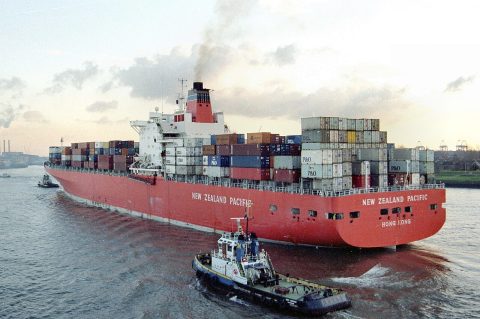
In September, a UN report acknowledged that the 1.5C threshold will be breached but said temperatures could still be brought back down to that level by the end of the century with stepped-up climate action.
A month ago, Türkiye‘s COP31 President Murat Kurum told a press conference in the northern Turkish city of Trabzon that limiting global warming to 1.5C “does not really look possible”, adding that “around 1.5C, that will be a success”.
But after seeing the “anxiety” of children and mothers in Tuvalu caused by rising sea levels, Kurum told reporters in Fiji that 1.5C is a “matter of survival – the survival of cultures, history, memories, your homeland, your homes – it’s that important.”
“The 1.5C target is in jeopardy and we do not have a single minute, a single day to lose,” he added through an interpreter.
Jacobo Ocharan, head of political strategies at Climate Action Network International, warned that “words of concern will not protect anyone”. “The Pacific has shown the world what is at stake. Now governments must show they are ready to act,” he said. “[COP31 in] Antalya must deliver decisions that change people’s lives for the better.”
$1.5 billion for 1.5C
In Fiji, Kurum echoed the call of Australia and Pacific nations for contributions to the fledgling Pacific Resilience Facility (PRF), which aims to use the returns on its investments to fund community climate adaptation projects like water storage, building sea walls and protecting homes from storms. “$1.5 billion for 1.5 degrees will save the Pacific,” he said. “It’s that easy. Life will continue in Tuvalu. Children will be smiling again.”
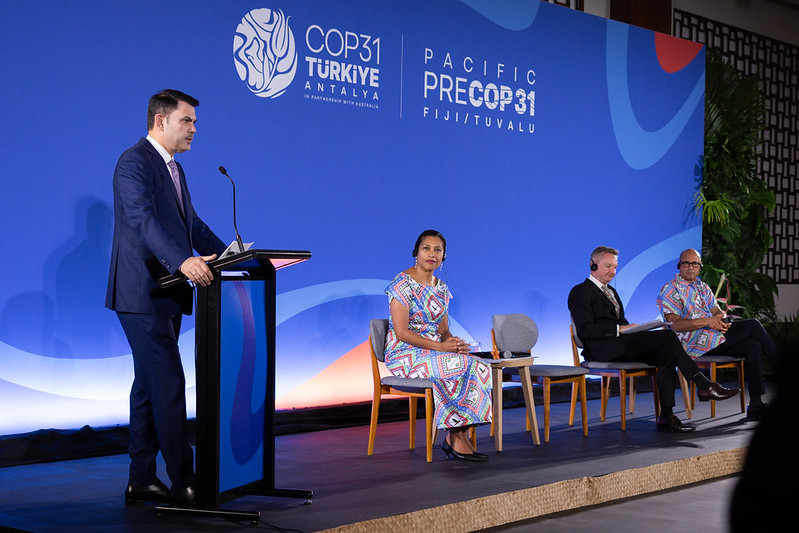
Sitting next to him, Fiji’s Tabuya said she was “encouraged” by his words. “$1.5 billion for 1.5. We will hold COP 31 to that,” she said. The PRF has been promised just under $200 million so far – including about $15 million pledged by European and Pacific governments at pre-COP – and is aiming for $500 million by COP31. It has a longer-term target of mobilising $1.5 billion in capital.
After Pacific leaders on Tuesday aired a litany of concerns about the barriers to accessing the global climate finance system, Kurum joined in at Thursday’s press conference. “Justice in climate finance is essential,” he said. “Resources must reach those in need in a timely and accessible manner, not through a lot of red-tape, and we cannot accept that the same countries should always bear the burden.”
Plan for easier access to climate finance
Australian climate and energy minister Chris Bowen, who is COP31’s president of negotiations, also lamented that “the countries that need the finance the most get it the least”. He said he would ask governments and multilateral development banks to support an access to finance plan for small island states and the world’s poorest nations, launched by Australia on Thursday.
The plan says that while there has been progress in making it easier and quicker to obtain international climate funding, “multiple persistent challenges have continued to limit access to climate finance for developing countries”.
It adds that the amounts available are insufficient to meet climate goals and stresses the need for “grant-based and highly concessional financing”, especially for adaptation and responding to loss and damage. The plan proposes an annual high-level forum on climate finance access to track implementation.
The pre-COP summit closed with an emotional plea from Fiji’s host minister Tabuya. Fighting back tears before finally succumbing, she asked delegates to “carry something of the Pacific with you”.
“Remember the people you met, the stories you heard and why we gathered. This pre-COP draws to a close tonight. Our responsibility does not,” she said to applause.
The post Pre-COP draws attention to Pacific’s climate plight and 1.5C goal appeared first on Climate Home News.
Pre-COP draws attention to Pacific’s climate plight and 1.5C goal
Climate Change
Australia’s climate credibility tested at Pacific Pre-COP talks, as High Court fossil fuel ruling puts government on notice
NADI, FIJI Thursday 8 October 2026 — As the Pacific Pre-COP talks wrap up and Australia prepares to take the reins of COP31 Negotiations in Türkiye next month, Greenpeace Australia Pacific says the government is on notice over fossil fuel expansion and exports, and must accelerate action to align with a 1.5°C pathway.
Following yesterday’s landmark High Court ruling that the climate impacts of coal and gas exports must be considered by New South Wales planning authorities, Greenpeace Australia Pacific is calling on the Albanese government to find the “courage, leadership and grit” to chart a new course away from fossil fuels.
High res images and video from yesterday’s ‘Keep 1.5C Alive’ flotilla in Nadi can be found here
Speaking from Nadi, Shiva Gounden, Head of Pacific at Greenpeace Australia Pacific, said:
“The outcomes of this week’s talks are a drop in the ocean given the scale of need, and urgency of the crisis our communities are facing. It is like taking a glass of water to a burning house if we do not urgently act to address the root cause of the existential threat facing Tuvalu, Fiji and all Pacific countries: fossil fuel expansion.
“The Electrification Pledge must end fossil fuel dependence, not be an end in itself — its ultimate success depends on ensuring electricity comes from renewable sources that displace fossil fuels and align with a 1.5°C pathway. It must be underpinned by justice and backed by finance flowing from polluters to communities.
“Limiting global warming to 1.5°C is a non-negotiable survival line for humanity and Australia must act. The landmark climate advisory ruling from the ICJ is clear — 1.5°C is the moral, the scientific and the legal limit. Continuing down the fossil fuel path, and failing to align efforts with limiting warming to 1.5°C, is a breach of our international legal obligations, and risks making Australia liable for future reparations from climate-vulnerable nations.”
Also in Nadi, Dr Simon Bradshaw, COP31 Lead and climate expert at Greenpeace Australia Pacific, said: “The Pacific was never going to be a mere backdrop for Australia in its role as incoming chair of the COP31 climate talks, but where its credibility and commitment to climate leadership would be tested.
“Here we see communities fighting for their survival and doing everything possible to hold the line on returning warming to 1.5°C. When governments profess to take their concerns seriously, only to then throw more fuel on the fire, the pain and sadness is visceral.
“This week the High Court of Australia recognised what the Federal Government refuses to — that Australia is responsible for the climate damage of our fossil fuel exports and if governments don’t act, the courts will intervene. The message is simple: this is not someone else’s problem, it is ours.
“We must now follow other countries in developing a national roadmap away from fossil fuels that ensures a managed wind-down of fossil fuel production, including exports, in line with our legal obligation to help return warming to 1.5°C.”
ENDS
Media contact: Kate O’Callaghan in Nadi on +61 406 231 892 (Whatsapp/Signal)
A Dutch NGO has filed the first climate complaint under the European Union’s trade rules, arguing that New Zealand violated the environmental provisions of its free trade agreement with the bloc by weakening its climate regulations.
The case will test whether binding climate provisions in the EU’s free trade deals can be enforced to hold governments accountable to their climate obligations, experts told Climate Home News.
The EU-New Zealand free trade agreement, which came into force in 2024, was the first in the world to include legally-binding climate provisions and possible sanctions for violating them, as the EU seeks to use its trade partnerships to advance greater environmental protection.
Under the deal, both parties committed not to weaken their environmental law to promote trade or investment and to “refrain from any action or omission that materially defeats the object and purpose of the Paris Agreement”.
