

The European Commission has rejected requests by green groups to review the status of 16 controversial projects it has designated as “strategic” to shore up the bloc’s supply of critical minerals needed for the energy transition, despite environmental concerns.
Campaigners accused the European Union’s executive arm of being more interested in labelling projects as “strategic” to accelerate their development than ensuring they meet its environmental standards.
Legal experts told Climate Home News that despite the EU’s rhetoric on developing sustainable mining standards, it will be very difficult for local communities and NGOs to use the judicial system to enforce compliance with environmental safeguards.
Earlier this year, the European Commission labelled 47 mineral extraction, processing and recycling projects within EU member states as “strategic“, granting them preferential treatment for gaining permits and easier access to EU funding.
-
Europe’s lithium rush leaves mineral-rich communities in the dark
Local residents are seeking more information and want stronger guarantees that mining won’t harm the nature on which their incomes depend -
South Africa’s platinum mine dumps get a second look as clean energy lifts demand
Mining firms say extracting minerals from tailings is a sustainable way to boost global supplies, but local communities want to see benefits this time around -
COP30 draft text includes energy transition minerals in UN climate first
A draft negotiating text on defining principles for a just transition to clean energy systems recognises the social and environmental risks associated with mining critical minerals


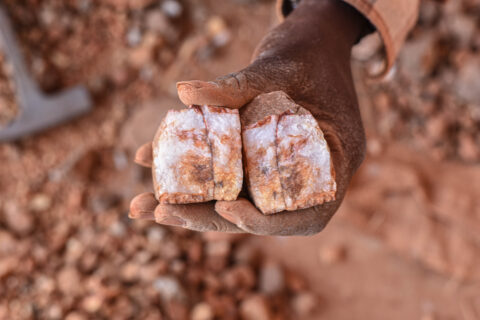
Spanning from the north of Sweden to Portugal and southern Spain, these projects are due to help the EU reach targets for sourcing more of the minerals it needs for clean energy and digital technologies within its own borders in an environmentally friendly way, while reducing its dependence on imports from China.
However, NGOs and local communities have accused the European Commission of a lack of transparency and of failing to engage civil society over the selection of these projects, most of which are in the early stages of development and are yet to obtain the necessary permits or conduct detailed environmental impact assessments.
Civil society groups challenged the decision to include around a third of projects on the strategic list, arguing that the commission had not properly assessed their sustainability. They also cited risks of social and environmental harm and human rights violations.
EU: Environmental compliance lies with member states
In total, 11 requests for review covering 16 of the projects planned within the EU were filed under the Aarhus Regulation, which gives NGOs the right to ask the European Commission to review administrative decisions if they are considered to violate the bloc’s environmental law.
In a single response shared with green groups this week, and seen by Climate Home News, the commission found that the requests to review the projects’ status were “unfounded”.
“A thorough assessment confirmed that all points raised by the NGOs had already been properly addressed during the selection process. All the projects concerned therefore retain their status as strategic projects,” a European Commission spokesperson told Climate Home News. They did not respond to detailed questions about their assessment.
Under the EU’s Critical Raw Materials Act, which was adopted last year, the commission can designate mineral projects as strategic if they meet a shortlist of criteria, including that the project “would be implemented sustainably” and monitor, prevent and minimise environmental and adverse social impacts.
The strategic status can be revoked if projects no longer meet the criteria.
However, the commission said it was not its job to carry out a full and detailed assessment of whether the projects fully comply with EU environmental laws, adding that it is only required to make an “overall assessment”.
Rather, it argued, member states have the responsibility to ensure the projects fully comply with EU environmental standards including impacts on biodiversity and ground water as well as waste management.
The commission also refused to examine the social impacts of the projects on community livelihoods, health and human rights – which could arise from environmental degradation – arguing that this was outside the scope of the review mechanism under the Aarhus Regulation.
Campaigners have strongly criticised the response.
“Cosmetic”sustainability criteria
Ilze Tralmaka, a lawyer at Client Earth, told Climate Home News the commission’s decision showed that the designation of mineral projects as “strategic” doesn’t make them safe or sustainable, despite creating a legal presumption that they serve the public interest and protect public health and safety.
“While on paper, there is mention of sustainability, in practice, it’s almost cosmetic,” she said. “It seems the environmental standards are just briefly looked at and that the policy of declaring these projects as strategic is more important than real engagement with the sustainability criteria.”
Client Earth argues that while securing supplies of minerals for the energy transition is a legitimate goal, the status of strategic project is being “misused” to fast-track questionable mining projects.
Tralmaka said the European Commission should engage where there are “unanswered questions, or if there is credible information about these projects being potentially unsafe”.
Client Earth was part of a group of NGOs that challenged the decision to designate the Barroso lithium project in Portugal as a strategic project.

“Textbook example of how not to do a green transition”
London-listed Savannah Resources is planning to dig four open pit mines in the northern Barroso region to extract lithium from Europe’s largest known deposit. The company says it will extract enough lithium every year to produce around half a million batteries for electric vehicles.
However, local groups have staunchly opposed the mining project, citing concerns over waste management and water use as well as the impact of the mine on traditional agriculture in the area.
Earlier this year, a UN committee found that Portugal had failed to respect citizens’ rights to information and public participation in the case of the Barroso project. Portuguese authorities denied the breach.
Efforts to green lithium extraction face scrutiny over water use
The commission said it was satisfied with the project’s overall sustainability credentials and that campaign groups should take a case to their national court if they are concerned about the legality of any project.
“This decision shows that the EU is willing to trade rural lives and irreplaceable landscapes for a political headline,” said Nik Völker of MiningWatch Portugal. “The truth is, the Mina do Barroso mine offers minimal benefits and enormous risks: a textbook example of how not to do a green transition.”
Savannah Resources did not respond to a request for comment.
“Murky” standards make legal challenge hard
Simon Simanovski, a business and human rights attorney with German law firm Günther Rechtsanwälte, has advised dozens of communities affected by projects designated as “strategic” under the EU’s Critical Raw Materials Act over the past year.
For him, the commission’s response creates a disconnect between its role as a decision-making body and the responsibility for enforcing the bloc’s environmental laws, by pushing it to member states. That, he said, creates “murky standards”.
This, he added, will make it “really difficult” to challenge inadequate environmental safeguards through the courts. “It means that there is no effective judicial protection… and that the projects will happen,” he told Climate Home News.
However, Simanovski still expects some campaign groups to try filing a case before the general court of the European Court of Justice to challenge the European Commission’s response and ask it to review its assessment of the projects.
Simanovski represents communities in Serbia that are also challenging the “strategic” designation of the Jadar lithium mine – one of an additional 13 “strategic projects” located outside EU countries – which has seen massive local opposition.
The commission is expected to respond to requests to review those external strategic projects in January.
The post EU refuses to review “strategic” mineral projects for energy transition appeared first on Climate Home News.
EU refuses to review “strategic” mineral projects for energy transition

Go behind the scenes with senior editor Corey Mitchell and reporter Bob Berwyn as they discuss critical measures of the planet’s health.
“Earth is being pushed beyond its limits while every key climate indicator is flashing red,” warned U.N. Secretary-General António Guterres after the release of the latest State of the Global Climate report from the World Meteorological Organization.
Climate Change
Summit Sold Its Midwest Pipeline as a Carbon Solution. Now, It’ll Be Used for Fossil Fuels.
The pivot reveals a company adapting to Trump’s “drill, baby, drill” agenda and looking to cash in on recently boosted tax incentives for enhanced oil recovery.
For four years, battles over private property rights have gridlocked state legislatures across the Midwest and stalled plans for a pipeline to transport liquified carbon dioxide from ethanol plants in the region.
Summit Sold Its Midwest Pipeline as a Carbon Solution. Now, It’ll Be Used for Fossil Fuels.
“Today, as in the beginning, life is still made out of carbon dioxide, and the world’s problems are made out of carbon dioxide as well.”
From our collaborating partner Living on Earth, public radio’s environmental news magazine, an interview by Jenni Doering with Peter Brannen, the author of “The Story of CO2 Is the Story of Everything.”
The 4-Billion-Year Perspective to Understanding Earth’s Current Climate Crisis



-
Greenhouse Gases8 months ago
Guest post: Why China is still building new coal – and when it might stop
-
Climate Change8 months ago
Guest post: Why China is still building new coal – and when it might stop
-

 Greenhouse Gases2 years ago
嘉宾来稿:满足中国增长的用电需求 光伏加储能“比新建煤电更实惠”
-
Climate Change2 years ago
Bill Discounting Climate Change in Florida’s Energy Policy Awaits DeSantis’ Approval
-

 Climate Change2 years ago
嘉宾来稿:满足中国增长的用电需求 光伏加储能“比新建煤电更实惠”
-
Climate Change Videos2 years ago
The toxic gas flares fuelling Nigeria’s climate change – BBC News
-

 Carbon Footprint2 years ago
US SEC’s Climate Disclosure Rules Spur Renewed Interest in Carbon Credits
-

 Renewable Energy5 months ago
Sending Progressive Philanthropist George Soros to Prison?