Welcome to Carbon Brief’s DeBriefed.
An essential guide to the week’s key developments relating to climate change.
This week
‘Lukewarm’ end to COP30
BYE BELÉM: The COP30 climate talks in Belém ended last weekend with countries agreeing on a goal to “triple” adaptation finance by 2035 and efforts to “strengthen” climate plans, Climate Home News reported. The final deal “fell short on the global transition away from oil, gas and coal”, the outlet said, as Brazil announced that it would bring forward voluntary roadmaps to phase out fossil fuels and deforestation, before the next COP. It was a “frustrating end” for more than 80 countries who wanted a roadmap away from fossil fuels to be part of the formal COP agreement, BBC News said.
WHAT HAPPENED?: Carbon Brief published its in-depth analysis of all the key outcomes from COP30, spanning everything from negotiations on adaptation, just transition, gender and “Article 6” carbon trading through to a round-up of pledges on various issues. Another Carbon Brief article summed up outcomes around food, forests, land and nature. Also, Carbon Brief journalists discussed the COP in a webinar held earlier this week.
ART OF THE DEAL: The “compromise” COP30 deal – known as the “global mutirão” – “exposed deep rifts over how future climate action should be pursued”, Reuters noted. The “last-ditch” agreement was reached after fossil-fuel wording negotiations between the EU and Saudi Arabia, according to the Guardian. Meanwhile, Carbon Brief revealed the “informal” list of 84 countries said to have “opposed” the inclusion of a fossil-fuel roadmap in the mutirão decision, but analysis of the list exposed contradictions and likely errors.
UNITY, SCIENCE, SENSE: The final agreement received “lukewarm praise”, said the Associated Press. Palau ambassador Ilana Seid, who chaired the coalition of small-island nations, told the newswire: “Given the circumstances of geopolitics today, we’re actually quite pleased…The alternative is that we don’t get a decision and that would have been [worse].” UN climate chief Simon Stiell said that amid “denial, division and geopolitics”, countries “chose unity, science and economic common sense”, reported the Press Trust of India.
Around the world
- Floods and landslides killed more than 200 people in Thailand and Indonesia this week, reported Bloomberg. At least 90 people also died in recent floods in Vietnam, said Al Jazeera.
- New measures to cut energy bills and a “pay-per-mile” electric-vehicle levy were among the announcements in the UK’s budget, said Carbon Brief.
- The Group of 20 (G20) leaders signed off on a declaration “addressing the climate crisis” and other issues, reported Reuters, which had no input from the US who boycotted last week’s G20 summit in South Africa.
- Canadian prime minister Mark Carney signed a deal with the province of Alberta “centred on plans for a new heavy oil pipeline”, said the Guardian, adding that Canadian culture minister and former environment minister, Steven Guilbeault, resigned from cabinet over the deal.
- Greenpeace analysis, covered by Reuters, found that permits for new coal plants in China are “on track to fall to a four-year low” in 2025.
27
The number of hours that COP30 talks went over schedule before ending in Belém last Saturday, making it the 11th-longest UN climate summit on record, according to analysis by Carbon Brief.
Latest climate research
- The risk of night-time deaths during heatwaves increased “significantly” over 2005-15 in sub-Saharan Africa | Science Advances
- Almost half of climate journalists surveyed showed “moderate to severe” symptoms of anxiety | Traumatology
- Lakes experienced “more severe” heatwaves than those in the atmosphere over the past two decades | Communications Earth & Environment
(For more, see Carbon Brief’s in-depth daily summaries of the top climate news stories on Monday, Tuesday, Wednesday, Thursday and Friday.)
Captured
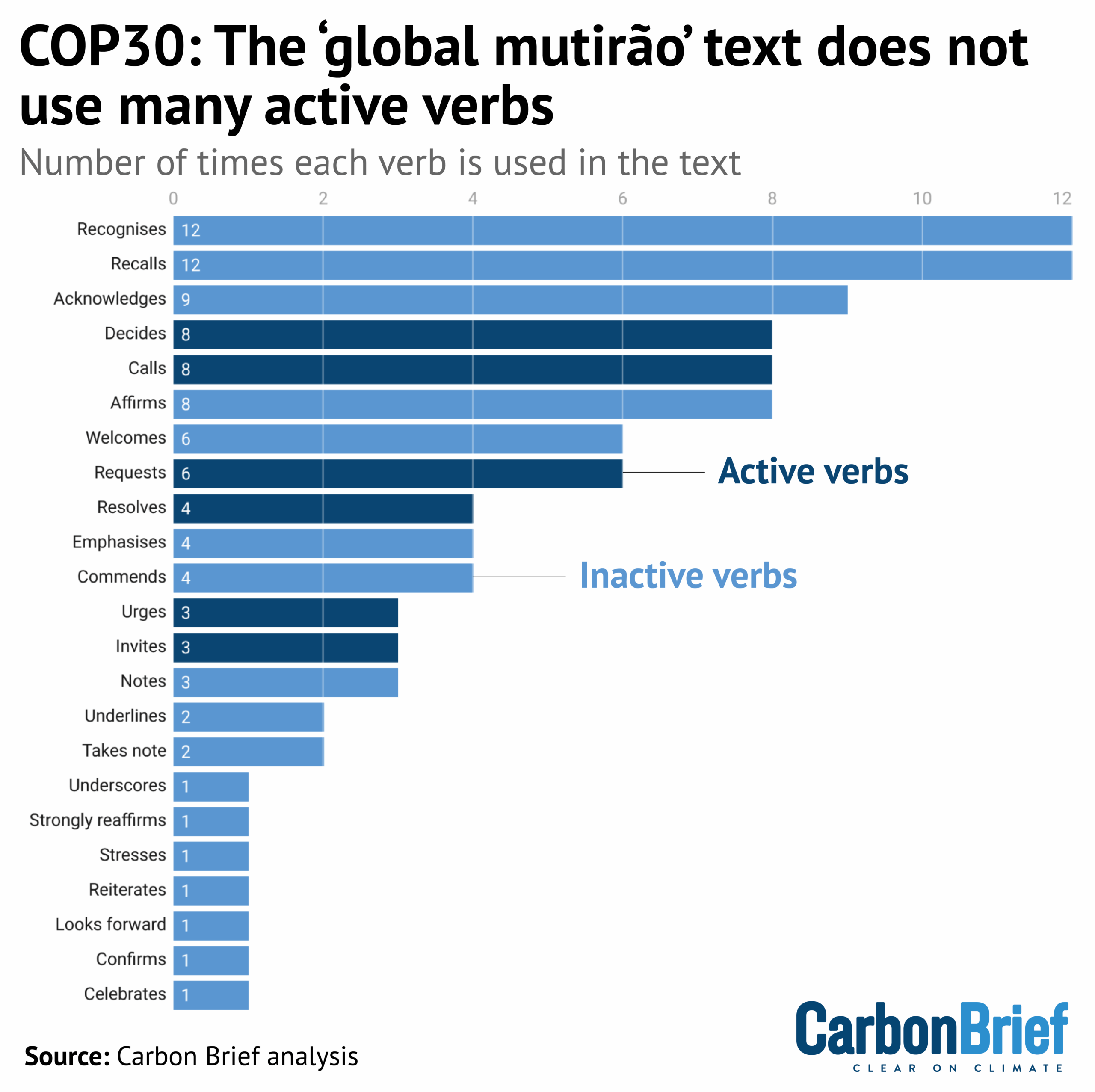
The key COP30 agreement – termed the “global mutirão” – contained 69 inactive verbs, which require no action from countries, compared to 32 active ones. “Recognises”, “recalls” and “acknowledges” were used far more often than more active verbs, such as “decides”, “calls” and “requests”, showed Carbon Brief analysis.
Spotlight
Nine warnings from a UK climate and nature ‘emergency’ briefing
This week, Carbon Brief’s Orla Dwyer reports from an event where experts and campaigners sounded the alarm bell on climate change and nature loss.
Naturalist and broadcaster Chris Packham urged attendees at a climate and nature “emergency briefing” in London yesterday to “listen to the science” on climate change amid a “dangerous wave of misinformation and lies”.
The “first-of-its-kind” event heard from nine experts on the links between climate change, nature loss, health, food production, economics and national security.
Event host, Prof Mike Berners-Lee from Lancaster University, called for a “World War II level of leadership” to tackle the interconnected crises.
Hundreds of people showed up, including Green Party, Labour and Liberal Democrat MPs, leader of the Greens Zack Polanski, musician Brian Eno and actress Olivia Williams.
Here is a snapshot of what the nine speakers said in their short, but stark, presentations.
Prof Kevin Anderson, professor of energy at University of Manchester
Anderson focused on the risks of a warmer world and the sliver of emissions left in the global carbon budget, noting:
“We have to eliminate fossil fuels or temperatures will just keep going up.”
He urged a “Marshall-style” plan – referencing the 1948 post-war US plan to rebuild Europe – to ramp up actions on retrofitting, public transport and electrification.
Prof Nathalie Seddon, professor of biodiversity at University of Oxford
Nature is not a “nice to have”, but rather “critical national infrastructure”, Seddon told attendees. She called for the “need to create an economy that values nature”.
Prof Paul Behrens, British Academy global professor at University of Oxford
Behrens discussed the food security risks from climate change. Impacts such as poor harvests and food price inflation are “barely acknowledge[d]” in agricultural policy, he said.
He also emphasised the “unsustainable” land use of animal agriculture, which “occupies around 85% of total agricultural land” in the UK.
Prof Tim Lenton, chair in climate change and Earth system science at Exeter University
Lenton outlined the “plenty” of evidence that parts of the Earth system are hurtling towards climate tipping points that could push them irreversibly into a new state.
He discussed the possibility of the shutdown of the Atlantic Meridional Overturning Circulation, which he said could cause -20C winters in London. He also noted positive tipping points, such as momentum that led the UK to stop burning coal for electricity last year.

Prof Hayley Fowler, professor of climate change impacts at Newcastle University
One in four properties in England could be at risk of flooding by 2050, Fowler said, and winters are getting wetter.
She discussed extreme weather risks and listed the impacts of floods in recent years in Germany, Spain and Libya, adding:
“These events are not warnings of what might happen in the future. They’re actually examples of what is happening right now.”
Angela Francis, director of policy solutions at WWF-UK
Francis factchecked several claims made against climate action, such as the high cost of achieving net-zero.
She noted that the estimated cost for the UK to achieve net-zero is about £4bn per year, which is less than 0.2% of GDP.
Lieutenant general Richard Nugee, climate and security advisor
Discussing the risks climate change poses to national security, Nugee said:
“Climate change can be thought of as a threat multiplier, making existing threats worse or more frequent and introducing new threats. Climate shocks fuel global instability.”
Tessa Khan, environmental lawyer and executive director of Uplift
Khan said the rising cost of energy in the UK is “turning into a significant political risk for the energy transition”.
She discussed the cost of fossil-fuel dependency and the fact that these fuels cost money to burn, but renewable “input[s], sun or wind [are] free forever”.
Prof Hugh Montgomery, professor of intensive care medicine at University College London
Montgomery discussed the health and economic benefits of climate actions, such as eating less meat and using more public transport, noting:
“The climate emergency is a health emergency – and it’s about time we started treating it as one.”
Watch, read, listen
WATER WORRIES: ABC News spoke to three Iranian women about the impacts of Tehran’s water crisis amid the “worst drought in 60 years”.
CLIMATE EFFORT: The BBC’s Climate Question podcast looked at the main outcomes from COP30 and discussed the “future of climate action” with a team of panelists.
CRIMINAL BEHAVIOUR:New Scientist interviewed criminal psychologist Julia Shaw about the psychology behind environmental crimes.
Coming up
- 24 November-5 December: COP20 on international trade in endangered species of wild fauna and flora, Samarkand, Uzbekistan
- 29-30 November: First part of global youth environment assembly, Nairobi, Kenya
- 3-4 December: Second round of Egyptian parliamentary elections
- 5 December: World soil day, global
Pick of the jobs
- Aldersgate Group, head of policy | Salary: £56,650-£66,950 per year. Location: London
- Ofgem, climate resilience expert | Salary: £61,446-£86,547. Location: Cardiff, Glasgow or London
- Green Climate Fund, integrity risk management lead | Salary: $171,200. Location: Incheon, South Korea
- Isles of Scilly Wildlife Trust, project manager – seabird recovery | Salary: Up to £45,000 per year. Location: Isles of Scilly, UK
DeBriefed is edited by Daisy Dunne. Please send any tips or feedback to debriefed@carbonbrief.org.
This is an online version of Carbon Brief’s weekly DeBriefed email newsletter. Subscribe for free here.

The post DeBriefed 28 November 2025: COP30’s ‘frustrating’ end; Asia floods; UK ‘emergency’ climate event appeared first on Carbon Brief.
DeBriefed 28 November 2025: COP30’s ‘frustrating’ end; Asia floods; UK ‘emergency’ climate event
Climate Change
Fossil fuel crisis offers chance to speed up energy transition, ministers say
The fossil fuel crisis triggered by the Iran war should push nations to speed up their shift towards clean energy and break their dependence on volatile sources, energy and climate ministers said on Tuesday.
Murat Kurum, Türkiye’s climate minister and COP31 president, said the crisis was yet another demonstration that fossil fuels cannot guarantee energy security, making it crucial for countries to diversify by investing in renewable energy.
“We know that relying solely on fossil fuels means walking towards volatility, insecurity and climate collapse,” he told fellow ministers at the Petersberg Climate Dialogue, an annual gathering in Berlin that traditionally opens the global climate diplomacy calendar.
Ministers from more than 30 countries, along with United Nations representatives, are meeting until Wednesday to lay the groundwork for a deal to accelerate climate action at COP31 in Antalya, Türkiye.
They will debate how to ramp up efforts to cut greenhouse gas emissions, mobilise climate finance amid shrinking international aid budgets, and leverage a strained multilateral system to deliver results.
Fossil fuels not the answer
The gathering is taking place in the shadow of what some energy analysts have described as the largest oil and gas supply disruption in history. The conflict in the Middle East has sent oil and gas prices soaring, with growing ripple effects on food production and industrial manufacturing.
Australia’s escalating fuel crisis meant the country’s energy minister Chris Bowen, who will also be in charge of COP31 negotiations, cancelled his trip to the Berlin summit. Joining by videolink, he said the crisis is a “unique opportunity” to underline the message that “energy reliability, energy sovereignty and energy security are entirely in keeping with strong decarbonisation”.
“Doubling down on fossil fuels is not the answer to this crisis,” he added. “Wind cannot be subject to a sanction, the sun cannot be interrupted by a blockade. These are all reliable forms of energy, which must be supported by storage”.
Electrification is a “megatrend”
Echoing Bowen’s remarks, Germany’s climate minister Carsten Schneider said the current crisis will be “an accelerator [of the energy transition] because it will help many people understand and realise how dependent we are on fossil fuels”.
He added that “electrification is turning into a global megatrend” but called for more discussion on how to ensure that industry and transport become less reliant on oil and gas across the world.
At last year’s climate talks, countries failed to agree to start a process to draft a global plan to shift away from oil, coal and gas. But the Brazilian COP30 presidency is taking it upon itself to deliver this roadmap before the summit in Antalya.
Discussions are expected to kick into higher gear at the first-ever conference on transitioning away from fossil fuels due to start at the end of this week in Colombia. COP30 president André Corrêa do Lago has said the roadmap should be published in September.
Clear plans needed
Addressing the Petersberg summit, the head of the United Nations António Guterres said that transition roadmaps can help countries manage urgent choices during the ongoing fuel crisis while advancing a just transition to a clean and secure energy future.
“We must respond to the energy crisis without deepening the climate crisis,” he added. “Short-term measures must not lock in long-term fossil fuel dependence and expansion”.
The ministers argued that, despite the US withdrawal from international climate diplomacy under President Trump, other countries remained committed to working together to tackle the climate crisis.
But Türkiye’s Kurum scolded the more than 40 governments that have not yet published their national climate plans, more than a year after the official UN deadline. These are mostly smaller nations, but the group of laggards also includes Vietnam, Argentina and Egypt.
“We will ensure that countries fulfil the fundamental requirements of the COP,” he said, adding that his team is working intensely with the UN to ensure these plans – known as nationally determined contributions – are submitted.
“Without diagnosis, you can’t treat”, he said.
The post Fossil fuel crisis offers chance to speed up energy transition, ministers say appeared first on Climate Home News.
Fossil fuel crisis offers chance to speed up energy transition, ministers say
Climate Change
Earth Day is an opportunity for communities to show the way on climate action
Ilka Vega is the executive for economic and environmental justice at United Women in Faith, the largest denominational faith organisation for women in the United States.
For climate justice advocates around the globe, many of the United States’ environmental policies have felt dangerous. In this moment, Earth Day might feel sobering as we acknowledge the gravity of these dangers. However, we cannot allow bad actors at the national level to shake our spirit. Instead, we can harness the energy of Earth Day and mobilize our communities for change.
Of course, while local action is powerful, it is against a backdrop of rollbacks to environmental protections. In 2026, the current US administration has continued on its track of undermining climate action, taking us back decades on efforts to mitigate and adapt to the escalating climate crisis.
In January, the US withdrew from several international climate organizations and treaties, including the United Nations Framework Convention on Climate Change and the Paris Agreement. In February, the Environmental Protection Agency (EPA) repealed the Greenhouse Gas Endangerment Finding, which will make it more difficult to regulate greenhouse gas emissions and pollutants.
More destructive weather extremes
Climate change is not a future threat – it is affecting people right now. And it is not an abstract concept. We have seen its impact in tangible ways.
In 2025, the mainland United States experienced the fourth hottest year on record. In February of this year, the National Oceanic and Atmospheric Administration reported an average surface temperature 2.12° F higher than the 20th-century average.
Tornadoes, tropical cyclones, floods and other natural disasters devastated communities around the world, and have been growing more frequent and destructive due to climate change. Frontline communities disproportionately suffer these effects. Women and children are most likely to be displaced and are more likely to suffer gender-based violence when natural disasters and weather emergencies occur.
As climate change devastates communities, it is important that we take practical steps to prevent future harm. We can work with each other to encourage new practices, even without the support of powerful people. Our force can have an impact on communities beyond our imaginations. I have seen this in action, from my own neighborhood to organizations across the US and around the world.
Communities resisting the old and building the new
For example, last year in Texas, people from all walks of life came together to protest the toxicity of fossil fuels in front of oil and gas CEOs. In Oak Flat Arizona, an Apache stronghold is still resisting a destructive copper mine project despite setbacks that threaten to shatter their sacred lands.
One woman in La Mesa, California led efforts to engage nearby school districts in discussions about joining the EPA’s Clean School Bus program. In the wake of hurricanes, First Grace United Methodist Church in New Orleans used their solar panels to offer relief through charging and cooling for neighbors experiencing power outages.
Q&A: Look beyond Trump for the full story on US climate action, says university dean
In Marange, Zimbabwe, Environmental Buddies Zimbabwe installed energy-efficient stoves in their community. A project with similar goals, Eco-Green Gold in Bolgatanga, Ghana trained 40 women to produce charcoal from grass as an eco-friendly alternative to wood-based charcoal. They both are creating opportunities for their neighbors while reducing deforestation and promoting renewable energy.
Shared responsibility for a cleaner, safer planet
These communities have shown that we all have a responsibility to fight for a cleaner, healthier and safer Earth. That responsibility does not end when the government is not doing enough; rather, it becomes imperative that we boost our efforts.
Although there is only so much we can do about the actions of a powerful government and wealthy corporations, we can influence what happens in our own communities – and that influence matters.
Individual actions build powerful movements; change must always begin at the local level. When we see people around the world organizing and taking direct action, we realize the true scale of what is possible. Every effort, no matter how small, becomes part of a larger movement that cannot be ignored.
We hold onto the unwavering belief that we can still turn the tide on climate change – and it is that hope that drives every step of our work toward a better, sustainable future.
The post Earth Day is an opportunity for communities to show the way on climate action appeared first on Climate Home News.
Earth Day is an opportunity for communities to show the way on climate action
Climate Change
Extreme heat is rewriting food security. The best fixes are already within reach
Kaveh Zahedi is the Assistant Director-General of the UN Food and Agriculture Organization (FAO) and Director of FAO’s Office of Climate Change, Biodiversity and Environment. Ko Barrett is the Deputy Secretary-General of the World Meteorological Organization (WMO).
Every crop, every animal and every fish has a thermal limit, the point where additional heat stops being normal weather and starts doing damage. In food systems, that threshold arrives sooner than many people realise.
For key agricultural species, the danger zone often sits between 25 and 35°C at the moments that matter most, such as flowering and reproduction. As climate change drives more days into the mid-40s°C in major breadbaskets, those limits are already being crossed. The result is lower yields, weaker livestock, stressed fisheries, higher fire risk and farmworkers – the backbone of the system – forced into unsafe conditions.
A new joint FAO-WMO report, released on April 22, shows that extreme heat is already cutting production and exposing agricultural workers to dangerous conditions. One analysis found that beef cattle mortality reached as high as 24% in some documented heatwaves. Marine heatwaves were linked to an estimated $6.6 billion loss in fisheries production. And the outlook worsens as temperatures rise. For every 1°C of warming, maize and wheat yields are projected to drop 4–10%.
Adapting to a hotter world will take long-term investment in science, technology and infrastructure if food supplies are to keep pace with demand. We will need more heat-tolerant varieties and breeds, new farming practices, and we will need to make hard choices about what can still be grown as conditions change. But we also need a plan for next season, not just 2100.
With more severe heat likely in the coming years and another El Niño poised to test unprepared systems, the priority is to move from crisis response to heat readiness. That starts with early warnings and practical measures to help farmers protect harvests, supply chains and their own safety.
Heat warnings farmers can use
Weather forecasts should give farmers time to act before extreme heat turns into loss. That is the strategy behind Early Warnings for All, the UN initiative coordinated by WMO with partners including FAO. But early warning only works when reliable observations, modelling and verification turn weather and climate data into forecasts farmers can actually use.
Cambodia’s Green Climate Fund-funded PEARL project, supported by FAO, upgraded and installed new weather stations to feed a phone-based app that sends forecasts with crop- and region-specific guidance. When forecasts exceed 38°C, alerts recommend maintaining soil moisture with mulch, shading vegetables, delaying sowing rice seeds, and shifting irrigation to cooler hours.


That advice is part of a practical set of heat measures that help farmers reduce losses before extreme heat turns into crisis. In some cases, that means shading crops with cloth or solar panels, increasing water storage, installing low-cost cooling misters, or adjusting planting windows. Cattle generate heat when they eat, so feeding them in cooler hours can help.
Poultry cannot sweat, so shade is essential. Where extreme heat is becoming the norm, farmers may need to move from cattle to more heat-tolerant goats and sheep, or even switch crops. Evidence from Pakistan shows these adjustments can pay off. A FAO-GCF project field-tested the combination of heat- and drought-tolerant cotton and wheat varieties with mulching and adjusted planting windows. Over six seasons, returns reached as high as $8 for every $1 invested.
Extreme heat doesn’t only damage food in the field. It also speeds up spoilage after harvest, turning heat stress into income loss and poorer diets. An estimated 526 million tonnes of food, about 12% of the global total, is lost or wasted because of insufficient refrigeration. In Jamaica, a GCF-funded, FAO-supported programme treats cold storage as climate adaptation, using solar-powered cold storage to help smallholders keep produce market-ready when heat hits.
Protecting workers
Cold chains and toolkits matter, but they don’t protect the people doing the work. Extreme heat is one of the biggest threats to farmers’ health, driving dehydration, kidney injury and chronic disease, and taxing public health systems in the process. More than a third of the global workforce, around 1.2 billion people, face workplace heat risk each year, with agriculture among the hardest-hit sectors.
We already know what basic protection looks like, and it is already being put into practice in Cambodia, where the extreme heat advisories are paired with advice for farmers to shift heavy work to cooler hours and ensure access to water, shade and rest breaks.
The World Health Organization (WHO) and WMO are calling for the same approach at a wider scale: adjusted work–rest schedules, access to shade and safe drinking water, training to recognize heat illness, and integrating weather and climate information into workplace risk management.
Why preparation pays
The tools to prepare for extreme heat already exist. The problem is that funding still falls far short of the scale of the risk, and rural communities are too often overlooked by the assumption that extreme heat is mainly an urban problem.
In 2023, agrifood systems received just 4% of total climate-related development finance. Without more investment, early warnings won’t reach the people who need them most, extension services will remain under-resourced, and basic protections for crops, livestock and workers will stay out of reach.
Preparing in advance is cheaper than absorbing the same losses year after year. It can stabilise production and prices now, while buying time for the bigger scientific and structural shifts agriculture will need in a hotter world.
We don’t need a new playbook. We need to use the one we already have. The FAO-WMO report lays out the risks of extreme heat. Now is the time to use that evidence to protect food systems and the people who sustain them.
The post Extreme heat is rewriting food security. The best fixes are already within reach appeared first on Climate Home News.
Extreme heat is rewriting food security. The best fixes are already within reach
-
Greenhouse Gases8 months ago
Guest post: Why China is still building new coal – and when it might stop
-
Climate Change8 months ago
Guest post: Why China is still building new coal – and when it might stop
-
Greenhouse Gases2 years ago嘉宾来稿:满足中国增长的用电需求 光伏加储能“比新建煤电更实惠”
-
Climate Change2 years ago
Bill Discounting Climate Change in Florida’s Energy Policy Awaits DeSantis’ Approval
-
Climate Change2 years ago嘉宾来稿:满足中国增长的用电需求 光伏加储能“比新建煤电更实惠”
-
Climate Change Videos2 years ago
The toxic gas flares fuelling Nigeria’s climate change – BBC News
-
Renewable Energy6 months agoSending Progressive Philanthropist George Soros to Prison?
-
Carbon Footprint2 years agoUS SEC’s Climate Disclosure Rules Spur Renewed Interest in Carbon Credits