

The United States Environmental Protection Agency (EPA) has issued the first-ever nationwide, legally enforceable limits on harmful per- polyfluoroalkyl substances (PFAS) — known as “forever chemicals” — in drinking water.
The rule is the biggest leap so far in EPA’s PFAS Strategic Roadmap and will lower exposure to the toxic substances for roughly 100 million people, a press release from EPA said.
“Drinking water contaminated with PFAS has plagued communities across this country for too long,” said Michael S. Regan, EPA administrator, in the press release. “Our PFAS Strategic Roadmap marshals the full breadth of EPA’s authority and resources to protect people from these harmful forever chemicals. Today, I am proud to finalize this critical piece of our Roadmap, and in doing so, save thousands of lives and help ensure our children grow up healthier.”
PFAS exposure has been associated with cancer, heart and liver disease and damage to the development and immune systems of children and infants. The new rules will lead to tens of thousands of fewer related health issues while preventing thousands of fatalities.
EPA is making funding available to implement the new rule through the Biden-Harris administration’s Investing in America agenda. Through the Bipartisan Infrastructure Law, nearly $1 billion will be accessible to assist states and territories with carrying out testing for PFAS, public water system treatment and help for private well owners with addressing contamination from forever chemicals. A total of $9 billion is being invested to assist communities with PFAS and other contaminants in drinking water, as well as $12 billion for general improvements to drinking water.
Last year, a study by the U.S. Geological Survey found PFAS in almost half of tap water samples in the country.
“The first national drinking water standards for PFAS marks a significant step towards delivering on the Biden-Harris Administration’s commitment to advancing environmental justice, protecting communities, and securing clean water for people across the country,” said Brenda Mallory, White House Council on Environmental Quality chair, in the press release.
The new rule establishes limits for PFOA, PFNA, PFOS, PFHxS and HFPO-DA — known as “GenX Chemicals.”
“For PFOA and PFOS, EPA is setting a Maximum Contaminant Level Goal, a non-enforceable health-based goal, at zero. This reflects the latest science showing that there is no level of exposure to these contaminants without risk of health impacts, including certain cancers,” the press release said.
For each of PFOS and PFOA, the enforceable maximum levels will be four parts per trillion (ppt).
“This standard will reduce exposure from these PFAS in our drinking water to the lowest levels that are feasible for effective implementation,” according to the press release.
Maximum levels for PFHxS, PFNA and GenX Chemicals will be 10 ppt.
The EPA rule also limits mixtures of two or more of PFNA, PFBS, PFHxS and GenX chemicals.
“We learned about GenX and other PFAS in our tap water six years ago. I raised my children on this water and watched loved ones suffer from rare or recurrent cancers. No one should ever worry if their tap water will make them sick or give them cancer,” said Emily Donovan, Clean Cape Fear co-founder. “We will keep fighting until all exposures to PFAS end and the chemical companies responsible for business-related human rights abuses are held fully accountable.”
Approximately six to 10 percent of the public drinking water systems — 66,000 of them — subject to the new rule may need to take steps to reduce PFAS in order to meet the new standards. Public water systems will have three years to finish their initial monitoring for forever chemicals. Meanwhile, they will be required to inform the public of PFAS levels in their drinking water. When PFAS is detected at levels in excess of the standards, solutions must be implemented within five years.
“The new limits in this rule are achievable using a range of available technologies and approaches including granular activated carbon, reverse osmosis, and ion exchange systems,” the press release said. “For example, the Cape Fear Public Utility Authority, serving Wilmington, NC — one of the communities most heavily impacted by PFAS contamination — has effectively deployed a granular activated carbon system to remove PFAS regulated by this rule. Drinking water systems will have flexibility to determine the best solution for their community.”
EPA will host informational webinars available to the public in the coming weeks. Information is available on the PFAS drinking water regulation website.
“For decades, the American people have been exposed to the family of incredibly toxic ‘forever chemicals’ known as PFAS with no protection from their government. Those chemicals now contaminate virtually all Americans from birth. That’s because for generations, PFAS chemicals slid off of every federal environmental law like a fried egg off a Teflon pan,” said Ken Cook, president and co-founder of Environmental Working Group, in the press release. “There is much work yet to be done to end PFAS pollution.”
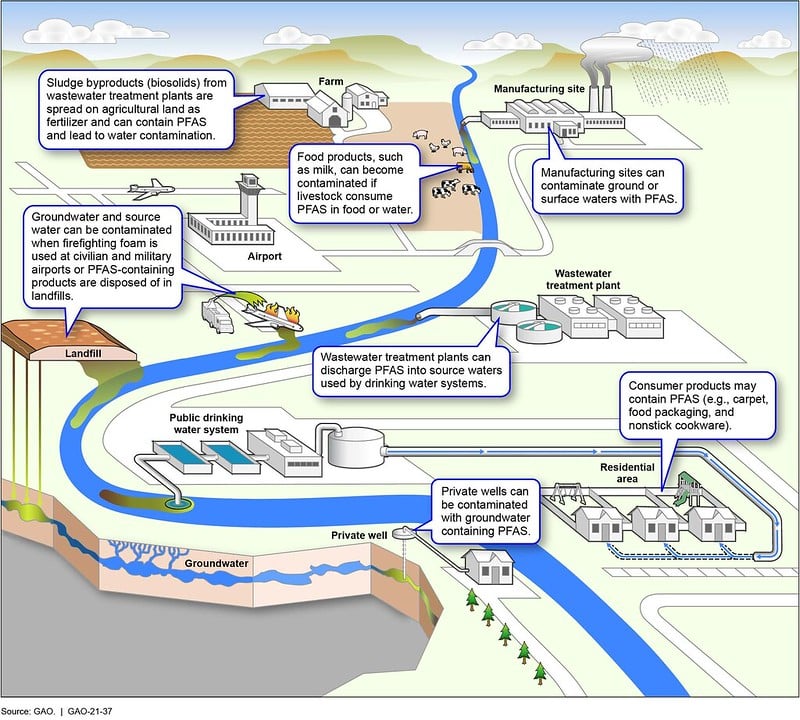
Examples of how PFAS enter the environment and water, from a U.S. GAO report published in 2021. U.S. Government Accountability Office
The post EPA Announces First-Ever Rule Limiting PFAS ‘Forever Chemicals’ in Drinking Water appeared first on EcoWatch.
https://www.ecowatch.com/epa-pfas-forever-chemicals-drinking-water-rule.html

One gallon of water. That’s roughly how much a well-run aquaponics system uses to grow a kilogram of leafy greens. Compare that to the 30 or more gallons required by conventional soil farming, according to a 2024 comparative greenhouse study, and the benefits are inescapable.
That efficiency is why aquaponics — raising fish and growing plants in a closed-loop system — has moved from backyard novelty to subject of serious agricultural research. A 2025 review in Sustainable Environment Research documents how integrating AI, IoT sensors, and automation into aquaponics can significantly enhance system efficiency, increase food production, reduce operational costs, and minimize waste. For home gardeners in 2026, the barrier to entry has never been lower. All-in-one kits start under $100, water quality testing has become more accurate and affordable, and the science behind getting both fish and plants to thrive is well-established.
Nitrification is at the heart of every aquaponics system. Fish produce ammonia-rich waste. Beneficial bacteria convert that ammonia first into nitrite, then into nitrate — a form plants can absorb directly. The plants filter the water. The cleaned water returns to the fish. Once the system cycles, the main inputs are fish food and occasional water top-offs.
This article contains affiliate links. If you purchase an item through one of these links, we receive a small commission that helps fund our Recycling Directory.
1. Invest in Reliable Equipment
-
The core hardware list hasn’t changed much — but what’s available at each price point has improved considerably.
Aquarium or tank. A 100-gallon tank remains the recommended starting point for a serious home system. It gives you flexibility in fish species, plant density, and system stability. Acrylic tanks are lighter and optically clearer; glass tanks are heavier but scratch-resistant. Expect to pay $300–$600 for a quality 100-gallon tank. Search current options on Amazon.
If you’re new to aquaponics, the AquaSprouts Garden Kit is a well-reviewed all-in-one beginner system that fits a standard 10-gallon aquarium. It includes a grow bed, submersible pump, mechanical timer, and light bar mounting system, and costs $75–$90. The aquarium itself is sold separately.
Canister filter. For a 100-gallon aquaponics tank, target 500–600 gallons per hour (GPH) of water turnover, well above what the tank volume alone would suggest, because the fish load demands high filtration. The Fluval FX2 (~$269 on Amazon) is consistently top-rated for tanks up to 100 gallons, featuring 4-stage filtration, Smart Pump technology that auto-adjusts flow, and a built-in water change system. A solid budget alternative is the Penn-Plax Cascade 1000 (~$199 on Amazon), which handles up to 100 gallons, recirculating the water more than twice an hour.
Air pump. Dissolved oxygen is critical for fish health and for the beneficial bacteria driving nitrification. A quality air pump — or a canister filter with an integrated spray bar — will keep oxygen levels stable. A 2025 review in Reviews in Aquaculture found that micro-nano bubble (MNB) aeration increased butterhead lettuce yield by 35% compared to conventional diffusers, and raised nitrate concentration in the water. MNB systems are commercially available but not yet mainstream for home setups, so a conventional air pump remains the practical choice for most beginners.
Grow lights (optional, system-dependent). Indoor systems need supplemental lighting. Full-spectrum LED grow lights have dropped substantially in price and energy draw. Look for LED bars with daylight-spectrum output (5000–6500K) sized to your grow bed. Search LED grow lights on Amazon.
Water heater (optional). Tilapia require 70–85°F. If your space runs cooler, a submersible aquarium heater is essential. Search aquarium heaters on Amazon.
2. Choose Your Setup
Three system types work at home scale. The choice depends on available space, target crops, and tolerance for complexity.
Media bed are recommended for beginners. Plants grow in a bed of inert media, such as expanded clay pebbles, gravel, or lava rock, positioned above or beside the fish tank. A pump floods the bed periodically, then drains back. The media supports roots and houses beneficial bacteria. Research from Texas A&M confirmed media beds are the most forgiving system for beginners and support the widest range of crops, including fruiting vegetables like tomatoes and cucumbers. The Oklahoma Cooperative Extension Service provides detailed DIY build plans.
A 2025 study found that carbonized rice husks and cocopeat as grow media can yield five times more crop than traditional expanded clay aggregate (LECA), though they decompose over time and require more frequent replacement.
Nutrient film technique (NFT). A thin stream of water flows continuously through PVC tubes past plant roots dangling inside. Excellent for herbs, lettuce, and small greens in tight or vertical spaces; the tubes can be wall-mounted. Vertical aquaponics setups can increase productivity per unit area by up to 160% compared to horizontal systems, based on research with strawberries and basil. NFT kits are available on Amazon for both DIY and complete systems.
Raft (deep water culture). Plants float on foam rafts with roots submerged directly in nutrient-rich water drawn from the fish tank. They produce a higher yield than NFT for leafy greens, but requires more robust filtration because solids aren’t removed by a media bed. More common in semi-commercial operations than small home setups. Check options on Amazon.
A growing range of IoT sensors let you track pH, dissolved oxygen, ammonia, and temperature continuously from your phone. WiFi pH/EC meters designed for hydroponic and aquaponic systems are now in the $60–$120 range. For beginners, manual weekly testing is fine. For anyone running a system unattended or scaling up, continuous monitoring significantly reduces the risk of a water quality crash.

3. Add the Fish
An aquaponics system will support many species of fish. Several of the most popular options are:
- Tilapia: The most common aquaponics fish for good reason. Tilapia tolerate temperature swings, pH variation, and elevated ammonia better than most species. They grow quickly (typical harvest: 6–8 months), are inexpensive to stock, and provide a dual harvest of vegetables and protein. Best for warm indoor or greenhouse systems (70–85°F).
- Koi: Popular ornamental choice. Koi tolerate poor water quality and are hardy once established, but they’re susceptible to a range of pathogens and aren’t typically harvested for food. Well-suited to media bed systems where water quality is easier to maintain.
- Bluegill, perch, and catfish. Solid edible alternatives to tilapia in cooler climates where tilapia’s warmth requirements are a challenge. Texas A&M’s fish species selection guide covers temperature ranges, feed conversion ratios, and disease susceptibility for home-scale species in detail.
These are great options, but you can also consider carp, perch, largemouth bass, bluegills, guppies, and more. Purchase fish from a reputable aquaculture supplier or local fish hatchery when possible — disease-carrying fish is one of the fastest ways to crash a new system. Pet store fish are not certified disease-free.
4. Add the Plants
Like fish, the options are endless when deciding which vegetables to grow in your aquaponics system. Some popular options include broccoli, celery, cucumbers, and basil.
But because different plants require different conditions, you’ll want to select plants that will thrive in your setup. As Go Green Aquaponics explains, it is important to consider the following:
- System: What type of aquaponics system you will use – plants with no root structure do well in a raft setup, while root vegetables do well in a media bed.
- The optimal temperature and pH level for your fish and your plants – the closer the match, the more successful you’ll be.
- Environment: the amount of light, temperature and – if you’re setting up your system outside – rain the plants will get.
- How much space you have for plants versus how much space the plants need to grow.
- Plant-to-fish ratio: The more fish you plan on having, the more plants you need to absorb the nutrients.
5. Maintain Your System
Keeping healthy plants and fish will require regular maintenance. Some tips include:
-
Feed your fish two to three times daily in small amounts. Overfeeding is the most common cause of ammonia spikes in home systems. Uneaten food decomposes rapidly and overwhelms the beneficial bacteria that keep the system in balance.
Test pH weekly. Target range is 6.4–7.4, with most systems running best around 6.8–7.0. The API Freshwater Master Test Kit (~$35 on Amazon) tests pH, ammonia, nitrite, and nitrate in one kit — the standard recommendation for aquaponics monitoring. For more serious systems, the LaMotte Aquaponics Water Test Kit (~$85 on Amazon) covers nine parameters including dissolved oxygen and carbon dioxide, and comes with a rugged carrying case. To raise pH naturally, dissolve a tablespoon of food-grade potassium carbonate (potash) in a bucket of system water, add it slowly to the tank, and retest after 24 hours before adding more.
Test ammonia and nitrate weekly or biweekly. Ammonia should be below 2 ppm; nitrates should stay under 160 ppm. Elevated ammonia: feed less, increase aeration, or reduce fish density. High nitrates: add more plants or remove some fish.
Mind the cycling period. A new system takes 4–6 weeks to fully cycle and for the bacterial colony to establish and nitrogen conversion to stabilize. Don’t increase fish load or plant density during this period. Ammonia and nitrite readings near zero consistently is your green light.
The following video from Rob Bob’s Aquaponics provides guidance on how to check the pH, ammonia levels, and nitrate levels.
Get Some Fish In Your Garden
Aquaponics is an easy and environmentally conscious way to grow produce and raise fish at the same time. It can be used to grow all your favorite leafy greens, and there are endless varieties of fish that will adapt well to this system. Just keep up with regular maintenance and aquaponics will prove to be a viable and sustainable new way to garden.
The science of aquaponics is advancing quickly. Three developments from recent peer-reviewed literature are worth knowing about, even if most aren’t yet practical for home systems:
Algae co-cultivation. Reviews in Aquaculture reports that introducing macroalgae such as Spirogyra spp. can nearly double plant yields compared to traditional aquaponic systems. Co-cultivating microalgae (Chlorella) with plants in raft systems also controls ammonia at twice the efficacy of non-algal systems. This is emerging research — not yet mainstream for home growers — but a promising direction for anyone looking to push yields further.
Decoupled system design. Research from the Journal of the World Aquaculture Society (2024) documents that decoupled systems, which separate the aquaculture unit from the hydroponic unit, allow optimized conditions in each component, resulting in better nutrient utilization and increased productivity compared to coupled designs. Decoupled systems allow independent pH management for fish and plants, which is otherwise a constant compromise in standard coupled setups. Commercially available decoupled systems are beginning to become available; for DIY builders, it’s a worthwhile design consideration when scaling up.
AI and IoT integration. A 2025 Sustainable Environment Research review emphasizes that monitoring strategies using artificial intelligence, the Internet of Things, and renewable energy can significantly enhance aquaponic system efficiency. For home growers, this means the WiFi monitoring systems mentioned in Step 2 are part of a broader wave of automation coming to small-scale aquaponics. The good news: prices will continue to drop.
Editor’s Note: This article was originally published on March 17, 2021, and updated in April 2026. Feature image of outdoor aquaponics system courtesy of Vasch~nlwiki, CC BY-SA 4.0, via Wikimedia Commons
About the Author
David Thomas is founder and editor-in-chief of Everything Fishkeeping, a fishkeeping and aquascaping magazine. He has been keeping fish since he was a child and has kept over 12 different setups. His favorite is his freshwater tank with Tetras and Loaches.
The post How To Grow Vegetables With Aquaponics appeared first on Earth911.
https://earth911.com/home-garden/grow-vegetables-with-aquaponics/
Gas just broke $4 a gallon again — and this time, it happened in weeks, not months. The war with Iran and the closure of the Strait of Hormuz triggered what the International Energy Agency called the largest oil supply disruption in history, cutting roughly 20% of global petroleum from accessible markets and sending U.S. pump prices surging more than 30% since late February. Diesel has climbed above $5.60 a gallon. Analysts warn that if the Strait stays shut through summer, prices could reach $6–7 a gallon.
At the same moment, the federal government pulled a $7,500 lever it had been offering EV buyers for three years. Trump’s One Big Beautiful Bill Act ended the IRA’s clean vehicle tax credit on September 30, 2026, sooner than almost anyone expected. For anyone considering an EV right now, both of these developments matter enormously, and they cut in opposite directions.
Here’s how EV math works in April 2026.
6 Benefits of Electric Cars
The benefits of owning an EV arguably outweigh any cons — from spending less money in the long run to making fewer trips to the repair shop. And it doesn’t stop there.
1. Gasoline Prices Have Never Made the Cost-Per-Mile Case for EVs More Clearly
With U.S. gas prices above $4 a gallon and diesel topping $5.60, the fueling cost gap between EVs and gas vehicles has widened sharply. The EIA’s March 2026 short-term outlook projected average retail gas prices of $3.34 per gallon for the full year — but that forecast was built on assumptions about the Strait reopening quickly. Prices are already well above that. Electricity prices, by contrast, remain stable and domestically produced.
A typical EV running on home electricity still costs roughly one-third as much per mile as a comparable gas vehicle — a savings that grows with every ten-cent jump at the pump. The current energy shock makes that argument harder to dismiss.
2. Energy Independence Means Something Different Now
The Iran war viscerally confirmed energy analysts argument that American households are deeply exposed to disruptions on the other side of the planet, even as the U.S. produces record quantities of domestic oil. Global crude oil prices are set by global markets, and domestic production buffers the shock but doesn’t eliminate it.
Charging an EV from the grid — or better, from rooftop solar — can insulate a household from price shocks. It’s a form of energy resilience that’s worth taking seriously as a financial and practical argument, not just an environmental one.
3. EV Range Has Left ‘Range Anxiety’ Behind
The 2021 version of this article listed 60-to-100 miles as a typical EV range. That figure is obsolete. As of 2026, the Lucid Air leads at 410 EPA-rated miles, the Hyundai IONIQ 6 Long Range delivers 361 miles, and the Chevrolet Equinox EV — the best-selling non-Tesla EV of 2025 — offers 319 miles starting under $35,000. Even mid-range EVs from mainstream brands now routinely clear 250 miles per charge.
The range question has effectively been answered for most everyday use cases. Long-distance travel remains more planning-intensive than gas, but it’s a planning question, not a stranding question, for most drivers on most routes.
4. Charging Infrastructure Has Reached Critical Mass
As of January 2026, the U.S. had nearly 68,000 public DC fast-charging ports, a 33% increase compared to 2024. Tesla’s Supercharger network alone accounts for over 52% of fast-charging stalls, and more than two-thirds of those are now open to non-Tesla vehicles. Ford, GM, Rivian, Hyundai, Kia, Mercedes-Benz, Volvo, and Stellantis have all adopted NACS, effectively granting their drivers access to the Supercharger network via native ports or adapters.
Reliability, long the Achilles heel of non-Tesla charging facilities that were often out of commission, is also improving. New stations are being built with redundant chargers, remote monitoring, and real-time availability data integrated into vehicle navigation. The experience of pulling up to a broken charger on a long trip is becoming less common, though rural coverage gaps persist.
5. Maintenance Costs Remain Lower — and the Gap Is Growing
EVs require no oil changes, no exhaust system. They need fewer brake replacements because regenerative braking extends pad life substantially. And they have significantly fewer moving parts subject to wear. A Consumer Reports analysis drawing on survey data from hundreds of thousands of members found that EV owners spent about half as much on maintenance and repair as owners of comparable gas vehicles; that’s an average savings of $4,600 over the life of the vehicle.
With inflation squeezing household budgets and the Iran war likely to push repair and parts costs higher as diesel-driven supply chain expenses rise, lower maintenance overhead matters more in 2026 than it did even a year ago.
6. State Incentives Fill Some of the Federal Gap — For Now
The federal $7,500 clean vehicle credit is gone. But the replacement focused on American-made cars makes up the gap. The One Big Beautiful Bill introduced a federal auto loan interest deduction of up to $10,000 annually through 2028, available for U.S.-assembled EVs financed with new loans. It’s a deduction rather than a credit, meaning it reduces taxable income rather than tax owed directly, and it phases out for households with incomes above $100,000 for a single person and $200,000 for couples.
State incentives come in many forms and have different eligibility rules. Several states with high EV adoption still offer significant savings, which are especially important now that federal credits are no longer available.
- Colorado provides a $750 state tax credit for buying or leasing a new EV with an MSRP up to $80,000. There is also an extra $2,500 credit for EVs priced under $35,000, so budget-conscious buyers can save up to $3,250. You can assign the credit to a participating dealership and get the discount at the point of sale, so you do not have to wait until you file your taxes.
- New Jersey’s Charge Up program gives up to $4,000 in point-of-sale rebates for eligible new battery-electric vehicles, applied directly at the dealership through June 30, 2026. The state plans to keep EV incentives active through 2030, with funding renewed each year. This is one of the strongest long-term commitments among states.
- Oregon’s program has some important updates. The Standard Rebate, which offered up to $2,500 for any Oregon resident, was suspended in September 2025. The Charge Ahead Rebate, which provided up to $7,500 for income-qualified buyers, was suspended on December 5, 2025 due to limited funding. If you bought an EV during the eligible period, you still have six months from your purchase date to apply. Approved applications may be put on a waiting list for payment in spring 2026. New funding rounds may happen, but they are not confirmed yet. Check the Oregon DEQ’s program page before counting on the rebate.
- California’s Clean Cars 4 All program is one of the most generous for income-eligible buyers. Low-income residents in certain air districts can get up to $12,000 toward an EV purchase, plus up to $2,000 for home charging or prepaid charging credits. If you do not need to scrap an old vehicle, you can get up to $7,500 through the Driving Clean Assistance Program. Both programs are income-based and run by regional air districts. Use the state’s DriveClean incentive search to see what is available in your ZIP code.
- Massachusetts provides a $3,500 rebate through the MOR-EV program for buying or leasing a new qualifying EV with an MSRP under $55,000 at participating dealerships. If you meet income requirements, you can add another $1,500 through MOR-EV+, for a total of $5,000. There is also a $3,500 rebate for used EVs, but only for income-qualified buyers.
- New York’s Drive Clean Rebate gives up to $2,000 off the purchase or lease of over 60 new EV models. The rebate is applied at the point of sale by participating dealerships across the state, and there is no income requirement. The amount depends on the vehicle’s range: you get the full $2,000 for EVs with over 200 miles of range on a 36-month lease or purchase, $1,000 for 40 to 199 miles, and $500 for shorter-range models or those with MSRPs above $42,000.
All of these programs depend on available funding and may change their rules. Check the DOE Alternative Fuels Data Center for the latest information before you buy.
Many automakers are also stepping in with manufacturer cash incentives and subsidized lease deals to offset the lost federal credit. Hyundai, for example, cut the price of its 2026 IONIQ 5 by nearly $10,000.

5 Drawbacks of EVs
Of course, nothing is perfect, and electric cars are no exception. There are a few important factors to consider before signing on the dotted line at the dealership.
1. The Federal Tax Credit Is Gone — And the Replacement Is More Complicated
The $7,500 IRA clean vehicle credit that made EVs significantly more accessible to middle-income buyers expired on September 30, 2025. The $4,000 used EV credit expired at the same time. The EV charger installation credit survives through June 30, 2026, but only in eligible census tracts, such as low-income communities and non-urban areas.
The loan interest deduction that replaced the purchase credit is available only to buyers who finance a U.S.-assembled EV, ruling out cash purchases and vehicles assembled in Canada or Mexico (check the vehicle’s VIN: U.S.-assembled vehicles start with 1, 4, 5, or 7). This program is also an annual deduction on taxable income rather than a dollar-for-dollar credit, which means buyers in lower tax brackets get proportionally less benefit.
The net result is that the out-of-pocket cost of EVs is higher upfront in 2026 than in 2024–2025 for most buyers who don’t live in a high-incentive state. Automaker discounts and competitive leasing help, but the headline sticker shock is real.
2. Charging Can Still Be Slow — And Fast Charging Carries a Cost
DC fast charging, which can replenish an EV from 10% to 80% in 15 to 45 minutes depending on the vehicle, is increasingly available. But it comes at a premium: public fast charging costs significantly more per kilowatt-hour than home charging, and some networks charge idle fees after your session ends, so don’t leave your EV hooked up longer than needed. Home Level 2 charging (overnight, plugged into a 240V outlet) remains the most cost-effective option but requires an upfront equipment investment, and not everyone has access to dedicated parking.
The EV charger tax credit’s narrowed eligibility means many urban apartment dwellers and suburban homeowners outside those tracts get no federal help with installation costs.
3. Upfront Cost Remains Higher Than Comparable Gas Vehicles
The Chevrolet Equinox EV starts at $34,995. That’s genuinely competitive, and several EVs now undercut the critical $40,000 price point. But comparable gas hybrids remain several thousand dollars cheaper at purchase, a gap that the loan interest deduction only partially closes, and only over several years of ownership.
The economic argument for EVs is stronger over the lifetime of the vehicle than at the point of purchase. For buyers who are payment-sensitive or unable to finance, the math favors gas vehicles in the short term, even as gasoline prices strain monthly budgets.
4. Rural Charging Gaps Persist
The Biden administration’s $5 billion National Electric Vehicle Infrastructure program, which was funding charger buildout along highway corridors including in rural and underserved areas, was suspended by the Trump administration in early 2025. Private investment continues, but it concentrates in high-traffic corridors and urban markets where utilization rates justify the capital.
For drivers in rural areas or anyone frequently traveling through them, this remains a practical constraint. Home charging covers most daily use, but highway travel through low-density regions still requires careful route planning.
5. Policy Uncertainty Makes Long-Term Planning Harder
The EV market has experienced whiplash between 2022 and 2026 due to the IRA’s expansion of credits and their accelerated elimination. The OBBBA’s auto loan deduction expires at the end of 2028. Fuel economy standards have been relaxed. Several states are fighting against preemption of their own EV mandates. HOV lane access for EVs has been eliminated in New York and California.
None of this changes the fact that EVs make environmental or financial sense over a 10-year ownership horizon. It does mean that buyers should research current incentives carefully before purchase, verify vehicle assembly origin, and not assume that today’s program landscape will look the same in two years.
What You Can Do
If you’re weighing an EV purchase in 2026:
- Check your state’s current incentive programs at the DOE Alternative Fuels Data Center (afdc.energy.gov) before assuming federal credits apply — they don’t.
- Verify vehicle VIN origin before financing: only U.S.-assembled EVs (VIN starting with 1, 4, 5, or 7) qualify for the new loan interest deduction.
- Request manufacturer incentives directly: automakers including Toyota, Hyundai, Ford, and GM have introduced their own cash discounts and subsidized leases to offset the lost federal credit.
- Model the 5-year total cost, not just the sticker price: fuel savings, reduced maintenance, and available incentives often close the gap faster than the purchase price suggests.
- If you rent or lack dedicated charging, factor public charging costs into your fuel savings estimate — DC fast charging at public stations costs more per mile than home Level 2 charging.
- For rural buyers, check PlugShare or ABRP (A Better Route Planner) to map charging availability along your most common routes before committing to an electric vehicle—you’ll find the gaps are closing.
Editor’s Note: This article was originally written by Stephanie Braun on May 3, 2017, and was most recently updated in April 2026. Feature image courtesy of Shutterstock.
The post The Pros and Cons of Electric Vehicles In 2026 appeared first on Earth911.
https://earth911.com/eco-tech/pros-cons-electric-vehicles/
Green Living
Best of Sustainability In Your Ear: Liquidonate CEO Disney Petit On Solving The Retail Returns Crisis
Subscribe to receive transcripts by email. Read along with this episode.
What if the solution to the retail industry’s $890 billion returns crisis wasn’t better logistics, but better logic? Disney Petit, founder and CEO of Liquidonate, is proving that the most sustainable return skips the trip back to a warehouse and goes directly to a community in need. Americans returned nearly 17% of all retail purchases last year, generating 2.6 million tons of landfill waste and 16 million tons of CO2 emissions. Each return costs retailers between $25 and $35 to process, yet 52% of consumers admit to participating in return fraud at least once. Petit witnessed this broken system firsthand as employee number 15 at Postmates, where she built the customer service team and created Civic Labs, the company’s social responsibility arm. Her food security product Bento, which allowed people without smartphones to access free food via text message, won Time Magazine’s 2021 Invention of the Year Award. Now Liquidonate has earned recognition as one of Time’s Best Inventions of 2025.

Liquidonate integrates directly with retailers’ existing warehouse and return management systems. When a product comes back and can’t be resold—open box, slightly damaged, or simply unwanted—the platform automatically matches it with a local nonprofit or school that needs it. “It’s the same reverse logistics workflow they already use,” Petit explains. “It’s just redirected toward community good instead of going to the landfill.” The platform handles everything: shipping labels, pickup coordination, and tax documentation so retailers can write off donations. Retailers recover logistics costs through tax benefits while communities receive quality products, and millions of pounds of goods stay out of landfills.
To date, retailers using Liquidonate have diverted over 12 million items from landfills, working with more than 4,000 nonprofits across the country. Liquidonate also tackles return fraud by eliminating “keep it” returns, when customers claim they want to return something but are told to keep the item and still receive a refund. “One hundred percent of the time we’re producing a shipping label for a nonprofit who wants that product,” Petit says. “We completely eliminate that keep-it return option, so we eliminate the returns fraud option.” With $900 billion worth of inventory potentially available for redirection, Petit approaches the business through the lens of environmental justice, building a for-profit company designed to prove that doing good and doing well aren’t mutually exclusive—they’re interdependent.
Nonprofits and schools can sign up for free at liquidonate.com. Retailers interested in partnering can reach out to partners@liquidonate.com.
- Subscribe to Sustainability In Your Ear on iTunes
- Follow Sustainability In Your Ear on Spreaker, iHeartRadio, or YouTube
Editor’s Note: This episode originally aired on November 17, 2025.
The post Best of Sustainability In Your Ear: Liquidonate CEO Disney Petit On Solving The Retail Returns Crisis appeared first on Earth911.
https://earth911.com/podcast/sustainability-in-your-ear-liquidonate-ceo-disney-petit-on-solving-the-retail-returns-crisis/


-
Greenhouse Gases8 months ago
Guest post: Why China is still building new coal – and when it might stop
-
Climate Change8 months ago
Guest post: Why China is still building new coal – and when it might stop
-

 Greenhouse Gases2 years ago
嘉宾来稿:满足中国增长的用电需求 光伏加储能“比新建煤电更实惠”
-
Climate Change2 years ago
Bill Discounting Climate Change in Florida’s Energy Policy Awaits DeSantis’ Approval
-

 Climate Change2 years ago
嘉宾来稿:满足中国增长的用电需求 光伏加储能“比新建煤电更实惠”
-
Climate Change Videos2 years ago
The toxic gas flares fuelling Nigeria’s climate change – BBC News
-

 Renewable Energy6 months ago
Sending Progressive Philanthropist George Soros to Prison?
-

 Carbon Footprint2 years ago
US SEC’s Climate Disclosure Rules Spur Renewed Interest in Carbon Credits