

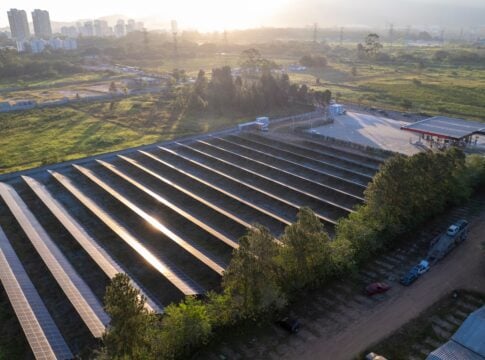
ENGIE has officially brought its Assú Sol photovoltaic complex into full commercial operation. The French utility secured final approval from Brazilian authorities on February 13, 2026, after completing construction in December 2025. With a total investment of BRL 3.3 billion, the project now stands as ENGIE’s largest operational solar asset worldwide.
Located in Rio Grande do Norte in northeast Brazil, Assú Sol has an installed capacity of 895 MWp. The complex spans 2,344 hectares and consists of 16 solar plants. At full output, it can generate enough electricity to meet the annual demand of roughly 850,000 people.
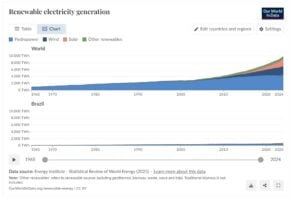
- In 2025, Brazil added 7.4 GW of new large-scale electricity generation capacity, driven primarily by over 2.81 GW of solar PV, according to the energy regulator Agência Nacional de Energia Elétrica (ANEEL).
-
By January 1, 2026, the country’s total large-scale power generation capacity reached 215.9 GW, with renewables accounting for 84.6% of the mix. ANEEL projects a 23.4% increase in renewable capacity in 2026, equivalent to an additional 9.14 GW.
However, while the scale is impressive, the project also reflects a deeper shift underway in Brazil’s renewable energy market.
Assú Sol Delivers at Scale: Advanced Tech Powers Brazil’s Largest Solar Plant
ENGIE completed the project over 30 months, keeping it on schedule and within budget. More than 4,500 direct jobs were created during construction. The development required over 1.5 million solar modules, extensive cabling, and new internal road infrastructure.
Importantly, the company adopted advanced construction technologies. Drone-based aerial mapping improved site planning. Automated graders linked to 3D models enhanced precision. In addition, ENGIE deployed Brazil’s first dedicated automatic pile-driving machine for a solar project.
As a result, execution was faster, safer, and more efficient. Assú Sol demonstrates that large-scale renewables can be delivered with industrial discipline. Yet commissioning marked only the beginning of a more complex challenge.
Assú Sol photovoltaic complex
Curtailment Pressures Test Solar Profitability
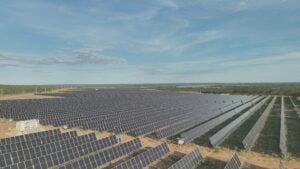
Despite reaching full operations, Assú Sol faces curtailment — a structural issue affecting Brazil’s clean energy sector since 2023. Curtailment occurs when renewable plants must reduce output because the grid cannot absorb all available electricity.
Brazil has added wind and solar capacity at record speed. At the same time, electricity demand has grown slowly. Distributed generation, especially rooftop solar, has also expanded rapidly. Consequently, supply often exceeds transmission capacity and real-time demand.
According to Reuters, ENGIE’s Brazil country manager Eduardo Sattamini confirmed that Assú Sol’s production has already been curtailed to balance the grid. Although specific volumes were not disclosed, the impact is material enough to prompt strategic adjustments.
In other words, renewable abundance does not automatically translate into revenue. Infrastructure constraints now shape project economics as much as generation capacity does.
How ENGIE Plans to Use Storage and Bitcoin
Reuters further revealed that to address this imbalance, ENGIE is evaluating two parallel strategies: battery storage and localized demand solutions such as bitcoin mining data centers.
Battery storage provides the most direct fix. By storing excess midday solar output and discharging it during peak demand hours, batteries reduce curtailment and improve grid stability. They also open access to ancillary service markets, strengthening revenue streams.
However, ENGIE is also studying a more unconventional model — using surplus electricity to power bitcoin mining operations. At first glance, the combination may seem unusual. Yet, from an energy economics perspective, it offers several compelling advantages.
Solar farms often produce maximum output during midday, precisely when grid demand can soften. Instead of shutting down generation, operators can redirect excess electricity to mining operations that can scale consumption up or down in real time.
This model delivers multiple strategic benefits.
-
Lower carbon intensity: Solar-powered mining sharply reduces emissions compared to fossil-fuel-based operations, helping reposition crypto infrastructure within a cleaner energy framework.
-
Flexible demand response: Mining facilities can quickly ramp power usage up or down, absorbing excess electricity during peak solar hours and easing pressure during grid stress.
-
Stable long-term energy costs: Solar generation offers predictable operating expenses after initial capital deployment, protecting operators from volatile power markets.
-
Improved asset utilization: Co-locating data centers with large solar plants maximizes land use and monetizes electricity that might otherwise be curtailed.
-
Diversified revenue streams: Developers gain an additional income channel beyond wholesale power sales, strengthening overall project economics.
Of course, integration comes with challenges. Both solar infrastructure and mining facilities require significant upfront investment. Moreover, energy supply must remain balanced to avoid operational disruptions. Smart-grid systems and, ideally, battery storage will play a critical role in stabilizing performance.
Sattamini made clear that such initiatives would take time to implement. Nonetheless, the strategy signals an evolution in renewable business models — from pure generation toward integrated energy ecosystems.
Community Development and Long-Term Strategy
The company has also invested in the Assú region’s social infrastructure. It supported the construction of a school, a health center, and sports facilities. It improved access to water and provided agricultural equipment to local communities. Such initiatives enhance local acceptance and reinforce the long-term sustainability of the project.
ENGIE’s Renewable and Storage Capacity Goal
Looking ahead, it aims to reach 95 GW of renewable and storage capacity globally by 2030. More than 80% of its planned capital expenditure aligns with the European Taxonomy framework, focusing on low-carbon generation, infrastructure modernization, green gas, and storage technologies.
The company currently operates 15.7 GW of fully renewable installed capacity across hydropower, wind, and solar assets. It also manages 3,200 kilometers of transmission lines and 22 substations.
Some significant achievements include:
- In late 2025, ENGIE commissioned the Serra do Assuruá wind complex in Bahia, adding 846 MW of onshore wind capacity.
- Meanwhile, the Asa Branca transmission project continues to expand grid infrastructure across several states, with more than 1,000 kilometers planned upon completion.
- Another initiative, the Graúna transmission project, will further strengthen interconnections in southern Brazil.
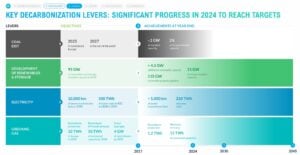
These investments are critical. Without stronger transmission networks, renewable curtailment will persist. Therefore, grid expansion and flexibility solutions must advance alongside generation growth.
As renewable penetration rises, profitability depends not only on installed megawatts but also on flexibility, storage, and innovative demand-side solutions. In that context, combining solar power with storage or even bitcoin mining may redefine how excess clean energy is valued.
And Assú Sol is part of ENGIE’s broader renewable expansion in Brazil, setting an example for renewable markets facing maturity challenges.
The post ENGIE’s Brazil Solar Plant Explores Energy Storage and Bitcoin to Solve Grid Curtailment appeared first on Carbon Credits.

The post Promoting Improved Cooking Practices in Nigeria appeared first on Terrapass.
For most companies, the largest figure in the carbon inventory is not the office, the vehicle fleet, or the electricity bill. It sits upstream, in the goods and materials a business buys to make and sell its products. These purchased inputs form the bulk of a company’s Scope 3 emissions, which routinely exceeds everything the business controls directly, and can add up to 90% of their global footprint.




-
Climate Change1 year ago
Guest post: Why China is still building new coal – and when it might stop
-

 Greenhouse Gases2 years ago
嘉宾来稿:满足中国增长的用电需求 光伏加储能“比新建煤电更实惠”
-
Greenhouse Gases1 year ago
Guest post: Why China is still building new coal – and when it might stop
-

 Climate Change2 years ago
嘉宾来稿:满足中国增长的用电需求 光伏加储能“比新建煤电更实惠”
-

 Renewable Energy12 months ago
Sending Progressive Philanthropist George Soros to Prison?
-
Climate Change2 years ago
Bill Discounting Climate Change in Florida’s Energy Policy Awaits DeSantis’ Approval
-
Greenhouse Gases1 year ago
嘉宾来稿:探究火山喷发如何影响气候预测
-

 Climate Change2 years ago
Analysis: China’s CO2 falls 1% in Q2 2024 in first quarterly drop since Covid-19