


Engie, the world’s largest independent power producer, has made a significant commitment to sustainability by pre-ordering 5 million tons of nature-based carbon removals from Catona Climate, a climate finance company.
This move is part of Engie’s strategy to meet its Net Zero target by 2045. It also represents a major investment in nature-based solutions, which are becoming crucial for climate change mitigation.
A Major Deal for High-Quality Climate Solutions
The recent reports from the Intergovernmental Panel on Climate Change (IPCC) have highlighted the necessity of scaling up carbon removal methods to achieve climate goals. The latest IPCC report emphasizes nature-based solutions, which can remove at least 3 gigatons of CO2 annually by 2030.
Traditionally, efforts focused on technological solutions for carbon capture. However, nature-based solutions are also gaining traction due to their additional environmental benefits, as evidenced in recent Xpansiv report.
Engie’s partnership with Catona Climate reflects a broader industry trend toward integrating ecosystem restoration projects into corporate carbon strategies. This shift highlights the growing recognition of carbon removal alongside direct emission reductions in achieving net zero emissions.
Engie’s pre-order aligns with these findings and marks a significant step up from its previous smaller-scale carbon offset projects. However, scaling these projects faces several challenges, including complexities related to impacts on local communities and balancing carbon sequestration with other environmental benefits.
This is where Catona Climate’s solutions come in.
Based in California, Catona Climate funds high-impact, nature-based projects through carbon removal purchases. These projects are aligned with science-based targets and focus on regenerative land management, reforestation, and combating deforestation.
The climate finance company sources, invests, and monitors these projects, offering businesses a portfolio of high-quality climate solutions. By creating clear demand signals, Catona aims to de-risk carbon investments and accelerate the development of high-quality climate solutions.
A Growing Trend of Nature-Based Carbon Removal
The agreement enables Engie to secure carbon removal credits from multiple projects at fixed prices, offering financial stability and predictability. Under the partnership, the carbon removal credits will be issued between 2030 and 2039, with Engie having the flexibility to source from multiple projects at locked-in pricing.
Jérôme Malka, a member of Engie’s Executive Committee, emphasized the shared commitment to quality and impact between Engie and Catona. He further highlighted the benefits of this deal, saying that:
“Collaborating with Catona to address residual emissions was a natural fit given our alignment on quality and impact, and our shared commitment to supporting projects that not only remove carbon, but also provide meaningful benefits to local ecosystems and communities.”
Tate Mill, CEO of Catona Climate, stressed the importance of the partnership with Engie to drive capital and expand nature-based projects.
“Those signals help us de-risk carbon investments and drive more capital through our trusted network of project developers to accelerate the development of nature-based carbon removal solutions so critical to turning the tide on climate change.”
Engie’s collaboration with Catona is a key component of its strategy to decarbonize clients’ operations and achieve net zero. Here are the other major operational levers of action the company is undertaking.

What’s Inside Engie’s Ambitious Net Zero Goal?
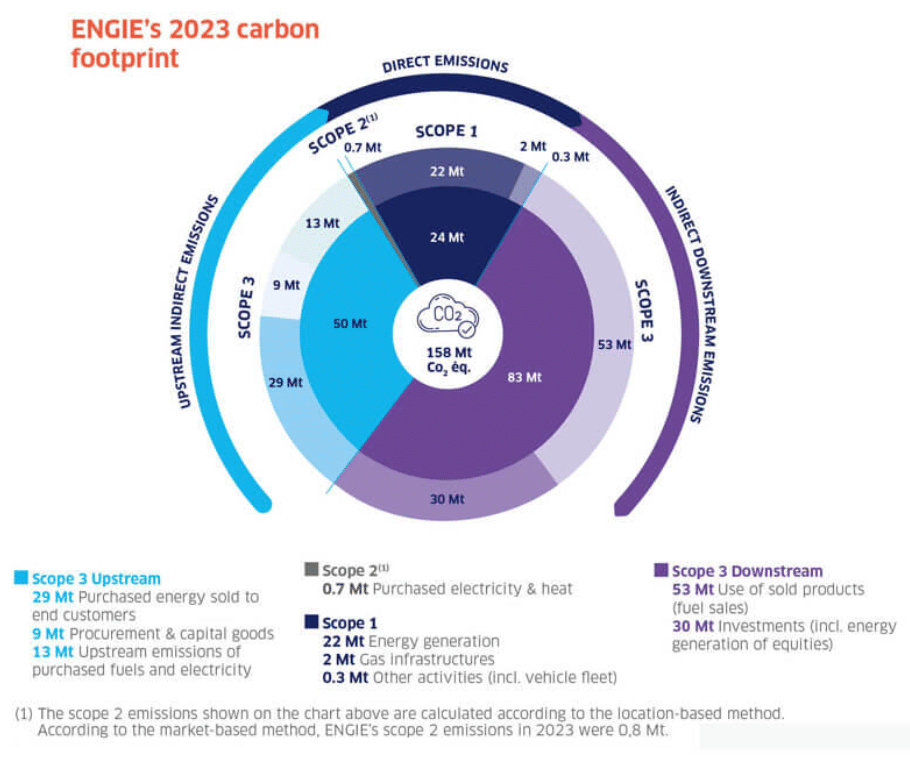
Engie is committed to a bold decarbonization strategy, aiming to achieve net zero across its three scopes. In 2023, the Group’s carbon emissions totaled 158 million tonnes of CO2 equivalent, a significant reduction of 39% from 2017’s 260 million tonnes.
The French power company’s roadmap sets a goal to cut all emissions by at least 90% between 2017 and 2045, with the remaining 10% to be neutralized. The company’s 2030 decarbonization trajectory, certified as “well below 2°C” by the Science-Based Targets initiative (SBTi), involves four main goals to reduce emissions. These include:
- 59% reduction in energy production emissions (scopes 1 and 3),
- 34% decrease in emissions from gas sales (scope 3),
- 66% reduction in carbon intensity from energy production (scope 1) and consumption (scope 2), and
- 56% cut in the carbon intensity of energy sales (scopes 1 and 3).
To achieve these targets, the power company is adopting several key strategies:
- Phase Out Coal: The Group plans to completely eliminate coal by 2025 in Europe and by 2027 globally.
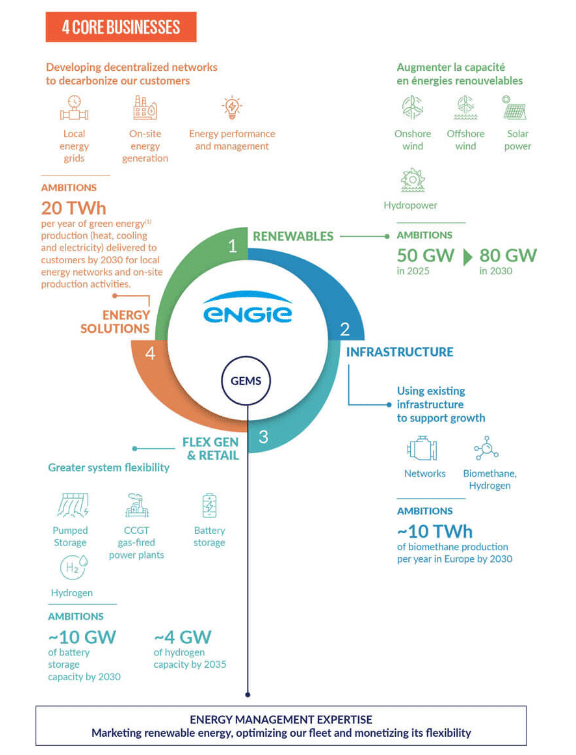
- Expand Renewable Energy: ENGIE aims for renewables (solar, onshore, and offshore wind) to comprise 58% of its electricity generation mix by 2030, boosting production capacity by 50 GW by 2025, reaching 80 GW by 2030. Additionally, 10 GW of battery storage capacity will be installed, mainly in Europe and the US, to enhance the flexibility of the energy mix.
- Increase Green Gases: The biomethane production capacity is targeted to reach 10 TWh/year in Europe by 2030, with an injection capacity of 50 TWh/year across ENGIE’s networks. Green hydrogen is also a crucial component, with a goal of producing 4 GW by electrolysis by 2030, supported by a 700km transport network and 1 TWh storage capacity.
Notably, the Group aims to manage 30 TWh/year of decarbonized hydrogen and establish over 100 hydrogen refueling stations.
Finally, Engie commits to a program to reduce carbon emissions, targeting 45 million tons of CO2 eq. avoided each year. Part of this goal is investing in 5 million tons of carbon credits, which what the company just did.
Engie’s pre-order from Catona represents a step towards achieving its net zero goal by 2045. This collaboration aims not only to reduce carbon emissions but also to support local ecosystems and communities, ensuring the long-term viability of nature-based carbon removal solutions.
The post Engie Buys 5 Million Tons of Nature-Based Carbon Credits for Net Zero appeared first on Carbon Credits.

The post Promoting Improved Cooking Practices in Nigeria appeared first on Terrapass.
For most companies, the largest figure in the carbon inventory is not the office, the vehicle fleet, or the electricity bill. It sits upstream, in the goods and materials a business buys to make and sell its products. These purchased inputs form the bulk of a company’s Scope 3 emissions, which routinely exceeds everything the business controls directly, and can add up to 90% of their global footprint.




-
Climate Change1 year ago
Guest post: Why China is still building new coal – and when it might stop
-

 Greenhouse Gases2 years ago
嘉宾来稿:满足中国增长的用电需求 光伏加储能“比新建煤电更实惠”
-
Greenhouse Gases1 year ago
Guest post: Why China is still building new coal – and when it might stop
-

 Climate Change2 years ago
嘉宾来稿:满足中国增长的用电需求 光伏加储能“比新建煤电更实惠”
-

 Renewable Energy12 months ago
Sending Progressive Philanthropist George Soros to Prison?
-
Climate Change2 years ago
Bill Discounting Climate Change in Florida’s Energy Policy Awaits DeSantis’ Approval
-
Greenhouse Gases1 year ago
嘉宾来稿:探究火山喷发如何影响气候预测
-

 Climate Change2 years ago
Analysis: China’s CO2 falls 1% in Q2 2024 in first quarterly drop since Covid-19