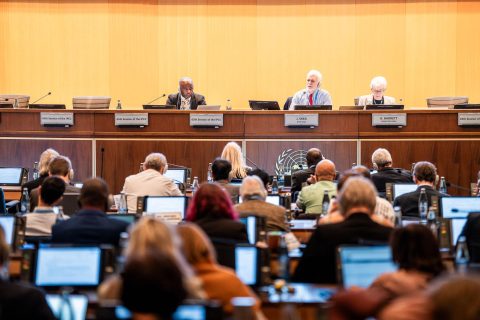
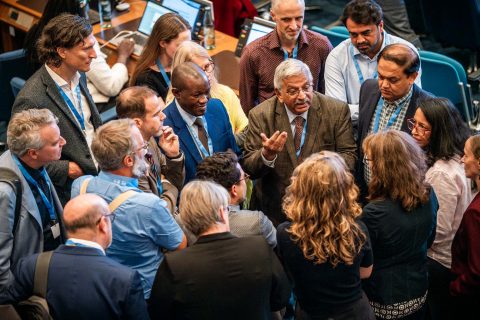
The Turkish government and the International Renewable Energy Agency have called for a stronger global push to run vehicles, industry and buildings on electricity rather than fossil fuels, ahead of this year’s COP31 climate talks.
COP31 President Murat Kurum told the Copenhagen Climate Ministerial on Wednesday that governments should be “decarbonising the way we generate electricity, but also expanding electrification into every sphere of life”.
“We must make the technologies of the future accessible at scale – and we must ensure that no one is left behind,” he told the gathering of climate diplomats and ministers from around 40 countries in the Danish capital.
Kurum said that the percentage of final energy consumption which is met by electricity – the key metric of electrification, which is currently around 20% globally – should be increased “as much as we possibly can”.
The head of the International Renewable Energy Agency (IRENA), Francesco La Camera, also addressed the Copenhagen gathering. While his comments to ministers were not public, IRENA released a statement ahead of the talks calling for a goal to increase electricity’s share of final energy consumption to 35% by 2035.
The two officials did not reference the war with Iran and the price hikes in oil and gas as a result of related supply disruptions, but UN and other leaders have used this as an argument in favour of transitioning away from planet-heating fossil fuels towards clean, domestically produced renewables.
35 by 35 goal
“The world must adapt to a new energy reality,” La Camera said in the IRENA statement. “Beyond the goals of tripling renewables and doubling energy efficiency [by 2030] lies the wider challenge of transforming entire energy systems and reducing fossil fuel use across supply and demand. Electrification and fossil fuel phase-out are inseparable and must advance together.”
He said electrification, which can be achieved through technologies like electric heat pumps, vehicles and cookers, will reduce greenhouse gas emissions, enhance energy security and bolster economic competitiveness.
A new “transitioning away from fossil fuels” roadmap released by IRENA says this 35% by 2035 electrification goal is vital if the world is to “remain” on a pathway to limit global warming to 1.5C. Electrification should reach at least 50% by 2050, it adds.
To enable this goal to be met, the amount of money invested in power grids each year should double from $0.5 trillion in 2025 to around $1 trillion each year until 2035. Significant investment in electricity storage and demand flexibility is also needed, the roadmap says.
Clémence Dubois, campaigns manager for green group 350.org, welcomed Kurum’s remarks but added that electrification and energy justice should be funded through large developed countries taxing the windfall profits of fossil fuel companies.
Collective goal or coalition?
It is not yet clear whether the Turkish government, or the Australian government which is tasked with leading the COP31 negotiations, will attempt to get all countries to agree to an electrification goal at November’s climate summit in Antalya.
If so, such a goal could be collectively endorsed by all nations in a COP decision, as with the COP28 targets to triple renewables capacity and double the rate of growth in energy efficiency, both by 2030. Where there is narrower support, other goals have been voluntarily launched at COPs, backed by coalitions of countries, including pledges to boost nuclear energy, biofuels and grid investment.
A source with knowledge of Türkiye’s priorities confirmed that electrification is important to the COP31 host, alongside energy storage, energy security, clean cooking and resilient and clean energy systems.
The post Electrification emerges as Turkish COP31 priority appeared first on Climate Home News.
Climate Change
We need no-go mining zones for the energy transition to be just: Here’s how it could work
Perrine Fournier is a trade, mining, and forest campaigner at Fern.
The threat that mining critical raw materials poses to some of the planet’s most important ecosystems is beyond dispute. To prevent it, some places on Earth must be declared off-limits for mining under any circumstances. Work has already began to identify them.
A global power struggle to secure strategic resources powering the energy transition, AI and weapons systems is driving growing demand for minerals such as copper, cobalt, lithium, nickel and manganese, which are used to make electric vehicles (EVs), batteries, wind turbines and other clean energy technologies needed to transition away from fossil fuels.
This mining boom is compounding the threats that extraction poses to precious ecosystems – including tropical forests which are vital to address climate change – and the communities who depend on them.
Preventing this environmental destruction and ensuring that mining is carried out within planetary boundaries is urgent. One solution that is gaining traction has long been advocated by Indigenous groups: creating mining no-go zones.
Fern and a group of NGOs in consultations with Indigenous Peoples’ organisations have began to sketch out a methodology to map out where mining poses unacceptable social, environmental and human rights-related risks and should be prohibited.
Off-limits: Fragile ecosystems that store carbon
The methodology is based on six criteria to determine where mining should be off-limits.
This includes areas protected under international conventions; areas with high conservation value from intact forests to key biodiversity hotspots; forests, peatlands and wetlands that are critical for carbon storage; significant ecosystems such as small islands, mangroves and grasslands; critical water bodies and Indigenous Peoples’ territories.

Around half of the of the metals and minerals needed for the energy transition are located on or near Indigenous Peoples’ territories.
A case in point is Brazil, one of the most mineral-rich countries on earth. Recent research shows that the expansion of mining threatens the conservation of about 363,000 km2 of protected land in the Brazilian Amazon, which consist mainly of forests, and is home to 195,000 traditional and Indigenous people.
Deforestation is a major driver of climate change as it releases carbon stored in the trees into the atmosphere, weakening the forests’ role as a carbon sink. Most of the Brazilian Amazon should therefore be off-limits to mining, both to protect Indigenous Peoples’ rights and because of its crucial role for the climate and biodiversity.
In the Democratic Republic of Congo, mining has had a devastating impact on the precious Miombo forest, one of the world’s largest dry forest ecosystems, and local peoples’ food security. This too is an area where mining should not be allowed to take place.
Protected areas must be default no-go zones
In Europe, efforts to secure access to minerals is also threatening fragile ecosystems. Recent reporting revealed that the European Commission disregarded expert advice when selecting “strategic” mining sites eligible for streamlined permitting procedures, with several environmentally and socially controversial projects added to the list after they initially failed to meet expert assessments.
One project which met the expert assessment but is nevertheless attracting controversy is the Sakatti nickel mining project in Finnish Lapland.
Part of its nickel deposit lies under a rich peat bog ecosystem, a major carbon store which developed when glacial rivers and a lake melted at the end of the late Ice Age. The site is protected under Finnish law and is as part of the Natura 2000 network intended to protect Europe’s most valuable species and habitats. These legal safeguards are on the verge of being overridden. Such protected areas should always remain off-limits to mining.
Kicking starting a discussion
To prevent mining from undermining human rights and global climate and biodiversity goals, we urgently need to adopt a global and precautionary approach. This should start with a shared definition of which areas on land and sea should be considered off-limits for extraction.
The methodology we propose is intended to kick-start a broader and transparent discussion, based on scientific, legal and social criteria, in which rights-holders and Indigenous Peoples’ organisations have a seat at the table. No mining should go ahead if it doesn’t have the Free Prior and Informed Consent (FPIC) of Indigenous Peoples’ or local communities.
Many of the restricted areas are bound to lie in forested tropical countries in the Global South, which understandably want to capitalise on their resources to spur industrial development and create jobs. But history has taught us that relying on a single resource for development runs the risk of being trapped in a resource curse. The more diversified an economy is, the more secure it is.
Reducing mineral demand
Our modelling shows that for minerals such as nickel, cobalt, lithium, there are sufficient resources that could be mined outside of these restrictive areas to wean the global economy away from climate-wrecking fossil fuels and shift to clean energy systems.
However, that requires hard policy choices, such as reducing mineral demand by promoting more efficient vehicles and alternative battery technologies that are less reliant on critical minerals, as well as better public transport, active travel and car sharing opportunities.
In addition, recycling has a major role to play. A major study recently showed that Europe could meet half of its critical mineral needs through recycling by 2050.
Some mining to access the materials the world needs to address climate change is both inevitable and necessary. But agreeing on a framework to restrict mining in the world’s most sensitive areas will protect them from its ravages, and break the destructive patterns of the past.
The post We need no-go mining zones for the energy transition to be just: Here’s how it could work appeared first on Climate Home News.
We need no-go mining zones for the energy transition to be just: Here’s how it could work
Climate Change
Guest post: Climate change has caused one-fifth of Pine Island glacier retreat
The Pine Island glacier in West Antarctica is one of the fastest-changing glaciers in the world.
Alongside its neighbour, the Thwaites glacier, it is responsible for almost half the sea level rise caused by melting ice sheets in Antarctica.
Scientists know the West Antarctic ice sheet – which includes Thwaites and Pine Island – is retreating because of warm water eroding the ice sheet from below.
But the extent to which this process has been driven by human-caused greenhouse gas emissions, as opposed to natural variations to the Earth’s climate, remains unknown.
Our study, published in the Cryosphere, looks at how human-caused warming has contributed to the retreat of the Pine Island glacier since pre-industrial times.
The research, the first attribution study of glacier retreat on Antarctica, finds that climate change has been responsible for around 4km – roughly a fifth – of the glacier’s retreat.
The West Antarctic ice sheet
Glaciers are frozen rivers of ice and snow that move slowly over land. They are found at high elevations on mountains and on ice sheets.
There are two ice sheets on Earth – covering Antarctica and Greenland. Both were formed over millennia, as layers of snow compressed into dense ice.
Ice sheets grow and shrink depending on temperature and snowfall conditions. In the past, when global temperatures were much colder than present day, vast ice sheets also covered large areas of North America, Scandinavia and Patagonia.
Today, human-driven climate change is accelerating the retreat of ice sheets. This is contributing to sea level rise and altering the Earth’s climate system by pumping vast quantities of fresh melt water into the ocean.
Our research looks at the Pine Island glacier, which is found on the western part of the Antarctic ice sheet.

It is one of the fastest-melting glaciers in the world. Research has shown it has been responsible for a fifth of net ice loss from the West Antarctic ice sheet, which, in turn, has been responsible for almost all ice loss in Antarctica over the past 40 years.
At the coldest point of the last ice age – the “last glacial maximum” period around 20,000 years ago – the West Antarctic ice sheet was much bigger than it is today. Since then, it has retreated by approximately 500km – roughly the distance from Paris to London.
Most of this retreat took place between 10,000 and 20,000 years ago. For the past 10,000 years or so, the ice sheet has been about as big as it is today.
Sediment records beneath the Pine Island glacier reveal that, for hundreds of years until the 1940s, the glacier rested on a seabed ridge that is about 30km ahead of where it sits today.
The sediment records also tell us that the Pine Island glacier started to retreat in the 1940s. This coincided with a strong El Niño event, a recurring climate pattern in the tropical Pacific that drives up global temperatures, that brought a large pulse of warm water to the ice sheet.
This is illustrated in the figures below, which shows how the grounding line – the boundary between grounded and floating ice – of the Pine Island glacier shifted between pre-industrial times (red line) and 2015 (bright blue line).
The map on the left shows an aerial view of grounding line retreat from pre-industrial times (red) to 2015 (blue). The graphic on the right illustrates how the grounding line has shifted across a cross-section of the glacier.
Both illustrate how the glacier has contracted.

Climate reconstructions suggest that human-caused climate change only started to increase the amount of warm water reaching the West Antarctic ice sheet in the 1960s.
This indicates that climate change started to affect the melt rate in the region 20 years after the retreat had already been initiated.
In our research, we wanted to find out how important climate change was to the overall retreat since the 1940s.
Attributing ice sheet retreat
Currently, scientists do not know precisely how much of the retreat of the world’s ice sheets – and the associated sea level rise – is due to human-caused global warming.
Through the field of attribution science, the links between climate change and extreme weather and climate events, including heatwaves, wildfires and droughts, are routinely quantified by scientists.
In attribution studies, scientists typically use climate models to simulate the severity or frequency of an event in two worlds. The first is our existing, climate-changed world and the second is a “counterfactual” world that has not been affected by human-caused warming.
By comparing the model runs, scientists can assess how much climate change influenced an event.
To create these two modelled worlds in an Antarctic context, scientists need to run historical models for at least 200 years into the past. This is because ice sheets respond very slowly to changes in the climate, with very small changes year-on-year.
This presents a challenge, given the limited information available about ice sheet change before satellite records began in the 1970s.
To build a picture of the ice sheets prior to this, scientists have to rely on a few, sparse, palaeoclimate records – including sediment records and seafloor imprints – which tell us where ice was present in the past.
Reconstructing Pine Island’s past
To reconstruct the retreat of the Pine Island glacier – and, therefore, determine the role of climate change – we used a combination of physical climate models and machine learning.
First, we ran many simulations of our model under a range of different settings. This included variations in how important processes are represented, such as how the ice moves and interacts with the ocean.
Then, we compared the results of these simulations to modern satellite observations and older sediment records, allowing us to narrow down the settings that were most realistic. This gave us a set of plausible simulations that agreed with the available observational data.
However, to reconstruct the retreat in full, we needed to find all settings of our model that would agree with the observational data.
Because simulations take a lot of time to run, this was not possible.
Therefore, to fill the gaps and find all plausible simulations, we used machine learning to identify relationships between model settings and simulated glacier retreat.
This exercise allowed us to build a good picture of how the glacier actually retreated over the past 250 years. We call this our “reconstructed” scenario.
We then compared the glacier retreat in this reconstructed world with changes that took place in a counterfactual scenario where there had been no human-caused climate change.
In doing so, we were able to quantify the role that warming played in the shrinking of the Pine Island glacier since the 1940s.
Overall, we estimate that warming has been responsible for around 4km – roughly a fifth – of the glacier’s retreat since 1940.
This is shown in the figure below, which shows how grounding line retreat in the reconstructed scenario (blue) is more extreme than projected by the counterfactual scenario (green).

Interpreting the numbers
Our work quantifies, for the first time, the role of climate change in the retreat of a glacier in the world’s ice sheets – directly linking greenhouse gas emissions with glacier decline.
We also find that the Pine Island glacier may have retreated even without climate change, just not as far. This is similar to how extreme weather events, such as drought or extreme rainfall, could still happen without climate change, just with less frequency or intensity.
One of the key challenges in our research arises from not knowing exactly how large the ice sheet was prior to satellite records.
Although the sediment records tell us where the ice was grounded – that is, what its footprint was – they do not tell us exactly how much ice there was.
This means we do not know exactly how to set up our model at the start of the simulations, which leads to uncertainty in our predictions.
Further work is underway to determine exactly how to best set up the simulations for future research.
The post Guest post: Climate change has caused one-fifth of Pine Island glacier retreat appeared first on Carbon Brief.
Guest post: Climate change has caused one-fifth of Pine Island glacier retreat
Climate Change
Climate adaptation in Africa needs investment, not imported solutions
Ellen Davies is head of programmes at the African Climate Foundation and is based in Kenya. Wole Hammond is programme officer for adaptation and resilience at the foundation, based in Nigeria.
For generations, African communities have lived on the frontlines of climate disruption, managing erratic rainfall, prolonged droughts and the slow erosion of their livelihoods, which depend on predictable seasons.
When the rains failed across Southern Africa in 2024, it was but the latest chapter of a crisis already long underway. During that season, maize crop failures of 40-80% devastated farming communities in Zambia, Zimbabwe and Malawi, where roughly 70% of people depend on rain-fed agriculture. Governments already stretched by debt were forced to raid development budgets, trading long-term growth for emergency relief.
Then came the floods. In early 2026, parts of Mozambique, Zimbabwe and South Africa received over a year’s worth of rain in days. More than 2 million people were affected. In East Africa, drought has displaced nearly 62,000 people in Somalia this year alone, with nearly one in four Somalis now facing acute food insecurity.
This is what climate change looks like on the ground – not parts per million or diplomatic jargon, but whether a school stays open after floods cut off the road, whether a clinic can function in extreme heat, whether a country can still invest in its future when every year brings another disaster bill.
As Nigeria rails at loss and damage “mirage”, fund boss assures money is coming
Africa as a continent contributes the least to global emissions yet bears a disproportionate share of the consequences. Nine of the ten countries most vulnerable to climate change are African. As livelihoods collapse and rural economies fail, migration pressures will intensify, driven by climate change intersecting with poverty, conflict and constrained opportunity.
Chronic under-funding
Europe is only now beginning to experience, in more limited form, what African communities have navigated for decades with far less fiscal space, thinner insurance coverage and fewer resources for recovery. With El Niño conditions confirmed and a “super” version of the naturally occurring weather pattern possible later this year, the pressure is set to intensify further.
In Africa, climate action is fundamentally a development challenge where adaptation and mitigation must go hand in hand. Building a solar grid and flood-proofing the road that serves it are not separate agendas. Yet for too long, the global climate conversation has prioritised mitigation while leaving adaptation – the work of protecting lives, livelihoods and economies in a changing climate – chronically under-funded.
The result is three compounding gaps. A visibility gap: much of Africa’s adaptation work remains under-documented and under-recognised in global climate narratives. A financing gap: capital does not flow at the scale or speed required to the people and institutions best placed to use it. And a decision-making gap: too many solutions are still designed elsewhere and imported into African contexts, rather than backing African-led platforms to scale what is already working.
Live from LCAW – Raw diplomacy: Can new mineral alliances deliver a just energy transition?
Solutions ready for finance
The solutions exist. Rwanda’s green investment fund has mobilised climate finance at national scale through its own systems. Egypt’s Nexus of Water, Food and Energy programme has shown how integrated planning can stretch limited resources across interdependent systems.
Zambia’s Presidential Irrigation Initiative is building climate-resilient food production from the ground up. In Pata, Senegal, a solar irrigation project has unlocked agricultural production and created jobs, demonstrating how integrated investments in water, energy and livelihoods can deliver resilience and development gains simultaneously.
In South Africa, the African Climate Foundation’s work with the South African Local Government Association (SALGA) is supporting district municipalities to assess their climate risks and develop fit-for-purpose Climate Action Plans, building adaptation capacity where it is needed most – at the local level.
These are not pilot projects waiting to be validated. They are working systems waiting for investment.
Closing the gaps requires a decisive shift in posture from global finance, philanthropy and development institutions. It means backing country-led platforms that can prepare, aggregate and finance adaptation projects. It means investing in place-based initiatives grounded in local knowledge.
French court rules Total must revise climate plan to account for all emissions
It means fostering intra- and inter-continental collaboration, so that lessons from Kigali inform decisions in Nairobi and innovations in Lagos reach communities in Dakar. And it means treating adaptation as core economic infrastructure, not charitable relief.
Invest now for future gains
The economic case is clear. Every dollar invested in climate adaptation returns an estimated four dollars in benefits on average – and up to five in the poorest economies. Under-investment in African adaptation is as economically irrational as it is morally unjust.
The world depends on Africa’s food systems, its young workforce – the majority of the continent’s population is under 25 – and its minerals. Several African countries supply a substantial share of the copper, cobalt and other critical materials underpinning the global clean energy transition.
Drought in Zambia has already shown how climate stress can disrupt hydropower, electricity supply and mining output. A transition that depends on African minerals cannot afford to ignore African climate resilience.
The world can continue to under-fund adaptation and pay repeatedly for emergencies, instability and lost development. Or it can invest now in the people, institutions and systems already doing the work on the ground in Africa, not in solutions imported from elsewhere.
Africa has the agency, the knowledge and the platforms. What it needs is the finance to match. A super El Niño will not wait for consensus to form. Neither, frankly, should we.
The post Climate adaptation in Africa needs investment, not imported solutions appeared first on Climate Home News.
Climate adaptation in Africa needs investment, not imported solutions
-
Greenhouse Gases11 months ago
Guest post: Why China is still building new coal – and when it might stop
-
Climate Change11 months ago
Guest post: Why China is still building new coal – and when it might stop
-
Greenhouse Gases2 years ago嘉宾来稿:满足中国增长的用电需求 光伏加储能“比新建煤电更实惠”
-
Climate Change2 years ago嘉宾来稿:满足中国增长的用电需求 光伏加储能“比新建煤电更实惠”
-
Renewable Energy8 months agoSending Progressive Philanthropist George Soros to Prison?
-
Climate Change2 years ago
Bill Discounting Climate Change in Florida’s Energy Policy Awaits DeSantis’ Approval
-
Carbon Footprint2 years agoUS SEC’s Climate Disclosure Rules Spur Renewed Interest in Carbon Credits
-
Greenhouse Gases12 months ago
嘉宾来稿:探究火山喷发如何影响气候预测