

english version below
Heute begleiten wir Julia vom Institut für Chemie und Biologie des Meeres der Uni Oldenburg bei ihrer Arbeit auf der Maria S. Merian. Im letzten Beitrag ging es schon ein bisschen um die Unterwegsdaten, die auf Schiffen gemessen werden. Julia hat noch ein weiteres Gerät mitgebracht, das auch in diese Kategorie fällt: eine FerryBox.


Die FerryBox ist ein sogenanntes Durchflussgerät. Das bedeutet, dass Wasser unter dem Schiff mit einer Pumpe angesaugt und durch das Gerät geleitet wird. Dann kann das Messgerät Temperatur und Salzgehalt des Wassers messen. Diese beiden Größen sind wichtig, da sie die Dichte des Wassers bestimmen und damit Aufschluss über Strömungen geben. Außerdem misst das Gerät auch bio-optische Werte, nämlich Chlorophyll A und CDOM (Colored Dissolved Organic Matter = farbige gelöste organische Substanz auch Gelbstoff genannt). Chlorophyll gibt Aufschluss darüber, wieviel Phytoplankton sich im Wasser befindet. Phytoplankton sind kleine Algen, die die Grundlage für das gesamte Nahrungsnetz des Meeres bilden. Der große Vorteil der Ferry Box ist ihr modularer Aufbau. So können zum Beispiel auch Sensoren für totale Alkalinität (wieviel Säure das Wasser binden kann), Kohlenstoffdioxid oder PH-Wert zusätzlich angebaut werden.
Das sind also alles wichtige Größen, um Prozesse im Meer zu verstehen. Aber warum ist das Gerät genau an Bord und woher kommt der Name FerryBox?
Vielleicht fangen wir mit der Namenserklärung an. Die FerryBox ist dafür gedacht auf Fähren (englisch: ferry) mitzufahren. Fähren bieten sich gut dafür an Messgeräte mitzunehmen, da sie regelmäßig die gleiche Strecke fahren. Die Ferry Box ist ein kastenförmiges Gerät, dass autonom messen kann und nur von Zeit zu Zeit von einem Wissenschaftler oder einer Wissenschaftlerin gewartet werden muss.
Das große Ziel dieses ersten Teils der Forschungsfahrt ist es, die Übertragung der Daten von Messgeräten an Land zu optimieren. Die FerryBox kann beispielhaft dafür betrachtet werden. Julia hat sie an Bord gebracht und kümmert sich jetzt zusammen mit Norbert vom Alfred-Wegener-Institut darum, dass die Daten annähernd in Echtzeit an Land übertragen werden. Wenn sie im zweiten Teil der Forschungsreise wieder an Land in ihrem Büro ist, kann sie die Daten an ihrem Computer abrufen. Sollte dann ein Fehler auftreten, kann sie direkt auf dem Schiff Bescheid sagen, damit das Problem direkt behoben werden kann. Zusätzlich dazu kalibriert Julia die FerryBox auch noch. Dafür lässt sie Wasserproben im Labor durch einen Filter laufen und lagert sie danach in einem Kühlschrank, der eine Temperatur von -80°C hat. So bleiben die Proben haltbar, bis sie im Anschluss in Deutschland in einem Labor ausgewertet werden.


Am Ende soll die entwickelte Software als Blaupause für anderen Geräte nutzbar sein. Die annähernden Echtzeitdaten sind dann auch öffentlich sichtbar und können von jedem genutzt werden.
The FerryBox
Today we accompany Julia from the Institute of Marine Chemistry and Biology of the University of Oldenburg in her work on the Maria S. Merian. The last post was a bit about the underway data, which are measured on ships. Julia brought with her another device that also falls into this category: a FerryBox.
ph-value (Photo: Christiane Lösel)
The FerryBox is a so-called flow device. This means that water under the ship is sucked in with a pump and passed through the device. The instrument can then measure the temperature and salinity of the water. These two quantities are important because they determine the density of the water and thus provide information about currents. In addition, the device also measures bio-optical values, namely chlorophyll A and CDOM (Colored Dissolved Organic Matter). Chlorophyll provides information about how much phytoplankton is present in the water. Phytoplankton are small algae that form the basis of the entire marine food web. The great advantage of the Ferry Box is its modular structure. For example, sensors for total alkalinity (how much acid the water can bind), carbon dioxide or PH value can also be added.
So these are all important variables for understanding processes in the ocean. But why is the device on board and where does the name FerryBox come from?
Maybe we’ll start with the declaration of names. The FerryBox is meant to be used on ferries. Ferries are good for carrying measuring instruments, as they regularly travel the same distance. The FerryBox is a box-shaped device that can measure autonomously and only needs to be maintained by a scientist from time to time.
The main objective of this first part of the research trip is to optimise the transmission of data from measuring instruments to land. The FerryBox can be seen as an example of this. Julia brought them aboard and, together with Norbert from the Alfred Wegener Institute, is now making sure that the data is transmitted to shore in near real time. When she is back ashore in her office during the second part of the research trip, she can retrieve the data from her computer. If an error should occur, she can notify the ship directly so that the problem can be rectified immediately. Julia also calibrates the FerryBox. To do this, she passes water samples through a filter in the lab and then stores them in a refrigerator with a temperature of -80°C. This means that the samples remain stable until they are subsequently evaluated in a laboratory in Germany.
In the end, the developed software should be usable as a blueprint for other devices. The near real-time data is then also publicly visible and can be used by anyone.


Our ocean is an incredibly vast and mysterious place. And there is no place where that is more evident than the deepest ocean area in the world: the legendary Mariana Trench. Located east of the Philippines, the Mariana Trench lies in the Mariana Archipelago in the western portion of the North Pacific. The greater area of the Mariana Trench Marine National Monument is made up of more than 95,000 square miles of ocean. Beneath these waters lie incredibly complex aggregations of submerged islands and volcanoes … and of course, an astoundingly massive trench.
Dive in with us to have your biggest questions answered about the famed Mariana Trench.
How deep is the Mariana Trench?
The deepest part of the Mariana Trench, known as Challenger Deep, is almost 36,000 feet below the ocean’s surface. For context, Mount Everest is about 29,000 feet above sea level, so the Mariana Trench is about 7,000 feet deeper than Mount Everest is tall. For one more comparison, the RMS Titanic lies at a depth of about 12,500 feet below sea level. The Challenger Deep is in waters nearly three times deeper than this ship’s final resting place.
Due to its enormous size, the Mariana Trench has at times been affectionately nicknamed the Grand Canyon of the ocean. This is certainly a picturesque image, but don’t let the mammoth size of this U.S. national terrestrial park fool you into thinking the Mariana Trench matches its size. The trench’s footprint is estimated to be 120 times larger than the Grand Canyon’s, and to reach the bottom of Challenger Deep, you’d need to descend through almost six Grand Canyons stacked on top of each other before you’d reach the seafloor.
Oh … and did we mention it’s five times wider than it is deep? It’s about 43 miles wide!
What is Challenger Deep, and how long would it take to reach it?
Challenger Deep is the deepest point of the Mariana Trench. Fewer than 30 people have ever journeyed to this area. The trek below the surface is long, dark and time-consuming, and it’s not an expedition considered lightly by scientists and explorers.
The first people to descend into the depths of this area in 1960 were oceanographers Jacques Piccard and Don Walsh, and it took them close to five hours to reach Challenger Deep. Since then, more advanced submersibles have been created, but it still takes two to four hours for modern vessels to reach such depths. For example, explorer and filmmaker James Cameron reached the seafloor in a little more than 2.5 hours in the first documented solo submarine dive to the area, and it took oceanographer Dr. Dawn Wright about four hours in 2022. It is crucial that these submersibles descend slowly and steadily beneath the surface, as the immense water pressure compounds with every mile a submersible descends. Speaking of pressure …
Get Ocean Updates in Your Inbox
Sign up with your email and never miss an update.
What is the water pressure at the bottom of the Mariana Trench?
If you thought the depth of the Mariana Trench was its only jaw-dropping feature, think again. Water pressure is one of the most important factors affecting deep-sea life. In the ocean, pressure increases by one atmosphere for every 33 feet (10 meters) of depth. One atmosphere (a unit of measurement for pressure equivalent to average air pressure at sea level) is equal to about 14.7 pounds per square inch (PSI), which is the approximate standard atmospheric pressure at sea level. If you were to convert atmospheric pressure into weight, one atmosphere is about the weight of a bowling ball. Stay with me, friends.
If a vessel were to dive 2,000 feet below the surface, the pressure would equal that of 60 bowling balls stacked atop every square inch of that submersible. But 60 bowling balls is simply nothing compared to the pressure in the Mariana Trench. The atmospheric pressure at the depths of Challenger Deep is equal to about 16,000 PSI. That pressure is about the same as the weight of an entire full-grown elephant on every square inch of a submersible!
Need a more extreme comparison? If a human were to be placed at the bottom of the Mariana Trench, the pressure would be equal to that of 50 jumbo jets piled on top of a person!
Do any animals live in the Mariana Trench?
The depths of the Mariana Trench come with immense pressure and extreme darkness, but somehow, life finds a way to survive. Organisms that live at an extreme depth, like that of Challenger Deep, have to be highly adapted to low temperatures (typically just above freezing), high pressure and virtually no light at all.
Species found in the depths of the Mariana Trench might look vastly different from animals from other ocean depths because their anatomy has been refined to thrive in harsh conditions. At such great depths, these animals typically depend on chemosynthesis (using nutrient-rich waters being pumped out of hydrothermal vents) or descending detritus (dead matter that has fallen from higher parts of the ocean) for food, such as whale falls. Just a handful of these animals include species of octopuses and squids, sea cucumbers, amphipods, sea jellies, shrimp, sea worms and some wild-looking fish!
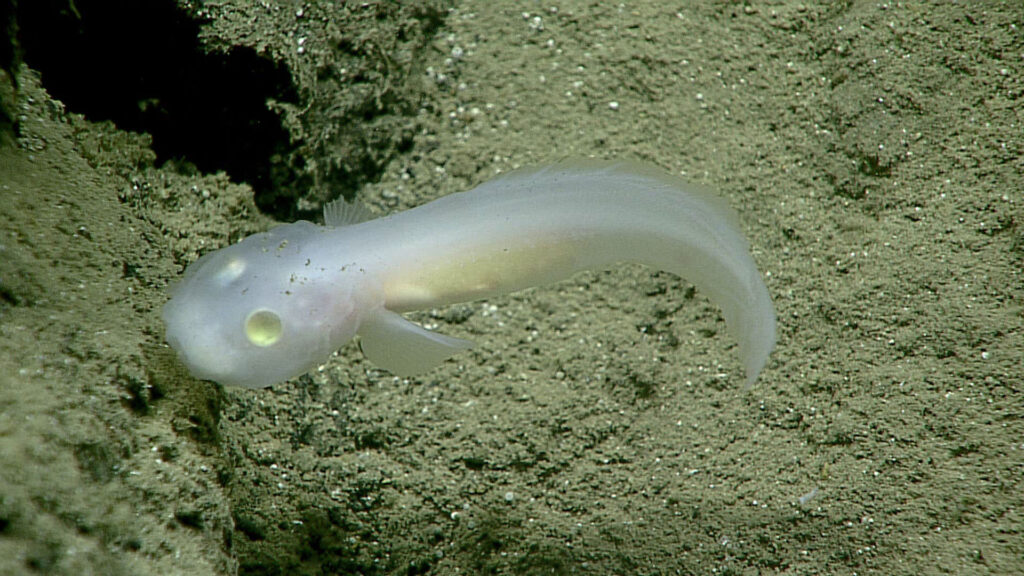
In 2025, more than 7,000 new species were discovered in the Mariana Trench, including the hadal snailfish (Pseudoliparis swirei). This is the deepest-dwelling fish currently known to science. Now, the fish has been dubbed “the Mariana snailfish.”
How was the Mariana Trench formed?
The process by which the Mariana Trench was created is a geologically fascinating one known as subduction. On the Earth’s surface, there are thin plates that cover the planet’s mantle, which is made of molten rock. If two of these plates collide, one pushes down into the Earth’s mantle while the other is pushed over the bottom plate. When this happens, a trench is formed from the drag of the bottom plate. This process can sometimes create incredibly strong earthquakes. The plates that forged the Mariana Trench’s creation are estimated to be up to approximately 180 million years old.
This trench was unknown to scientists until 1875. It was then that a team of explorers on the HMS Challenger measured the depth of the sea by simply lowering a weighted rope into the water. They were baffled when they measured that first portion of the seafloor to be five miles below the surface. And so was born the origin of some of the most daring deep-sea explorations known to mankind to date.
Is the Mariana Trench protected?
The Mariana Trench is in waters off Guam and the Mariana Islands. The region is protected from some human activities under its status as a marine monument. The creation of the Mariana Trench Marine National Monument signified that international, national and local leaders all recognize the importance of protecting this area.
However, just because the region is protected does not mean it’s not vulnerable to modern threats to ocean health. Plastic bags have been spotted in the Mariana Trench during several expeditions, highlighting the far-reaching impact of the marine debris problem. No corner of our ocean is safe from the ever-present threat of plastic pollution. The reality of a changing climate makes the future well-being of wondrous places like the Mariana Trench uncertain. What’s more: More than 70% of the global ocean has yet to be mapped. And what we don’t yet know about, we cannot wisely work to protect.
It’s up to us to work together to defend our ocean, from the sandy shores of our favorite beaches to the deepest, darkest parts of the sea. Together, we can work to protect our ocean as a whole, which ultimately helps protect treasured places like Challenger Deep.
Find out how you can join Ocean Conservancy’s wave of momentum to secure a healthy ocean and a thriving planet, forever and for everyone!
The post The Mysteries of the Mariana Trench appeared first on Ocean Conservancy.
Intro
At the western tip of Luzon, which is the biggest island of the Philippines, lies the small coastal town of Bolinao. Tourists seldom find their way here as it takes around seven hours to get here by bus from Manila. Still, you can spot foreigners walking around every now and then, but they really stand out among the Filipinos. A reason for their presence is often that they study or work at the Bolinao Marine Laboratory (BML), which belongs to the University of the Philippines (UP). It is one of the seven research institutions participating in the GAME project 2026. Every year, GAME brings together Master’s students from all over the world to experience different cultures and conduct globally replicated experiments in marine ecology.

This year’s Team Ph