

Welcome to Carbon Brief’s DeBriefed.
An essential guide to the week’s key developments relating to climate change.
This week
Eve of COP30
MULTILATERAL HOPES A gathering of world leaders kicked off in Belém, Brazil, ahead of the official opening of COP30 next week. The leaders of China, the US and India – the “planet’s three biggest polluters” – are “notably absent” from the two-day leaders summit, reported the Associated Press. Some Latin American leaders “were openly critical” of the US president’s stance on climate change in their speeches at the “diminished” summit, noted the Financial Times.
‘MORAL FAILURE’: Speaking at the world leaders summit, UN secretary-general António Guterres described failing to remain below 1.5C as a “moral failure and deadly negligence”, reported the Guardian. Guterres added: “Every fraction of a degree means more hunger, displacement and loss – especially for those least responsible.” The UN chief’s speech came as the World Meteorological Organization confirmed that 2025 is “on track to be the second or third warmest globally”, noted Reuters.
‘POSITIVE TIPPING POINT’: The Brazilian COP presidency published a “Baku to Belém roadmap” detailing how climate finance for developing nations could be scaled up to $1.3tn a year by 2035, Climate Home News reported. The roadmap was published ahead of the UN climate talks, but will not be formally discussed as part of the negotiations, the outlet added. Read Carbon Brief’s summary of what the roadmap means for climate finance.
FORESTS NOT FOREVER: Brazil also launched its Tropical Forests Forever Facility (TFFF) this week, said Agence France-Presse, designed to help tropical countries protect their forests. Norway has joined France and Brazil in investing in the fund, while Germany will announce its contribution on Friday, noted Bloomberg. The Guardian dubbed the UK’s decision to opt out as “a major letdown”. For more on the TFFF, see Carbon Brief’s explainer.
UN report says world is heading for 2.8C
UNFULFILLING: The United Nations Environment Programme (UNEP) annual “emissions gap” report warned that global temperature rise could be heading for 2.8C this century, if only current policies are fulfilled, the Financial Times reported. The rise could be limited to 2.5C, if unconditional national pledges are met in full – or to 2.3C, if pledges conditional on financial support are put into action, the newspaper noted.
STALLED PROGRESS: The world’s warming trajectory is now “0.3C lower than it was a year ago…meaning new plans announced this year have done little to move the needle”, noted Reuters. Some of this progress will be “cancelled” out, the New York Times added, once the US withdrawal from the Paris Agreement takes effect. See Carbon Brief’s in-depth coverage of the UNEP report.
Around the world
- WATERED DOWN: The EU finally confirmed a “significantly weakened” plan to cut emissions to 90% below 1990 levels by 2040, reported the Financial Times.
- DEADLY DISASTER: The Philippines is in a state of emergency after Typhoon Kalmaegi left at least 114 people dead and nearly 130 missing.
- DROPPING COMMITMENTS: The junior partner in Australia’s opposition Coalition – the Nationals – has formally abandoned a commitment to reach net-zero emissions by 2050, reported ABC News.
- MAYORAL WIN: Zohran Mamdani won New York City’s mayoral election, having “refram[ed] climate policy as a quality-of-life issue”, Inside Climate News reported.
100
The number of proposed indicators to track progress towards the “global goal on adaptation” that will be negotiated at COP, according to Carbon Brief‘s new Q&A.
Latest climate research
- Rising temperatures could affect the muscles that Arctic bumblebees use to generate their “charismatic buzz” | Nature Communications
- The release of CO2 from the the Southern Ocean has been “underestimated” by up to 40% in previous studies | Science
- Outdoor heat stress has led to a 10% decline in labour capacity in “rural to urban migration hotspots” in India | Environmental Research Letters
(For more, see Carbon Brief’s in-depth daily summaries of the top climate news stories on Monday, Tuesday, Wednesday, Thursday and Friday.)
Captured
IPCC funding shortfall
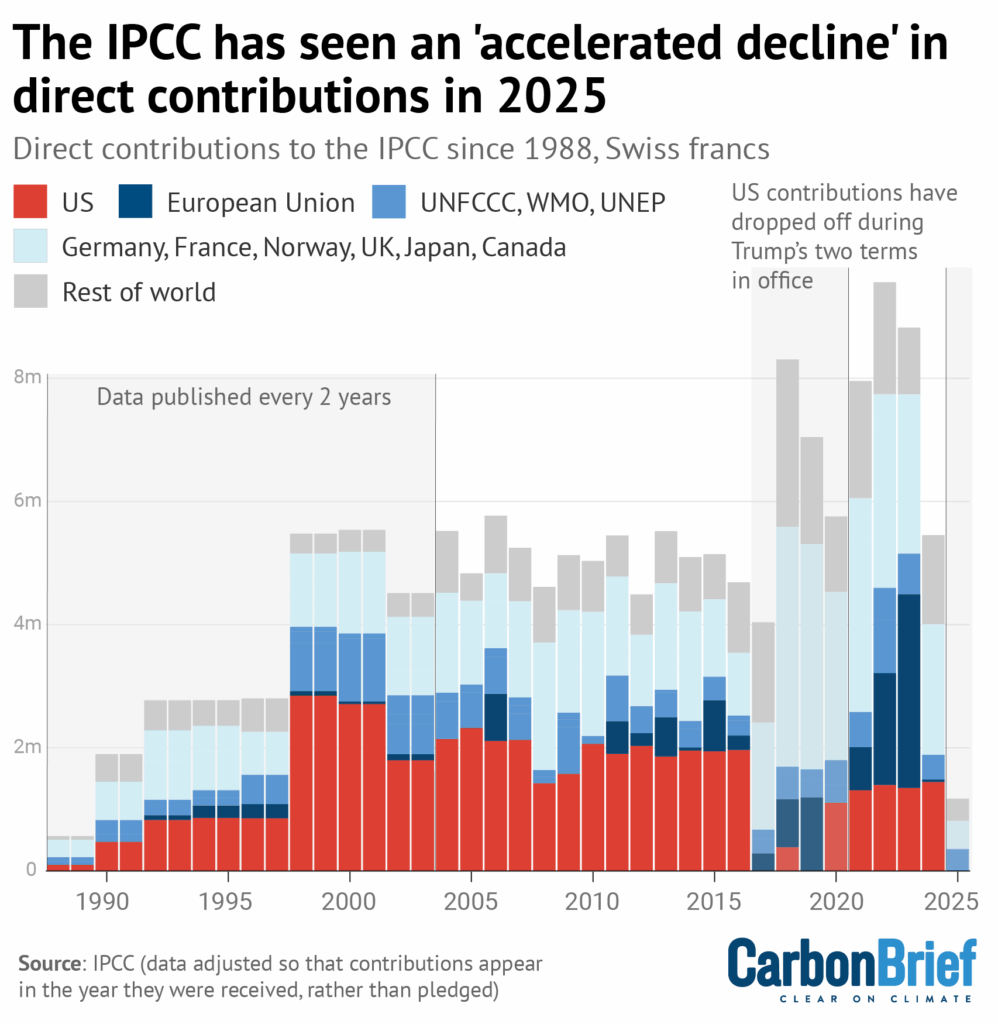
Carbon Brief covered the latest meeting of the Intergovernmental Panel on Climate Change (IPCC) in Lima, Peru. Alongside funding from parent organisations the World Meteorological Organization (WMO) and UN Environment Programme, voluntary contributions by countries help pay for the work of the IPCC. The biggest contributors so far in 2025 are Norway, the UNFCCC, Canada and the WMO. The red bars show how US contributions have dropped off during Trump’s two terms in office. Having provided 30% of direct contributions throughout the IPCC’s history, the US has not made a contribution so far this year.
Spotlight
‘With knowledge comes responsibility’: the changing role of climate scientists in a warming world
This week, Carbon Brief speaks to a researcher about the different ways climate scientists are feeling and taking responsibility for the knowledge they hold.
From calling for action in Belém to defending science against attempts to discredit or downplay it, climate scientists are responding to world events in ever-more visible ways.
Dr Friederike Hartz is a research and policy associate at University College London.
For her PhD thesis, carried out at the University of Cambridge, Hartz interviewed 77 experts who participated in IPCC reports, the world’s most authoritative global assessments of climate science coordinated by the UN.
‘You can’t unsee it’
Hartz’s findings show how climate scientists can feel a sense of responsibility, as those who bear the knowledge and evidence of climate change.
Some interviewees felt a sense of “representational responsibility” – motivated by the wish to improve the lives of the vulnerable or underrepresented communities they belong to.
Others expressed a sense of “intergenerational responsibility”, resolving to contribute to a better world for their children and grandchildren.
Hartz called this the “inescapability” of climate knowledge. She told Carbon Brief:
“Once you know, you know. As one of my interviewees shared with me, you simply can’t unsee it. Especially as a scientist, you’re trained to see those things.”
Taking responsibility
Hartz’s research looked at what it means for climate scientists to act on the sense of responsibility they feel, beyond producing the science itself.
Some take part in formal IPCC assessments. Others “have come to accept and further embrace a responsibility for communicating” their knowledge, Hartz noted in her paper.
Beyond the IPCC, some scientists take on additional responsibility for evidence-based “advocacy” or even call for more “activism” in science.
Similarly, on the grounds that “with knowledge comes responsibility”, some have called for scientists to “step beyond their traditional roles” or act as “sentinels” to alert society to threats. Hartz told Carbon Brief:
“This is all part of what I call ‘science enactment’: putting science into action or putting it in the hands of other people who can act on it.”
Navigating what it means to take responsibility is a very individual thing, said Hartz, which speaks to late biologist Stephen Schneider’s “double ethical bind” – the balance between a commitment to the “scientific method” and the “wish to see the world a better place”.
Lived experience
Hartz pointed to research suggesting the traditional view – that engaging in activism or advocacy can damage a scientist’s credibility – may be unwarranted. But there can be other downsides, she noted, including the emotional toll. As one of her interviewees expressed it:
“As scientists, we are not droids…And, so, to say that we are not at all influenced by what is going on in science is not true.”
Hartz suggested that scientists can simultaneously experience feelings of enthusiasm about their work and frustration about its uptake. Or as she noted in her thesis, citing a seminal political science study:
“Knowledge can only speak ‘truth to power’ to the extent that ‘power listens to truth’.”
Watch, read, listen
‘WHITE HOUSE EFFECT’: A Netflix documentary looked at how a “crucial opportunity” to take climate action was “deliberately undermined” during the George HW Bush administration.
‘COP OF TRUTH’: Brazil’s president, Luiz Inácio Lula da Silva, wrote in the Guardian ahead of COP30 about the need to act “with the urgency the climate crisis demands”.
HUMAN STORIES: A video by the Grantham Institute at Imperial College London explored the pivotal moments leading to the historic establishment of a loss and damage fund.
Coming up
- 10 November: UN Climate Change conference (COP30) begins in Belém, Brazil
- 12 November: IEA World Energy Outlook 2025 launch, Paris
- 13 November: Global Carbon Budget annual update released
Pick of the jobs
- Project Drawdown, program manager, research fellow and senior analyst | Salary: Various. Location: Remote
- UK Centre for Ecology and Hydrology, laboratory assistant | £26,206 – £27,808. Location: Lancaster, UK
- Ofwat, Wales environmental policy lead | £57,783 – £72,000. Location: Cardiff, UK
- UNEP, mitigation expert on sand and dust storms | Salary: Not specified. Location: Riyadh, Saudi Arabia
- Conservation International, senior manager, climate & landscape restoration | Salary: Not specified. Location: Acornhoek, South Africa.
DeBriefed is edited by Daisy Dunne. Please send any tips or feedback to debriefed@carbonbrief.org.
This is an online version of Carbon Brief’s weekly DeBriefed email newsletter. Subscribe for free here.

The post DeBriefed 7 November 2025: Belém COP begins; UN warns of 1.5C breach; changing roles of climate scientists appeared first on Carbon Brief.

Cleaner cooking projects in the UN carbon market will have to set aside a share of their credits to insure against the risk that the trees they save are lost to fire, drought or logging, after the market’s regulator rejected calls to exempt the sector.
The requirement is part of a new rulebook that the Paris Agreement carbon market regulator – the Article 6.4 Supervisory Body – approved last Friday for programmes that aim to cut emissions by distributing new and cleaner cookstoves in regions that still burn wood or charcoal for cooking.
These are the UN mechanism’s first rulebooks for cookstoves, one of the carbon market’s most popular credit types and also one of its most criticised for overstating climate benefits.
They consist of two methodologies: one for programmes that aim to cut greenhouse gas emissions by distributing more efficient cookstoves that burn less wood or charcoal, and a separate methodology for projects shifting households to lower-emissions cookers running on electricity or liquid petroleum gas (LPG).
Mkhuthazi Steleki, the South African chair of the Supervisory Body, said “this decision gives cleaner cooking projects a new pathway under the UN carbon market, with clear rules to ensure that each credit represents a real and credible emission reduction”.
Industry and NGOs lobby to weaken UN carbon credit rules in “coordinated” push
In copycat submissions and a private briefing to government officials, the groups have opposed a proposal to tighten safeguards for emissions offsetsLaunch of Africa Energy Bank delayed again in blow to oil and gas hopes
Repeated delays are raising questions about the bank’s momentum and whether it can mobilise investment to finance Africa’s oil and gas ambitions in an era of energy transition

Exemption push rejected
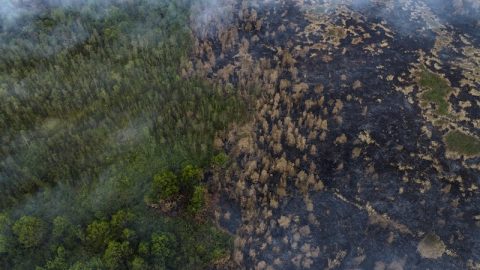
More efficient cookstove projects earn credits based on the amount of carbon they save by preserving trees that would have otherwise been cut down and burned for fuel. But if those trees later burn in a wildfire or are logged, the carbon stored would be released anyway, erasing the climate benefits of the credits.
Several carbon credit developers, conservation NGOs and the UN Environment Programme (UNEP) disputed that cookstove projects face this risk, in what critics described as a “coordinated lobbying campaign”.
They argued that, unlike forest protection schemes, this type of credit represents a “flow” of avoided emissions rather than a “stock” of stored carbon that can be released. They also warned that requiring a buffer would impose disproportionate costs and undermine the financial viability of these activities.
But the UN carbon market regulator was not persuaded by the argument. It decided that projects would have to protect against this reversal risk by handing over a percentage of credits to a so-called “buffer pool” instead of selling them.
‘New paradigm’
The amount of credits to be given up is calculated by applying different methods for natural risks, like wildfires, droughts or hurricanes, and human-caused ones, such as logging or land clearing.
For natural risks, project developers will need to apply local risk values derived from new modelling published by a group of independent scientists.
Campaigners have broadly welcomed the decision. Federica Dossi, an expert at Brussels-based advocacy group Carbon Market Watch, said it sets a new paradigm for calculating reversal risk based on empirical data. “This approach is grounded in science and we hope to see this now being adopted by other carbon crediting mechanisms in the voluntary market,” she added.
Backers claim this method is more rigorous than current practice in the voluntary carbon market, which largely relies on expert guesswork.
Pre-COP draws attention to Pacific’s climate plight and 1.5C goal
Pushback over science
As Climate Home News previously revealed, the same industry and NGO groups that sought an exemption from the “buffer pool”, along with some corporate buyers, criticised the use of a study backed by the UN carbon market’s experts that recommended the new risk assessment approach.
The groups pushed for more flexible rules that would have allowed natural risk values drawn from other sources, including national databases, or from the project developers themselves.
While the Supervisory Body rejected this approach, it gave project developers and countries the option to propose alternative values that would first need to be vetted by the mechanism’s expert panel and then approved by the regulator.
A carbon market expert told Climate Home News that, while it is too early to say how this provision will be used, they expect requests will have to be backed up with solid scientific evidence, lowering the risk of unfounded claims.

Policy discounts questioned
To guard against human-caused risks, projects will need to apply a flat 20% value set by the Supervisory Body, at the bottom of the 20-45% range recommended by its technical experts ahead of last week’s meeting.
That value can be further reduced by up to two-thirds if the host country has an emission-reduction plan covering forests, a long-term climate strategy and a framework for the UN’s REDD+ forest protection scheme.
Injy Johnstone, senior research fellow at the Munich-based Max Planck Institute, said that, while these are important governance measures, their existence does not necessarily demonstrate that the underlying risk of forest carbon loss has been reduced.
“It is important to distinguish between evidence of actual risk reduction and assumptions about the effectiveness of policy commitments,” she added.
Moving target
A UN source told Climate Home News that, under the approved formula, improved cookstove projects must set aside at least 9% of credits linked to saved wood if they operate in the lowest-risk areas and the host country can claim all available discounts. The share of credits rises significantly in regions with high natural risk values, such as Guyana, Sri Lanka and Timor Leste, or that do not have REDD+ programmes.
These factors could change in the future as the Supervisory Body asked its technical experts to recommend revisiting the risk values “should credible new evidence arise”.
Climate change is likely to make forest destruction events, such as wildfires or hurricanes, more frequent and more severe in certain regions. Meanwhile, national policies on forest protection can shift significantly depending on government changes.
Johnstone said the UN carbon market needs periodic reassessment to respond to new evidence showing that previously assumed levels of risk were too low.
“The integrity of credits is not guaranteed simply because a reversal risk tool exists,” she added. “The real test will be whether the mechanism provides equivalent atmospheric protection over time, rather than simply introducing another layer of accounting requirements”.
The post UN carbon market forces cookstove projects to protect against forest loss appeared first on Climate Home News.
UN carbon market forces cookstove projects to protect against forest loss