

Welcome to Carbon Brief’s DeBriefed.
An essential guide to the week’s key developments relating to climate change.
This week
Trump vs world
TILTING AT ‘WINDMILLS’: At the World Economic Forum meeting in Davos, Switzerland, Donald Trump was quoted by Reuters as saying – falsely – that China makes almost all of the world’s “windmills”, but he had not “been able to find any windfarms in China”, calling China’s buyers “stupid”. The newswire added that China “defended its wind power development” at Davos, with spokesperson Guo Jiakun saying the country’s efforts to tackle climate change and promote renewable energy in the world are “obvious to all”.
SPEECH FACTCHECKED: The Guardian factchecked Trump’s speech, noting China has more wind capacity than any other country, with 40% of global wind generation in 2024 in China. See Carbon Brief’s chart on this topic, posted on BlueSky by Dr Simon Evans.
GREENLAND GRAB: Trump “abruptly stepped back” from threats to seize Greenland with the use of force or leveraging tariffs, downplaying the dispute as a “small ask” for a “piece of ice”, reported Reuters. The Washington Post noted that, while Trump calls climate change “a hoax”, Greenland’s described value is partly due to Arctic environmental shifts opening up new sea routes. French president Macron slammed the White House’s “new colonial approach”, emphasising that climate and energy security remain European “top priorities”, according to BusinessGreen.
Around the world
- EU MILESTONE: For the first time, wind and solar generated more electricity than fossil fuels in the EU last year, reported Reuters. Wind and solar generated 30% of the EU’s electricity in 2025, just above 29% from plants running on coal, gas and oil, according to data from the thinktank Ember covered by the newswire.
- WARM HOMES: The UK government announced a £15bn plan for rolling out low-carbon technology in homes, such as rooftop solar and heat pumps. Carbon Brief’s newly published analysis has all the details.
- BIG THAW: Braving weather delays that nearly “derail[ed] their mission”, scientists finally set up camp on Antarctica’s thawing Thwaites glacier, reported the New York Times. Over the next few weeks, they will deploy equipment to understand “how this gargantuan glacier is being corroded” by warming ocean waters.
- EVS WELCOME: Germany re-introduced electric vehicle subsidies, open to all manufacturers, including those in China, reported the Financial Times. Tesla and Volvo could be the first to benefit from Canada’s “move to slash import tariffs on made-in-China” EVs, said Bloomberg.
- SOUTHERN AFRICA FLOODS: The death toll from floods in Mozambique went up to 112, reported the African Press Agency on Thursday. Officials cited the “scale of rainfall” – 250mm in 24 hours – as a key driver, it added. Frontline quoted South African president Cyril Ramaphosa, who linked the crisis to climate change.
$307bn
The amount of drought-related damages worldwide per year – intensified by land degradation, groundwater depletion and climate change – according to a new UN “water bankruptcy” report.
Latest climate research
- A researcher examined whether the “ultra rich” could and should pay for climate finance | Climatic Change
- Global deforestation-driven surface warming increased by the “size of Spain” between 1988 and 2016 | One Earth
- Increasing per-capita meat consumption by just one kilogram a year is “linked” to a nearly 2% increase in embedded deforestation elsewhere | Environmental Research Letters
(For more, see Carbon Brief’s in-depth daily summaries of the top climate news stories on Monday, Tuesday, Wednesday, Thursday and Friday.)
Captured
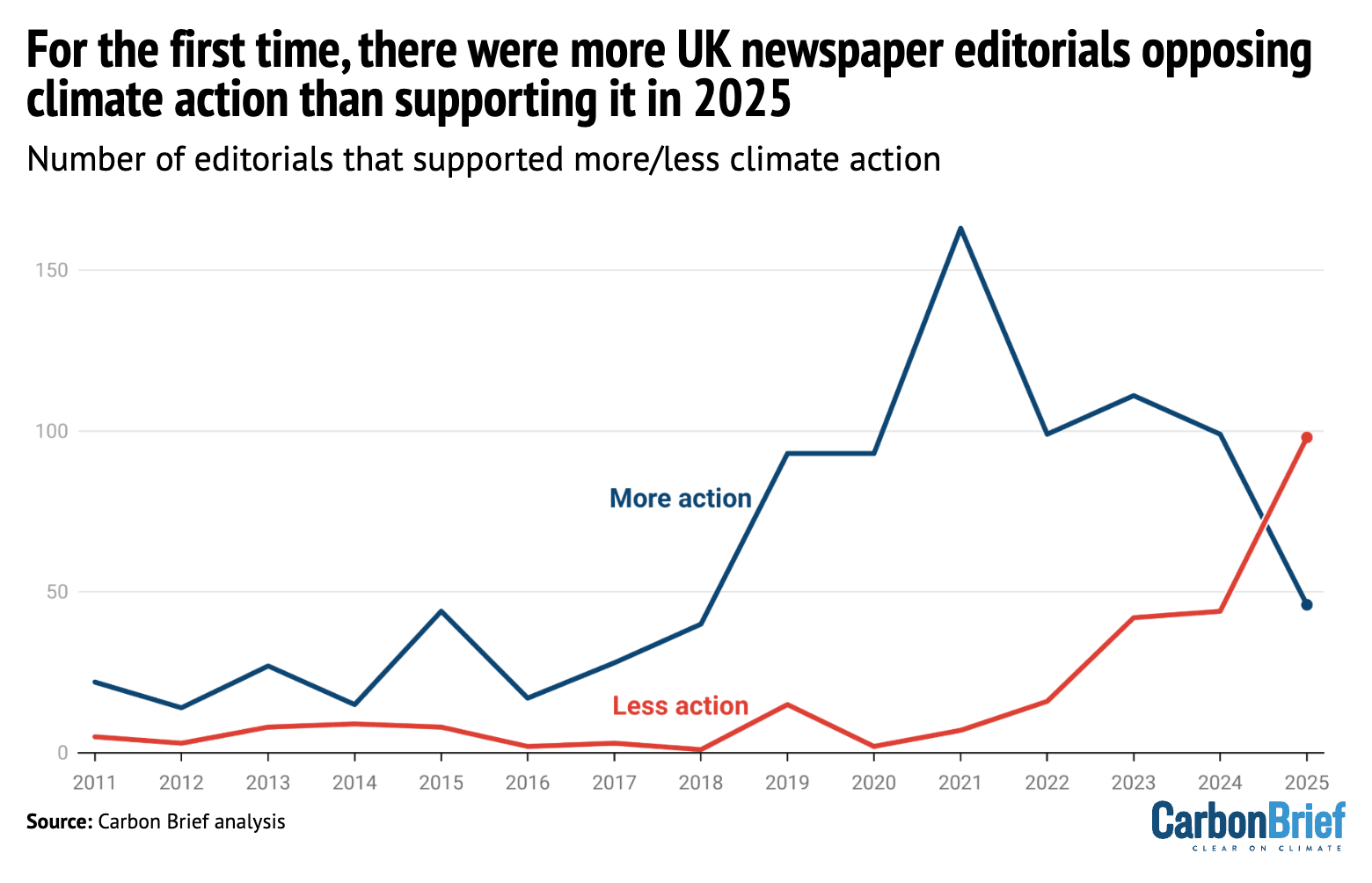
For the first time since monitoring began 15 years ago, there were more UK newspaper editorials published in 2025 opposing climate action than those supporting it, Carbon Brief analysis found. The chart shows the number of editorials arguing for more (blue) and less (red) climate action between 2011-2025. Editorials that took a “balanced” view are not represented in the chart. All 98 editorials opposing climate action were in right-leaning outlets, while nearly all 46 in support were in left-leaning and centrist publications. The trend reveals the scale of the net-zero backlash in the UK’s right-leaning press, highlighting the rapid shift away from a political consensus.
Spotlight
Do the oceans hold hope for international law?
This week, Carbon Brief unpacks what a landmark oceans treaty “entering into force” means and, at a time of backtracking and breach, speaks to experts on the future of international law.
As the world tries to digest the US retreat from international environmental law, historic new protections for the ocean were quietly passed without the US on Saturday.
With little fanfare besides a video message from UN chief Antonio Guterres, a binding UN treaty to protect biodiversity in two-thirds of the Earth’s oceans “entered into force”.
What does the treaty mean and do?
The High Seas Treaty – formally known as the “biodiversity beyond national jurisdiction”, or “BBNJ” agreement – obliges countries to act in the “common heritage of humankind”, setting aside self-interest to protect biodiversity in international waters. (See Carbon Brief’s in-depth explainer on what the treaty means for climate change).
Agreed in 2023, it requires states to undertake rigorous impact assessments to rein in pollution and share benefits from marine genetic resources with coastal communities and countries. States can also propose marine protected areas to help the ocean – and life within it – become more resilient to “stressors”, such as climate change and ocean acidification.
“It’s a beacon of hope in a very dark place,” Dr Siva Thambisetty, an intellectual property expert at the London School of Economics and an adviser to developing countries at UN environmental negotiations, told Carbon Brief.
Who has signed the agreement?
Buoyed by a wave of commitments at last year’s UN Oceans conference in France, the High Seas treaty has been signed by 145 states, with 84 nations ratifying it into domestic law.
“The speed at which [BBNJ] went from treaty adoption to entering into force is remarkable for an agreement of its scope and impact,” said Nichola Clark, from the NGO Pew Trusts, when ratification crossed the 60-country threshold for it to enter into force last September.
For a legally binding treaty, two years to enter into force is quick. The 1997 Kyoto Protocol – which the US rejected in 2001 – took eight years.
While many operative parts of the BBNJ underline respect for “national sovereignty”, experts say it applies to an area outside national borders, giving territorial states a reason to get on board, even if it has implications for the rest of the oceans.
What is US involvement with the treaty?
The US is not a party to the BBNJ’s parent Law of the Sea, or a member of the International Seabed Authority (ISA) overseeing deep-sea mining.
This has meant that it cannot bid for permits to scour the ocean floor for critical minerals. China and Russia still lead the world in the number of deep-sea exploration contracts. (See Carbon Brief’s explainer on deep-sea mining).
In April 2025, the Biden administration issued an executive order to “unleash America’s offshore critical minerals and resources”, drawing a warning from the ISA.
This Tuesday, the Trump administration published a new rule to “fast-track deep-sea mining” outside its territorial waters without “environmental oversight”, reported Agence France-Presse.
Prof Lavanya Rajamani, an expert in international environmental law at the University of Oxford, told Carbon Brief that, while dealing with US unilateralism and “self-interest” is not new to the environmental movement, the way “in which they’re pursuing that self-interest – this time on their own, without any legal justification” has changed. She continued:
“We have to see this not as a remaking of international law, but as a flagrant breach of international law.”
While this is a “testing moment”, Rajamani believes that other states contending with a “powerful, idiosyncratic and unpredictable actor” are not “giving up on decades of multilateralism…they just asking how they might address this moment without fundamentally destabilising” the international legal order.
What next for the treaty?
Last Friday, China announced its bid to host the BBNJ treaty’s secretariat in Xiamen – “a coastal hub that sits on the Taiwan Strait”, reported the South China Morning Post.
China and Brussels currently vie as the strongest contenders for the seat of global ocean governance, given that Chile made its hosting offer days before the country elected a far-right president.
To Thambisetty, preparatory BBNJ meetings in March can serve as an important “pocket of sanity” in a turbulent world. She concluded:
“The rest of us have to find a way to navigate the international order. We have to work towards better times.”
Watch, read, listen
OWN GOAL: For Backchannel, Zimbabwean climate campaigner Trust Chikodzo called for Total Energies to end its “image laundering” at the Africa Cup of Nations.
MATERIAL WORLD: In a book review for the Baffler, Thea Riofrancos followed the “unexpected genealogy” of the “energy transition” outlined in Jean-Baptiste Fressoz’s More and More and More: An All-Consuming History.
REALTY BITES: Inside Climate News profiled Californian climate policy expert Neil Matouka, who built a plugin to display climate risk data that real-estate site Zillow removed from home listings.
Coming up
- 26 January: International day of clean energy
- 27 January: India-EU summit, New Delhi
- 31 January: Submit inputs on food systems and climate change for a report by the UN special rapporteur on climate change
- 1 February: Costa Rica elections
Pick of the jobs
- British Antarctic Survey, boating officer | Salary: £31,183. Location: UK and Antarctica
- National Centre for Climate Research at the Danish Meteorological Institute, climate science leader | Salary: NA. Location: Copenhagen, with possible travel to Skrydstrup, Karup and Nuuk
- Mongabay, journalism fellows | Stipend: $500 per month for 6 months. Location: Remote
- Climate Change Committee, carbon budgets analyst | Salary: £47,007-£51,642. Location: London
DeBriefed is edited by Daisy Dunne. Please send any tips or feedback to debriefed@carbonbrief.org.
This is an online version of Carbon Brief’s weekly DeBriefed email newsletter. Subscribe for free here.


The post DeBriefed 23 January 2026: Trump’s Davos tirade; EU wind and solar milestone; High seas hope appeared first on Carbon Brief.
DeBriefed 23 January 2026: Trump’s Davos tirade; EU wind and solar milestone; High seas hope

A bill to restore the state’s consumer utilities counsel failed to move forward, meaning Georgia will remain one of only a handful of states without a statutory advocate representing ratepayers.
Eighteen years after Georgia eliminated its consumer utility advocate, the fight to bring the office back recently resurfaced at a Senate hearing.
Georgia Hasn’t Had a Consumer Advocate for Electric Ratepayers for 18 Years
Discussing climate change can make a difference. Focusing on the impacts in everyday life is a good place to start, experts say.
When Bad Bunny climbed onto broken power lines during his Super Bowl halftime show, millions of viewers saw a spectacle. Climate communicators saw a lesson in how to talk about climate change.
Wondering How to Talk About Climate Change? Take a Lesson from Bad Bunny
Sydney, Thursday 19 March 2026 — In response to escalating attacks on gas fields in the Middle East, including Israeli strikes on Iran’s giant South Pars gas field and Iranian retaliations on gas fields in Qatar and Saudi Arabia, the following lines can be attributed to Solaye Snider, Campaigner at Greenpeace Australia Pacific:
“The targeting of gas fields across the Middle East is a perilous escalation that reinforces just how vulnerable our fossil-fuelled world really is.
“Oil and gas have long been used as tools of power and coercion by authoritarian regimes. They cause climate chaos and environmental pollution and they drive conflict and war. The energy security of every nation still hooked on gas, including Australia, is under direct threat.
“For countries that are reliant on gas imports, like Sri Lanka, Pakistan and South Korea, this crisis is just getting started. It can take months to restart a gas export facility once it is shut down, meaning the shockwaves of these strikes will be felt for a long time to come.
“It is a gross and tragic injustice that while civilians are killed and lose their homes to this escalating violence, and families struggle with a tightening cost-of-living, gas giants like Woodside and Santos have seen their share prices surge on the prospect of windfall war profits.
“We must break this cycle. Transitioning to local renewable energy is the way to protect Australian households from the inherent volatility of fossil fuels like gas.”
-ENDS-
Images available for download via the Greenpeace Media Library
Media contact: Lucy Keller on 0491 135 308 or lkeller@greenpeace.org
Greenpeace response to escalating attacks on gas fields in Middle East


-
Greenhouse Gases7 months ago
Guest post: Why China is still building new coal – and when it might stop
-
Climate Change7 months ago
Guest post: Why China is still building new coal – and when it might stop
-

 Greenhouse Gases2 years ago
嘉宾来稿:满足中国增长的用电需求 光伏加储能“比新建煤电更实惠”
-
Climate Change2 years ago
Bill Discounting Climate Change in Florida’s Energy Policy Awaits DeSantis’ Approval
-

 Climate Change2 years ago
嘉宾来稿:满足中国增长的用电需求 光伏加储能“比新建煤电更实惠”
-
Climate Change Videos2 years ago
The toxic gas flares fuelling Nigeria’s climate change – BBC News
-

 Carbon Footprint2 years ago
US SEC’s Climate Disclosure Rules Spur Renewed Interest in Carbon Credits
-

 Renewable Energy5 months ago
Sending Progressive Philanthropist George Soros to Prison?