

Welcome to Carbon Brief’s DeBriefed.
An essential guide to the week’s key developments relating to climate change.
This is an online version of Carbon Brief’s weekly DeBriefed email newsletter. Subscribe for free here.
This week
UN General Assembly
FOSSIL FAILURE: At the UN’s 78th general assembly in New York, secretary general António Guterres said that “the fossil fuel age has failed”, but “stopped short of calling on specific countries”, the New York Times reported. On Wednesday, Guterres invited leaders from 34 countries to speak at the first-ever “climate ambition” summit “in recognition of their strong action on climate change” – notably omitting China, the US and the United Arab Emirates, Reuters reported.
FINANCING THE FIGHT: Nigerian president Bola Tinubu told the general assembly that Africa’s fight against climate change must happen “on our own terms”, namely, alongside “overall economic efforts”, reported Nigerian daily the Premium Times. Surangel Whipps Jr, president of Palau, called for “scaled-up climate finance that adequately recognise[s] the context” of small island developing states, Pacific News Service wrote.
BREAKING THE BANK: On Sunday, an estimated 75,000 people took to the streets of New York to demand stronger action on climate change. The protest was “far more focused on fossil fuels and the industry than previous marches” had been, the Associated Press wrote. The next day, more than 100 protesters were arrested outside New York’s Federal Reserve Bank, Inside Climate News reported.
PM rolls back UK climate commitments
UK U-TURN: UK prime minister Rishi Sunak has made a “major shift on green policies”, announcing “exemptions and delays” to a range of plans and programmes, BBC News reported. Among them is a five-year postponement of the ban on new petrol and diesel cars, originally set for 2030. The prime minister “denied he was ‘watering down’ the government’s net-zero commitments”, the outlet added.
‘IN JEOPARDY’: Carbon Brief analysis showed that these policy changes “could put the UK’s legally binding emissions targets in jeopardy”, as well as its commitment under the Paris Agreement. Carbon Brief has also just published an in-depth Q&A which includes a factcheck of Sunak’s claims and policy announcements. Despite Sunak’s emphasis on being “honest with the public” about the “unacceptable costs” of net-zero, the assessment makes it clear that many of his statements were misleading and his policy changes could cost consumers billions of pounds.
Around the world
- CLIMATE (RE)COMMITMENT: Brazil’s government has approved amending the country’s pledge under the Paris Agreement returning it “to the level of climate ambition of 2015”, according to the Brazilian newspaper Folha de São Paulo.
- ‘LEGAL BLITZKRIEG’: California has filed a lawsuit against five oil majors, seeking billions of dollars to cover future damages from climate change. The state’s suit alleges wrongdoing on many counts, including misleading the public, violating state pollution regulations and defrauding investors, San Jose’s Mercury News reported.
- LIBYA’S UNREST: “Hundreds of protesters” in Libya are accusing their government of neglect after more than 10,000 people died in catastrophic flooding last week, the North Africa Journal said. Analysis covered by Carbon Brief has shown that the extreme rainfall was made up to 50% more intense by climate change.
- OFF-TARGET: Climate change and conflict mean the world is “likely to miss” targets to end the spread of HIV/Aids, tuberculosis and malaria by 2030, Reuters wrote. Warmer temperatures are expanding the range of disease-carrying mosquitoes, while extreme weather events strain health services and interrupt public-health programmes.
- BUSHFIRES BURN: Several parts of Australia are facing record or near-record springtime temperatures, while dozens of fires burn across New South Wales in what the Sydney Morning Herald described as “a taste of the hot, dry summer ahead”.
- GOING GEOTHERMAL: The World Geothermal Congress concluded on Sunday with the launch of the Beijing Declaration, which proposed “principles and recommendations for the sustainable development of the global geothermal industry”, Chinese state-run news agency Xinhua reported.
60
Number of countries that saw marches, rallies and other actions over 15-17 September to demand fossil fuel phase-out, according to the campaign group the Global Fight to End Fossil Fuels.
Latest climate research
- Sea-level rise already delays US commuters in coastal areas by 22 minutes per year, which could increase to 200-650 minutes by 2060, according to a study in Environmental Research: Climate.
- A new paper in Geophysical Research Letters showed skill in predicting marine heatwaves in the Arabian Sea up to seven months in advance.
- Shading shallow-water coral reefs periodically can decrease light stress and slow bleaching, said new research in Frontiers in Marine Science.
(For more, see Carbon Brief’s in-depth daily summaries of the top climate news stories on Monday, Tuesday, Wednesday, Thursday and Friday.)
Captured

The sea ice extent around Antarctica is more than 1.5m square kilometres lower than the September average, satellite data has revealed. This extent is much smaller than has ever been measured in the austral winter, a record that goes back to 1979. “It’s so far outside anything we’ve seen, it’s almost mind-blowing,” Dr Walter Meier, senior research scientist at the US National Snow and Ice Data Center, told BBC News. Meier is “not optimistic that the sea ice will recover to a significant degree”, the outlet added.
Spotlight
Three ways to better protect the ocean
A new report from the OSPAR Commission, which is responsible for protecting the marine environment of the north-east Atlantic, assessed the status and health of that part of the ocean and its neighbouring seas. Here, Carbon Brief unpacks three key takeaways from the report.
Climate change and ocean acidification are “driving major changes” in the north-east Atlantic.
A range of climate impacts are already being felt across the north-east Atlantic, from marine heatwaves and sea-level rise to deoxygenation and changes in the ocean circulation. “While the root cause is global, the effects are felt at more local scales,” the report said. For example, it identified the Arctic waters as warming more rapidly than elsewhere in the region.
Local changes can have knock-on effects, it added, such as shifts in wind patterns and strength due to changes in Arctic sea-ice extent. Warming also affects ecosystems, with the report providing evidence of changes in plankton, “which, in turn, trigger changes at other trophic levels”.
Ocean acidification is also having both direct and indirect impacts on marine ecosystems in the region, “with significant negative impacts for calcareous or shelled organisms”, the report concluded.
While supporting improved ocean resilience is important, it cannot come at the expense of broader climate action, said Dr Bee Berx, one of the lead authors of the climate change assessment within the report.
She told Carbon Brief: “Reducing global warming in compliance with the UNFCCC Paris Agreement would be the main way to ensure the impacts of marine climate change and ocean acidification are minimised.”
Human pressures on marine ecosystems “reduce their resilience to climate change”.
Besides climate change, the world’s oceans face a multitude of other human impacts. Some of these pressures have eased over the past several decades.
Pollution from the oil and gas industries operating in the north-east Atlantic has waned and the amount of marine litter has diminished, despite increasing use of plastics overall. Excessive nutrient inputs from agriculture and wastewater have also decreased over much of the OSPAR region – although not everywhere.
At the same time, pressures, such as noise pollution from shipping traffic and contamination by pharmaceuticals, have increased. According to the report, such pressures weaken marine ecosystems and make them less resilient to the effects of climate change and ocean acidification.
There is “emerging understanding of the complex interactions between cumulative pressures”, Berx told Carbon Brief. Managing those pressures will be a “critical tool for the OSPAR countries to support climate change resilience”, she added.
“Collective trends point to declining biodiversity”, despite gains for some species.
Understanding ecosystem change “is crucially important for developing effective and efficient management”, the report said. It noted that “collective trends” indicate continuing biodiversity decline and ecosystem degradation, despite measures that OSPAR countries have taken.
The report did note some bright spots for biodiversity. For example, the introduction of invasive alien species – one of the five major drivers of biodiversity loss – to the OSPAR region has slowed.
But, at the same time, the status of most of the threatened species assessed by OSPAR was either “not good” or “unknown”. Species are harmed by both direct and indirect pressures, with localised pressures such as habitat loss exacerbated by climate change.
Watch, read, listen
THREE STRIKES: The historic labour action by the US United Auto Workers union is inextricably linked to the future of electric vehicles, Grist wrote.
PAKISTAN’S PROGNOSIS: The Third Pole interviewed Sherry Rehman, former climate minister of Pakistan, on the challenges her country faces under increasing uncertainty.
OLD FOREST, NEW APPROACH: Garry Merkel, a Canadian forester and a member of the Tahltan Nation, discussed holistic forest management on the YourForest podcast.
Coming up
- 25-27 September: 32nd session of the North American Forest Commission, Fredericton, Canada
- 26-28 September: Second annual forum on environmental defenders in Latin America and the Caribbean, Panama City
- 28 September: IEA critical minerals and clean energy summit, Paris
- 30 September: Maldives presidential election (2nd round)
Pick of the jobs
- Inside Climate News, senior editor | Salary: $85,000-$100,000. Location: Remote (US)
- National Taiwan University, atmospheric sciences faculty | Salary: up to $51,000. Location: Taipei
- Global Green Growth Institute, climate finance technical officer | Salary: from $64,920. Location: Suva, Fiji
- UN Environment Programme, climate risk analyst | Salary: Unknown. Location: Santo Domingo, Dominican Republic
DeBriefed is written in rotation by Carbon Brief’s team and edited by Daisy Dunne. Please send any tips or feedback to debriefed@carbonbrief.org

The post DeBriefed 22 September 2023: UN’s first ‘climate-ambition’ summit; UK govt’s climate U-turn; How to protect the north-east Atlantic appeared first on Carbon Brief.

For the first time, new-energy vehicles (NEVs) made up 67% of new car sales in China in September, according to the latest data from the China Passenger Car Association (CPCA).
The figures show that NEVs, which include battery electric cars and plug-in hybrids, captured a record share of sales, even though fewer were sold than last year.
This is because sales of combustion-engine cars are falling steeply, a trend that the CPCA has attributed to rising petrol prices following the start of the Hormuz crisis.
Indeed, sales of fuel-only cars were down 31% year-on-year in the first nine months of 2026, with plug-in hybrid sales down 26% – whereas battery EV sales were only down 4%.
One analyst tells Carbon Brief that China’s rapidly growing EV fleet has offset demand for 143m barrels of oil since the start of the Hormuz crisis.
Another says that the crisis is “reinforcing China’s electrification of road transport”.
Meanwhile, amid slowing domestic sales, Chinese carmakers’ exports of NEVs more than doubled [in 2026 to date / in September] from a year earlier.
NEV record
A record two out of every three cars sold in September in China were NEVs, according to CPCA data, as shown in the figure below.
(NEVs predominantly include battery electric vehicles – BEVs – and plug-in hybrids – PHEVs. BEVs only run on electricity, whereas PHEVs also have a combustion engine.)
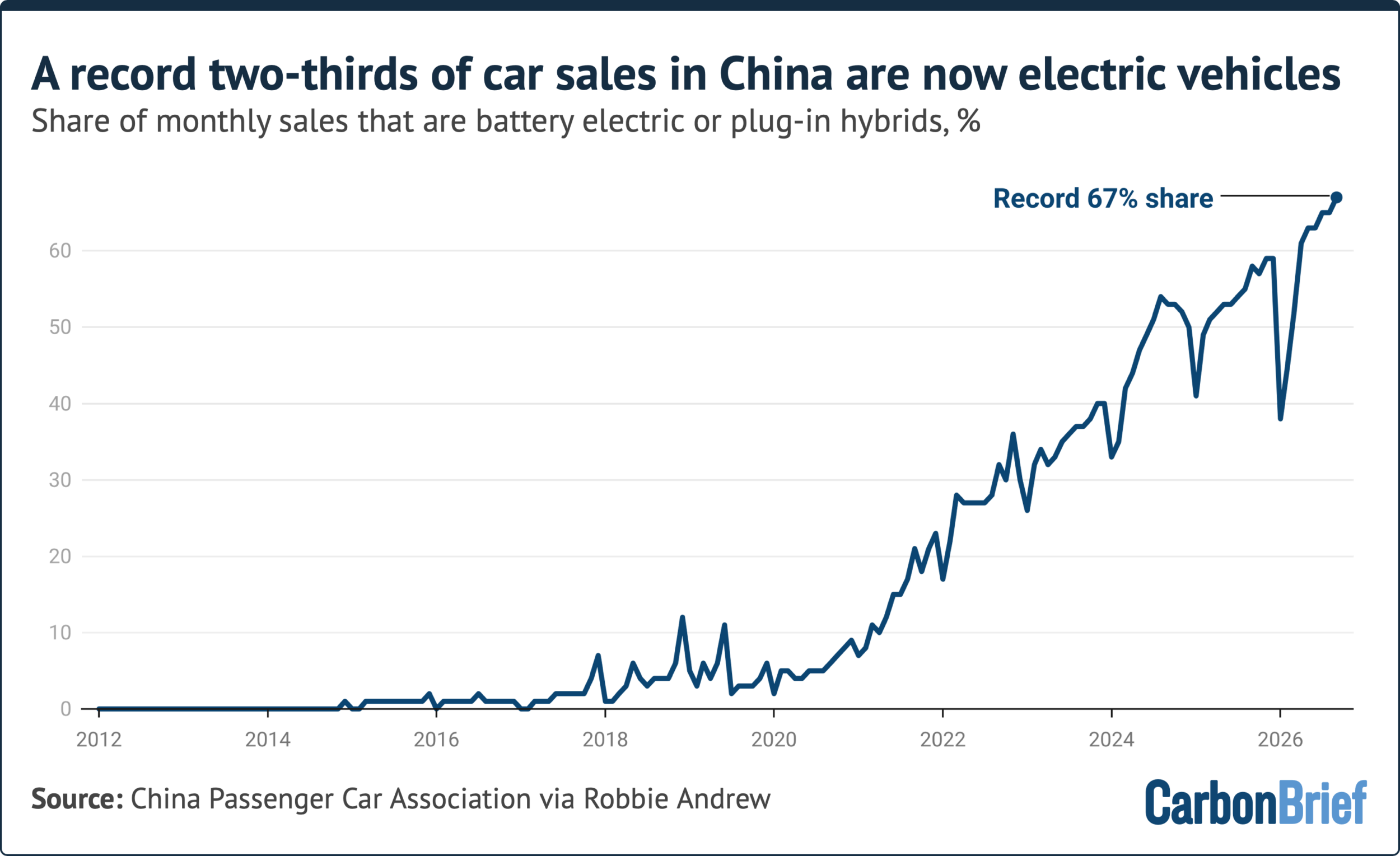
This marks a rapid rise for NEVs from just 6% of new car sales in 2020 up to 58% in 2026 to date – and a record 67% in the month of September.
This year, NEVs’ share of sales has also bounced back from a low of 39% in January, after the full purchase tax exemption that had been in place for more than a decade came to an end in December 2025.
The gain in NEV share in 2026 has come amid a slowdown across the wider domestic passenger-car market, which has hit sales of combustion-engine vehicles particularly hard.
This September, passenger-car retail sales across all categories declined, with overall sales volumes falling 28% year-on-year.
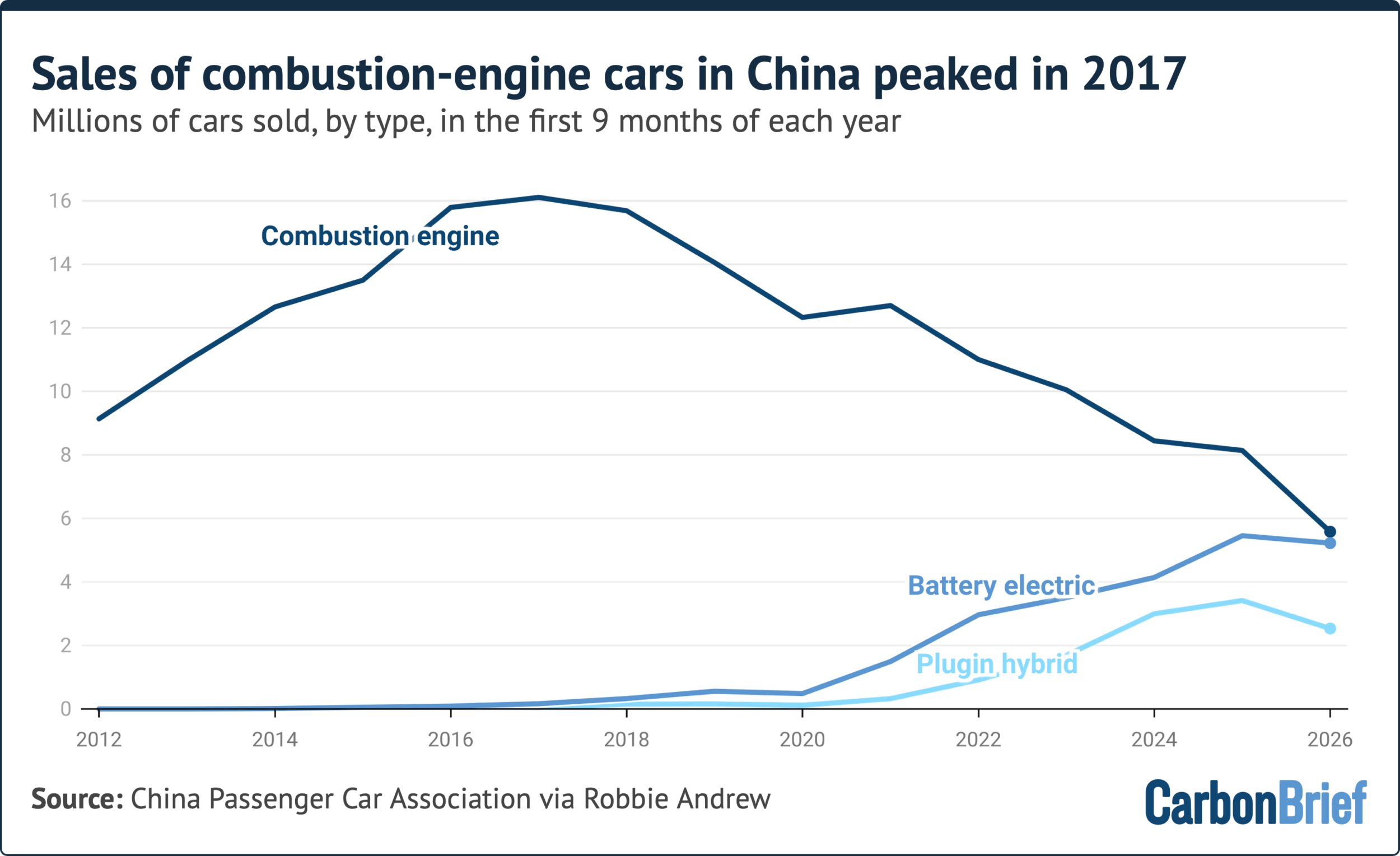
The contraction was led by combustion-engine vehicles, which saw sales fall 43% year-on-year in September and 31% in 2026 to date.
However, sales of PHEVs also fell by 36% year-on-year in September and by 26% in 2026 to date. By comparison, BEVs performed better, although sales still declined 8.5% from a year earlier in September and 4% in 2026 to date.
As a result, NEV sales overall fell by 17% in September and 13% in 2026 to date.
While the market changes in 2026 to date were particularly dramatic, they reflect a broad continuation of trends seen over the past decade.
Indeed, sales of combustion-engine cars in China peaked in 2017 and they have been declining ever since, shown in the figure below.
Impact of Hormuz
Part of the reason for the advance of NEVs in 2026, said Chinese technology news outlet OFweek, was petrol cars “giving up market share” as they were outperformed by electric alternatives.
Cui Dongshu, secretary-general of the CPCA, cited higher petrol prices as an explanation for September’s weak combustion-car sales, in comments to financial news outlet National Business Daily.
Imports of oil into China in January-September have fallen 15% compared to 2025, equivalent to 470m barrels, as ongoing conflict tightened supply and drove up prices.
China’s passenger-car NEV fleet has displaced 143m barrels of oil so far during the strait of Hormuz crisis, Euan Graham, senior energy analyst at thinktank Ember, tells Carbon Brief.
EVs “accounted for 12% of the decrease in China’s oil use post-Hormuz”, according to an estimate provided to thinktank the Brookings Institute by an unnamed analyst.