Welcome to Carbon Brief’s DeBriefed.
An essential guide to the week’s key developments relating to climate change.
This week
Germany’s €100bn climate funding
BILLIONS IN FUNDING: Germany’s parliament on Tuesday voted to create a €500bn defence and infrastructure fund and relax “constitutionally-protected debt rules”, the Guardian reported, with “the last-minute backing of the Greens” in return for “guarantees that €100bn of the funds destined for infrastructure would be allocated for climate and economic transformation investments”. The deal came following “clumsy” initial negotiations from Germany’s chancellor-in-waiting, Friedrich Merz, Bloomberg said. It reported that the Greens “finally came around” after Merz’s negotiators “conceded to their key demands”, which also included adding Germany’s 2045 climate-neutrality target into the constitution.
TAKING CLIMATE ‘SERIOUSLY’: The Greens said in a statement on social media that the agreement “finally takes the challenges of the future seriously”, according to the New York Times. Paula Piechotta, a member of the Greens in the German Bundestag, told the German newspaper Tagesspiegel that the deal was a “great success for democracy in our country, for sustainability and intergenerational justice”. The newspaper added that the far-right Alternative for Germany (AfD) and the Left party, “unsurprisingly”, criticised the agreement.
UK opposition breaks cross-party climate consensus
BREAKING AWAY: In a speech, Kemi Badenoch, leader of the UK opposition Conservative party, said it was “impossible” for the UK to meet its net-zero target by 2050, marking a “sharp break from years of political consensus”, BBC News reported. She did not offer an alternative target for the goal, the broadcaster said, quoting her telling reporters that if the Conservatives “do find a target is necessary, then yes we will have one”. Badenoch “failed to cite any evidence in support” of her arguments, according to a factcheck published by Carbon Brief, which concluded that much of the existing evidence “contradicts” her claims.
TORY BACKLASH: In response, Conservative former prime minister Theresa May, who was responsible for passing the 2050 target into law, warned the move “will hurt future generations and cost Britons”, the Times reported. The Confederation of British Industry (CBI) also criticised the speech, warning that “now is not the time to step back from the opportunities of the green economy”, according to the i newspaper. In the Daily Telegraph, Ambrose Evans-Pritchard said Badenoch’s “rant comes close to political tragedy”.
Around the world
- CARNEY CUTS: New Canadian prime minister Mark Carney removed the country’s “consumer carbon tax”, CBC News reported, adding that the policy had been a “potent point of attack” for his political opponents.
- GREENPEACE BILL: Greenpeace has been ordered to pay $660m in damages over its protests against the Dakota Access pipeline in 2016, which could “bankrupt its US operations” if upheld, the Financial Times said.
- UK-CHINA FORUM: The UK and China agreed to establish an “annual climate dialogue”, with the first meeting to be held in London later this year, the Times reported.
- CHEQUES AND BALANCES: A US judge has “temporarily barred” attempts by the Trump administration to recoup at least $14bn in “grants issued by the Biden administration for climate and clean-energy projects”, the Washington Post said.
- EXTREME HEAT: “Severe heatwave conditions” have begun affecting several areas across India “unusually early in the season”, the Hindustan Times reported.
- SOUTH AFRICAN SUPPORT: The EU will fill a “$1bn hole” in South African’s “just energy transition partnership” left by the US, the Financial Times reported. The US is also “stalling” $2.6bn of climate finance for South Africa, Bloomberg said.
152
The number of “unprecedented” extreme weather events that occurred in 2024, according to the World Meteorological Organization’s State of the Climate 2024 report. Heatwaves were the most common type of unprecedented events – defined as events “worse than any ever recorded in the region” – followed by “rain or wet spells” and floods.
Latest climate research
- New research in Climate and Development explored how environmental justice featured in the climate action plans of rust-belt cities in the US, finding that few “provided enough details” to determine if it was a priority.
- A new Science Advances study identified “increasing storminess” in the south-western Caribbean, which was attributed to “industrial-age warming”.
- Marine heatwaves are now 5.1 times more frequent and 4.7 times more intense since records began, new research in Communications Earth & Environment found.
(For more, see Carbon Brief’s in-depth daily summaries of the top climate news stories on Monday, Tuesday, Wednesday, Thursday and Friday.)
Captured

The UK’s high electricity prices are primarily driven by gas prices, according to an analysis published by Carbon Brief, with the UK typically seeing gas set electricity prices 98% of the time – compared to an average in the EU of 40%.
Spotlight
Chatham House talks climate and resilience
Carbon Brief outlines key takeaways from Chatham House’s climate and energy summit.
Chatham House, the UK’s leading international affairs thinktank, held its annual summit on climate and energy on 18-19 March. This year’s theme was: “Securing a resilient future.”
Carbon Brief attended the conference, where speakers including COP30 CEO Ana Toni, UK climate envoy Rachel Kyte and Moroccan minister for energy transition and sustainable development Leila Benali shared their thoughts on encouraging and enacting climate action.
Climate backlash
A sense of urgency permeated discussions at the summit, underpinned by concerns over growing anti-climate narratives.
Toni argued climate scepticism proves climate action is on the right track.
She said: “First people ignore you, then they laugh at you, then they fight you – and this is where we are – then we win.”

Other speakers said that increasing support for climate action by building new norms and creating overlapping interests could also be effective strategies.
Former US climate envoy Todd Stern pointed to increasing adoption of electric vehicles, while ClientEarth CEO Laura Clarke raised the example of community-owned renewable power.
Fretting over finance
Clean Earth Gambia founder Fatou Jeng warned that climate finance, as ever likely to be an important issue at COP30, has “not progressed much”.
“Blended finance” – using public money to leverage private funds – was heavily criticised in several panels. Ben Parsons, a partner at consultancy firm Oaklin, noted that only 72 such deals were agreed in 2024.
Speakers agreed that innovative mechanisms to derisk climate finance were needed, with Morocco’s Benali critiquing “exclusive” and inflexible private financing options.
Ndongo Samba Sylla, head of research and policy at International Development Economics Associates, argued that using local currencies would significantly boost climate finance.
Resilience through renewables
A key benefit of the UK’s “climate leadership”, Kyte argued, is that the energy transition will “make British people more secure”.
Parsons said the argument – recently deployed by Conservative leader Badenoch – that the energy transition replaced reliance on Russian fossil fuels with reliance on Chinese technology was incorrect.
“Fossil fuels are fuel – they require constant replenishment. Renewables are infrastructure,” he said, adding that arguably the UK should be accelerating its deployment of clean-energy technology.
On cybersecurity challenges in renewable power systems, Alex Schoch, vice president and group director of flexibility and electrification at Octopus Energy, argued that the key issue is how renewable energy “hardware” is managed, rather than where it is sourced from.
Parsons agreed, noting that the UK’s current power system has “plenty of cybersecurity vulnerabilities in it today”.
He said: “We have to make sure we’re putting [cybersecurity strategies] in place…But I don’t think that goes hand in hand with thinking we should avoid buying renewables from certain parts of the world.”
In a session on energy security in war-time Ukraine, held under the Chatham House rule, participants noted that the country was a case study for the importance of energy security.
Speakers said that since Russia’s invasion of Ukraine, attacks on thermal power plants have seen growing use of low-carbon energy – particularly distributed solar.
Watch, read, listen
ELEPHANT IN THE ROOM: The Columbia Energy Exchange podcast explored how the new Trump government underpinned discussions at the energy industry event CERAWeek.
‘CONFLICT BLINDSPOT’: A new report by ODI found that “less than 10% of international climate finance” in 2022 went to fragile and conflict-affected countries.
METHANE INACTION: Leading supermarkets in the global north are “failing to address the methane pollution in their supply chains”, according to a study covered by Desmog.
Coming up
- 24-26 March: 16th Petersberg Climate Dialogue, Berlin, Germany
- 24-26 March: IPCC lead author meeting for methodology report on inventories for short-lived climate forcers, Bilbao, Spain
- 24-28 March: 20th session of the UN FAO commission on genetic resources for food and agriculture, Rome, Italy
- 25 – 28 March:First G20 climate and environment sustainability working group meeting, online
Pick of the jobs
- ClientEarth, lawyer or legal consultant, energy systems, Asia | Salary: 455m-585m Indonesian rupiah. Location: Jakarta
- European External Action Service, policy officer for green diplomacy | Salary: Unknown. Location: Brussels
- Bloomberg, climate reporter | Salary: Unknown. Location: Hong Kong
- The Grantham Research Institute on Climate Change and the Environment, project manager | Salary: £42,679-£51,000. Location: London
DeBriefed is edited by Daisy Dunne. Please send any tips or feedback to debriefed@carbonbrief.org.
This is an online version of Carbon Brief’s weekly DeBriefed email newsletter. Subscribe for free here.

The post DeBriefed 21 March 2025: Germany’s climate win; Conservatives’ net-zero row-back; Key messages from major UK climate conference appeared first on Carbon Brief.

Three countries have been named by the Paris Agreement’s compliance committee for failing to submit a nationally determined contribution (NDC) and repeatedly snubbing offers of help with their climate plans.
After months of internal debate over whether to identify serial non-responders, the Paris Agreement’s Implementation and Compliance Committee (PAICC) named the three countries which have failed to engage with it over their NDCs on Friday.
It named Democratic Republic of Congo, Senegal and North Korea in a footnote of its annual report, adding that it decided to name them “with a view to facilitating engagement”, adding that representatives of the three nations had been invited to its meeting in early 2027 “with the purpose of identifying any challenges and constraints”.
“The Committee noted the importance of Parties engaging with the Committee in a timely manner, while noting that some delays may be due to the national capabilities and circumstances of the Parties”, the report said.
-
Under US pressure, World Bank says it will back gas “where appropriate”
The US wants the World Bank to expand its gas support while climate campaigners are pushing for it to end – its head spoke this week of limited backing for the fossil fuel -
IPCC scientists vow to press on with climate reports despite political deadlock
After governments again failed to agree a timeline, nearly 120 IPCC authors pledged to complete their assessment on time and with full scientific rigour -
Paris Agreement committee snubbed over missing NDC climate plans
Many governments have still not submitted a nationally determined contribution to the UN, breaching a key requirement of the Paris Agreement

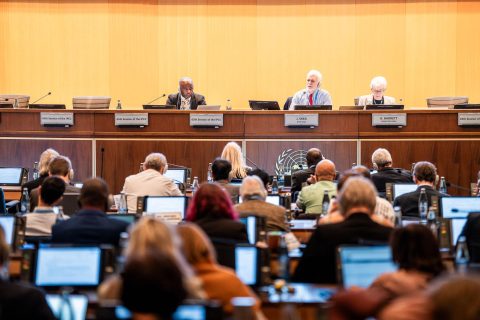

In July, PAICC said 12 countries had ignored its repeated attempts to discuss why they had not published an NDC as required every five years under the 2015 Paris accord.
Members of the committee had been divided over whether to name them, but at a September meeting decided to do so in their annual report to the annual climate COP summit.
By the time the report was published on Friday, only Congo, Senegal and North Korea “had not communicated an NDC or submitted a [Biennial Transparency Report] and had not yet responded to any of the Committee’s notifications, despite several reminders issued by the Committee in this regard”.
Rainforest and renewable energy ambitions
The silence from Congo and Senegal is notable because the former is home to much of the Congo Basin rainforest while the latter has sought billions of dollars in climate finance to support its renewable energy ambitions.
After Brazil, Congo has more rainforest than any country in the world. This forest, and the country’s peatlands, absorb huge amounts of greenhouse gas but are fast being lost to expanding farmland, charcoal production, logging and mining.
Senegal signed a Just Energy Transition Partnership with Canada and wealthy European nations in 2023, to help it meet its renewable energy targets under the-then government of Macky Sall. It was chair of the Least Developed Countries group between January 2022 and December 2023.

Tejas Rao, who is researching the PAICC as part of a doctoral thesis at Cambridge University, said the governments of the three countries should engage with the committee.
“Engagement costs these governments very little and the committee has shown it will listen,” he said.
“Silence leaves the committee with no basis to help, and it leaves the [governments] exposed to the narrative that they are simply disengaged,” he told Climate Home News.
Paris Agreement requirement
The 2015 Paris Agreement requires all parties to publish an NDC every five years outlining their emissions reduction targets, with each plan meant to be more ambitious than the country’s last NDC.
The latest set – the third round of plans, with new targets for 2035 – was due in February 2025. While most countries missed this deadline, all but around 30 – mostly small emitters but including Egypt, Vietnam and Argentina – have now submitted them.
Over the year, the PAICC – which is made up of government climate officials from developed and developing countries – has been communicating with governments that have not submitted NDCs and trying to overcome barriers to them doing so.
Some nations have cited exceptional circumstances as the reason for not submitting an NDC, a process that requires a significant amount of work in tracking emissions and consulting on how to curb them across the economy. For example, a letter from a Sudanese official to the PAICC, seen by Climate Home News, said that the country’s civil war had led to the suspension of its NDC preparation.
-
IPCC scientists vow to press on with climate reports despite political deadlock
After governments again failed to agree a timeline, nearly 120 IPCC authors pledged to complete their assessment on time and with full scientific rigour -
Under US pressure, World Bank says it will back gas “where appropriate”
The US wants the World Bank to expand its gas support while climate campaigners are pushing for it to end – its head spoke this week of limited backing for the fossil fuel -
Who shapes climate science? The equity question facing the IPCC
Early completion of the next global climate science assessment reports risks excluding research from the Global South, which is key to ensuring the findings are fair