

Welcome to Carbon Brief’s DeBriefed.
An essential guide to the week’s key developments relating to climate change.
This week
Africa’s second climate summit
‘NOT CHARITY’: At the second Africa climate summit held in Addis Ababa in Ethiopia this week, leaders “chastised developed nations for failing to honor [climate finance] pledges” and said they will “tap the private sector” to help fill the gap, Bloomberg reported. In a joint statement, African leaders said that providing climate finance is “a legal obligation and not charity, as anchored in the UN Framework Convention on Climate Change and its Paris Agreement”, according to the outlet.
SOLUTIONS CENTRED: Climate Home News reported that Ethiopian president Taye Atske Selassie told the closing ceremony on Wednesday the summit had repositioned Africa “not as victims of a crisis it never created but as a global centre for climate solution, renewable energy and green growth”. The outlet added that the joint leaders’ declaration called for “strengthened and sustained support” to scale up African-led climate initiatives, such as the 8,000km Great Green Wall across the Sahel and the African Forest Landscape Restoration Initiative.
Around the world
- ‘SILLY’: Chris Wright, the climate-sceptic US energy secretary, has dismissed the impacts of climate change as “not incredibly important” and described the Paris Agreement as “silly”, reported the New York Times. Elsewhere, the group of “climate contrarians” behind Trump’s misleading climate report have been “disbanded” following a lawsuit challenging their appointment, CNN reported.
- CHINA BOOM: The world’s fossil-fuel use could begin to drop by 2030 as a result of China’s “rapid adoption of renewables and its increasing reliance on electricity”, Bloomberg reported, citing a new study by thinktank Ember.
- NDC INDECISION: EU member states are still “wrangling” over the bloc’s overdue 2035 climate target, “with no sign of agreement”, according to a leaked draft text seen by the Guardian.
- TRADE SPOTLIGHT: Brazil plans to propose a new forum for governments to discuss how climate policy affects trade at the next World Trade Organization meeting next week, according to Reuters.
- UK PUBLIC POLLED: In a frontpage story, the Times covered new polling it commissioned, reporting that the number of people who think the dangers of global warming are exaggerated has increased by more than 50% in the past four years, from 16% to 25%. [Polling experts have criticised the framing of the Times coverage, noting that a large majority of the public still back net-zero.]
£797 million
The record amount of UK climate aid spent on nature last year – largely due to an increase in spending on carbon offsets, according to new Carbon Brief analysis.
Latest climate research
- Disadvantaged communities in the US are eating more sugar as temperatures rise | Nature Climate Change
- Videos of climate scientists making personal appeals for climate action were more likely to motivate viewers to act if the messengers were “older, male [and] attractive” | PLOS One
- Carbon-credit purchases for major airlines often come at the expense of funding other decarbonisation measures | Nature Communications
(For more, see Carbon Brief’s in-depth daily summaries of the top climate news stories on Monday, Tuesday, Wednesday, Thursday and Friday.)
Captured
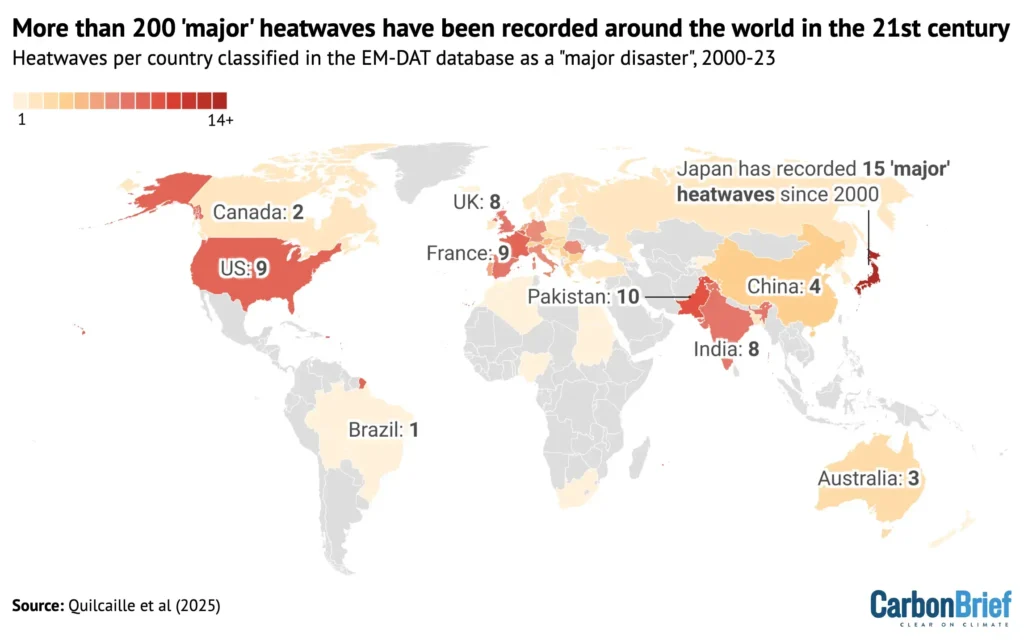
A new study used “extreme event attribution” to assess the impact of climate change on all 21st-century heatwaves that were classified as “major disasters”. It found that global warming linked to the world’s biggest 180 oil and gas companies made all 213 heatwaves analysed more intense and frequent. Meanwhile, one-quarter of the heatwaves would have been “virtually impossible” without human-caused global warming. The paper, covered by Carbon Brief, analysed 213 heatwaves over 2000-23 that were recorded in the EM-DAT database of “major disasters” . These heatwaves are shown in the map above.
Spotlight
How scientists can tackle net-zero backlash
This week, Carbon Brief asks climate scientists attending a summit at the University of East Anglia, UK how researchers can better combat net-zero misinformation.
It comes as the UK’s right-wing political parties and press are increasingly making misleading claims about net-zero.
Asher Minns, executive director of the Tyndall Centre for Climate Change Research at the University of East Anglia
The whole discourse around net-zero has become something that it was never intended to be. It’s a quite specific scientific concept that came out of the IPCC 1.5C report, following up on [the] Paris [Agreement], so it actually has quite a specific definition, but it has actually become a phrase that is being used really just to mean “removing CO2” or “saving energy”, even. It’s become this kind of huge term across public, across media, across policy, that everybody can just pin what they mean to “net-zero” without actually referring to what it actually is, which is absolute zero emissions, getting CO2 out of the atmosphere. The fact that there is a government department called “net-zero” isn’t great for that public discourse, for public understanding, and that’s why we’ve got a bit of a backlash. I don’t think we need to necessarily abandon the phrase net-zero, but I think we should just talk about clean energy and concepts that people have a chance of hanging onto, rather than something that’s really quite difficult.
Prof Corinne Le Quéré, Royal Society research professor of climate change science at the University of East Anglia
I think narratives about the way that we present climate action can be very negative, and, in fact, we do climate action all the time. We’ve cut emissions by half in the UK and most people haven’t realised that this is happening. Just talking about climate change in the way that there are things that you can do that are desirable and have benefits for you. Of course, the government needs to make climate solutions accessible to everybody. But improving the narratives about how we talk about climate change, that would be, for me, a small thing that we could do.
Prof Hayley Fowler, professor of climate change impacts at Newcastle University
I don’t think we can do it alone. I think we try to do everything alone and I don’t think that’s the right approach. My personal opinion is we need to be collaborating with key influencers and celebrities, quite honestly, who can actually get that message across to the people who need to hear that message. I think we need probably a few key spokespeople. And I don’t think they should be scientists, but they should have simple and clear scientific messages that they convey. There’s lots of misinformation and it’s conveyed in very clear ways with simple messaging. Often climate science is really, really complicated and that’s why people just don’t understand it, they don’t understand the jargon surrounding it and, therefore, perhaps they are more likely to understand the simple messages that come from the climate deniers.
Dr Ruth Wood, senior lecturer in environment and climate change at the University of Manchester
I find it quite challenging to work out how to engage in those discussions because they’re taking place in forums that I’m not at. Do we need a groundswell of voices around supporting net-zero, which have the same level of media savviness of the anti net-zero groups? If we had their same ability to mobilise and get the message out there, maybe that would counter some of their narratives. The gap between science and communication is a huge challenge.
Prof Charlie Wilson, professor of energy and climate change and senior research fellow in the Environmental Change Institute at the University of Oxford
I guess that part of the answer is how we’ve always done it, which is forceful rebuttals and corrections with appropriate evidence. The second bit is like learning how the algorithms work to promote both information, as well as misinformation. This misinformation is being amplified by algorithmic preferences expressed through social media platforms, which emphasise juicy clickbait-type stuff.
Watch, read, listen
FIXING TOMORROW: Climate scientist Dr Kimberly Nicholas and the NGO Project Drawdown released an evidence-based online guide for how individuals can take actions to address climate change.
‘WAR ON SCIENCE’: Bloomberg had a special feature on how Donald Trump’s “war on science” is crippling the US.
CLIMATE IN COURT: The New York Times unpacked how and why a group of students from the Pacific Islands took a climate case to the International Court of Justice.
Coming up
- 9-23 September: 80th session of the UN general assembly, New York
- 16 September: Malawi elections
- 19 September: First technical session of the UN Environment Programme working group on nitrogen, online
Pick of the jobs
- Floodlight, editor-in-chief | Salary: $130,000. Location: Remote (US)
- University of Birmingham, research fellow in climate intervention | Salary: £36,636-£46,049. Location: Birmingham, UK
- Climate Group, communications coordinator | Salary: 695,800-850,000 rupees. Location: New Delhi, India
- Wired, senior writer, science frontiers | Salary: Unknown. Location: London
DeBriefed is edited by Daisy Dunne. Please send any tips or feedback to debriefed@carbonbrief.org.
This is an online version of Carbon Brief’s weekly DeBriefed email newsletter. Subscribe for free here.


The post Debriefed 12 September 2025: Africa calls for promised finance; Deadly heat linked to big oil; How to tackle net-zero backlash appeared first on Carbon Brief.

That would be American ratepayers—i.e., you.
From our collaborating partner Living on Earth, public radio’s environmental news magazine, an interview by Jenni Doering with Katharine Kollins, the president of Southeastern Wind Coalition.
Who Loses in the Trump Administration’s $1 Billion ‘Deal’ to Abandon Offshore Wind?
County officials have said they will eventually close the incinerator, located in a predominantly Black community. Advocates want a concrete plan.
Minneapolis activists are escalating a decades-long fight by going on a hunger strike to demand that local officials shut down a polluting trash incinerator.
Minneapolis Activists Launch Hunger Strike to Protest Polluting Trash Incinerator
Ahead of next year’s legislative session, lawmakers probe regulators and industry leaders about how data centers operate.
As Texas confronts decades of water mismanagement and growing demands for electricity from data centers, the state’s top utility regulator, Public Utility Commission Chairman Thomas Gleeson, told a state House committee on Thursday that it’s critical to have a clear picture of how much water data centers use.
Texas Data Center Developers Play Offense on Water, Claiming Huge Cuts in Usage

Who Loses in the Trump Administration’s $1 Billion ‘Deal’ to Abandon Offshore Wind?
Minneapolis Activists Launch Hunger Strike to Protest Polluting Trash Incinerator
Texas Data Center Developers Play Offense on Water, Claiming Huge Cuts in Usage
-
Climate Change8 months ago
Guest post: Why China is still building new coal – and when it might stop
-
Greenhouse Gases8 months ago
Guest post: Why China is still building new coal – and when it might stop
-

 Greenhouse Gases2 years ago
嘉宾来稿:满足中国增长的用电需求 光伏加储能“比新建煤电更实惠”
-
Climate Change2 years ago
Bill Discounting Climate Change in Florida’s Energy Policy Awaits DeSantis’ Approval
-

 Climate Change2 years ago
嘉宾来稿:满足中国增长的用电需求 光伏加储能“比新建煤电更实惠”
-
Climate Change Videos2 years ago
The toxic gas flares fuelling Nigeria’s climate change – BBC News
-

 Renewable Energy6 months ago
Sending Progressive Philanthropist George Soros to Prison?
-

 Carbon Footprint2 years ago
US SEC’s Climate Disclosure Rules Spur Renewed Interest in Carbon Credits