

Welcome to Carbon Brief’s DeBriefed.
An essential guide to the week’s key developments relating to climate change.
This week
Intensifying hurricanes
STILL POWERFUL: Hurricane Milton made landfall in Florida on Wednesday “weakening but still tremendously powerful”, the Guardian reported, bringing “catastrophic winds likely to cause significant property damage” and leaving “nearly 3m homes and businesses…without power”. At least 16 people were killed across the state, officials told CBS News. Bloomberg noted that the US “has been hit by five hurricanes so far this year”.
2.5 TIMES MORE FREQUENT: Record-breaking sea temperatures across the Gulf of Mexico are a key driver of the intense hurricanes devastating the region this year, Carbon Brief reported (see more below). The Independent covered new World Weather Attribution analysis finding that hurricanes as intense as Hurricane Helene, the second most deadly US storm in history which made landfall just days before Milton, “are now about 2.5 times more frequent” because of human-caused climate change.
GLOBAL CRISIS: Elsewhere, “unprecedented” flooding in Niger killed 339 people and displaced more than 1.1 million, Radio France Internationale said, adding that “neighbouring Mali [saw] over 40 people killed and thousands displaced”. Floods and landslides in Bosnia killed at least 22 people, Le Monde reported. Finally, in Bangladesh, five people died and more than 100,000 were stranded by floods, Reuters said.
Oil rush
AMBITION ABANDONED: BP will abandon its “ambitious target” to cut oil and gas production by 40% by 2030, the Times reported, with the move expected to be formalised in February. The newspaper added that BP is “battl[ing] to close a valuation gap” with industry rivals and faces pressure from investors to increase fossil fuel production and “stop investing in any more ill-conceived wind projects”. (Any new fossil fuel projects globally are incompatible with keeping global warming at 1.5C.)
RACE TO THE BOTTOM: India will “radically reform regulations and invite foreign oil majors to explore both onshore and offshore [opportunities]” as the country “races to extract as much oil as possible while there remains a market”, according to the Financial Times. The newspaper noted that oil companies hope India’s strong economic growth forecast “will underpin future demand”.
UNLIKELY CHAMPIONS: In the US, oil companies are lobbying Republican presidential candidate Donald Trump “not to slash provisions of the Inflation Reduction Act”, the Wall Street Journal said, as many of them benefit from the law’s provision of billions of dollars in “tax credits vital for their investments in renewable fuel, carbon capture and hydrogen”.
Around the world
- NO-SHOWS: Ahead of COP29, the EU has called for a phaseout of “inefficient fossil fuel subsidies that do not address energy poverty or just transitions”, ENDS Europe reported. Meanwhile, Bank of America, BlackRock, Standard Chartered, Deutsche Bank and other financial institutions will “skip” COP29, the Financial Times said.
- STREAMLINING: COP16 host Colombia is pushing for the United Nations to combine the COPs for climate change, biodiversity and desertification in order to avoid “wasting time” and create “synergies” in countries’ climate plans, according to Reuters.
- NEW RULES: The UN has developed a compulsory mechanism that aims to prevent carbon credit project developers from breaching human rights or causing environmental damage with their activities, Climate Home News reported.
- ‘CATASTROPHIC’ DECLINE: Wildlife populations have dropped by a “catastrophic” average rate of 73% over the past 50 years, according to a World Wild Fund for Nature (WWF) report covered by the Washington Post.
- TWO EXTREMES: The World Meteorological Organization found that 2023 was the “driest year in more than three decades for the world’s rivers”, the Associated Press said. At the same time, the Financial Times reported, rising temperatures “helped drive extreme rainfall events” in September.
5,500
The amount of new renewable energy capacity, in gigawatts, to be added globally between 2024 and 2030, 2.6 times greater than total additions between 2017 and 2023, according to a new report by the International Energy Agency.
Latest climate research
- The presence of permafrost almost halves riverbank erosion rates in an Arctic river, according to a study published in Nature.
- Research in Nature Climate Change found that, even if global warming is limited to 1.5C, climate change’s impact will increase inequality by an average of 1.4 points of the Gini index, the most common measure of income disparity, by the end of the century.
- A new study in Nature Climate Change estimated that climate change will increase the risk of whale sharks, the world’s largest fish, crossing into global shipping routes and colliding with vessels.
(For more, see Carbon Brief’s in-depth daily summaries of the top climate news stories on Monday, Tuesday, Wednesday, Thursday and Friday.)
Captured

The amount of heat stored in the waters of the Gulf of Mexico has reached record levels this month amid an unprecedented marine heatwave. These temperatures, themselves made 200-500 times more likely by climate change, played a key role in causing the hurricanes devastating the US this year to be more intense, according to a new study covered by Carbon Brief. The hurricanes Helene and Milton, which struck the US within two weeks of each other, were made more powerful by passing over the gulf, due to the hotter ocean water passing more energy to the storms and making them intensify more quickly.
Spotlight
How Scotland is protecting its ancient stone circles from climate change
This week, Carbon Brief explores what climate change means for a 5,000-year-old monument in Orkney.
Orkney, in the north of Scotland, is famous for its neolithic monuments, including the Ring of Brodgar, the largest stone circle in Scotland.
Historic Environment Scotland (HES), a public body that maintains Scotland’s historic sites, encourages tourists to help monitor the monument for signs of the impact of climate change through the citizen science programme Monument Monitor.
Carbon Brief interviews Dr Mairi Davies, climate change policy manager at HES, about the impact of climate change on the site and the effectiveness of citizen science in combating it.
Carbon Brief: What impact has climate change had on the Ring of Brodgar?
Mairi Davies: In 2019, we hosted a workshop in Orkney to apply the Climate Vulnerability Index (CVI), a methodology developed to rapidly assess climate impacts for all types of world heritage properties, to the Heart of Neolithic Orkney World Heritage site (HONO), which includes the Ring of Brodgar.
HONO was determined to be extremely vulnerable to the impacts of three key climate drivers: sea level change; precipitation change; and storm intensity and frequency change.
Increased footfall at the Ring of Brodgar is interacting with changes in precipitation patterns – primarily increased precipitation, but also periods of very dry weather – which has led to serious and increasing footfall erosion, threatening the fabric of the site.
CB: What inspired HES to turn to citizen science to monitor these impacts? And has it been effective?
MD: We care for a diverse estate of properties, many of which are in remote areas. While we undertake regular site inspection visits, we can’t be everywhere at once.
Since launching in 2018, Monument Monitor has been a really useful tool for aiding conservation work across the sites we care for, as well as fostering engagement with visitors and local communities alike. Using pictures sent to us by visitors, we’ve been able to model how climate change is affecting flooding at Machrie Moor Standing Stone Circle in Arran, as well as measuring the impact of increased visitor footfall at Clava Cairns…At the Ring of Brodgar, visitor photos are helping us record how well the site can drain after increasing incidences of extreme weather.

CB: What more needs to be done to protect Scotland’s neolithic heritage from climate impacts?
MD: Over the last few years at the Ring of Brodgar, we have undertaken an extensive programme…to create more resilient footpaths for visitors. Balancing access at the Ring of Brodgar, especially to the inner ring, with conservation is now a key issue for site management, with periods of partial site closure required to allow areas of footpath to recover.
Projects such as SCAPE (Scotland’s Coastal Archaeology and the Problem of Erosion) work with the public to research and promote the eroding archaeological remains on Scotland’s coasts.
More broadly, HES will continue its work with communities and partners across Scotland to investigate the impacts of climate change on our historic sites and to support climate adaptation. Our Guide to Climate Impacts identifies many of the risks and hazards of climate change that are facing Scotland’s historic environment and offers owners, local communities and carers of historic sites routes to…enhance resilience to climate change.
The interview has been edited for length and clarity.
Watch, read, listen
EUROPE’S FUTURE: The Columbia Energy Exchange podcast spoke with European commissioner for energy Kadri Simson about the EU’s energy strategy following Russia’s invasion of Ukraine.
BY THE NUMBERS: The Associated Press interviewed the founder of consulting firm Rystad Energy about why he believed technology is key to “containing climate change”.
CHINA NDC: An op-ed in Foreign Policy argued that China must avoid setting “weak” targets in its 2035 climate commitments, adding it “is in China’s own interest” to include ambitious goals.
Coming up
- 13 October: Lithuania parliamentary elections (first round)
- 14-16 October: Intergovernmental Panel on Climate Change (IPCC) scoping meeting for carbon dioxide removal, Copenhagen, Denmark
- 16 October: IEA 2024 World Energy Outlook report launch
Pick of the jobs
- Ellen MacArthur Foundation, senior editor | Salary: £39,000. Location: Cowes, Isle of Wight or remote
- Oxford Economics, lead economist – climate consulting | Salary: Unknown. Location: Oxford or London
- Grantham Research Institute on Climate Change and the Environment, policy analyst and research advisor to Prof Lord Nicholas Stern | Salary: £40,229-£48,456. Location: London
- Bloomberg, Bloomberg Green editor | Salary: $120,000-160,000. Location: New York
DeBriefed is edited by Daisy Dunne. Please send any tips or feedback to debriefed@carbonbrief.org.
This is an online version of Carbon Brief’s weekly DeBriefed email newsletter. Subscribe for free here.


The post DeBriefed 11 October 2024: Hurricane Milton; BP abandons oil reduction target; Scotland’s ancient stone circles and climate change appeared first on Carbon Brief.

About a quarter of the countries signed up to the Paris Agreement are still breaching its rules by failing to submit a new national climate plan, 18 months after the February 2025 deadline.
Forty-five nations had not submitted a plan known as a nationally determined contribution (NDC), according to the Paris Agreement Implementation and Compliance Committee’s (PAICC) newly-published report of its 7-10 July 2026 meeting. One, Oman, has published it since the meeting.
Twelve countries ignored the committee’s repeated attempts to find out why they had not yet produced a climate plan, the report said. They will be invited to the committee’s next meeting, from September 1-4, so it can identify the challenges and constraints they face.
Members of the committee are divided, as they were at their last meeting, on whether to name those countries publicly and will debate the question again in September.
The PAICC does not have any power to punish governments, as building these powers into the Paris Agreement was thought to be so controversial that it could have stopped some governments from joining, experts have previously told Climate Home News.
A key requirement of the landmark 2015 Paris Agreement is that governments publish a more ambitious NDC every five years, setting targets to reduce their planet-heating emissions and outlining their policies to adapt to climate change, in order to meet the accord’s goals on limiting global warming and protecting people from its effects.
The latest set – the third round of plans, with new targets for 2035 – was due in 2025.
Some medium-sized emitters
Countries without an updated NDC include Egypt, Vietnam, Argentina and the Phillippines, all of which rank among the world’s 40 largest greenhouse gas emitters. The rest of the countries are smaller, poorer nations, with many in Africa or the Caribbean.
Some nations have argued that they cannot put together an NDC – which requires a significant amount of work in tracking emissions and consulting on how to curb them across the economy – because of exceptional circumstances. For example, a letter from a Sudanese official to the PAICC committee, seen by Climate Home News, says that the country’s civil war has led to the suspension of its NDC preparation.
-
Southeast Asia’s fragile grids threaten billions in clean energy investment
Renewables developers need reliable electricity infrastructure and stable policies to help the region meet climate goals and surging demand for power -
Santa Marta coalition tested as co-chair Colombia turns back to fossil fuels
Despite a leadership gap, outgoing environment minister Irene Vélez Torres says the anti-fossil fuel coalition can “live without Colombia” -
Egypt seeks to unlock renewable potential to power regional clean energy hub
Europe is investing in Egypt’s bid to position itself as a clean electricity exporter to reduce its emissions and generate a new source of income

The US and Iran are not signed up to the Paris Agreement, although the US submitted a 2035 NDC under the Biden administration before Donald Trump pulled the US out of the UN climate accords.
The committee also expressed concern that the UN’s NDC registry continued to label the climate plans of countries that are no longer party to the Paris Agreement as “active”, according to its report. The US submission has since been archived.
Since the last PAICC meeting in March, ten countries have published NDCs. The committee did not name them but they include India, Algeria, Cameroon and Guyana.
The post Quarter of countries still missing UN climate plans 18 months after deadline appeared first on Climate Home News.
Quarter of countries still missing UN climate plans 18 months after deadline
China’s use of coal for electricity grew in the first half of 2026 as a record amount of wind and solar power was wasted through curtailment, new research has found.
The world’s largest greenhouse gas emitter brought 30 gigawatts (GW) of new coal power capacity into operation in the six months to June and coal-fired generation rose 3% after falling last year, according to a report by the Centre for Research on Energy and Clean Air (CREA) and Global Energy Monitor (GEM). Only 2.7GW of coal power was retired in the same period.
The coal expansion stems from a surge in power plant approvals that followed power shortages caused primarily by high coal prices in 2021, when blackouts and factory shutdowns hit roughly 20 Chinese provinces. Local governments responded by fast-tracking new coal projects as insurance against future outages.
A further 274 GW of coal capacity – equivalent to roughly a fifth of China’s existing coal fleet – is already either under construction or has permits to be built, meaning much of the sector’s expansion is locked in for years, the report says.
-
Southeast Asia’s fragile grids threaten billions in clean energy investment
Renewables developers need reliable electricity infrastructure and stable policies to help the region meet climate goals and surging demand for power -
Is FOMO undermining climate diplomacy?
The negotiating community has not become 20 times larger, but the COP has – and the rising number of participants, from politicians to business executives, is getting in the way of the task at hand

“Climate concern”
Qi Qin, the report’s author, said the coal lock-in is a “climate concern”. “After coal power plants are built, they will seek revenue and operating hours for decades and that can crowd out clean power and slow the retirement of the older coal power units,” she added.
The coal buildout is happening at the same time as Beijing signals a gradual shift in its energy rhetoric. In a document published last April, the Chinese government called for the country to “reasonably control” both China’s capacity to generate electricity from coal and, for the first time, how much electricity it actually generates from coal.
China has also pledged in its latest five-year plan to cut carbon emissions per unit of gross domestic product – known as carbon intensity – by 17% between 2026 and 2030. It plans to reach net zero by 2060.
But, according to Qi, there is still a real gap between the direction of national policy and what is happening on the ground.
Growing renewables curtailments
While China generated less than half of its electricity from coal for the first time in the six months to last June, growing demand for electricity meant coal power generation still rose 3.4%, reversing a roughly 1% decline recorded in 2025, the report said.
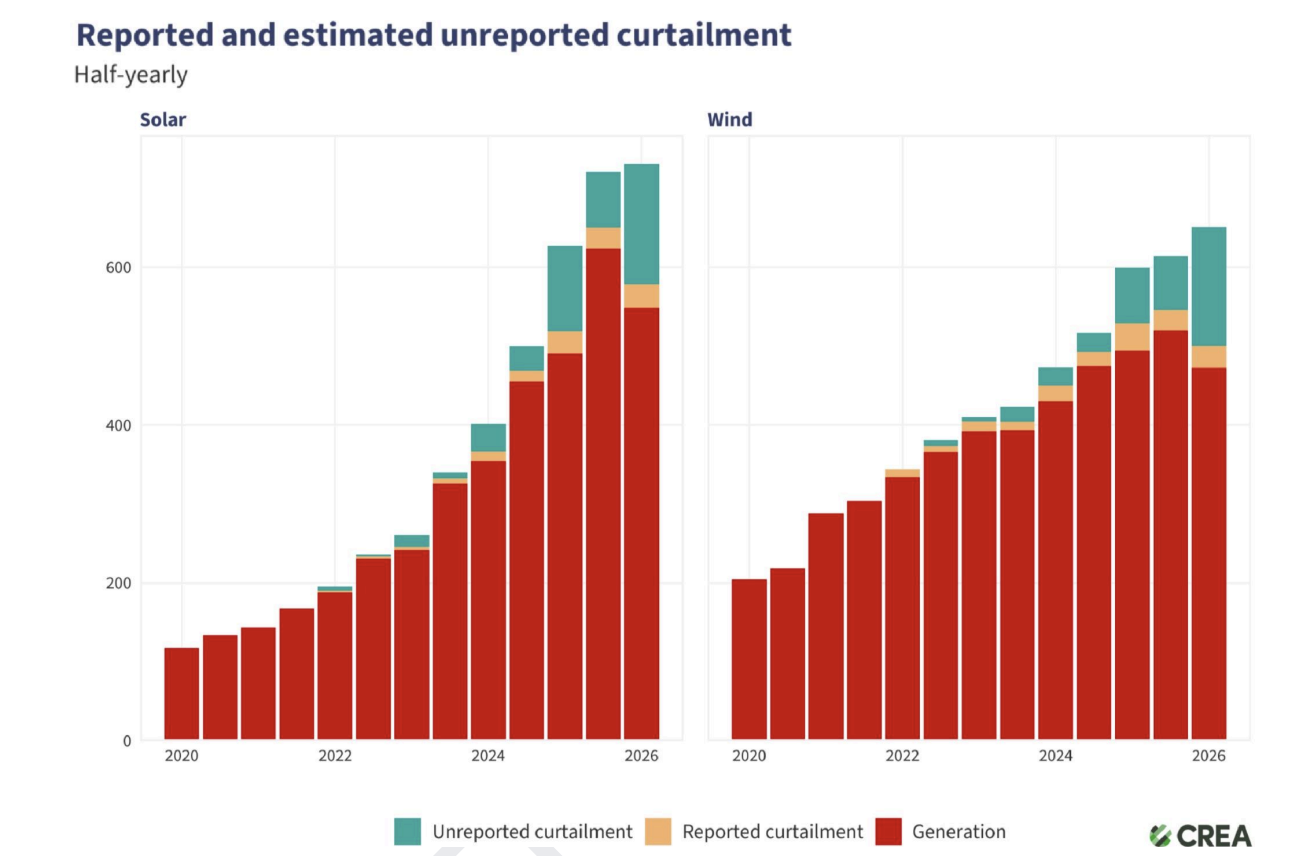
Available clean electricity from solar and wind, which have seen a record expansion in China, would have been more than enough to meet the extra demand and drive coal power down if it had been fully used, the report said. Instead, the amount of clean electricity wasted kept growing.
Estimated rates of curtailment, the intentional reduction of electricity from a source, for wind and solar were up by about a half in the six-month period compared to last year, wasting the equivalent of Indonesia’s annual electricity output.
Coal’s protected status
Researchers said that was caused by the Chinese grid’s inability to absorb the additional clean electricity, in addition to energy contracts and pricing mechanisms skewed in favour of coal power.
Chinese coal generators are required to sign long-term contracts covering a fixed share of the previous year’s output, now standing at 70%. Qi said that, out of fear of electricity shortages, regulators introduced these arrangements to protect coal power plants by guaranteeing them predictable prices and utilisation rates.
Additionally, China has also begun paying coal plants to stand ready to generate electricity, rather than for actually running, through new capacity payments introduced this year.
China unveils underwhelming emissions-cutting target for 2035
Qi said that, while each of these mechanisms has a legitimate purpose on its own, they now combine to give coal power excessive protections. “When renewables are abundant, they [coal operators] don’t have the incentive and are not required to ramp down,” she added.
The report suggested lowering, or even suspending, coal-specific contract minimums in provinces that are experiencing clean energy being wasted or prolonged periods of zero or negative electricity prices. That would help coal transition to a more flexible backup role and facilitate the integration of renewables, the researchers argued.
They also urged the Chinese authorities to halt permits for new coal power projects and reassess those that have already been permitted, while favouring grid expansion, energy trade across provinces and storage as ways to boost energy reliability.
The post China’s coal power rebounds as record clean energy goes to waste appeared first on Climate Home News.
China’s coal power rebounds as record clean energy goes to waste
Bemnet Agata is a communications officer at the Tax Justice Network, where Alison Schultz is a research fellow.
We are entering an age of permanent volatility.
Climate change is making extreme weather more destructive. Geopolitical tensions are disrupting energy markets and supply chains. Governments are expected not only to decarbonise their economies, but to protect them against an increasingly unpredictable world. That requires sustained public investment at precisely the moment repeated shocks are placing ever greater pressure on public finances.
Governments are rightly debating how to mobilise the trillions needed for the energy transition. Yet one of the largest untapped sources of climate finance requires neither higher corporate tax rates nor new international funds. It lies in correcting one of the oldest assumptions underpinning the international corporate tax system.
One of the stranger features of the modern economy is that we no longer disagree about what a multinational corporation is—until the conversation turns to tax.
-
UN chief warns climate crisis “in overdrive” as El Niño threatens to fuel the fire
Top politicians and scientists blamed the deadly fires on the climate crisis and said it should inspire more emissions reductions and adaptation measures -
Governments weigh response to US going alone on deep-sea mining
At annual talks in Kingston, the International Seabed Authority (ISA) launched legal processes to challenge a unilateral US push for deep-sea mining -
Egypt seeks to unlock renewable potential to power regional clean energy hub
Europe is investing in Egypt’s bid to position itself as a clean electricity exporter to reduce its emissions and generate a new source of income

Investors value Apple as a single global business. Consumers experience it as a single company. Its executives manage it as an integrated enterprise, allocating capital, production and marketing across continents according to commercial strategy rather than national borders. Nobody seriously believes its subsidiaries are independent businesses negotiating with one another as though they were unrelated companies.
Yet this is precisely the legal fiction upon which the international corporate tax system was built—and continues to rest.
That legal fiction does more than misdescribe how multinational businesses operate. It enables profits to be shifted away from the places where real economic activity takes place and into jurisdictions where little or no tax is paid. This not only erodes public revenues, but also undermines the level playing field by giving multinational corporations tax advantages that purely domestic businesses cannot replicate.
$500 billion a year
Taxing multinational corporations as the integrated businesses they actually are could generate around $500 billion in additional corporate tax revenues every year. That’s almost 40% of the $1.3 trillion in annual climate finance that, two years ago, governments agreed should be mobilised by 2035. That is exactly what governments are negotiating this week under the United Nations Framework Convention on International Tax Cooperation in New York.
Imagine Apple sold one million iPhones in Kenya. Few people would dispute that those sales depend on the Kenyan economy. Every iPhone arrives through Kenyan ports, travels on Kenyan roads, is sold by Kenyan workers, connects through Kenyan telecommunications infrastructure and is protected by Kenyan courts. Apple’s success depends not only on its own innovation, but on the public investments and institutions that make economic activity possible.
The negotiations underway under the United Nations Framework Convention on International Tax Cooperation would replace this legal fiction with a system known as unitary taxation with formulary apportionment. Rather than allowing multinational corporations to pay tax where they say their profits arise, it would allocate taxing rights according to where they undertake genuine economic activity—where they employ workers, manufacture goods, provide services and sell to customers. It would replace today’s pay where you say model with one based on pay where you play
This is not about increasing corporate tax rates. It is about deciding where multinational corporations should pay tax on the profits they already earn. Allocating taxing rights in this way would benefit countries across the income spectrum. While higher-income countries would gain the most in absolute terms, lower-income countries would see the largest proportional increases.
France, for example, would collect an additional US$25.5 billion each year, while Kenya would increase its corporate tax revenues by 406%. At a time of mounting climate costs, those revenues could help governments drive the transition to clean energy while investing in the resilience needed to withstand future shocks.
An overdue correction
The strongest argument for reform, however, is not the scale of the projected revenue gains. It is that the proposal corrects a century-old foundational error by bringing international tax rules into closer alignment with how the modern economy actually works.
Every successful market depends on foundations that no company creates alone: public investment, functioning institutions and the participation of millions of workers and consumers. If multinational profits are generated collectively across many countries, the rules governing where those profits are taxed should recognise that reality rather than the legal and accounting artifices that determine where profits appear on paper.
The international tax system remains an outlier. Every other area of economic governance has long since recognised multinational corporations as integrated global businesses. Tax rules remain the last custodian of the legal fiction that multinational corporations are not, in fact, multinational.
The debate taking place in New York is therefore about much more than tax. It is about whether the rules underpinning the global economy still reflect the economy they are meant to govern—and whether they equip governments with the fiscal capacity to confront the defining challenges of the twenty-first century.
Energy sovereignty without fiscal sovereignty is an unfinished transition. Countries cannot build a more secure and resilient future if the wealth generated within their economies continues to escape taxation where it is created.
Recovering those revenues would strengthen public finances, giving governments not only the resources to accelerate the energy transition but also the fiscal capacity to plan, coordinate and sustain it over the long term. In an age of permanent volatility, that capacity may prove to be every country’s most important climate adaptation strategy.
The post A legal fiction blocking billions in climate finance will be challenged this week appeared first on Climate Home News.
A legal fiction blocking billions in climate finance will be challenged this week



-
Climate Change12 months ago
Guest post: Why China is still building new coal – and when it might stop
-
Greenhouse Gases12 months ago
Guest post: Why China is still building new coal – and when it might stop
-

 Greenhouse Gases2 years ago
嘉宾来稿:满足中国增长的用电需求 光伏加储能“比新建煤电更实惠”
-

 Climate Change2 years ago
嘉宾来稿:满足中国增长的用电需求 光伏加储能“比新建煤电更实惠”
-
Climate Change2 years ago
Bill Discounting Climate Change in Florida’s Energy Policy Awaits DeSantis’ Approval
-

 Renewable Energy10 months ago
Sending Progressive Philanthropist George Soros to Prison?
-

 Carbon Footprint2 years ago
US SEC’s Climate Disclosure Rules Spur Renewed Interest in Carbon Credits
-
Greenhouse Gases1 year ago
嘉宾来稿:探究火山喷发如何影响气候预测