Connect with us

Published

on

Crusoe Energy's $600M Raise Fuels AI Revolution with Clean Energy Data Centers

Crusoe Energy Systems, a clean energy and AI infrastructure innovator, has raised $600 million in a Series D funding round, propelling its valuation to $2.8 billion. The company receives backing from prominent investors like Founders Fund, Nvidia, and Fidelity. With this funding, Crusoe is set to address the growing energy needs of artificial intelligence (AI) while prioritizing sustainability.

From Flaring to AI: How Crusoe is Scaling Clean Energy Data Centers

Founded in 2018, Crusoe began by tackling natural gas flaring—an environmentally harmful process where excess gas like methane is burned at oil sites. Using its Digital Flare Mitigation technology, Crusoe converted waste gas into energy to power small, containerized data centers. This approach reduces methane emissions while offering oil and gas companies a reliable, cost-free alternative to routine flaring.

  • According to the company, 1 Crusoe DFM-powered GPU reduces emissions by ~4.4 carbon dioxide equivalent metric tons per year.

Initially focused on cryptocurrency mining, the company has since shifted to AI-driven workloads, building clean energy data centers designed for the immense computational demands of machine learning (ML) and generative AI.

The recent funding round fuels Crusoe’s vision of building vertically integrated, AI-focused data centers powered by clean energy. A flagship project in Abilene, Texas, developed in partnership with Blue Owl Capital and Primary Digital, exemplifies this mission. 

This facility, spanning 998,000 square feet, is capable of housing up to 100,000 GPUs and delivering over 1.2 gigawatts of power—enough to support the energy needs of approximately 700,000 homes.

Chase Lochmiller, co-founder and CEO of Crusoe, emphasized the importance of building the facility, noting that:

“We’ve designed this data center to enable the largest clusters of GPUs in the world that will drive breakthroughs in AI.”

Crusoe’s newly launched Crusoe Cloud platform extends its capabilities to developers and researchers globally. Designed specifically for AI and machine learning workloads, the platform provides high-performance computing power while aligning with the company’s sustainability goals. 

By leveraging stranded and waste energy, Crusoe ensures that its cloud services contribute to environmental preservation without compromising on performance.

Addressing AI’s Growing Energy Demands with Nvidia’s Support

The rise of AI technologies has spiked energy demands for data centers worldwide. According to the International Energy Agency (IEA), data centers consumed 460 terawatt-hours (TWh) of energy in 2022. This figure will double by 2026. 

According to an analysis by the Electric Power Research Institute (EPRI), data center energy use in the U.S. will double driven by AI.

US data centers power use under 4 scenarios EPRI analysis

SEE MORE: US Data Center Power Use Will Double by 2030 Because of AI

  • Global energy demands for computing are surging, with projections of over 38GW by 2030. Meanwhile, inefficiencies in energy use persist: 144 billion cubic feet of natural gas were flared in 2021 and data centers alone could consume over 8% of global electricity by 2030, up from just 1% in 2020, per the IEA data.

Major companies like Microsoft, Google, and Amazon have cited energy consumption as a key hurdle in their decarbonization efforts. Crusoe’s innovative model offers a sustainable solution by repurposing waste energy and incentivizing the development of new low-carbon power sources.

By using Digital Flare Mitigation (DFM) and Digital Renewable Optimization (DRO) technologies, Crusoe captures and converts natural gas that would otherwise be flared. It also strategically positions its computing workloads near renewable energy sources, reducing inefficiencies and emissions.

The $600 million Series D round reflects the industry’s confidence in Crusoe’s ability to balance energy efficiency and technological advancement. Key supporters include Nvidia, which sees Crusoe’s infrastructure as crucial for advancing AI. Other major players like Deloitte and Vast Data do the same.

Sean Liu, Partner at Founders Fund, remarked on the company’s work, noting that:

“Crusoe is reimagining AI infrastructure from the ground up to meet and exceed organizations’ demands, powering the next wave of innovation in a sustainable way.”

The Environmental Benefits of Crusoe’s Model

Crusoe’s approach addresses two critical challenges: 

  1. Reducing methane emissions and 
  2. Supporting high-performance AI infrastructure. 

Methane, a potent greenhouse gas, is often released during flaring, contributing significantly to climate change. By converting this waste into a productive energy source, Crusoe mitigates environmental harm while fueling technological progress.

In addition to natural gas, Crusoe taps into stranded and surplus renewable energy, further reducing reliance on traditional fossil fuels. The company’s operations span 9 U.S. states and 3 countries, including Iceland. And it has more than 15 gigawatts of clean energy projects in development.

Through its DFM tech in the U.S., Crusoe was able to avoid over 680,000 metric tons of GHG emissions. The infographic below further shows how the company’s DFM helps reduce emissions.

Crusoe DFM emission reduction

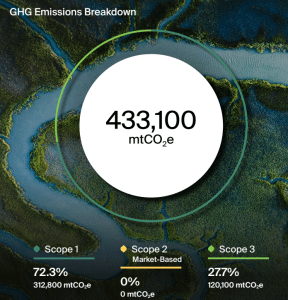
When it comes to its own GHG footprint, Crusoe actively tracks and reduces it by measuring Scope 1, 2, and 3 emissions annually with Emitwise’s carbon accounting platform, aligned with the GHG Protocol. The company uses quantity and spend data to calculate emissions across its operations, value chain, and employee activities.

Crusoe GHG emissions
Crusoe GHG footprint 2023

In 2023, despite business growth doubling emissions, Crusoe’s Digital Flare Mitigation technology significantly reduced methane emissions by capturing flared gas for energy use. Combined with renewable energy purchases, Crusoe avoided more emissions than it produced, and so, Scope 2 emissions are zero.

Revolutionizing Energy Use of AI Infrastructure

Crusoe’s clean energy data centers could support the future of AI. By combining energy efficiency with technological capability, the company offers a scalable solution to the industry’s growing demands. Its vertically integrated approach enables rapid deployment of cutting-edge infrastructure, allowing it to outperform legacy cloud providers in cost and speed.

This innovative model not only meets immediate energy needs but also sets the stage for long-term sustainability. By lowering the cost of clean energy-powered AI computing, Crusoe aligns the future of computing with global climate goals.

With its latest funding, Crusoe plans to expand its data centers, enhance its cloud platform, and support the development of new clean energy projects, while remaining committed to technological innovation.

As the demand for AI infrastructure continues to grow, Crusoe’s sustainable model offers a clear path forward. By turning waste energy into a valuable resource, the company is proving that AI advancements can coexist with a greener, more sustainable future.

The post Crusoe Energy’s $600M Raise Fuels AI Revolution with Clean Energy Data Centers appeared first on Carbon Credits.

Continue Reading

Carbon Footprint

Environmental Groups Urge U.S. Congress to Pause Data Center Growth as Federal AI Rule Looms

Published

on

Environmental Groups Urge U.S. Congress to Pause Data Center Growth as Federal AI Rule Looms

More than 230 environmental and public-interest groups asked Congress to halt approvals for and construction of new data centers. They want a temporary national moratorium until federal rules address energy use, water needs, local impacts, and emissions. The request came from Food & Water Watch and was signed by national and local groups across the country.

They said that the fast growth of artificial intelligence (AI) and cloud services is putting big new demands on local grids and water systems. They also said current federal rules do not cover the environmental or social impacts linked to data center growth.

Why the Groups Want a Moratorium

Data centers are using more electricity each year. U.S. data centers consumed an estimated 183 terawatt-hours (TWh) of electricity in 2024. That was about 4% of all U.S. power use. Some national studies project that number could rise to 426 TWh by 2030, which would be about 6.7% to 12% of U.S. electricity, depending on growth rates.

Global data centers used around 415 TWh of electricity in 2024. Analysts expect double-digit annual growth as AI loads increase.

US data center power demand 2030
Source: S&P Global

AI-ready data center capacity is projected to grow by about 33% per year from 2023 to 2030 in mid-range market scenarios. Industry groups say global data center capacity could reach over 220 gigawatts (GW) by 2030.

Some groups warn that data center CO₂ emissions might hit 1% of global emissions by 2030. That’s about the same as a mid-size industrial country’s yearly emissions. They say the growth rate is rising faster than the reductions in many other sectors. 

An excerpt from their letter reads:

“The rapid expansion of data centers across the United States, driven by the generative artificial intelligence (AI) and crypto boom, presents one of the biggest environmental and social threats of our generation. This expansion is rapidly increasing demand for energy, driving more fossil fuel pollution, straining water resources, and raising electricity prices across the country. All this compounds the significant and concerning impacts AI is having on society, including lost jobs, social instability, and economic concentration.”

When AI Growth Collides With the U.S. Power Grid

Several utilities have linked new power plant plans to data center growth. In Virginia, the largest power company and grid planners see data centers as a key reason for new infrastructure.

In Louisiana, Entergy moved forward with a new gas-plant plan expected to support a large hyperscale data center campus. These cases show how utilities now size new plants with AI-related load in mind.

Some utilities believe these expansions might increase local electricity rates by a few percentage points. This depends on how costs are shared. Regulators in various areas say that extra load can increase distribution and transmission costs. This might lead to higher bills for households.

Several grid operators also report congestion or long waiting lines for new power connections. Northern Virginia, Texas, and parts of the Pacific Northwest now have interconnection queues. In these areas, data center projects make up a large part of the pending requests.

Water Use and Siting Concerns

Water demand is another point of conflict. Many large data centers rely on water-cooled systems. A typical water-cooled data center may use around 1.9 liters of water per kWh. More advanced or dry-cooled facilities may use as little as 0.2 liters per kWh, but these designs are not yet common.

One medium-sized data center can use about 110 million gallons of water per year. Large hyperscale sites can use several hundred million gallons annually, and, in some cases, even more. Global estimates suggest data centers could use over 1 trillion liters of water per year by 2030 if growth continues.

data center water use
Source: Financial Times

These demands have triggered local resistance. In parts of Arizona, California, and Georgia, community groups have raised concerns about water use during drought periods. In some cases, local governments paused or limited data center approvals. A single campus can use more water each year than some small towns.

Trump Plans Executive Order on AI Regulation

While groups push for limits on new data centers, the White House is also preparing an executive order that would reshape AI policy nationwide, as reported by CNN. President Donald Trump has said he plans to issue an order that would block states from creating their own AI rules. 

The administration aims to create one national standard for AI. This way, companies won’t have to deal with different state regulations.

Drafts of the plan say the order may tell federal agencies to challenge state AI laws. This could happen through lawsuits or funding limits if the laws clash with federal policy. Supporters say a unified national rule could help U.S. companies compete globally and reduce compliance costs.

State leaders and consumer protection groups argue the opposite. They say states have a legal right to pass their own rules on privacy, safety, and data use. Some governors argue that an executive order cannot override state laws without action by Congress. Minnesota lawmakers, for example, continue to write their own AI bills focused on deepfakes and child-safety concerns.

The debate adds another layer to the data center issue. AI systems require massive computing power. If AI keeps growing quickly, analysts expect even heavier pressure on local grids and water systems. Advocacy groups say that this makes federal regulation more urgent.

Scale of AI and Hyperscale Build-out

The U.S. is in the middle of a major build-out of hyperscale and AI-optimized data centers. Industry trackers report that hundreds of new hyperscale facilities are planned or already under construction through 2030. Many of these campuses are designed specifically for AI training and inference workloads.

Major cloud and social media companies have sharply increased capital spending to support this build-out. Amazon, Google, Microsoft, Meta, and other major platforms, combined spending on AI chips, data centers, and network upgrades reached hundreds of billions of dollars per year in the mid-2020s. These spending levels signal how fast demand is growing.

Some experts track how major technology firms have changed over time. For example, one big cloud provider said its data center electricity use has more than doubled in the last ten years. This increase happened as its global reach grew. This gives a sense of how long-term trends feed current infrastructure pressures.

AI also adds new layers of demand. Training one large AI model can use millions of kilowatt-hours of electricity. Operating a popular chatbot can require many megawatt-hours per day, especially at peak traffic.

Research shows that processing one billion AI queries uses as much electricity as powering tens of thousands of U.S. homes for a day. This varies with the model’s size and efficiency.

AI power use by end 2025

Cities and States Move Faster Than Washington

Local governments have acted faster than federal agencies to respond to public concerns. More than 100 counties and cities have passed temporary moratoria, zoning limits, or new environmental rules since 2023. Examples include parts of Georgia, Oregon, Arizona, and Virginia, where communities plan to evaluate energy and water impacts before approving new projects.

Advocacy groups also argue that federal standards have not kept up. The U.S. does not have national energy-efficiency rules for private data centers. It also does not require detailed, mandatory reporting on energy, water, or emissions for the sector. The groups pushing for a moratorium say Congress must update these policies before more sites break ground.

What the Debate Means for 2026 and Beyond

Congress will review the environmental groups’ request in the coming months. Lawmakers are expected to weigh economic benefits against rising tensions around energy, water, and local resources. At the same time, the White House may release its AI executive order, which could shape how states and companies set their own rules.

With rapid AI growth, rising electricity use, and expanding data center construction, both debates are likely to continue through 2026. Many experts say long-term solutions will require national standards, better reporting, and closer coordination between states, utilities, and federal agencies.

The post Environmental Groups Urge U.S. Congress to Pause Data Center Growth as Federal AI Rule Looms appeared first on Carbon Credits.

Continue Reading

Carbon Footprint

ExxonMobil’s $20B Low-Carbon Bet in 2030 Plan: Big Emissions Cuts, Bigger Oil Production

Published

on

ExxonMobil’s $20B Low-Carbon Bet in 2030 Plan: Big Emissions Cuts, Bigger Oil Production

ExxonMobil published its updated 2030 Corporate Plan, which keeps the company’s “dual challenge” approach. The oil giant says it will supply reliable energy while cutting emissions. The update raises lower-emission spending, while also forecasting higher oil and gas production to 2030.

Billions in Motion: ExxonMobil’s Financial and Production Targets

ExxonMobil plans about $20 billion of lower-emission capital between 2025 and 2030. It says the $20 billion targets carbon capture and storage (CCS), hydrogen, and lithium projects.

The company projects ~5.5 million oil-equivalent barrels per day (Moebd) of upstream production by 2030. Exxon also forecasts ~$25 billion of earnings growth and ~$35 billion of cash-flow growth by 2030 versus 2024 on a constant price-and-margin basis.

The oil major gives a range for cash capex. It shows $27–29 billion for 2026 and $28–32 billion annually for 2027–2030. The updated plan highlights about $100 billion in major investments planned for 2026–2030. It notes these projects could bring in around $50 billion in total earnings during that time.

ExxonMobil earnings growth 2030
Source: ExxonMobil Updated 2030 Plan

Low-Carbon Plan: $20B for CCS, Hydrogen and Lithium

ExxonMobil describes the $20 billion as focused on three business lines:

  • CCS networks and hubs for third parties.
  • Hydrogen production and integrated fuels.
  • Lithium supply for batteries.

The company says roughly 60% of the $20 billion will support lower-emissions services to third-party customers. It estimates new low-carbon businesses could deliver ~$13 billion of earnings potential by 2040 if markets and policies develop as expected.

ExxonMobil $20B in low carbon investments
Source: ExxonMobil

Exxon’s updated Corporate 2030 Plan lists current and contracted CCS volumes. The company reports about 9 million tonnes per annum (MTA) of CO₂ capture capacity under contract for its U.S. Gulf Coast network. Key project entries include:

  • Linde — Beaumont, TX: ~2.2 MTA CO₂, start-up 2026.
  • CF Industries — Donaldsonville, LA: ~2.0 MTA, start-up 2026.
  • NG3 (Gillis, LA): ~1.2 MTA, start-up 2026.
  • Lake Charles Methanol II: ~1.3 MTA, start-up 2030.
  • Nucor — Convent, LA: ~0.8 MTA, start-up 2026.

The plan also highlights a proposed 1.0 GW low-carbon power/data center project paired with ~3.5 MTA capture, with a planned final investment decision in 2026. Exxon calls its Gulf Coast network an “end-to-end CCS system” and says scale depends on permitting and supportive policy.

ExxonMobil CCS system
Source: ExxonMobil

Counting Carbon: How Exxon Tracks Methane and Emissions Cuts

ExxonMobil says it is making measurable progress on emissions. The company reports faster-than-expected cuts in several intensity metrics. It states it has already met key 2030 intensity milestones and now expects to meet its methane-intensity target by 2026, four years early.

The company repeats its long-term net-zero framing for operated assets. Exxon’s plan targets Scope 1 and Scope 2 net-zero for its operated assets by 2050. It also sets a nearer target of net-zero Scope 1 and 2 for its operated Permian assets by 2035.

These commitments focus on emissions the company directly controls. They do not include a Scope 3 net-zero pledge for customer use of sold products. Exxon underscores that these goals depend on technology, markets, and supportive policy.

On operational achievements, Exxon highlights large cuts in routine flaring and improved equipment standards. The new plan states that the company reduced corporate flaring intensity by over 60% from 2016 to 2024.

  • As shown in the chart below, ExxonMobil’s operated-basis greenhouse gas profile shows a clear decline in Scopes 1 and 2 between the 2016 baseline and 2024.

Also, by 2024, Scope 1 emissions dropped to 91 million metric tons CO₂e. Scope 2 emissions (location-based) reached 9 million metric tons CO₂e. Together, this totals 100 million metric tons CO₂e. This is about a 15% reduction from 2016 based on operations.

ExxonMobil GHG emissions 2024

For the same period, Exxon’s Scope 1+2 emissions intensity dropped from 27.5 to 22.6 metric tons CO₂e per 100 metric tons produced. This shows they are decarbonizing operations, even as production has changed.

The company also hit other flaring and GHG intensity goals ahead of schedule. These outcomes came from replacing old equipment, tightening operations, and limiting routine venting and flaring.

Exxon lists four categories of near-term reduction actions it is scaling up:

  • Methane control: wider deployment of leak-detection and infrared cameras, more frequent inspections, and accelerated repairs.
  • Flaring reduction: operational changes and stricter shutdown protocols to cut routine flaring.
  • Efficiency and asset management: project design improvements, digital optimization, and selective asset sales or retirements to lower average carbon intensity.
  • CCS and low-carbon services: building capture hubs (about 9 MTA of contracted CO₂ capacity on the U.S. Gulf Coast) and contracting capture services for industrial customers.

The plan also names specific technology and program investments. Exxon highlights advanced sensor networks and real-time emissions monitoring. They also focus on expanding data systems to track and verify reductions. It expects these tools to improve measurement accuracy and speed up corrective action.

Limits and caveats appear repeatedly. Exxon links its long-term net-zero goal to several factors. These include market formation, policy incentives like tax credits and carbon pricing, and permitting timelines. The company warns that total emissions and some asset outcomes will change with production levels and energy demand.

In the near term, key metrics to watch include:

  • 2026 methane-intensity and flaring disclosures.

  • Volumes of CO₂ captured and stored as Gulf Coast CCS projects launch.

  • The pace of FID and execution for the 1.0 GW / 3.5 MTA low-carbon power and capture project.

These will show whether Exxon’s claimed progress converts into sustained emissions declines.

Fueling the Future: Rising Oil & Gas Output Through 2030

Exxon projects higher hydrocarbon output even as it invests in low-carbon businesses. The plan targets ~5.5 Moebd by 2030. The company expects ~65% of production to come from advantaged assets such as the Permian Basin, Guyana, and select LNG.

Permian growth is a core part of the supply outlook. Exxon expects roughly 2.5 Moebd from the Permian by 2030, up materially from 2024 levels. Guyana’s Stabroek Block is another major growth driver.

Exxon plans multiple new offshore start-ups in Guyana before 2030. The company argues that these barrels deliver lower operational carbon intensity compared with many older fields.

Critics say rising production risks locking in fossil reliance. Environmental groups, including the Sierra Club, called the plan inconsistent with a 1.5°C pathway. Exxon responds that the world will need oil and gas for decades and that its strategy balances supply security with emissions reduction. Reuters reported split investor and market reactions when the plan surfaced.

Investor Radar: Metrics to Track Exxon’s Low-Carbon Rollout

ExxonMobil links the pace of low-carbon roll-out to policy, permitting, and market formation. Key near-term items to watch include:

  • Final investment decision and execution of the 1.0 GW / 3.5 MTA project in 2026.
  • Gulf Coast CCS volumes will actually be placed into service in 2026–2030.
  • Methane-intensity disclosures in 2026 to confirm earlier achievement claims.

Market analysts noted Exxon’s plan targets improved earnings and cash flow through 2030 while retaining tight capital discipline. Some news channels highlighted that the company raised its earnings and cash-flow outlook to 2030 without raising total capital allocation.

ExxonMobil’s 2030 Corporate Plan balances growth and green ambition. With $20 billion dedicated to CCS, hydrogen, and lithium, the company aims to cut emissions while increasing oil and gas output.

Success will depend on technology, policy support, and timely project execution, making the next few years critical for investors and stakeholders tracking both energy transition and production growth.

The post ExxonMobil’s $20B Low-Carbon Bet in 2030 Plan: Big Emissions Cuts, Bigger Oil Production appeared first on Carbon Credits.

Continue Reading

Carbon Footprint

CSRD for SME Suppliers: How to turn data requests into a competitive advantage

Published

on

Across Europe, a quiet but decisive shift is reshaping how companies work with their suppliers. As the Corporate Sustainability Reporting Directive (CSRD) comes into force, large organisations are under mounting pressure to disclose detailed, verifiable sustainability information—not only about their own operations, but across their entire value chain. And because up to 80% of a company’s emissions often come from its supply chain, the spotlight naturally turns to SMEs.

Continue Reading

Trending

Copyright © 2022 BreakingClimateChange.com

