

Welcome to Carbon Brief’s Cropped.
We handpick and explain the most important stories at the intersection of climate, land, food and nature over the past fortnight.
Key developments
Weather-related hunger
‘LARGE-SCALE HUNGER’: A new report from the Clingendael Institute, a Dutch thinktank, found that “around 2.5 million people in Sudan could die from hunger by September 2024”, Middle East Eye reported. The report said “that parts of the country have likely already reached the tipping point at which large-scale hunger transitions into large-scale death”, the outlet wrote. The civil war that broke out in Sudan in April 2023 has disrupted food supply chains and logistics, but the shortage “has been worsened by drought and flooding, likely exacerbated by climate change”, Truthout said. Al Jazeera reported that “more than 25 million people scattered across Sudan, South Sudan and Chad are ‘trapped in a spiral’ of food insecurity”, according to the World Food Programme.
-
Sign up to Carbon Brief’s free “Cropped” email newsletter. A fortnightly digest of food, land and nature news and views. Sent to your inbox every other Wednesday.
PROLONGED DROUGHT: Zambia’s environment minister, Collins Nzovu, has warned that the drought that has gripped southern Africa in recent months is “a harbinger of what is in store for the region as the climate crisis worsens”, the Guardian reported. The newspaper continued: “People are reaching the end of their food stores, and importing from other countries in the region has become much harder as they too are feeling the impacts of the drought.” Hydropower capacity has also halved in the country, which receives about 95% of its electricity from dams. The Times of Zambia reported last month that the World Food Programme was giving Zambia $3.3m “to help the country respond to the drought”.
MARGINAL IMPROVEMENT: The Integrated Food Security Phase Classification (IPC), which monitors global hunger, “forecast that 28% of Afghanistan’s population, about 12.4 million people, will face acute food insecurity before October”, the Associated Press reported. This is a “slight improvement” over the previous IPC report, “but underline[s] the continuing need for assistance”, the newswire said. It added that “torrential rains and flash floods” in the northern part of the country last month killed more than 400 people, damaged or destroyed “thousands of homes” and turned farmland into mud. The Afghanistan Times reported that the floods have also “destroyed numerous water systems”, causing “difficulties in accessing sufficient clean water for drinking, cooking and bathing”.
END OF EL NIÑO: Meanwhile, despite the coming end to El Niño, “it is uncertain how soon a transition to a cooler La Niña will bring respite from the heat”, New Scientist wrote. The outlet explained: “El Niño is associated with hotter average temperatures and a distinctive pattern of weather conditions in much of the world.” It noted that background warming heightened the impacts of extreme weather events during this El Niño in many parts of the world, including flooding in Afghanistan and “intense” wildfire seasons in South America and Indonesia. But, it added: “Not all these effects were entirely negative. In the Horn of Africa, for instance, the rain helped ease a drought that has contributed to near-famine conditions in the region.”
Bird flu continues to spread
CASE BY CASE: The US reported a third human case of the H5N1 avian influenza and the first with the “respiratory symptoms that are more typical of human influenza infections”, CNN reported. All three cases so far have occurred in workers on dairy farms who had direct contact with infected cows. The outlet added that “the addition of respiratory symptoms doesn’t necessarily indicate that the virus has become more dangerous or that it may transmit more easily from person to person”. But in the New York Times, virologist Dr Rick Bright wrote that “the current bird flu situation is at a dangerous inflection point”.
SILENCE BEFORE THE STORM: Bright pointed out that the virus has now been found in 69 dairy herds in nine states. But the “agribusiness industry is eerily quiet about bird flu”, Gene Baur, an animal-rights activist, wrote in the Des Moines Register. He added that “lax responses from…industry indicate that there is no rush to spend the time and money needed to address this growing crisis”. Meanwhile, according to the Los Angeles Times, a “growing number” of states are moving to legalise the sale of raw milk, despite finding “high levels” of the virus in samples.
TWO FLUS: The first human case of H5N1 avian influenza in Australia was detected two weeks ago, in a child who had recently travelled to India, Reuters reported. The child has “made a full recovery” and there “was a very low chance of others becoming infected”, the newswire wrote. Meanwhile, a different strain of avian influenza has been detected near Melbourne, Reuters reported in a separate piece. The newswire wrote: “Hundreds of thousands of birds have already been destroyed after bird flu was found at two Australian egg farms last month.” According to the Victoria state government, “the outbreak poses no risk to consumers of eggs and poultry products”.
TREATY TALKS STALL: Meanwhile, the World Health Assembly ended without a finalised pandemic treaty, although member states agreed to extend the body’s mandate, with an aim to finalise the treaty by next year’s assembly, according to Down to Earth. The assembly did, however, “adop[t] crucial amendments to the International Health Regulations”. These included “pledging improved access to medical products and financing”, which will help protect the world against future pandemics, the outlet wrote. Al Jazeera explained that it appears that talks broke down over knowledge and technology sharing around new disease-causing pathogens. (For more on the importance of the pandemic agreement, see Carbon Brief’s DeBriefed from earlier this year.)
Offset push
MIXED MESSAGING: The US government announced new rules “to govern the use of voluntary carbon credits [while] seeking to boost confidence” in a market that has seen high-profile projects “failing to deliver” on emission cuts, Reuters reported. Meanwhile, a Financial Times story quoted US treasury secretary Janet Yellen calling for corporate buyers of carbon credits to “prioritise reducing their own emissions” and that participation in voluntary carbon markets should only “complement these efforts”. However, Yellen added that countries “need to use all the tools at our disposal”, including markets and private capital. The new federal guidelines attempt to define what “high-integrity” offsets are, the New York Times wrote, “meaning they can deliver real and quantifiable emissions reductions for projects that wouldn’t have happened otherwise”.
OFFSETS UNRAVELLING: Elsewhere, Bloomberg reported that one of the world’s biggest carbon-offsetting projects, based in Zimbabwe, is being withdrawn from Verra, a “key registry and standards body”. The Kariba forestry project, operated by Carbon Green Investments, “has emerged as one of the most controversial projects in the market for carbon offsets”, Bloomberg added. Kariba’s withdrawal from Verra “risks undermining one of the carbon market’s key insurance mechanisms”, which is a pool of surplus credits “set aside to cover events such as forest fires”, it said. Meanwhile, a SourceMaterial investigation with the Times questioned a claim from offset platform Carbon Done Right that it had “secured 57,000 hectares for offsetting” in Sierra Leone. The investigation found that no such leases had been registered with local authorities.
DWINDLING APPETITE: According to a new report by Ecosystems Marketplace, the market for carbon offsets “shrank dramatically” in 2023, falling from $1.9bn (£1.5bn) in 2022 to $723m (£551m) in 2023, the Guardian reported. The 61% contraction in market size was attributed to a “flurry of scientific studies and media reports that concluded millions of offsets were worthless”, the story adds. However, Prof Julia Jones of Bangor University, who co-authored one such study, told the Guardian – and wrote in Nature Ecology & Evolution – that she was “deeply concerned” that recent media coverage “gives the impression that the very idea of tackling climate change by slowing tropical deforestation is a scam”. She added: “This is not true and the idea could harm forests.”
News and views
‘BOILING NOT WARMING’: Thailand’s marine life is “suffering” due to record ocean temperatures, “worrying scientists and local communities”, the Bangkok Post reported. Mass coral bleaching is underway, with Lalita Putchim, a marine biologist with the country’s department of marine and coastal resources, telling the newspaper: “I couldn’t find a single healthy coral…Almost all of the species have bleached, there’s very little that’s not affected.” The temperatures – reaching close to 33C – are also impacting the livelihoods of local fishers, with potential knock-on effects for food prices and food security, the outlet noted.
POLAND FARMER STRIKES: A DeSmog investigation revealed that Orka – a new Polish farmers’ movement that stormed the country’s parliament on 9 May – rose to prominence “after it was championed by populist politicians”, despite identifying itself as an “apolitical” group of “common farmers”. DeSmog uncovered “a number of far-right links to two of the group’s leading figures”. Rightwing Polish MPs gave Orka “access to the parliament building” and have “also been quick to join” Orka’s protest, which has said it wants to put the EU Green Deal “in the trash”, the outlet added. Politicians named in the piece had not yet responded to DeSmog.
SEABED SUIT: WWF-Norway has sued the Norwegian government “for its controversial decision to open up vast parts of its continental shelf to deep seabed mining”, the Maritime Executive reported. The suit claims that the government’s impact assessment “fails to satisfy minimum requirements of the country’s subsea minerals act”. The outlet added that the NGO had sent an initial notice to the government in April, while the government responded that the lawsuit is “lacking merit”. According to the Guardian, the Norwegian Environment Agency “has also said the impact assessment does not provide a sufficient scientific or legal basis for deep-sea mining”.
WOLVES RETURN: The Irish Times reported that wolf populations are “making a comeback” in Europe “thanks to wildlife protection measures” introduced by the EU. According to the newspaper, the number of wolves has grown 81% since 2012, to more than 20,000, and their range is up 25%. While Spain, host to “one of the largest populations in the EU”, has “tightened” its measures to protect the wolf, a “backlash” is stirring at the EU level, it adds. In December, Ursula Von Der Leyen’s conservative party backed a proposal to downgrade the protected status of wolves, Agriland reported. And, last week, the EU council of agricultural ministers “heard calls for more to be done to address the rise in wolf attacks on livestock”.
NZ’S ‘WAR ON NATURE’: New Zealand’s rightwing government was accused of “waging a war on nature” by environmentalists after it made “sweeping cuts” to climate projects in its 2024-25 budget, the Guardian reported. While the country’s climate minister pointed to flood defences and a waste levy when asked about the absence of new funding for environmental protection, critics described these as “the ambulance at the bottom of the cliff without future-facing climate mitigation plans”, the paper added.
OJ INFLATION: Orange juice makers are considering switching to mandarins as wholesale prices have “gone bananas” following fears of poor harvests in Brazil, the Guardian reported. It added that orange trees in Brazil have been hit by an “incurable disease” after “extreme heat stress and drought during their key flowering period…fuelled by the climate crisis”. Florida, another key growing region, has been “hit by a series of hurricanes and the greening disease, which is spread by sap-sucking insects”, it added. The Financial Times quoted Kees Cools, the president of the International Fruit and Vegetable Juice Association, who said: “We’ve never seen anything like it, even during the big freezes and big hurricanes.”
MONKEY BUSINESS: More than 150 howler monkeys – “midsize primates known for their roaring vocal calls” – have died, apparently of heat stroke, amidst a major heatwave in Mexico, the Associated Press reported. In a northern Mexican animal park, “at least a hundred parrots, bats and other animals have died, apparently of dehydration”, the newswire added. Mexican newspaper La Prensa reported that volunteers were working to “establish drinking fountains for wildlife” in affected communities.
Watch, read, listen
FARMERS’ FURY: An Article 14 story explained why Punjab’s farmers “boycotted” Narendra Modi’s party in India’s general elections that concluded this week.
CHAT GPTREE?: This Guardian podcast looked at the literature to see if the “wood-wide web” – the idea that trees can talk to each other – holds water against new evidence.
FROG FUNGUS: In Sequencer, freelance journalist Max Levy explored the single deadliest pathogen for biodiversity loss: a deadly fungus imperilling amphibian populations.
ISLAND DROUGHT: Euronews Green followed the plight of Sicilian farmers trying to cope with one of the island’s worst droughts on record – exacerbated by poor water management.
New science
Global groundwater warming due to climate change
Nature Geoscience
New research found that, on average, global groundwater is projected to warm by more than 2C over the 21st century under a medium-emissions pathway. By modelling the diffusion of heat from the surface through the ground and maps of water-table depth, researchers calculated monthly temperatures for groundwater around the world from 2000 to 2100. They found that groundwater temperatures increased by an average of 0.3C over 2000-20, although with significant variation from place to place. They concluded that climate change under a medium-emissions pathway could push groundwater resources for 77-188 million people above the “highest threshold for drinking water temperatures set by any country”.
African food system and biodiversity mainly affected by urbanisation via dietary shifts
Nature Sustainability
Increasing rice demand due to urbanisation will increase Africa’s methane emissions by 2.4% by 2050, according to new research. Using projections of urban expansion in Africa, researchers modelled land-use changes and the accompanying production changes for staple crops. They found that more than 3m hectares of land will be converted to urban land under a “middle-of-the-road” narrative – a relatively small proportional decrease, but with potential major impacts on local biodiversity. The authors argued that land-use planning and policymaking should take into account impacts on food production and biodiversity loss.
The human side of rewilding: Attitudes towards multi-species restoration at the public-private land nexus
Biological Conservation
A new study looking to understand US public opinion towards rewilding found more negative attitudes and behaviour when it came to reintroducing species that could harm livestock or humans or those that require more regulation. Conversely, interest groups favoured initiatives that involved conserving species migration as an ecological process. Researchers surveyed five stakeholder groups – “local ranchers, statewide ranchers, rural residents, urban residents and members of conservation organisations” – across the state of Montana. The results, they concluded, highlight “how achieving rewilding in working lands will require community engagement to increase public support and continued assessments of social processes that may limit multi-species restoration”.
In the diary
- 3-13 June: 60th sessions of UN Climate Change’s subsidiary bodies | Bonn, Germany
- 6-9 June: European elections
- 7-8 June: High-level event on ocean action | San Jose, Costa Rica
- 12 June: Sixth meeting of the informal advisory group on benefit-sharing from the use of digital sequence information on genetic resources | Online
This is an online version of Carbon Brief’s fortnightly Cropped email newsletter. Subscribe for free here.
Cropped is researched and written by Dr Giuliana Viglione, Aruna Chandrasekhar, Daisy Dunne, Orla Dwyer and Yanine Quiroz. Please send tips and feedback to cropped@carbonbrief.org.

The post Cropped 5 June 2024: Sudan famine ‘imminent’; Pandemic treaty drags on; US backs offsets with ‘integrity’ appeared first on Carbon Brief.

Casting doubt on the determination that greenhouse gas emissions endanger public health and welfare, he said, “we’re not accepting all of the narrative of the left without any question or pushback.”
WASHINGTON—Addressing a conference of scientists and other experts skeptical of climate change, Environmental Protection Agency Administrator Lee Zeldin on Wednesday celebrated his decision to repeal what is known as the “endangerment finding,” which provided the backbone for federal regulation of greenhouse gas emissions.
Zeldin Celebrates Endangerment Finding Repeal With Climate Skeptics
With the U.S. bombing Iran and the Strait of Hormuz closed, energy experts say countries transitioning to renewables will be more resilient in the “face of the shock.”
The United States’ war on Iran could fundamentally alter how countries consume and generate energy and hamper international progress in combating climate change, a panel of energy experts said today.
The Global Energy Supply in a Decade ‘Is Not a World We’re Going to Recognize’
One month into the US and Israel’s war on Iran, at least 60 countries have taken emergency measures in response to the subsequent global energy crisis, according to analysis by Carbon Brief.
So far, these countries have announced nearly 200 policies to save fuel, support consumers and boost domestic energy supplies.
Carbon Brief has drawn on tracking by the International Energy Agency (IEA) and other sources to assess the global policy response, just as a temporary ceasefire is declared.
Since the start of the war in late February, both sides have bombed vital energy infrastructure across the region as Iran has blocked the Strait of Hormuz – a key waterway through which around a fifth of global oil and liquified natural gas (LNG) trade passes.
This has made it impossible to export the usual volumes of fossil fuels from the region and, as a result, sent prices soaring.
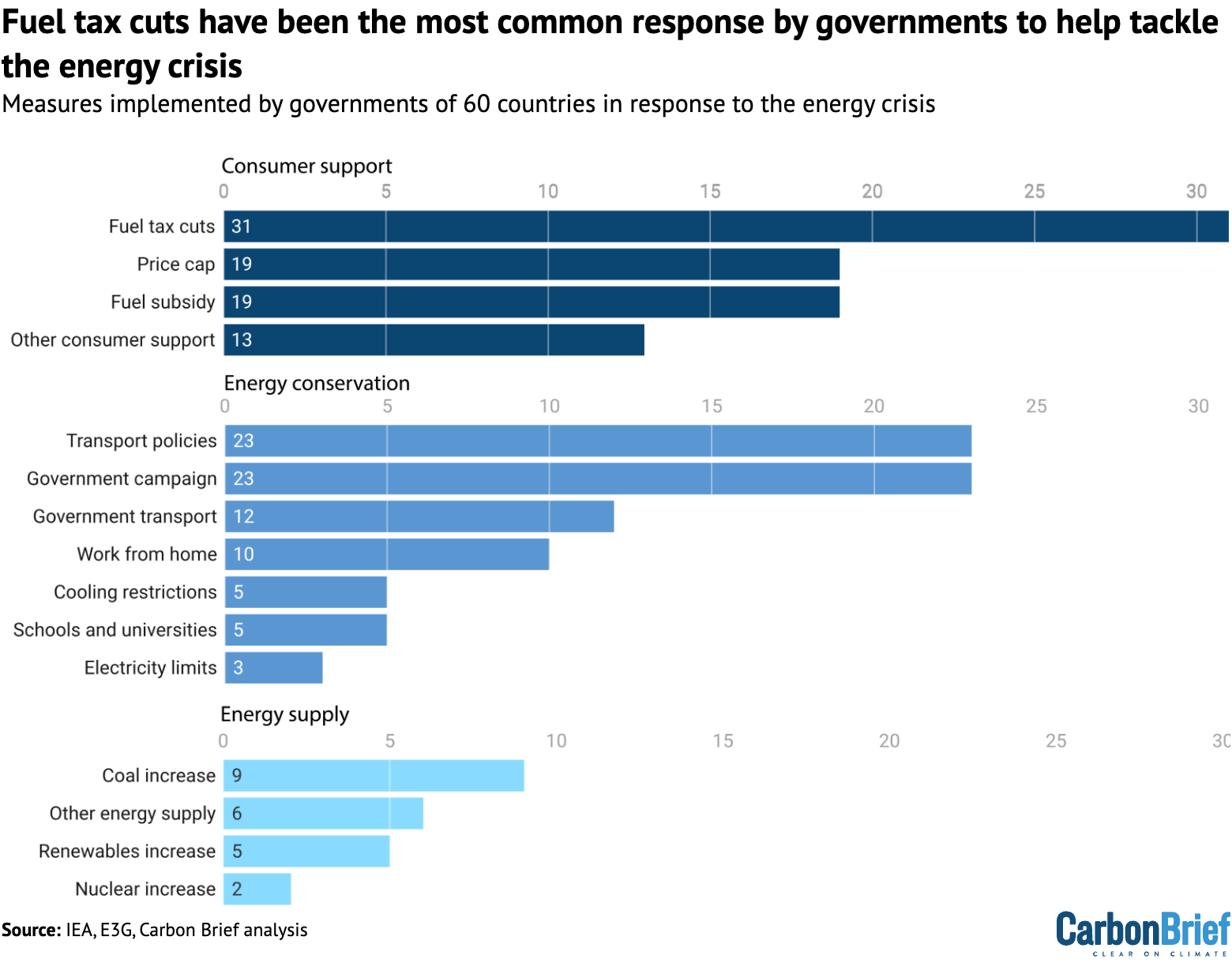
Around 30 nations, from Norway to Zambia, have cut fuel taxes to help people struggling with rising costs, making this by far the most common domestic policy response to the crisis.
Some countries have stressed the need to boost domestic renewable-energy construction, while others – including Japan, Italy and South Korea – have opted to lean more on coal, at least in the short term.
The most wide-ranging responses have been in Asia, where countries that rely heavily on fossil fuels from the Middle East have implemented driving bans, fuel rationing and school closures in order to reduce demand.
‘Largest disruption’
On 28 February, the US and Israel launched a surprise attack on Iran, triggering conflict across the Middle East and sending shockwaves around the world.
There have been numerous assaults on energy infrastructure, including an Iranian attack on the world’s largest LNG facility in Qatar and an Israeli bombing of Iran’s gas sites.
Iran’s blockade of the Strait of Hormuz, a chokepoint in the Persian Gulf, is causing what the IEA has called the “largest supply disruption in the history of the global oil market”.
A fifth of the world’s oil and LNG is normally shipped through this region, with 90% of those supplies going to destinations in Asia. Without these supplies, fuel prices have surged.
Governments around the world have taken emergency actions in response to this new energy crisis, shielding their citizens from price spikes, conserving energy where possible and considering longer-term energy policies.
Even with a two-week ceasefire announced, the energy crisis is expected to continue, given the extensive damage to infrastructure and continuing uncertainties.
Asian crunch
Carbon Brief has used tracking by the IEA, news reports, government announcements and internal monitoring by the thinktank E3G to assess the range of national responses to the energy crisis roughly one month into the Iran war.
In total, Carbon Brief has identified 185 relevant policies, announcements and campaigns from 60 national governments.
As the map below shows, these measures are concentrated in east and south Asia. These regions are facing the most extreme disruption, largely due to their reliance on oil and gas supplies from the Middle East.
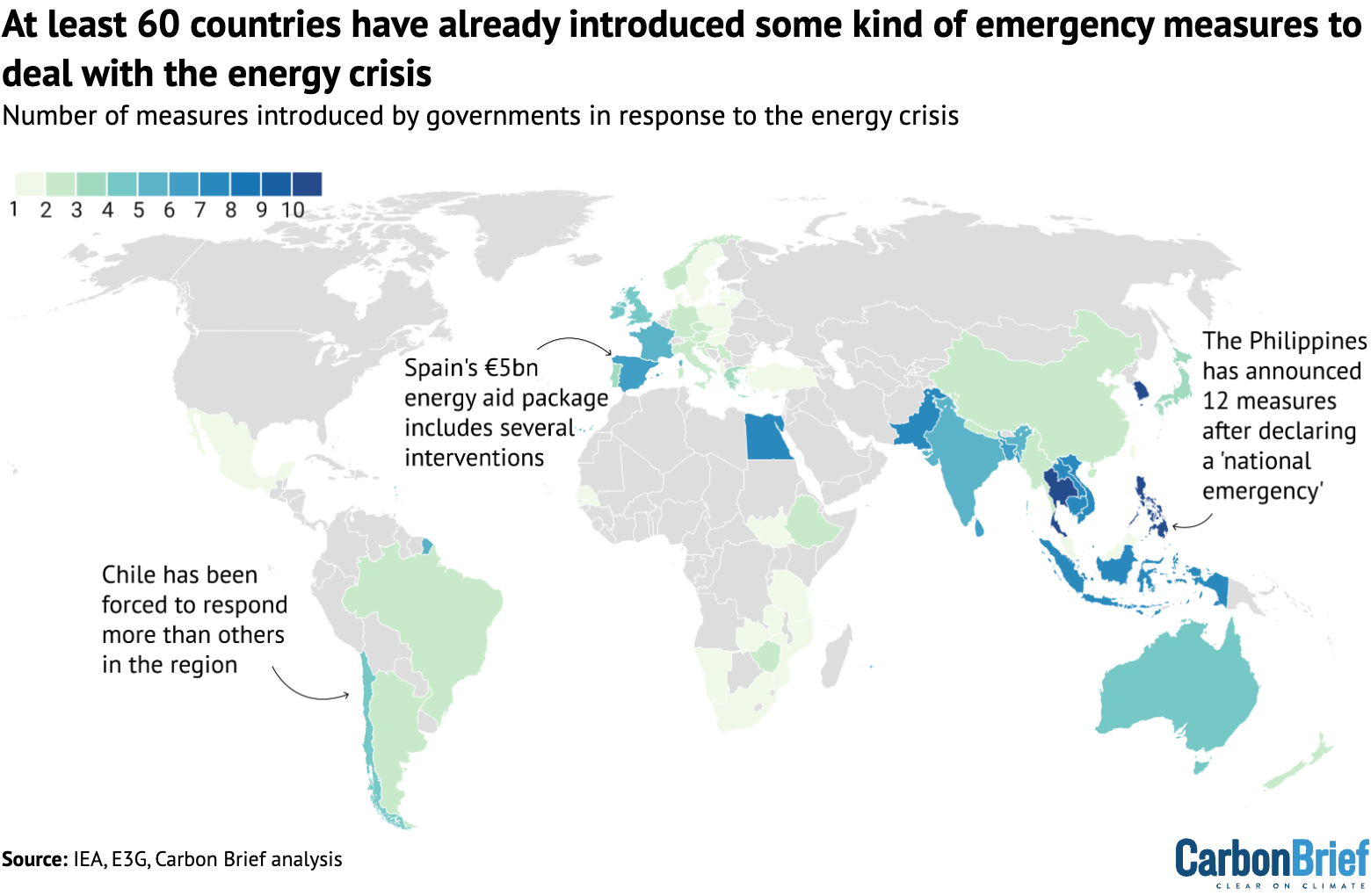
Nations including Indonesia, Japan, South Korea and India are already spending billions of dollars on fuel subsidies to protect people from rising costs.
At least 16 Asian countries are also taking drastic measures to reduce fuel consumption. For example, the Philippines has declared a “state of national emergency”, which includes limiting air conditioning in public buildings and subsidising public transport.
Other examples from the region include the government in Bangladesh asking the public and businesses to avoid unnecessary lighting, Pakistan reducing the speed limit on highways and Laos encouraging people to work from home.
Europe – which was hit hard by the 2022 energy crisis due to its reliance on Russian gas – is less immediately exposed to the current crisis than Asia. However, many nations are still heavily reliant on gas, including supplies from Qatar.
The continent is already feeling the effects of higher global energy prices as countries compete for more limited resources.
At least 18 European nations have introduced measures to help people with rising costs. Spain, which is relatively insulated from the crisis due to the high share of renewables in its electricity supply, nevertheless announced a €5bn aid package, with at least six measures to support consumers.
Many African countries, while also less reliant on direct fossil-fuel supplies via the Strait of Hormuz than Asia, are still facing the strain of higher import bills. Some, including Ethiopia, Kenya and Zambia, are also facing severe fuel shortages.
There have been fewer new policies across the Americas, which have been comparatively insulated from the energy crisis so far. One outlier is Chile, which is among the region’s biggest fuel importers and is, therefore, more exposed to global price increases.
Tax cuts
The most common types of policy response to the energy crisis so far have been efforts to protect people and businesses from the surge in fuel prices.
At least 28 nations, including Italy, Brazil and Australia, have introduced a total of 31 measures to cut taxes – and, therefore, prices – on fuel.
Even across Africa, where state revenues are already stretched, some nations – including Namibia and South Africa – are cutting fuel levies in a bid to stabilise prices.
Another 17 countries, including Mexico and Poland, have directly capped the price of fuel. Others, such as France and the UK, have opted for more targeted fuel subsidies, designed to support specific vulnerable groups and industries.
These measures are all shown in the dark blue “consumer support” bars in the chart below.
Such measures can directly help consumers, but some leaders, NGOs and financial experts have noted that there is also the risk of them driving inflation and reinforcing reliance on the existing fossil fuel-based system.
Christine Lagarde, president of the European Central Bank, spoke in favour of short-term measures to “smooth the shock”, but noted that “broad-based and open-ended measures may add excessively to demand”.
Measures to conserve energy, of the type that many developing countries in Asia have implemented extensively, have been described by the IEA as “more effective and fiscally sustainable than broad-based subsidies”.
So far, there have been at least 23 such measures introduced to limit the use of transport, particularly private cars.
These include Lithuania cutting train fares, two Australian states making public transport free and Myanmar and South Korea asking people to only drive their cars on certain days.
Clean vs coal
At least eight countries have announced plans to either increase their use of coal or review existing plans to transition away from coal, according to Carbon Brief’s analysis. These include Japan, South Korea, Bangladesh, the Philippines, Thailand, Pakistan, Germany and Italy.
These measures broadly involve delaying coal-plant closure, as in Italy, or allowing older sites to operate at higher rates, as in Japan – rather than building more coal plants.
There has been extensive coverage of how the energy crisis is “driving Asia back to coal”. However, as Bloomberg columnist David Fickling has noted, this shift is relatively small and likely to be offset by a move to cheap solar power in the longer term.
Indeed, some countries have begun to consider changes to the way they use energy going forward, amid a crisis driven by the spiralling costs of fossil-fuel imports.
Leaders in India, Barbados and the UK have explicitly stressed the importance of a structural shift to using clean power. Governments in France and the Philippines are among those linking new renewable-energy announcements with the unfolding crisis.
New renewable-energy capacity will take time to come online, albeit substantially less time than developing new fossil-fuel generation. In the meantime, some nations are also taking short-term measures to make their road transport less reliant on fossil fuels.
For example, the Chilean government has enabled taxi drivers to access preferential credit for purchasing electric vehicles (EVs). Cambodia has cut import taxes on EVs and Laos has lowered excise taxes on them.
Finally, there have been some signs that countries are reconsidering their future exposure to imported fossil fuels, given the current economics of oil and gas.
The New Zealand government has indicated that a plan to build a new LNG terminal by 2027 now faces uncertainty. Reuters reported that Vietnamese conglomerate Vingroup has told the government it wanted to abandon a plan to build a new LNG-fired power plant in Vietnam, in favour of renewables.


The post Iran war analysis: How 60 nations have responded to the global energy crisis appeared first on Carbon Brief.
Iran war analysis: How 60 nations have responded to the global energy crisis



-
Climate Change8 months ago
Guest post: Why China is still building new coal – and when it might stop
-
Greenhouse Gases8 months ago
Guest post: Why China is still building new coal – and when it might stop
-

 Greenhouse Gases2 years ago
嘉宾来稿:满足中国增长的用电需求 光伏加储能“比新建煤电更实惠”
-
Climate Change2 years ago
Bill Discounting Climate Change in Florida’s Energy Policy Awaits DeSantis’ Approval
-

 Climate Change2 years ago
嘉宾来稿:满足中国增长的用电需求 光伏加储能“比新建煤电更实惠”
-
Climate Change Videos2 years ago
The toxic gas flares fuelling Nigeria’s climate change – BBC News
-

 Renewable Energy6 months ago
Sending Progressive Philanthropist George Soros to Prison?
-

 Carbon Footprint2 years ago
US SEC’s Climate Disclosure Rules Spur Renewed Interest in Carbon Credits