Connect with us

Published

on

Billed as the “Amazon COP”, the UN climate talks will see the debut of Brazil’s flagship fund to “reward” tropical countries for keeping their forests intact.

The Tropical Forest Forever Facility (TFFF) will be launched at the COP30 leaders’ summit on 6 November.

The fund aims to raise and invest $125bn from a range of sources, with excess returns channelled to up to 74 developing countries that sufficiently protect their forests.

This, according to Brazil, would make it one of the biggest multilateral investment funds for nature.

(For comparison, the Green Climate Fund’s portfolio is around $18bn.)

While Brazil expects TFFF to “transform the world’s approach to environmental conservation”, many critics remain unconvinced.

They argue that conservation funding for climate-critical forests should not depend on “betting on stock market prices” and instead call for new biodiversity finance.

Here, Carbon Brief takes a closer look at where the fund came from, how it will be set up and how it is supposed to work.

What is the Tropical Forest Forever Facility?

First officially proposed by Brazil at COP28 in Dubai in 2023, the Tropical Forest Forever Facility aims to pay up to 74 developing tropical forest countries for keeping their existing old-growth forests intact.

It plans to do this by raising $25bn in capital from wealthy “sponsor” governments and philanthropies, which – it hopes – will attract an additional $100bn in private investment.

Returns on these investments will go towards paying back investors and making “forest payments” to countries that increase or maintain their forest cover.

On 4 November, Brazil’s finance minister Fernando Haddad told Bloomberg that “he believed the fund could raise $10bn by next year”, less than half the original target.

While the facility’s official launch is slated for COP30, its rules are still being finalised after several iterations of “concept notes” and consultations.

However, the idea that underpins the fund is not new.

Former World Bank treasurer Kenneth Lay first floated the idea of a Tropical Forest Finance Facility around 15 years ago.

Lay and others later envisioned the TFFF as a “pay-for-performance” sovereign wealth fund for forests. In their design of the TFFF, loans from developed countries and private investors would have been invested in the debt markets of tropical forest countries, with excess returns being allocated annually as “rainforest rewards”.

In their thinking, TFFF offered a “highly-visible, large-scale reward for successfully tackling deforestation without increasing funding demands” on developed countries, according to a 2018 article for the Center for Global Development.
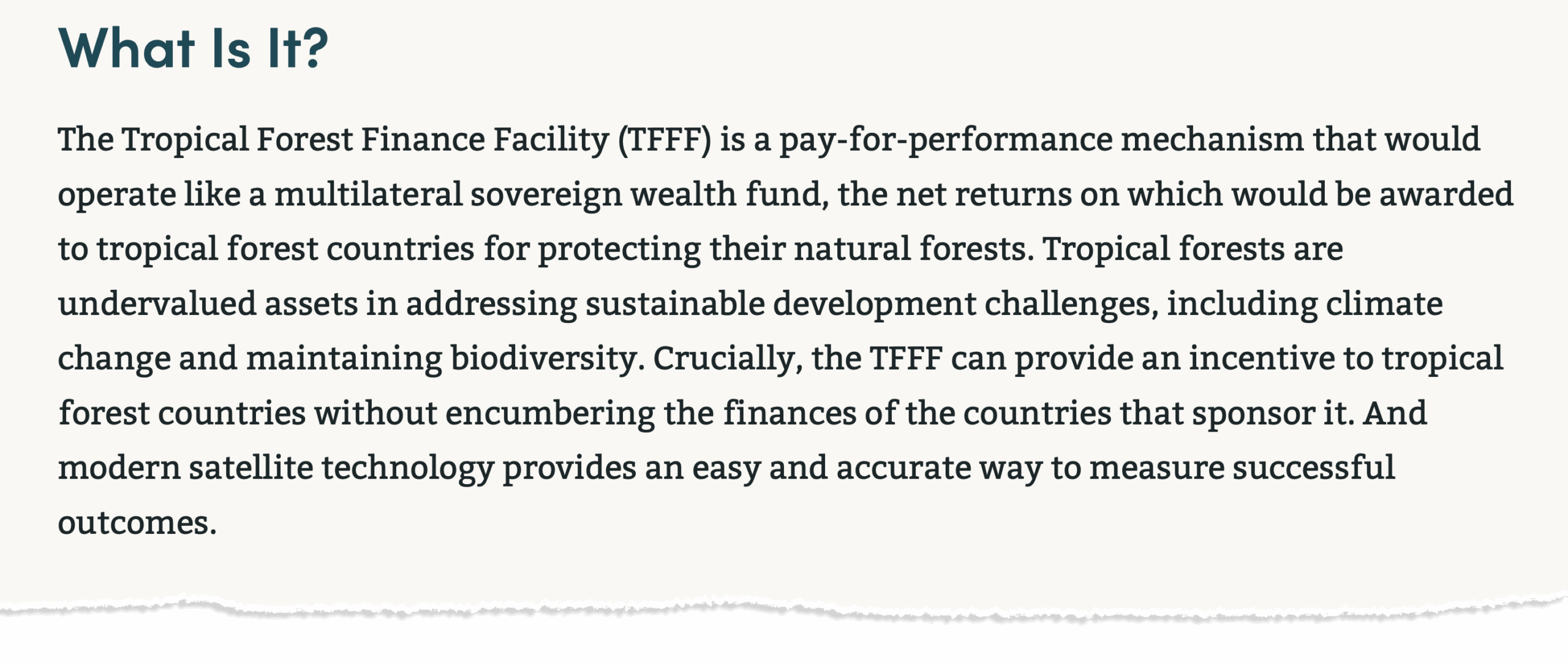
Definition of the Tropical Forest Finance Facility, taken from its website: "What Is It? The Tropical Forest Finance Facility (TFFF) is a pay-for-performance mechanism that would operate like a multilateral sovereign wealth fund, the net returns on which would be awarded to tropical forest countries for protecting their natural forests. Tropical forests are undervalued assets in addressing sustainable development challenges, including climate change and maintaining biodiversity. Crucially, the TFFF can provide an incentive to tropical forest countries without encumbering the finances of the countries that sponsor it. And modern satellite technology provides an easy and accurate way to measure successful outcomes."
The Tropical Forest Finance Facility, as defined in a 2018 article. Source: Center for Global Development (2018)

Others central to the TFFF’s current design are Christopher Egerton-Warburton – founder of London-based Lion’s Head Global Partners, who is credited with engineering the facility’s financial structure – and Garo Batmanian, director of Brazil’s forestry service.

What is it designed to achieve?

The ultimate goal of the TFFF is to pay for the conservation of the world’s major rainforests, which provide a range of ecosystem services, including carbon storage.

In a statement from the COP30 presidency, André Aquino, special advisor on economy and environment at Brazil’s ministry of environment, said:

“What the TFFF seeks is for the world to remunerate part of these services. It is to remunerate forests as the basis of life, as the basis of the economy, for our well-being.”

On the ground, this mechanism could help landowners to conserve trees and forests by ensuring that the value they bring as standing forests is higher than from cutting them down.

The facility also intends to finance long-term objectives for forest conservation, including policies and programmes for sustainable use and restoration.

More than 70 developing countries that are home to more than 1bn hectares of tropical and sub-tropical forests could be potential recipients from this facility. These countries span the Amazon, Congo and Mekong basins, as well as many other regions.

The following map shows the countries that host tropical rainforests and are potentially eligible to receive funds from the TFFF.
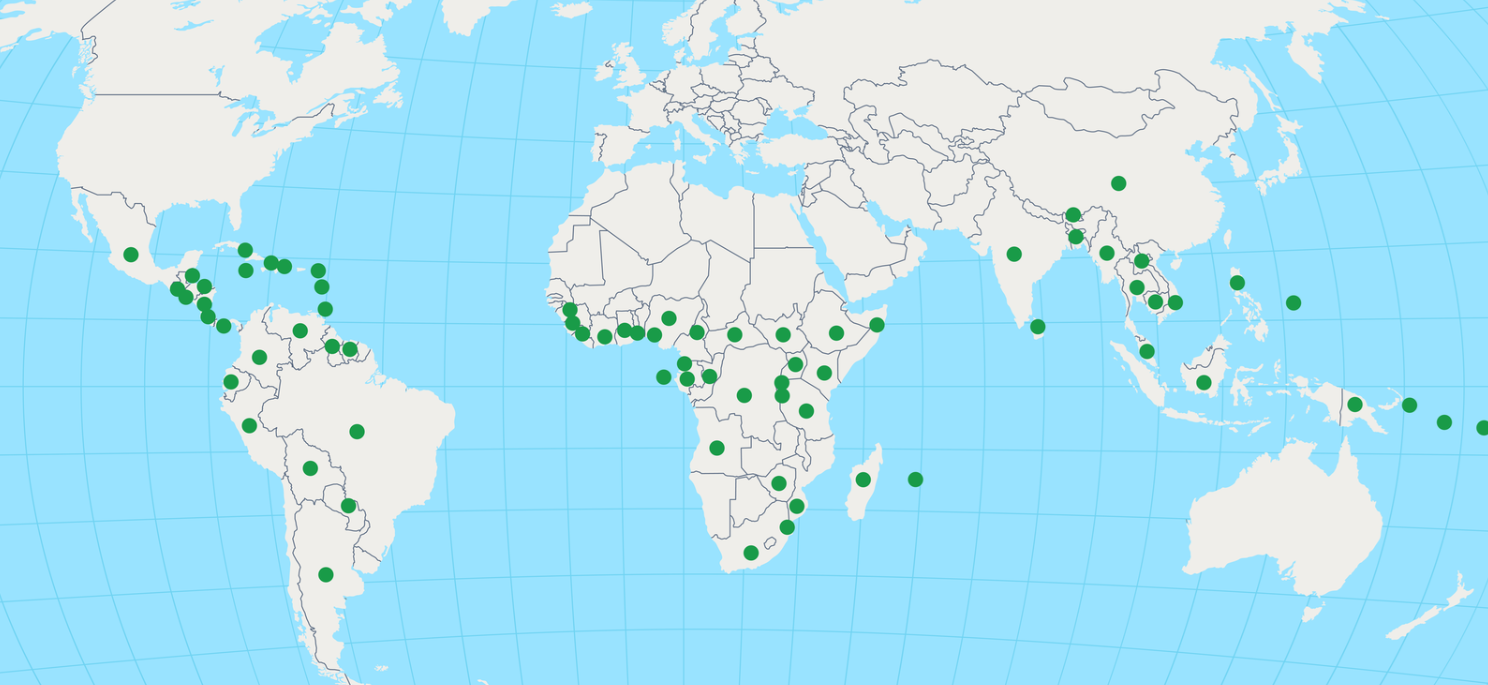
Global map showing around 74 countries with tropical rainforests marked with green dots are potential recipients of the TFFF. Source: COP30 official website.
Around 74 countries with tropical rainforests marked with green dots are potential recipients of the TFFF. Source: COP30 official website.

To be selected as beneficiaries, countries will require transparent financial management systems and must commit to allocating 20% of the funds to Indigenous peoples and traditional communities, according to the draft rules.

These countries would need to have a deforestation rate – averaged over the previous three years – of no more than 0.5% of their total forested area, with standing forest areas having a canopy cover of at least 20-30% in each hectare to be eligible for payments.

The TFFF’s third concept note says that areas that transition from above to below this 20-30% threshold would be “considered deforested”.

In a recent Yale Environment 360 article, forest ecologists warned that the low level of this threshold – for what counts as a forested area – is “not scientifically credible” and “would allow payments even where industrial logging is occurring in primary forests”.

However, TFFF argues that “including forest areas with lower canopy cover does provide an incentive for maintaining these areas”.

Additionally, payments would be reduced for each hectare of forest loss and for each hectare degraded by fire.

The funds for Indigenous peoples would be “put aside in a different account, following different rules”, Aquino said during a press briefing attended by Carbon Brief.

Brazil’s ministry of environment and climate change invited five countries with rainforests to support the creation of the fund: Colombia, the Democratic Republic of Congo, Ghana, Indonesia and Malaysia.

Individual national governments that are beneficiaries of the scheme would be free to define how and where the generated funds would be distributed.

How will the fund work?

The TFFF is split into two entities, with a secretariat to coordinate between them.

The facility is the first of these. It is tasked with setting up the rewards system, eligibility criteria, monitoring methodologies and disbursement rules, as well as engaging with participating recipient countries.

The other is the TFFF’s main financial arm, the Tropical Forest Investment Fund (TFIF) – responsible for raising and managing the TFFF’s resources.

So far, five potential sponsor countries have shown interest in supporting the fund: France, Germany, Norway, the United Arab Emirates and the UK.

These countries, along with five potential recipient countries – Brazil, Colombia, the DRC, Ghana, Indonesia and Malaysia – formed an interim steering committee to shape TFFF’s development.
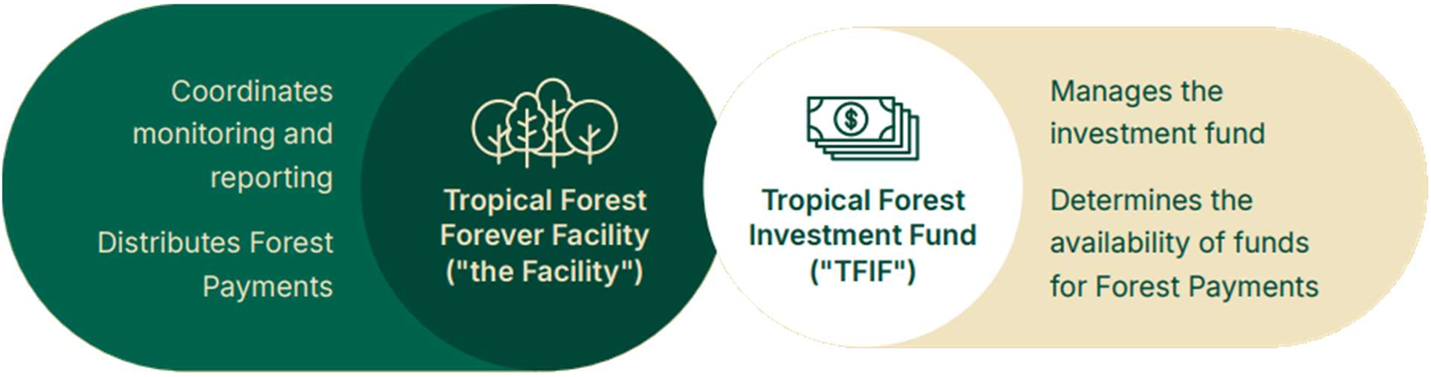
Graphic showing the TFFF governance scheme
The TFFF’s governance structure, according to an August concept note. Source: TFFF (2025)

According to its third concept note, published in October, the TFIF would be a “blended finance vehicle”, pooling public, philanthropic and private funding.

The TFIF is split into two tranches. The first is a “sponsor” tranche, where donor countries and philanthropies are invited to contribute long-term, low-cost capital investment to the tune of $25bn, either from long-term loans, guarantees or outright grants.

So far, Brazil’s initial pledge of $1bn to the facility is the only such pledge. Other governments, such as the UK, have played an “active part” in establishing the TFFF.

(Five days before COP30 kicked off, Bloomberg reported that the UK would not be investing in the TFFF, after the government’s treasury department warned that the investment is “not something the UK can afford at a time when it’s trying to tackle its surging debt burden”.)

This $25bn from sponsor countries, in turn, would be expected to absorb risk, cover losses and serve as a catalyst to raise $100bn from institutional investors in the global bond market.

(This sum raised from private investors is described as the “senior market debt” tranche of investment: if the markets see a downturn, private investors are protected first, making their interests “senior” to donor and recipient countries.)

TFIF and its asset managers then invest this $125bn of capital into a mixed portfolio of investments, including public and corporate market bonds, but excluding those with a significant environmental impact. (In a joint letter, issued in October, advocacy and research groups called for a more detailed exclusion criteria.)

Income from these investments, in turn, will be used to pay investors first, then interest to donor countries and, finally, to pay participating forest countries. The payments to participating countries will be roughly $4 per hectare of standing forest (subject to annual adjustment for inflation), as verified by satellite imagery.

The World Bank confirmed in September 2025 that it will serve as a trustee to the facility and host its interim secretariat.
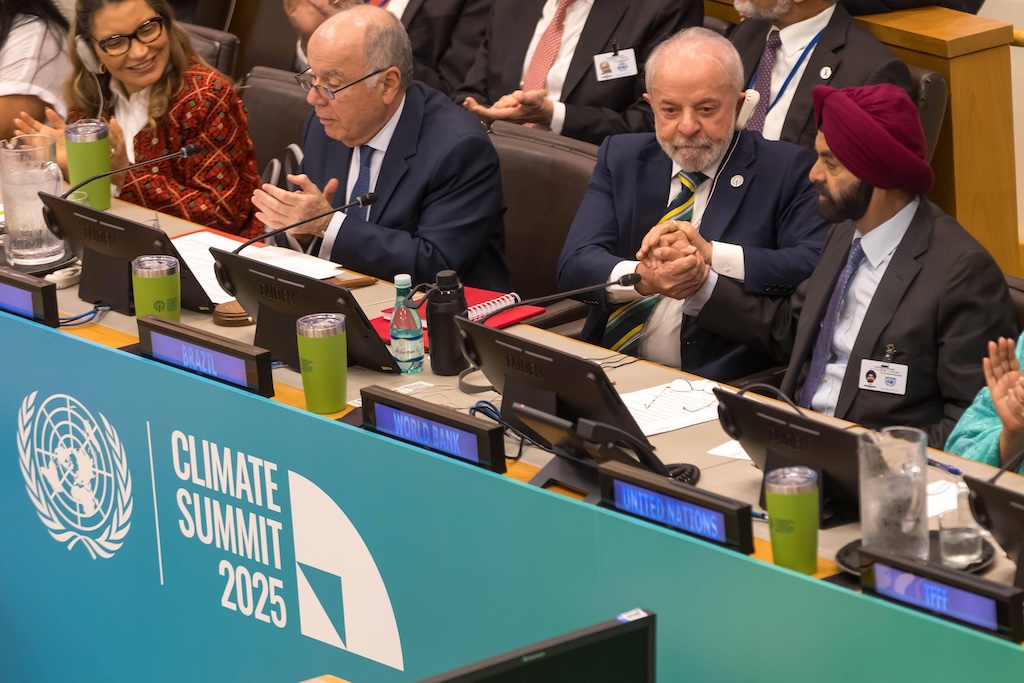
Brazilian president Lula da Silva shakes hands with the World Bank’s Ajay Banga at a high-level dialogue on the TFFF in the UN General Assembly in September 2025.
Brazilian president Lula da Silva shakes hands with the World Bank’s Ajay Banga at a high-level dialogue on the TFFF in the UN General Assembly in September 2025. Credit: William Volcov / Alamy Stock Photo

Liane Schalatek, a climate finance expert and associate director of German policy thinktank Heinrich-Böll-Stiftung’s Washington office, tells Carbon Brief:

“It’s a very clear hierarchy: you serve the money raised on the market and capital investors first before you go to the intended purpose of the fund – and that is compensating countries for basically leaving their tropical forest standing. To me, it seems that the focus is on the money, not necessarily on the outcome. That is really worrisome.”

While sponsor countries are guaranteed their money back over a 40-year period, payouts to forest countries depend on investment returns. These are subject to market risks and volatility and, therefore, are not guaranteed.

According to Frederic Hache, co-founder of the EU Green Finance Observatory thinktank, payouts promised by the TFFF are “really not appropriate to the emergency of the [biodiversity and climate] crises” and do not address their “root drivers”. Hache tells Carbon Brief:

“Even if you meet the very hard criteria as a country to get this money, obtaining this conservation funding is conditional upon financial market conditions and the skill of an asset manager. That’s not very generous and that’s not very appropriate.”

Hache warns that if the fund does not make enough money or experiences losses, the “first thing that is impacted is the forest payment”, which could be put on hold, while “sponsor capital protects private investors with taxpayer money”.

What issues might the fund face?

Civil-society organisations and climate finance experts have warned of several risks and gaps within the facility.

Finance fragmentation

Experts who spoke to Carbon Brief expressed concerns that TFFF could erode the legitimacy of existing, but under-resourced, multilateral funds for climate and biodiversity, as well as dilute the legal obligations of developed countries to pay their “fair share” of nature finance.

While the TFFF hopes to contribute to the goals of all three UN conventions – climate, biodiversity and land degradation – the fund is not officially part of any of the three treaties.

To Schalatek, the fact that the “biggest thing that is going to come out of COP30” is “outside” the UN Framework Convention on Climate Change (UNFCCC) and depends to a large extent on private investment is cause for disappointment.

A keenly awaited report ahead of COP30 is a roadmap towards a wider climate finance target of $1.3tn a year, which could include various sources beyond the jurisdiction of the UN climate process.

Schalatek tells Carbon Brief:

“While we’re trying to have a discussion about protecting the provision of public finance from developed to developing countries [after Baku and amid aid cuts], TFFF is almost contributing to a further undermining of the financial mechanism of the UNFCCC and the Paris Agreement.”

Sarah Colenbrander, director of the climate and sustainability programme at the UK-based global development thinktank ODI, tells Carbon Brief:

“The creation of the Tropical Forest Forever Facility risks not increasing total resources for climate and biodiversity finance, but rather fragmenting the funds already available.”

Potential financial risk

Given the fund’s long-term horizon, a significant challenge is managing financial risk down the line.

This could take the form of a debt crisis in emerging markets, which could “wipe out” sponsor capital and “halt rainforest flows, possibly before they even begin”, economists Max Alexander Matthey and Prof Aidan Hollis wrote in a Substack post in September.

Higher return rates for investors – as mentioned in the third draft of TFFF’s concept note – in combination with high financial fees and operational costs, have left several experts questioning what remains in the way of “rewards” to rainforest countries.

Hache tells Carbon Brief that the TFFF might be “fantastic” for investors who get a “AAA-rated investment without sacrificing any returns”, but real risk is borne by tropical forest countries.

In addition, the mooted payments of $4 a hectare is “ridiculous and not enough to displace alternatives” such as growing cash crops for export, he says, adding:

“$125bn sounds much better than, ‘Oh, we put $2.5bn on the table conditionally’. While there is very little political appetite for giving grant money, this is one of these mechanisms where innovation can obfuscate the lack of ambition and generosity by global-north countries.”

Commodification and transparency

Other experts fear that the new facility could contribute to the commodification of forests and a possible lack of adequate accountability.

The Global Forest Coalition (GFC), an alliance of not-for-profit organisations and Indigenous groups working on forest issues worldwide, have urged countries, Indigenous peoples and civil society to reject the TFFF.

In a press release in October, the GFC said that the TFFF views forests as “financial assets” and warned that the fund is “subject to investment returns, liquidation risks and payouts that are not even guaranteed”.

The press release quotes Mary Louise Malig, policy director at the GFC, who said:

“This is not about conserving forests; it is about conserving the power of elites over forests. It is the continuation of a free market model dressed up as climate finance.”

Information on transparency and governance of the TFFF is unavailable at the moment, says Tyala Ifwanga, forest governance campaigner at Fern, a civil-society organisation that works to protect forest people’s rights in the EU. She tells Carbon Brief that this makes it difficult to assess whether the facility can ensure payments meet the fund’s objectives, adding:

“Corruption is not the only issue we should have in mind here. Some tropical forest countries have autocratic regimes and very limited civic space.”

Pablo Solón, executive director of the Solón Foundation, is also quoted in the GFC press release. He warned:

“The TFFF is a distraction that diverts attention and resources from real solutions like regulation, corporate accountability and direct financing for Indigenous and local initiatives.”

Low Indigenous involvement

Another concern highlighted by the GFC is that while Indigenous peoples and local communities are expected to have “consultative roles”, the “decision-making power rests with governments and financial institutions”.

According to Fern’s Ifwanga, the Global Alliance for Territorial Community – a political platform bringing together coalitions of Indigenous peoples and local communities for defending nature – was involved in developing the TFFF concept notes related to Indigenous peoples and local communities.

She says that although the alliance agrees with the facility, “they are very aware that a lot of work remains to be done to ensure that their voices are heard at every level of the mechanism”.

She also encourages countries to increase direct access to funds for Indigenous communities.

Schalatek says that it is “sinister” that forest communities are being asked to “provide continued stewardship” and preserve forests “without any predictability on how much they’re going to receive for it”, while fund managers can get their money back. She concludes:

“This [TFFF] is exactly the kind of vehicle that gives developed countries the sick leave to not contribute to the GCF [Green Climate Fund], not contribute to the Adaptation Fund…We all know the world has changed, but that doesn’t apply to legal obligations you have signed on to.

“One could probably argue that the Brazilians put a lot more effort into the TFFF than in, for example, thinking about how to deal with the finance agenda within COP30.”

The post COP30: Could Brazil’s ‘Tropical Forest Forever’ fund help tackle climate change? appeared first on Carbon Brief.

COP30: Could Brazil’s ‘Tropical Forest Forever’ fund help tackle climate change?

Continue Reading

Climate Change

In Lahore’s Smog Season, This Gen Z Doctor Is Centering Climate Change

Published

on

Dr. Farah Waseem has advocated for climate awareness since childhood. Now, it’s a matter of life and death for her patients in Pakistan.

Dr. Farah Waseem can feel the smog the moment she steps outside each morning.

In Lahore’s Smog Season, This Gen Z Doctor Is Centering Climate Change

Continue Reading

Climate Change

What’s on the climate calendar for 2026?

Published

on

After a tough 2025 dominated by the US opposing climate action at home and abroad, 2026 looks set to be shaped by coalitions of countries willing to bypass the COP’s need for consensus and take voluntary action as a group.

While troubled multilateral talks on cleaning up plastics and shipping limp on, smaller groups of governments will gather to discuss taxing luxury air travel and planning a fair phase-out of fossil fuels. Australia and the Pacific’s initiatives for COP31 – which could continue discussions on the fossil fuel transition – will be crucial too.

As always, elections will shape the year too, particularly in the Americas. Presidential elections in Brazil and Colombia will determine whether Lula and Petro’s climate progress is reversed and Congressional elections in the USA will shape whether Trump’s climate vandalism can be checked.

    January

    From January 10-12, the International Renewable Energy Agency will gather ministers and officials at its Abu Dhabi headquarters for its annual assembly and related side events. The organisation will announce new insights into whether the world is on track to meet the COP28 goal of tripling renewable energy capacity by 2030, and our editor Megan Rowling will be there to cover the summit.

    The next week (January 19-23) is the World Economic Forum, where the global elite gather in the Swiss mountain town of Davos. With the Trump administration trying to push climate change down the agenda in return for his participation, we’ll be looking to see if he has got his way.

    Donald Trump arrives at the World Economic Forum in Davos, January 26, 2018 (Photo: World Economic Forum / Boris Baldinger)

    February

    On February 7, government representatives will gather in Geneva to elect a new chair of the Intergovernmental Negotiating Committee on Plastic Pollution. The previous chair – Ecuadorian Luis Vayas Valdivieso – stepped down in October after failing to get governments to agree to a plastics treaty.

    The new chair will face a tough task reviving those talks, with governments whose economies rely on oil and gas opposing any measures to reduce plastic production.

    March

    At a still undecided date in March, the Danish government will gather a representative group of climate ministers in their capital for the Copenhagen Climate Ministerial. Expect topics to include next steps in transitioning away from fossil fuels in energy systems.

    Meanwhile, on March 23-27, the oil and gas industry, energy ministers and other high-flyers in business and politics will travel to the Texan oil town of Houston for the CERAWeek conference. The annual gathering offers signals of what’s happening in the real economy.

    Around the same time, on March 26-29, trade ministers will head to Cameroon for the World Trade Organisation’s ministerial meeting. With trade issues increasingly overlapping with the climate space, especially with the European Union’s carbon border tax coming into force at the start of 2026, the statements and discussions here will shed light on climate policy around the world.

    April

    On April 13-18, the World Bank and International Monetary Fund will hold their annual spring meetings in Washington DC. Over the last few years, both institutions have tried to get more money to climate action. But, with the head of the World Bank effectively chosen by the US president, will this push survive Donald Trump’s presence in the Oval Office?

    On April 28-29, the governments of Colombia and the Netherlands will co-host the first “International Conference on the Just Transition Away from Fossil Fuels” in the Colombian port city of Santa Marta. With 24 countries signing a related voluntary declaration at COP30, the conference could launch a coalition against fossil fuels that grows outside of the notoriously slow COP process.

      May

      On May 11-12, the France-Africa summit will be held in the Kenyan capital of Nairobi. With Kenya and France both key backers of a coalition of countries seeking to tax luxury air travel to fund climate action, we will be looking out for progress on those proposals.

      The Colombian government of Gustavo Petro has inspired many climate campaigners with plans to phase out fossil fuel production. But Petro can’t run for another term and the first round of elections to replace him will take place on May 31. Who will replace him is currently highly uncertain.

      June

      On June 8-18, climate negotiators, campaigners and a select group of journalists – including Climate Home News – will travel to the German city of Bonn for the annual mid-year climate talks. Discussions on the Global Goal on Adaptation – unresolved at COP30 – will continue and the first trade-climate dialogue will be held.

      Overlapping this gathering will be the G7 leaders summit on the French shores of Lake Geneva (June 14) and the following week’s London Climate Week (June 21-29). The men’s football/soccer World Cup will begin in North America (June 14), with high temperatures expected.

      July

      On July 8-10, the Fund for Responding to Loss and Damage will have a board meeting in the Philippines, at which it is expected to approve its first set of projects, three and a half years after the fund’s creation grabbed headlines at COP27 in Egypt.

      August

      Dates are unconfirmed but there may be the next round of plastics treaty negotiations at some point in August or September and – with Australia and the Pacific involved in COP31 – Pacific leaders will gather for the annual Pacific Island Forum summit around this time.

      September

      Throughout September, diplomats will gather in New York for the United Nations General Assembly. Coinciding with that will be New York Climate Week (September 20-27), where power brokers in the climate world hold meetings, strike deals and make speeches.

      October

      Brazil’s president Lula has reversed the rising rainforest destruction of his predecessor Jair Bolsonaro, hosted COP30 and pushed for a roadmap towards fossil fuel phase-out. Whether he will be able to continue in that vein depends on the two rounds of presidential elections, scheduled for October 4 and 26. Polls suggest he is the clear favourite to win.

      Brazil’s President Luiz Inacio Lula da Silva speech during the opening ceremony of the 30th Conference of the Parties (COP30).
      Brazil’s President Luiz Inacio Lula da Silva speech during the opening ceremony of the 30th Conference of the Parties (COP30). (Photo: Ueslei Marcelino/COP30)

      On October 13-18, the World Bank and IMF host their annual autumn meetings and on October 19-30, the biodiversity COP comes to the Armenian capital city of Yerevan, where countries will produce the first global stocktake of the landmark Global Biodiversity Framework. Research suggests some of its goals, including a target to protect 30% of land and sea ecosystems, are highly off track.

      November

      An important month starts with US midterm elections for both branches of its Congress on November 3. The Democrats are currently expected to regain control of the House but not regain the Senate, where fewer seats are up for grabs. Losing either would limit Trump’s power in the world’s second-biggest emitter.

      Around the same time, the annual pre-COP meeting will be held in a still-undetermined Pacific Island nation. Pacific governments hope to attract world leaders to come and see firsthand how climate change is threatening their islands.

      Then on November 9-20, the climate COP will take place in the Turkish seaside city of Antalya, at its Expo Center. Australia is presiding over the talks – as part of a deal with Turkiye. Expect fossil fuel phase out and adaptation to be key themes.

      Overlapping with COP31 will be the Marine Environment Protection Committee of the International Maritime Organisation in London (November 16-20). In 2025, the US and Saudi Arabia won a year’s delay to green shipping measures. This meeting will determine if that delay becomes permanent.

      December

      On December 14-15, the leaders of the G20 (except South Africa) have been invited for a summit in Miami. The US, which is barring South Africa partly because of its green policies, has indicated it will use the G20 to promote fossil fuels.

      The post What’s on the climate calendar for 2026? appeared first on Climate Home News.

      What’s on the climate calendar for 2026?

      Continue Reading

      Climate Change

      Analysis: UK renewables enjoy record year in 2025 – but gas power still rises

      Published

      on

      The UK’s fleet of wind, solar and biomass power plants all set new records in 2025, Carbon Brief analysis shows, but electricity generation from gas still went up.

      The rise in gas power was due to the end of UK coal generation in late 2024 and nuclear power hitting its lowest level in half a century, while electricity exports grew and imports fell.

      In addition, there was a 1% rise in UK electricity demand – after years of decline – as electric vehicles (EVs), heat pumps and data centres connected to the grid in larger numbers.

      Other key insights from the data include:

      • Electricity demand grew for the second year in a row to 322 terawatt hours (TWh), rising by 4TWh (1%) and hinting at a shift towards steady increases, as the UK electrifies.
      • Renewables supplied more of the UK’s electricity than any other source, making up 47% of the total, followed by gas (28%), nuclear (11%) and net imports (10%).
      • The UK set new records for electricity generation from wind (87TWh, +5%), solar (19TWh, +31%) and biomass (41TWh, +2%), as well as for renewables overall (152TWh, +6%).
      • The UK had its first full year without any coal power, compared with 2TWh of generation in 2024, ahead of the closure of the nation’s last coal plant in September of that year.
      • Nuclear power was at its lowest level in half a century, generating just 36TWh (-12%), as most of the remaining fleet paused for refuelling or outages.

      Overall, UK electricity became slightly more polluting in 2025, with each kilowatt hour linked to 126g of carbon dioxide (gCO2/kWh), up 2% from the record low of 124gCO2/kWh, set last year.

      The National Energy System Operator (NESO) set a new record for the use of low-carbon sources – known as “zero-carbon operation” – reaching 97.7% for half an hour on 1 April 2025.

      However, NESO missed its target of running the electricity network for at least 30 minutes in 2025 without any fossil fuels.

      The UK inched towards separate targets set by the government, for 95% of electricity generation to come from low-carbon sources by 2030 and for this to cover 100% of domestic demand.

      However, much more rapid progress will be needed to meet these goals.

      Carbon Brief has published an annual analysis of the UK’s electricity generation in 2024, 2023, 2021, 2019, 2018, 2017 and 2016.

      Record renewables

      The UK’s fleet of renewable power plants enjoyed a record year in 2025, with their combined electricity generation reaching 152TWh, a 6% rise from a year earlier.

      Renewables made up 47% of UK electricity supplies, another record high. The rise of renewables is shown in the figure below, which also highlights the end of UK coal power.

      While the chart makes clear that gas-fired electricity generation has also declined over the past 15 years, there was a small rise in 2025, with output from the fuel reaching 91TWh. This was an increase of 5TWh (5%) and means gas made up 28% of electricity supplies overall.

      The rise in gas-fired generation was the result of rising demand and another fall in nuclear power output, which reached the lowest level in half a century, while net imports and coal also declined.

      UK electricity supplies by source 2010-2025
      UK electricity supplies by source 2010-2025, terawatt hours (TWh). Net imports are the sum of imports minus exports. Renewables include wind, biomass, solar and hydro. The chart excludes minor sources, such as oil, which makes up less than 2% of the total. Source: Carbon Brief analysis of data from NESO and DESNZ.

      The year began with the UK’s sunniest spring and by mid-December had already become the sunniest year on record. This contributed to a 5TWh (31%) surge in electricity generation from solar power, helped by a jump of roughly one-fifth in installed generating capacity.

      The new record for solar power generation of 19TWh in 2025 comes after years of stagnation, with electricity output from the technology having climbed just 15% in five years.

      The UK’s solar capacity reached 21GW in the third quarter of 2025. This is a substantial increase of 3 gigawatts (GW) or 18% year-on-year.

      These are the latest figures available from the Department for Energy Security and Net Zero (DESNZ). The DESNZ timeseries has been revised to reflect previously missing data.

      UK wind power also set a new record in 2025, reaching 87TWh, up 4TWh (5%). Wind conditions in 2025 were broadly similar to those in 2024, with the uptick in generation due to additional capacity.

      The UK’s wind capacity reached 33GW in the third quarter of 2025, up 1GW (4%) from a year earlier. The 1.2GW Dogger Bank A in the North Sea has been ramping up since autumn 2025 and will be joined by the 1.2GW Dogger Bank B in 2026, as well as the 1.4GW Sofia project.

      These sites were all awarded contracts during the government’s third “contracts for difference” (CfD) auction round and will be paid around £53 per megawatt hour (MWh) for the electricity they generate. This is well below current market prices, which currently sit at around £80/MWh.

      Results from the seventh auction round, which is currently underway, will be announced in January and February 2026. Prices are expected to be significantly higher than in the third round, as a result of cost inflation.

      Nevertheless, new offshore wind capacity is expected to be deliverable at “no additional cost to the billpayer”, according to consultancy Aurora Energy Research.

      The UK’s biomass energy sites also had a record year in 2025, with output nudging up by 1TWh (2%) to 41TWh. Approximately two-thirds (roughly 27TWh) of this total is from wood-fired power plants, most notably the Drax former coal plant in Yorkshire, which generated 15TWh in 2024.

      The government recently awarded new contracts to Drax that will apply from 2027 onwards and will see the amount of electricity it generates each year roughly halve, to around 6TWh. The government is also consulting on how to tighten sustainability rules for biomass sourcing.

      Rising demand

      The UK’s electricity demand has been falling for decades due to a combination of more efficient appliances and lightbulbs, as well as ongoing structural shifts in the economy.

      Experts have been saying for years that at some point this trend would be reversed, as the UK shifts to electrified heat and transport supplies using EVs and heat pumps.

      Indeed, the Climate Change Committee (CCC) has said that demand would more than double by 2050, with electrification forming a key plank of the UK’s efforts to reach net-zero.

      Yet there has been little sign of this effect to date, with electricity demand continuing to fall outside single-year rebounds after economic shocks, such as the 2020 Covid lockdowns.

      The data for 2025 shows hints that this turning point for electricity demand may finally be taking place. UK demand increased by 4TWh (1%) to 322TWh in 2025, after a 1TWh rise in 2024.

      After declining for more than two decades since a peak in 2005, this is the first time in 20 years that UK demand has gone up for two years in a row, as shown in the figure below.

      Annual UK electricity demand 2000-2025
      Annual UK electricity demand 2000-2025, terawatt hours (TWh). The truncated y-axis shows recent changes more clearly. Source: Carbon Brief analysis of data from NESO and DESNZ.

      While detailed data on underlying electricity demand is not available, it is clear that the shift to EVs and heat pumps is playing an important role in the recent uptick.

      There are now around 1.8m EVs on the UK’s roads and another 1m plug-in hybrids. Of this total, some 0.6m new EVs and plug-in hybrids were bought in 2025 alone. In addition, around 100,000 heat pumps are being installed each year. Sales of both technologies are rising fast.

      Estimates from the NESO “future energy scenarios” point to an additional 2.0TWh of demand from new EVs in 2025, compared with 2024. They also suggest that newly installed heat pumps added around 0.2TWh of additional demand, while data centres added 0.4TWh.

      By 2030, NESO’s scenarios suggest that electricity use for these three sources alone will rise by around 30TWh, equivalent to around 10% of total demand in 2025.

      EVs would have the biggest impact, adding 17TWh to demand by 2030, NESO says, with heat pumps adding another 3TWh. Data-centre growth is highly uncertain, but could add 12TWh.

      Gas growth

      At the same time as UK electricity demand was growing by 4TWh in 2025, the country also lost a total of 10TWh of supply as a result of a series of small changes.

      First, 2025 was the UK’s first full year without coal power since 1881, resulting in the loss of 2TWh of generation. Second, the UK’s nuclear fleet saw output falling to the lowest level in half a century, after a series of refuelling breaks and outages, which cut generation by 5TWh.

      Third, after a big jump in imports in 2024, the UK saw a small decline in 2025, as well as a more notable increase in the amount of electricity exported to other countries. This pushed the country’s net imports down by 1TWh (4%).

      The scale of cross-border trade in electricity is expected to increase as the UK has significantly expanded the number of interconnections with other markets.

      However, the government’s clean-power targets for 2030 imply that the UK would become a net exporter, sending more electricity overseas than it receives from other countries. At present, it remains a significant net importer, with these contributions accounting for 109% of supplies.

      Finally, other sources of generation – including oil – also declined in 2025, reducing UK supplies by another 2TWh, as shown in the figure below.

      A waterfall chart showing that gas power increased in 2025 despite renewables growth.
      Change in electricity supply by source between 2024 and 2025, TWh. Source: Carbon Brief analysis of data from NESO and DESNZ.

      These losses in UK electricity supply were met by the already-mentioned increases in generation from gas, solar, wind and biomass, as shown in the figure above.

      The government’s targets for decarbonising the UK’s electricity supplies will face similar challenges in the years to come as electrification – and, potentially, data centres – continue to push up demand.

      All but one of the UK’s existing nuclear power plants are set to retire by 2030, meaning the loss of another 27TWh of nuclear generation.

      This will be replaced by new nuclear capacity, but only slowly. The 3.2GW Hinkley Point C plant in Somerset is set to start operating in 2030 at the earliest and its sister plant, Sizewell C in Suffolk, not until at least another five years later.

      Despite backing from ministers for small modular reactors, the timeline for any buildout is uncertain, with the latest government release referring to the “mid-2030s”.

      Meanwhile, biomass generation is likely to decline as the output of Drax is scaled back from 2027.

      Stalling progress

      Taken together, the various changes in the UK’s electricity supplies in 2025 mean that efforts to decarbonise the grid stalled, with a small increase in emissions per unit of generation.

      The 2% increase in carbon intensity to 126gCO2/kWh is illustrated in the figure below and comes after electricity was the “cleanest ever” in 2024, at 124gCO2/kWh.

      Carbon intensity of UK electricity supplies
      Carbon intensity of UK electricity supplies, gCO2/kWh. Source: Carbon Brief analysis of data from NESO and DESNZ.

      The stalling progress on cleaning up the UK’s grid reflects the balance of record renewables, rising demand and rising gas generation, along with poor output from nuclear power.

      Nevertheless, a series of other new records were set during 2025.

      NESO ran the transmission grid on the island of Great Britain (GB; namely, England, Wales and Scotland) with a record 97.7% “zero-carbon operation” (ZCO) on 1 April 2025.

      Note that this measure excludes gas plants that also generate heat – known as combined heat and power, or CHP – as well as waste incinerators and all other generators that do not connect to the transmission network, which means that it does not include most solar or onshore wind.

      NESO was unable to meet its target – first set in 2019 – for 100% ZCO during 2025, meaning it did not succeed in running the transmission grid without any fossil fuels for half an hour.

      Other records set in 2025 include:

      • GB ran on 100% clean power, after accounting for exports, for a record 87 hours in 2025, up from 64.5 hours in 2024.
      • Total GB renewable generation from wind, solar, biomass and hydro reached a record 31.3GW from 13:30-14:00 on 4 July 2025, meeting 84% of demand.
      • GB wind generation reached a record 23.8GW for half an hour on 5 December 2025, when it met 52% of GB demand.
      • GB solar reached a record 14.0GW at 13:00 on 8 July 2025, when it met 40% of demand.

      The government has separate targets for at least 95% of electricity generation and 100% of demand on the island of Great Britain to come from low-carbon sources by 2030.

      These goals, similar to the NESO target, exclude Northern Ireland, CHP and waste incinerators. However, they include distributed renewables, such as solar and onshore wind.

      These definitions mean it is hard to measure progress independently. The most recent government figures show that 74% of qualifying generation in GB was from low-carbon sources in 2024.

      Carbon Brief’s figures for the whole UK show that low-carbon sources made up a record 58% of electricity supplies overall in 2025, up marginally from a year earlier.

      Similarly, low-carbon sources made up 65% of electricity generation in the UK overall. This was unchanged from a year earlier.

      Methodology

      The figures in the article are from Carbon Brief analysis of data from DESNZ Energy Trends, chapter 5 and chapter 6, as well as from NESO. The figures from NESO are for electricity supplied to the grid in Great Britain only and are adjusted here to include Northern Ireland.

      In Carbon Brief’s analysis, the NESO numbers are also adjusted to account for electricity used by power plants on site and for generation by plants not connected to the high-voltage national grid.

      NESO already includes estimates for onshore windfarms, but does not cover industrial gas combined heat and power plants and those burning landfill gas, waste or sewage gas.

      Carbon intensity figures from 2009 onwards are taken directly from NESO. Pre-2009 estimates are based on the NESO methodology, taking account of fuel use efficiency for earlier years.

      The carbon intensity methodology accounts for lifecycle emissions from biomass. It includes emissions for imported electricity, based on the daily electricity mix in the country of origin.

      DESNZ historical electricity data, including years before 2009, is adjusted to align with other figures and combined with data on imports from a separate DESNZ dataset. Note that the data prior to 1951 only includes “major” power producers.

      The post Analysis: UK renewables enjoy record year in 2025 – but gas power still rises appeared first on Carbon Brief.

      Analysis: UK renewables enjoy record year in 2025 – but gas power still rises

      Continue Reading

      Trending

      Copyright © 2022 BreakingClimateChange.com

