

The “monsoon downpour” that triggered deadly landslides in Kerala’s Wayanad district last month was made 10% heavier by human-caused climate change, a new rapid attribution study says.
The landslides followed an “exceptional spell of monsoon rain” on 30 July. They have killed at least 230 people, with more than one hundred people still missing and rescue operations ongoing.
Analysis by the World Weather Attribution (WWA) service shows the rainfall that hit Wayanad on 30 July was the region’s third-heaviest period on record, surpassing even the extreme rainfall that led to flooding in Kerala in 2018.
The team of 24 researchers from India, Malaysia, US, Sweden, Netherlands and UK find that downpours of this intensity have already become 17% heavier in the last 45 years.
In a world where average global temperatures are 2C above pre-industrial levels, they estimate that extreme single-day bursts of rainfall in Kerala could become a further 4% heavier, potentially leading to even more catastrophic landslides.
The study also looks at other “mixed” factors that may have contributed to the high casualties and Wayanad’s “increased susceptibility” to landslides. These include a 62% loss of forest cover in the district and warnings that “failed to reach many people”.
Slippery slope
Wayanad is a mountainous district in northern Kerala in India’s Western Ghats – a chain of mountains older than the Himalaya that runs parallel to the country’s western coast.
With its high elevation and steep slopes – combined with a tendency to receive “prolonged” rainfall and widespread changes to its natural vegetation – Wayanad is highly landslide-prone. It is the most susceptible district to landslides in Kerala, which accounted for 59% of the country’s landslides over 2015-22.

From 22 June onwards, Wayanad saw “nearly continuous” monsoon rainfall, the WWA study says – with some areas recording over 1.8 metres of rain in just a month.
On 30 July, Wayanad witnessed what study author Dr Mariam Zachariah – a research associate at Imperial College’s London’s Grantham Institute for Climate Change – calls “an extreme burst” of more than 140mm of rain in a single day. This is equivalent to nearly a quarter of the rain London receives all year. This rain landed on loose, erodible soils already saturated by two months of monsoon rains.
The first landslide that began at an altitude of 1,550 metres struck the village of Mundakkai at midnight on 30 July, followed by three more landslides within three hours, hitting the villages of Chooralmala and Attamala.
Torrents of mud, water and rock buried several neighbourhoods, swept away victims and collapsed an arterial bridge, delaying rescue operations to the hardest-hit areas.

While state authorities say that the death toll at the time of writing is 231, media reports suggest that the actual number of lives lost to the landslides is greater than 400 – disproportionately impacting migrant workers working in farms, holiday resorts and tea plantations.
In a press briefing, study author Prof Arpita Mondal from the Indian Institute of Technology Bombay said the “scale of the event was so huge that the debris registered a flow of several kilometres”, adding that “body parts have been recovered from downstream rivers as far as tens of kilometres from the location of the landslides”.
The event, she says, was “particularly devastating to two villages – Mundakkai and Chooralmala”, with one official telling News Minute that “I don’t think the Chooralmala ward will exist anymore”.
Monsoon downpour
To put Wayanad’s intense rainfall into its historical context and determine how unlikely it was, the authors analysed a timeseries of one-day maximum rainfall during the June-to-September monsoon season, focusing on northern Kerala.
They find that 140mm of rainfall hit northern Kerala on 30 July 2024, ranking as the third heaviest one-day rainfall event in a record stretching back to 1901.
The intensity of this rainfall surpassed even the “torrential” rainfall that hit large regions of Kerala in 2018, killing more than 40 people and earning the title of Kerala’s “worst floods in nearly a century”.
The map below shows total rainfall on 30 July 2024 in northern Kerala, based on data from the Indian Meteorological Department. Dark blue indicates a high total daily rainfall and yellow indicates a low total. The study region is shown in red on the map.

Total rainfall on 30 July 2024, based on data from the Indian Meteorological Department. Dark blue indicates a high total daily rainfall and yellow indicates a low total. The study region is shown in red. Source: WWA (2024)
The authors find that in today’s climate, this intense one-day rainfall is a one-in-50 year event.
Separately, using satellite observations, the authors find that heavy one-day rainfall events over northern Kerala have become about 17% more intense in the last 45 years, in which time the global climate has warmed by around 0.85C.
Attribution
Attribution is a fast-growing field of climate science that aims to identify the “fingerprint” of climate change on extreme-weather events, such as heatwaves and droughts.
In this study, the authors investigated the impact of climate change specifically on the heavy rainfall in northern Kerala on 30 July 2024.
To conduct attribution studies, scientists use climate models to compare the world as it is today to a “counterfactual” world, without the 1.3C of human-caused warming.
The authors find that climate change made the intense rainfall on 30 July around 10% more intense.
This “may not sound like very much, but really, when you are looking at this amount of rainfall, that is a lot of extra rain”, Dr Claire Barnes, a research associate at Imperial College’s London’s Grantham Institute for Climate Change, and author on the study, told the press briefing.
The authors note that Kerala is a mountainous region with “complex rainfall-climate dynamics” and explain that there is a high level of uncertainty in the model results.
However, Zachariah told the press briefing that the study findings are “consistent with Clausius Clapeyron relationship”, which states that the air can generally hold around 7% more moisture for every 1C of temperature rise.
The authors also investigate how rainfall intensity might change as the planet continues to warm. They find that if the planet were to warm to 2C above pre-industrial temperatures, rainfall intensity in northern Kerala is expected to become a further 4% more intense.
The study says that this increase in rainfall intensity is “likely to increase the potential number of landslides that could be triggered in the future”.
(These findings are yet to be published in a peer-reviewed journal. However, the methods used in the analysis have been published in previous attribution studies.)
Land-use change
The Western Ghats and their high-mountain tropical forest ecosystems are internationally recognised as a biodiversity hotspot and influence Indian monsoon weather patterns.
Wayanad is known for its dense forests and rich biodiversity, but it has also seen significant deforestation and land-use change.
While heavy rainfall was “a trigger” for the devastating landslides, human intervention “has played an important role, there’s no doubt about it”, says Madhavan Rajeevan, India’s former Earth sciences secretary who was not involved in the study. He tells Carbon Brief:
“In many interviews with local people, they say that [large-scale] construction work was going on in the worst-hit areas. And that construction [was done] by removing the local [Indigenous people] staying in the forest. But the landslide doesn’t differentiate between rich and poor. If there was no substantial human intervention in that area for the last four or five years, I’m very sure this landslide would not have happened.”
Between 1950 and 2018, Wayanad lost 62% of its forest cover while land under tea plantations grew by 1,800%, according to one study. The district’s high slopes are also host to coffee, pepper, tea and cardamom plantations, as well as being dotted by luxury resorts.
At the same time, a rise in construction and quarrying for building stones in recent years has “raise[d] concerns” among scientists about the impacts on the stability of hill slopes in the area.
On 31 July, the day after disaster struck, India’s climate ministry issued the sixth draft of a notification to classify parts of the Western Ghats as ecologically sensitive areas (ESAs), 14 years after experts had recommended curbs on development in the region.
Environmental lawyer Shibani Ghosh tells Carbon Brief that, to date, 72,000 square kilometres of the Western Ghats identified by these experts “do not even fall within the ambit of any proposed conservation scheme”.
While environmentalists still have “serious apprehensions” about the area that will be excluded from the Western Ghats ESA in the new draft, “had it been declared [even in its unsatisfactory form] by now, environmentally harmful activities would have been regulated, and perhaps the impact of these natural calamities would have been much less”, she adds.
Rajeevan, additionally, points to how the monsoon has changed in Kerala. He says:
“We know that seasonal rainfall is very high in the west coast, it rains continuously for many days and many hours, but the amount used to be very small: in millimetres per hour. But recent studies are suggesting that these shallow clouds are changing into deep convective clouds that drop very heavy rain in a very short spell, and that could be attributed to warming over the Arabian Sea.”
At the same time, forecasting is another issue that the study raises, drawing attention to the fact that warnings failed to reach many and impacts were not specifically spelt out.

In the aftermath of the landslides, whether meteorological authorities warned of heavy rains became the subject of parliamentary debate. But Rajeevan points out that accurate rain warnings alone are not enough:
“Red alerts and yellow alerts for the whole state or a few districts do not translate into a landslide warning. A district collector cannot translate them or take a decision. The Geological Survey of India issued a warning, but it was not alarming and a sophisticated, real-time landslide alert system needs a lot of money.
“The best solution is to identify and rehabilitate people living in landslide prone areas and to not trouble them by removing their forests.”


The post Climate change made ‘monsoon downpour’ behind Kerala landslides 10% more intense appeared first on Carbon Brief.
Climate change made ‘monsoon downpour’ behind Kerala landslides 10% more intense

When oil and gas shipments stopped flowing through the Strait of Hormuz at the start of the Iran war, Southeast Asian nations were left reeling as the supply crunch laid bare their acute reliance on fossil fuel imports.
As prices soared, governments in the region scrambled to introduce emergency energy-saving measures – from a four-day working week to curbs on air conditioning. Thailand revived decommissioned coal plants while the Philippines, which imports nearly all of its oil, declared a “national energy emergency”.
But the crisis has also prompted renewed resolve to find a long-term solution to their vulnerability at a time when electricity demand is booming to power the region’s growing industry, cooling needs and the mushrooming of energy-hungry data centres.
At the heart of Southeast Asian nations’ response is a longstanding infrastructure project to connect the region’s power grids by 2045 and enable cross-border trading of clean electricity through a network of underground and subsea interconnectors.
-
Southeast Asia’s fragile grids threaten billions in clean energy investment
Renewables developers need reliable electricity infrastructure and stable policies to help the region meet climate goals and surging demand for power -
UN backs push to upgrade grids slowing clean power uptake in Africa and SE Asia
The Global Grids Accelerator will help turn national and regional plans to expand electricity infrastructure into viable projects on the ground -
China keeps Indonesia’s battery dream afloat but future less certain
Chinese capital and technology turned Indonesia into the world’s top nickel supplier, but its dependence on China and the rise of nickel-free batteries could upset its battery ecosystem plans
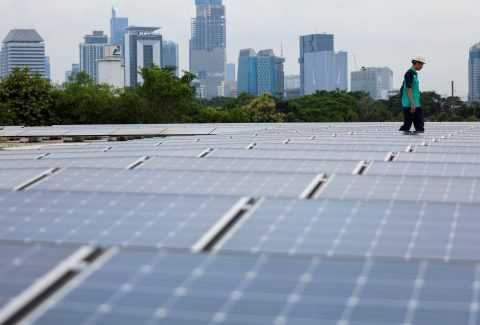
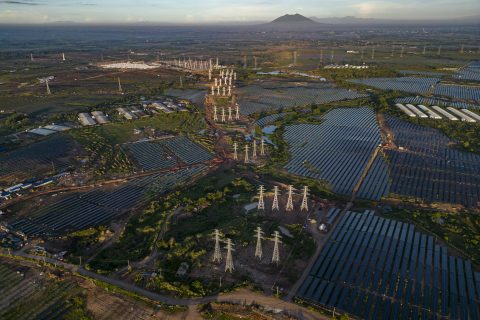
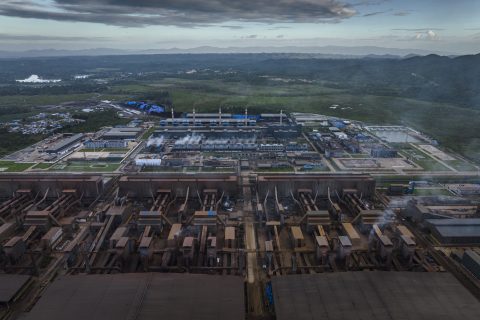
The plans will allow nations with high renewable energy generation potential to trade surplus power to their neighbours and major demand centres like Singapore, helping to integrate more renewables into the power mix and reduce reliance on fossil fuel imports.
“[It] will give us more energy security,” the Philippines’ energy secretary, Sharon Garin, told a press conference after a meeting of the Association of Southeast Asian Nations’ (ASEAN) energy ministers last week, when they discussed accelerating the delivery of the regional grid as part of measures to respond to the energy crisis.
“The Philippines is rich in solar power, Malaysia is rich in hydropower and Indonesia has geothermal: different countries have different resources. [The ASEAN Power Grid] will optimise the utilisation of renewables to the benefits of each member state,” said Garin.
But turning this decade-old political vision into a reality has been slow, held up by painstaking work to harmonise a patchwork of regulatory and legal frameworks and mobilise the private capital needed to build cross-border infrastructure.
More than $300 billion is needed to expand and modernise the region’s fragile grids to support the projected energy demand increase by 2050. This includes $27 billion required to deliver the cross-border interconnections by 2040, according to the International Energy Agency (IEA).
Every year of delay could cost the region billions of dollars in additional fuel costs and lock in new gas infrastructure for decades to come, according to analysis by global energy think-tank Ember.
The building block for energy security
With electrification high on the agenda of the COP31 climate talks in Türkiye next month, there is growing attention on the need to modernise and expand grid infrastructure to cope with growing electricity use and more renewables in the power mix.
Clean electrification and energy efficiency could deliver about a third of cumulative carbon emission reductions between 2026 and 2050, according to the International Renewable Energy Agency’s World Energy Outlook. But delivering that would require doubling annual global grid investment to $1 trillion between now and 2035.
Last month, the UN launched an initiative to accelerate investment into expanding and modernising grids in Southeast Asia and Africa.
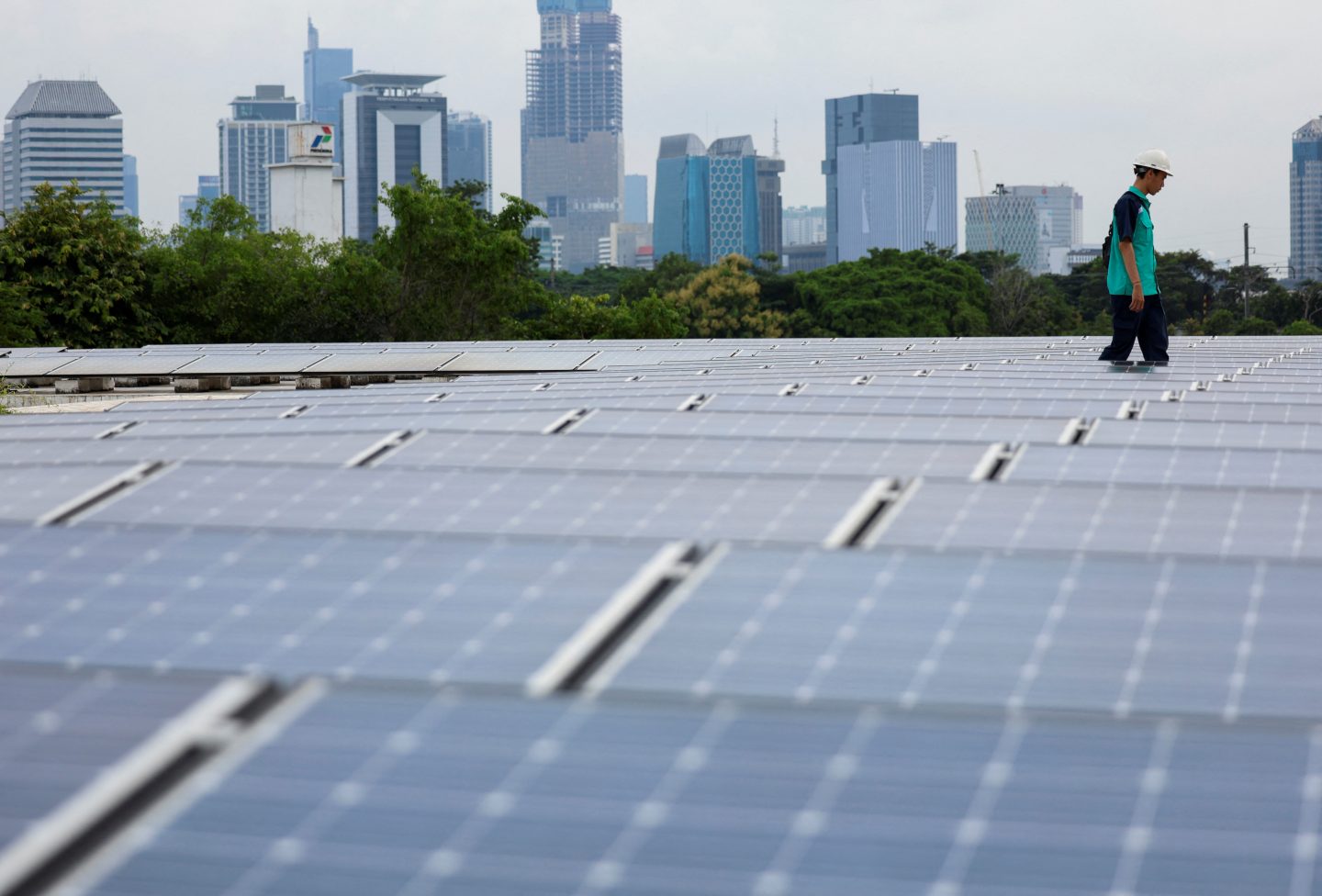
First conceptualised in 1997, the ASEAN Power Grid has gained fresh impetus in recent years as countries turn to renewables to cut their emissions and move away from volatile fossil fuel markets.
Energy supply disruption caused by wars in Ukraine and the Middle East has strengthened the case for regional grid connections. Before this year’s conflict began, the Middle East accounted for 60% of Southeast Asia’s crude oil imports. Competition for fewer, more expensive oil and gas shipments has left Southeast Asia facing a $160 billion energy import bill this year. Based on current policies, this could rise to $400 billion by mid-century.
In the Philippines last week, energy ministers agreed on an enhanced planning framework to deliver the ASEAN Power Grid and made progress on regulatory guidelines.
Garin said ministers were considering accelerating the project’s delivery. “The first study was to connect [by] 2045 – that’s too far,” she said.
A strong business case
The economic benefits of the plan have “captured the political imagination” of leaders in the region, Robert Cooke, grids advocacy lead at the Global Renewables Alliance, told Climate Home News. “The business case is stronger than ever,” he said.
“If countries were to go about building their own separate grids, of course that would be an expensive endeavour. But the discussion around the ASEAN Power Grid includes what costs could we share in building out this grid,” added Tiza Mafira, director of the Indonesia office for the Climate Policy Initiative.
Stronger grids would help the region meet collective targets to increase the share of renewable energy in total primary energy supply from 14% to 30% and in installed power capacity from 34% to 45% by 2030.
Connecting and pooling dispersed renewable resources would also help smooth local power shortages caused by daily and seasonal variations, reducing the need for backup gas plants and battery storage.
The IEA found the ASEAN Power Grid could help unlock some of the 20 terawatts of untapped solar and wind potential across Southeast Asia – an amount around 55 times the region’s current total power capacity.
From lines on a map to shovels in the ground
Rather than building a single unified network, the ASEAN Power Grid is developing cross-border links between neighbouring countries and smaller groups of nations.
As of 2025, nine of 18 priority interconnection projects are operational – accounting for around 10 GW of capacity with an additional 13.7 GW planned by 2040.
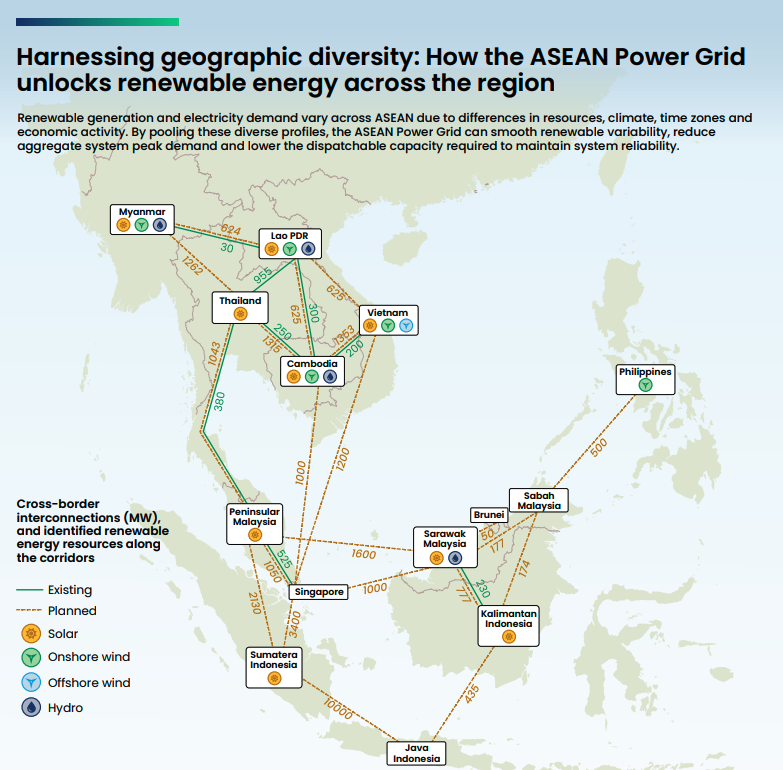
Source: Ember
A power line channelling up to 200 MW of clean electricity generated from hydropower in Laos to Singapore via Thailand and Malaysia has emerged as a key building block for grid-to-grid trading.
Progress on technical discussions will also help provide the clarity the private sector needs to invest in bankable projects, said Cooke.
In 2025, the Asian Development Bank and the World Bank announced a dedicated funding initiative to support the project.
“The enabling pieces are emerging,” said Monalisa Dimalanta, former chair of the Philippine Energy Regulatory Commission and the National Renewable Energy Board. “But the timelines remain unclear and a 2045 vision cannot answer today’s emergency,” she said.
“A power grid… that exists only on paper will not keep the lights on.”
Singapore: the delivery test
The implications of failing to deliver the ASEAN Power Grid are most acute in Singapore.
Constrained by space, with few renewable energy resources and dependent on gas for more than 90% of its electricity mix, Singapore has emerged as a leading proponent of a regional power grid as it seeks to achieve net-zero emissions by 2050.
To meet its power needs, the city-state aims to import 6 GW of low-carbon electricity by 2035, around one-third of its energy demand – a target which it is set to miss, however.
The plans heavily rely on building interconnectors to import solar power from Indonesia across the South China Sea. Around 40% of the ASEAN Power Grid’s planned interconnections are directed towards Singapore.