

Extreme “wind droughts” that reduce power output from turbines for extended periods could become 15% longer by the end of the century across much of the northern hemisphere under a moderate warming scenario.
That is according to a new study in Nature Climate Change, which explores how climate change could impact the length and frequency of prolonged low-wind events around the world.
According to the study, “prominent” wind droughts have already been documented in Europe, the US, northeastern China, Japan and India.
As the planet warms, wind droughts will become longer in the northern hemisphere and mid-latitudes – especially across the US, northeastern China, Russia and much of Europe – the paper says.
The study – which focuses on onshore wind – warns that “prolonged” wind droughts could “threaten global wind power security”.
However, they add that research into the effects of climate change on wind supply can help “prepare for and mitigate the adverse impacts” of these prolonged low-wind events.
Combining wind power with other energy technologies – such as solar, hydro, nuclear power and energy storage – can help reduce the impact of wind droughts on global energy supply, the study says.
One expert not involved in the research tells Carbon Brief that the findings do not “spell doom for the wind industry”.
Instead, he says the study is a “navigation tool” which could help the energy industry to “counteract” future challenges.
Wind drought
Wind power is one of the fastest-growing sources of energy in the world and currently makes up around 8% of global electricity supply. It is also playing a crucial role in the decarbonisation of many countries’ energy systems.
Wind is the result of air moving from areas of high pressure to areas of low pressure. These differences in air pressure are often due to the Earth’s surface being heated unevenly.
Human-caused climate change is warming the planet’s atmosphere and oceans. However, different regions are heating at different rates, resulting in a shift in global wind patterns. The IPCC finds that global average wind speeds (excluding Australia) slowed down slightly over 1979-2018.
There have already been dozens of recorded instances of prolonged low-wind events, known as wind droughts, which can drive down power production from wind turbines.
Dr Iain Staffell is an associate professor at the Centre for Environmental Policy at Imperial College London who was not involved in the study. He tells Carbon Brief that wind droughts often “push up power prices” as countries turn to more expensive alternative energy supplies, such as fossil fuels.
For example, Staffell tells Carbon Brief that, in the winter of 2024-25, Germany saw an “extended cold-calm spell which sent power prices to record highs”. (In German, this type of weather event is referred to as a “dunkelflaute”, often translated as “dark doldrums”.) He adds:
“It’s important to note that I’m not aware of anywhere in the world that has suffered a blackout because of a wind drought.”
Capacity factor
The productivity of wind power sites is often measured by their “capacity factor” – the amount of electricity that is actually generated over a period of time, relative to the maximum amount that could have been generated in theory.
A capacity factor of one indicates that wind turbines are generating the maximum possible amount of electricity, while zero indicates that they are not producing any power.
The authors define a wind drought as the 20th percentile in each grid cell – in other words, winds ranking in the slowest bottom fifth of winds typically recorded in the region.
They look at the frequency of prolonged wind droughts and how that might change as the world warms.
The map below shows regions’ average capacity factor at 100 metres above the ground level, derived from the ERA5 reanalysis data over 1980-2022, where darker shading indicates a higher capacity factor.
It also shows 19 wind droughts recorded since the year 2000 across Europe, the US, northeastern China, Japan and India. Wind droughts are indicated by yellow triangles for local events and hashed areas for larger-scale events.\

The map also shows that the darker shading for “abundant wind resources” is typically found in the mid-latitudes near “major storm tracks”, including the central US, northern Africa, northwestern Europe, northern Russia, northeastern China and Australia.
Modelling wind
To assess the severity of past and future wind droughts, the authors consider both the frequency and duration of these low-wind events.
To calculate wind drought duration, the authors use reanalysis data and models from the sixth Coupled Model Intercomparison Project (CMIP6) – the international modelling effort that feeds into the influential assessment reports from the Intergovernmental Panel on Climate Change (IPCC).
The authors then look at how wind drought conditions may change in the future, by modelling wind speeds over 2015-2100 under a range of future warming scenarios.
They find that wind drought frequency and duration will both increase in the northern hemisphere and mid-latitudes by the end of the century. The authors identify “particularly notable increases” in wind drought frequency in the US, northeastern China, Russia and much of Europe.
In the northern mid-latitudes, there will be a one-to-two hour increase in average wind drought duration by the end of the century under the moderate SSP2-4.5 scenario, according to the study. This is a 5-15% increase compared to today’s levels.
The authors also assess “extreme long-duration events” by looking at the longest-lasting wind drought that could happen once every 25 years.
The study projects roughly a 10%, 15% and 20% “elongation” in these long-duration wind droughts across “much of the northern mid-latitude regions” under the low, moderate and very high warming scenarios, by the end of the century.
However, the authors find “strong asymmetric changes” in their results, projecting a decrease in wind drought frequency and intensity in the southern hemisphere.
The authors suggest that the increase in wind droughts in the northern hemisphere is partly because of Arctic amplification – the phenomenon whereby the Arctic warms more quickly than the rest of the planet.
Accelerated warming in the Arctic narrows the temperature gap between the north pole and the equator and alters atmosphere-ocean interactions, which reduces wind speeds in the northern hemisphere.
Conversely, the authors suggest that increasing wind speeds in the southern hemisphere are caused by the land warming faster than the ocean, resulting in a greater difference in temperature between the land and the sea.
Record-breaking wind droughts
Finally, the authors also investigate the risk of “record-breaking wind droughts” – extreme events that would only be expected once every 1,000 years under the current climate.
They use CMIP6 models, based on historical data over 1980-2014, to assess how long-lasting such an event would be in different regions of the world. These results are shown on the map below, where darker brown indicates longer-duration wind droughts.

These 1,000-year record-breaking wind droughts typically last for 150-350 hours (6-15 days), occasionally reaching up to 400 hours in regions such as India, East Russia, east Africa and east Brazil, the paper says.
The authors go on to assess the risk of record-breaking wind droughts for existing wind turbines under different warming scenarios.
The plot below shows the fraction of the CMIP6 models used in this study that project record-breaking wind droughts for onshore wind turbines.
Blue bars show the percentage of wind turbines that face a “weak” risk of exposure, meaning that fewer than 25% of models predict that the turbine will be exposed to record-breaking wind droughts by the year 2100. Green bars indicate a “moderate” risk of 25-50% and brown bars denote “severe” risk of greater than 50%.
Each panel shows a different region of the world, with results for low (left) moderate (middle) and very high (right) warming scenarios.
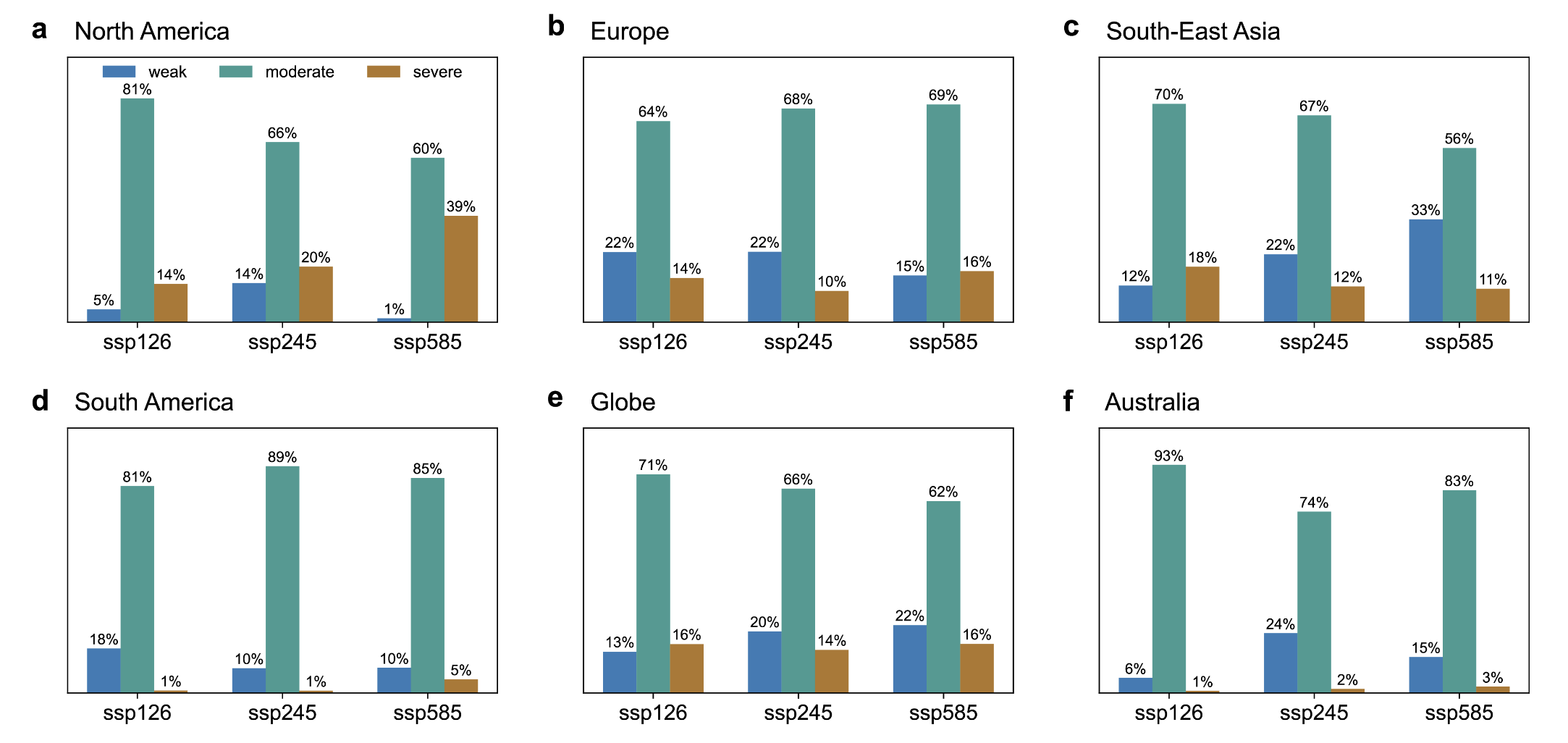
The study finds that, globally, around 15% of wind turbines will face “severe” risk from record-breaking wind droughts by the end of the century, regardless of the future warming scenario. However, different parts of the globe are expected to face different trends.
In North America, the percentage of turbines facing a “severe” risk from such extended wind droughts in the year 2100 rises from 14% in a low warming scenario to 39% in a very high warming scenario. Europe also faces a higher risk to its wind turbines under higher emissions scenarios.
However, the trends vary across the world. In south-east Asia, for example, the percentage of wind turbines at “severe” risk of the longest wind droughts drops from 18% under a low warming scenario to 11% under a very high warming scenario.
Energy security
The planet currently has 1,136GW of wind capacity. The authors say that, according to a report by the International Renewable Energy Agency, “wind power capacity is projected to grow substantially as the world pursues decarbonisation, aiming for 6,000GW by 2050”.
The paper sets out a number of ways that energy suppliers could reduce their exposure to record-breaking wind droughts.
The authors say that developers can avoid building new turbines in areas that are prone to frequent wind droughts. They add:
“Other effective mitigation measures include complementing wind power with other renewable energy sources, such as solar, hydro, nuclear power and energy storage.”
Staffell tells Carbon Brief the study provides helpful insights for how the world’s power supply could be made less vulnerable to prolonged low-wind events:
“I don’t see this study as spelling doom for the wind industry, instead it’s a navigation tool, telling us where to expect challenges in future so that we can counteract them.”
Staffell argues that there are “many solutions” for combatting wind droughts – including building the infrastructure to enable “more interconnection” between countries’ power grids.
For example, he says the UK could benefit from connecting its grid to Spain’s, noting that “wind droughts in the UK tend to coincide with [periods of] higher wind production in Spain”.
He adds:
“Increasing flexibility and diversity in power systems is a way to insure ourselves against extreme weather and cheaper than panic-buying gas whenever the wind drops.”
Similarly, Dr Enrico Antonini, a senior energy system modeller at Open Energy Transition, who was not involved in the study, tells Carbon Brief that wind droughts “do not necessarily threaten the viability of wind power”. He continues:
“Areas more exposed to these events can enhance their resilience by diversifying energy sources, strengthening grid connections over large distances and investing in energy storage solutions.”
In a news and views piece about the new study, Dr Sue Ellen Haupt, director of the weather systems assessment programme at the University of Colorado, praises the “robust” analysis.
She says the work “would ideally be accomplished with higher-resolution simulations that better resolve terrain, land-water boundaries and smaller-scale processes”, but acknowledges that “such datasets are not yet available on the global scale”.
Meanwhile, Dr Frank Kaspar is the head of hydrometeorology at Germany’s national meteorological service. He tells Carbon Brief how additions to this study could further help energy system planning in Germany.
Kaspar tells Carbon Brief it would be helpful to know how climate change will affect seasonal trends in wind drought, noting that in Germany, wind power “dominat[es] in winter” while solar plays a larger role in the energy mix in summer. [The UK sees a similar pattern.]
He adds that the study does not address offshore wind – a component of Germany’s energy mix that is “important” for the country.


The post Climate change could make ‘droughts’ for wind power 15% longer, study says appeared first on Carbon Brief.
Climate change could make ‘droughts’ for wind power 15% longer, study says

A first set of biodiversity plans filed by countries to reverse nature loss are “insufficient” to meet this decade’s global targets, including a landmark goal to protect at least 30% of the world’s land and marine ecosystems by 2030, a landmark UN report warned on Thursday.
The State of Biodiversity Action, put together by a panel of technical experts for the UN Convention on Biological Diversity (CBD), was released in Yerevan, ahead of the COP17 nature talks starting on Monday in the Armenian capital.
Over the next two weeks, governments will for the first time take stock of progress towards the Global Biodiversity Framework (GBF) agreed in 2022 – a set of 23 targets also known as the “Paris Agreement for nature” – and will decide on policy guidelines for ramping up ambition before the 2030 deadline. The UN report will be the main basis for these negotiations.
At a press conference in Armenia, UN Secretary-General António Guterres highlighted that, while there has been some progress on the GBF, the “bad news” is that less than half of country plans are on track to meet its targets.
If current commitments are met by the end of the decade, only 26% of land ecosystems and 12% of marine ecosystems will be protected – falling “real short” of the 30% target agreed in Montreal in 2022, Guterres said. “The war on nature has not yet ended,” he added.
UN Environment chief Inger Andersen said the report “sets the tone for the focus, ambition and urgent action we need to deliver” in Armenia, including by reducing subsidies that harm nature and mobilising new finance for biodiversity. “All leaders and all negotiators must respond to these findings,” she emphasised.
Andersen added that climate change amplifies threats to biodiversity, which makes protection all the more important as global warming is now almost certain to rise above a key threshold. “Exceedence of 1.5C increases the likelihood of forest diebacks, phenological shifts, warming oceans that become more inhospitable to species, irreversible tipping points and so much more,” she said.
-
Global deforestation slowed in 2025 but Brazil’s election could undo “fragile” gains
Countries remain 70% off track to meet a goal to end deforestation by 2030, as progress in Latin America offset by failures in Africa -
Carbon capture industry faces tough future, as UK raids green spending
Despite a spate of projects getting underway, the mood at an industry conference in London this week was low with government subsidies set to shrink -
World Bank and IMF should lead the financial system in responding to the climate crisis
Multilateral development banks have a vital role to play in delivering on donors’ climate finance promises and protecting the most vulnerable



Progress on land but ocean lags behind
The report shows that if countries meet all the biodiversity targets in their plans, this would protect about 27% of the world’s land and sea by 2030, a fivefold increase in the span of ten years.
Progress has been uneven, with most conservation efforts focused on terrestrial ecosystems. The report suggests that currently about 19% of land ecosystems are protected, up two percentage points from 2020, which UN authorities welcomed but said is not a fast enough pace.
However, the real gap is at sea, where only about 10% of the global ocean has some sort of protection. Coastal areas under national jurisdiction have done better, as currently 23% of this marine territory is protected, but the report shows most of the deep ocean is not.
Brian O’Donnell, director of Campaign for Nature, an advocacy group, said the new High Seas Treaty – which entered into force this year and will allow for the creation of Marine Protected Areas in the deep ocean – represents an opportunity, as only about 1.5% is under protection so far.
A group of environmental NGOs including WWF and Bloomberg Philanthropies has issued a call for governments to scale up ocean conservation and to designate $16 billion annually for marine protection measures, up from $1.8bn now.
SE Asia speeds up plan for connected clean power grid after oil shock
Some countries did not set a conservation target at all for both land and sea, the report says, blaming technical challenges like how to account for overlapping protected areas, difficulty recognising protections for private land and land-accounting methodologies changing over time.
A separate report by Campaign for Nature suggests that the 30×30 goal could still be met with “increased ambition and commitment”, and says that around 50 countries have already protected about 30% of their land.
A group of environmental NGOs has warned that, beyond the 30% headline figure, protected areas need to be “high integrity” and recognise the stewardship of local communities and Indigenous peoples.

Developing countries call for finance
Rich countries will arrive at COP17 with shrinking aid budgets and geopolitical preoccupations – yet they will likely hear the same plea they’ve heard for the past few years: stepping up commitments will require finance.
A submission by African countries in August said the “implementation gap” has at its core a shortfall in the provision of funds, and that bridging it will require predictable and accessible finance.
Pacific island nations launched a similar call, arguing there is “a treaty obligation” that developing countries, including themselves, will effectively implement commitments depending on the finance and technology made available by developed nations.
To close this gap, the EU made a proposal at preliminary talks in Nairobi in August to expand the base of donors so that richer developing countries could voluntarily assume donor responsibilities. Saudi Arabia and Qatar rejected the idea, while China said this should not weaken the responsibility of developed nations.
Pre-COP draws attention to Pacific’s climate plight and 1.5C goal
So far, wealthy governments have missed a target to provide $20bn per year in international public finance for nature protection by 2025, reaching only about $16bn per year from 2023 to 2025, according to an OECD report. By 2030, the GBF aims for developed countries to directly transfer $30bn per year, and mobilise $200bn from all sources.
The UN report released on Thursday shows even slower progress in redirecting harmful subsidies such as those which encourage the overuse of fertilisers and the production and consumption of new fossil fuels, and below-market fees that encourage overfishing. UN Environment estimates that for every dollar spent protecting nature, $30 goes on destroying it.
UN biodiversity chief Astrid Schomaker told journalists in Yerevan that “if you hear there is no finance, please do not believe it” because economies are continuing to grow. “It is being spent on activities that harm the economy rather than those that work with nature and sustain life on this planet,” she said.
Guterres said developed countries tend to say they are grappling with budget constraints due to increased defence expenditure, which “in my view does not justify a reduction” in international aid. He added that existing resources can be multiplied if they are used to mobilise private capital.
Campaigners, companies and the Armenian government want to shift the needle on this situation at COP17 by highlighting how positive subsidies help restore biodiversity. They will launch a flagship call to action that will be taken forward by countries and groups working to reform damaging incentives.

Global review: the main act
The Global Review of Collective Progress – a bit like the Global Stocktake for climate action – is set to be the most important outcome from COP17, and it will be the first time this process unfolds at the biodiversity talks. The actions decided in Yerevan will respond to the gaps outlined in the State of Biodiversity Action report and determine whether countries can turn the tide of biodiversity loss this decade.
Overall, the report shows that while countries have taken action to address all 23 targets in the GBF, none “present a fully positive picture”. A target to strengthen the resilience of ecosystems to climate impacts is the only one with high relative progress, the report says, as government have already made effective interventions that show “a positive trend”.
The report assessed each country’s national targets, which define their contribution to the global goals, as well as their separate National Biodiversity Strategy and Action Plans (NBSAPs) outlining how they will achieve the national targets.
But it does not paint a complete picture, since at the cut-off date, only 89 NBSAPs and national targets from 162 countries had been submitted, leaving out a couple of dozen plans that arrived late. Pacific island nations said this might undercount commitments.
Many of those lacking an NBSAP are biodiversity-rich developing countries, which say they need financial and technical support to fully develop these plans. Some large nations pending an NBSAP include South Africa, Bolivia and Russia.
Since the GBF was agreed in 2022, governments have mostly focused on developing their biodiversity targets and plans, while the lion’s share of implementation is expected to happen towards the end of the decade, according to UN biodiversity chief Schomaker.
But O’Donnell said “accelerated political ambition” is still needed to improve commitments and translate them into effective protection on the ground or at sea.
The post Countries urged to ramp up “insufficient” nature policies at COP17 appeared first on Climate Home News.
Countries urged to ramp up “insufficient” nature policies at COP17