

The amount of finance for nature delivered to date “falls far short” of what is needed to meet the UN’s global goals, according to a report released ahead of the COP17 biodiversity summit.
The global stocktaking report, prepared by the UN Convention on Biological Diversity (UN CBD) ahead of this month’s summit in Armenia, finds that developed nations are failing to close the $200bn “biodiversity finance gap”.
Initiatives designed to support this goal are also stumbling, with a special “framework” fund for biodiversity receiving less than $140m from developed countries in the past two years and the “landmark” Cali Fund receiving only $6,000 from private companies.
The availability of finance – or lack thereof – is likely to be a key point of contention in negotiations at COP17 in Yerevan, Armenia, which begin on 19 October.
Target for 2025 ‘not achieved’
At COP15 in 2022, 196 countries agreed to an ambitious global deal to reverse biodiversity loss by 2030, dubbed the Kunming-Montreal Global Biodiversity Framework (GBF).
Goal D of the agreement, shown below, states that countries must “close” a $700bn “biodiversity finance gap” by 2030.
This overall $700bn is made up of two parts: changes to nature-harming subsidies; and raising financial resources to support biodiversity.
Target 18 within the text calls for countries to “identify by 2025, and eliminate, phase out or reform incentives, including subsidies, harmful for biodiversity…progressively reducing them by at least $500bn per year by 2030”.
The remaining $200bn should be met by “mobilising” resources, according to target 19 of the GBF. It states that countries should “substantially and progressively increase the level of financial resources from all sources” to “at least” $200bn per year by 2030.
The overarching $200bn can be from national budgets, multilateral development banks or money “mobilised” from the private sector.
However, the target also specifically states that “at least $20bn per year by 2025 and…at least $30bn per year by 2030” should be public biodiversity funding provided to developing countries by developed countries – or others that “voluntarily assume” their obligations.
According to the global stocktaking report prepared by the CBD, between 2020 and 2023, countries mobilised a cumulative total of just $186.4bn. This is equivalent to an average of less than $50bn per year.
While the report – published on 10 September 2026 – cautions that it is “still too early to draw any conclusions”, it adds that this total “falls far short” of what is needed to close the $200bn-per-year biodiversity finance gap.
It continues to specify that the milestone of raising “at least $20bn per year by 2025” in public finance was also “likely not achieved”.
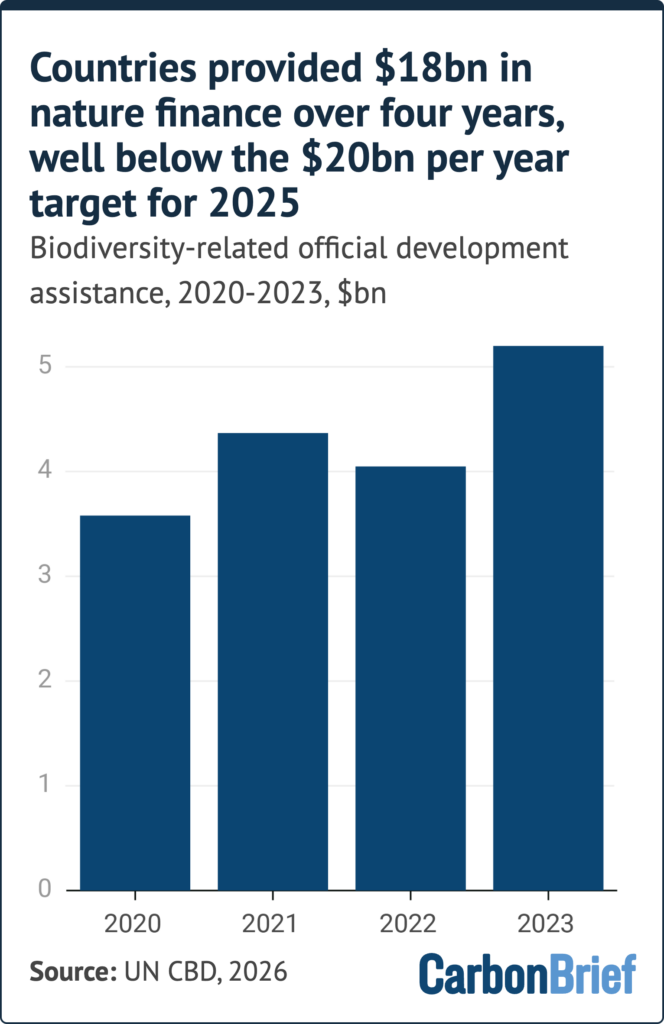
The report states that reporting countries raised a cumulative total of just $17.7bn in international public funding for biodiversity, across four years from 2020-23, as shown in the figure below. This amounts to an average of just $4.4bn per year.
These figures are supported by a report from the Organisation for Economic Co-operation and Development (OECD), which suggests that global biodiversity finance reached $74.9-92.4bn per year between 2023 and 2025.
It adds that, of this, international public finance contributed around $16.1bn per year on average – nearly $4bn below the 2025 goal.
Moreover, the OECD report says that only $7.9bn in 2023 to $8.5bn in 2024 was “biodiversity-specific” funding, with another $5.7bn and $6.5bn, respectively, coming in the form of funds for other priorities, in which support for biodiversity was a secondary aim.
While the GBF sets targets for nature finance in 2025 and 2030, developed countries should be making similar contributions every year, according to thinktank Third World Network.
Faltering initiatives
There are two main channels of international public finance that developed countries can use to meet their biodiversity finance commitments under the GBF. These are official development finance (ODF) and the Global Biodiversity Framework Fund (GBFF).
Separate figures for these channels also show financing falling behind the subtargets set out in the GBF.
This includes the Global Biodiversity Framework Fund (GBFF), which was established at COP15 in 2022.
It is currently housed under the Global Environment Facility (GEF) and reports directly to the biodiversity COP.
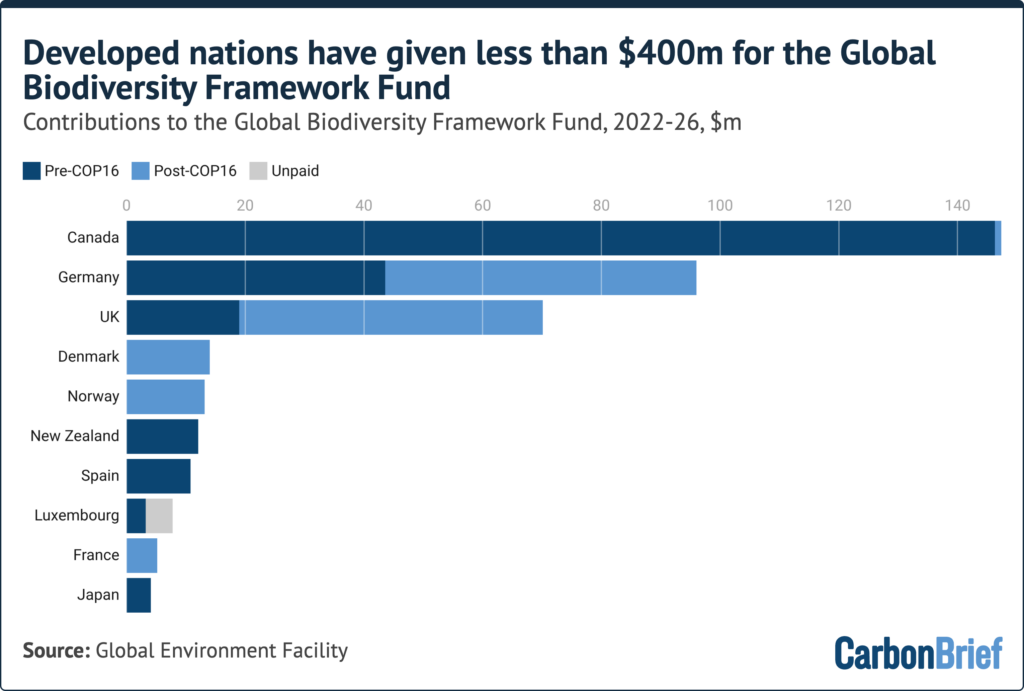
Despite an initial flurry of pledges for the initiative, developed nations had contributed less than $400m to the fund, as of July this year, according to data shared with Carbon Brief by the GEF.
Between August 2023 and 30 June 2026, the GBFF has received only $387.2m in signed commitments from 11 countries and one subnational government (Quebec in Canada).
The figure below shows that, after the initial pledges ahead of COP16 in 2024, there have only been a handful of new contributions to the fund.
Elsewhere, the Cali fund was created at the COP16 nature negotiations in Colombia in 2024.
It is the first-ever global fund for companies profiting from genetic data to contribute to conservation goals.
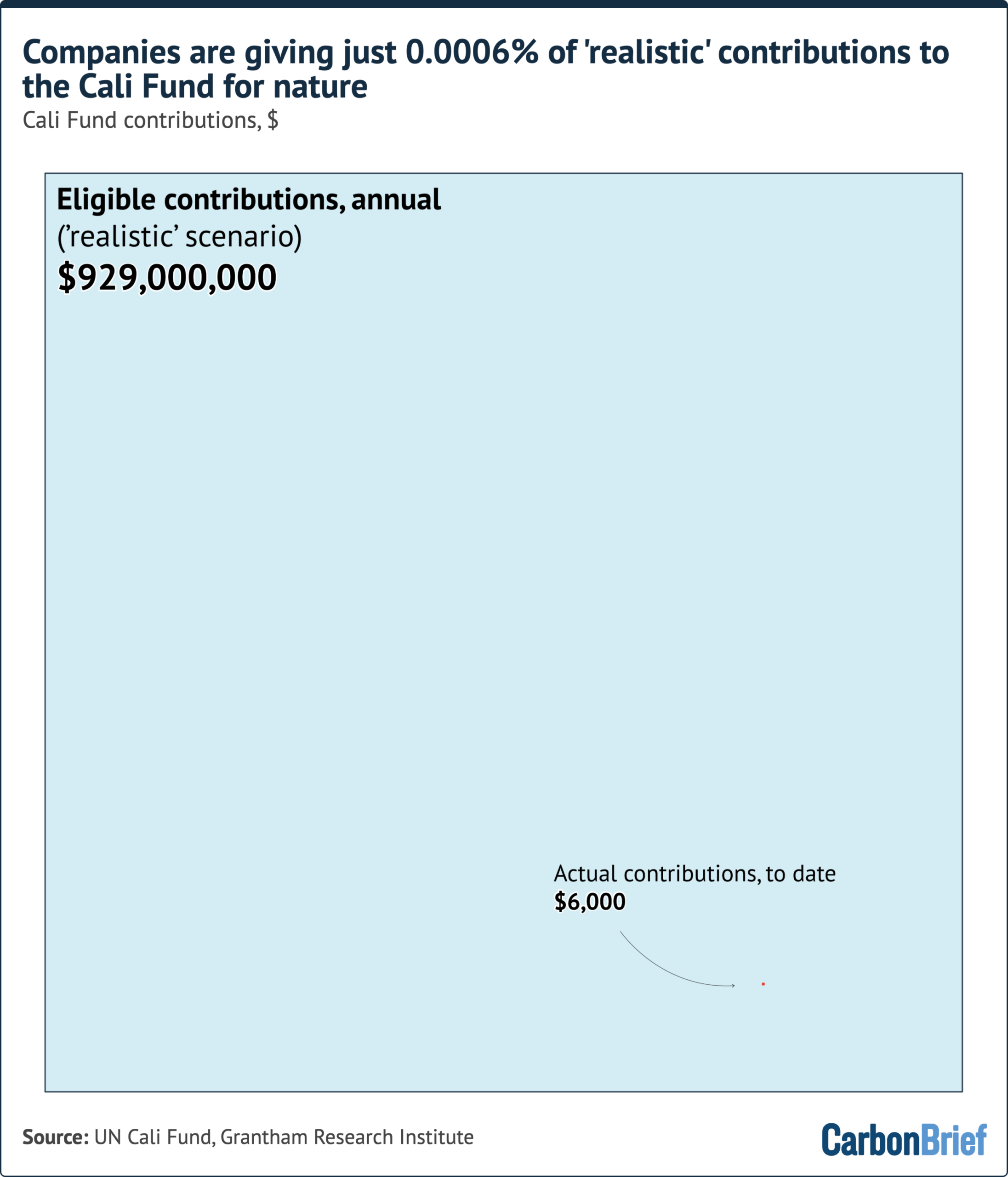
According to a working paper from the Grantham Research Institute at the London School of Economics, if all 21,690 eligible firms shared their profits according to the fund’s rules, they could raise $3.6bn for nature annually. The paper adds that, under a realistic uptake from companies, this could generate $929m annually for nature.
To date, however, the fund has received only two contributions, totalling $6,000.
Finance gap ‘fight’
Ahead of COP17 in Armenia, experts tell Carbon Brief that finance will be the most closely watched element of the stocktake of progress.
For developing countries that “hold most of the world’s biodiversity and bear the greater burden of implementation” of nature targets, the need for this financing is “very real”, says Lim Li Ching of the Third World Network speaking to Carbon Brief. She adds:
“These amounts fall far short of the GBF’s target 19. Developed countries have regrettably not met their legal obligations…[T]his failure should not be used as an excuse to pivot to the private sector or market-based mechanisms, which struggle to raise finance at scale and often deepen social and ecological harm.”
Options for private and “innovative” finance include debt-for-nature swaps, biodiversity offsets and carbon credits, but these are harder to monitor and have often faced criticism.
The Cali Fund is one avenue for companies to contribute directly to the CBD’s goals, with dedicated, transparent allocations for conservation projects and Indigenous peoples.
Dr Siva Thambisetty, associate professor of law at the London School of Economics, tells Carbon Brief that the fund is still a voluntary measure and it is up to countries “to create a constructive, ethical obligation” for companies to contribute. She adds:
“The private sector is doing what it always does: minimising outgoings and liability and maximising freedom to operate. I don’t believe the shift we need can be generated internally by businesses alone without outside pressure. States with jurisdiction over business need to take action.”
A non-profit initiative called the Cali Watch finds that “not a single government” has passed a law requiring companies to contribute to the fund. It estimates that eight companies alone should contribute more than $2bn, as part of what it calls their “Cali debt”.
Dr June Rubis, the Indigenous peoples and local communities lead on the Cali Fund’s steering committee, tells Carbon Brief that she is “worried about the pace” at which biodiversity finance is moving. Rubis continues:
“Each part of the finance architecture needs to start sending credible signals at the same time: developed countries on the $20bn commitment; donors on predictable finance for the GBFF; companies on Cali Fund contributions; and the Cali Fund itself on allocation and access. If one part moves while the others are repeatedly deferred, confidence in the wider biodiversity bargain becomes harder to sustain.”
She points out that for Indigenous peoples and local communities, “success also depends on whether finance can actually be accessed” to support communities’ priorities. She concludes:
“[H]eadline commitments matter, but so do the pathways through which money reaches people.”
The post COP17: Developed countries ‘fall far short’ of UN targets for nature finance appeared first on Carbon Brief.
COP17: Developed countries ‘fall far short’ of UN targets for nature finance

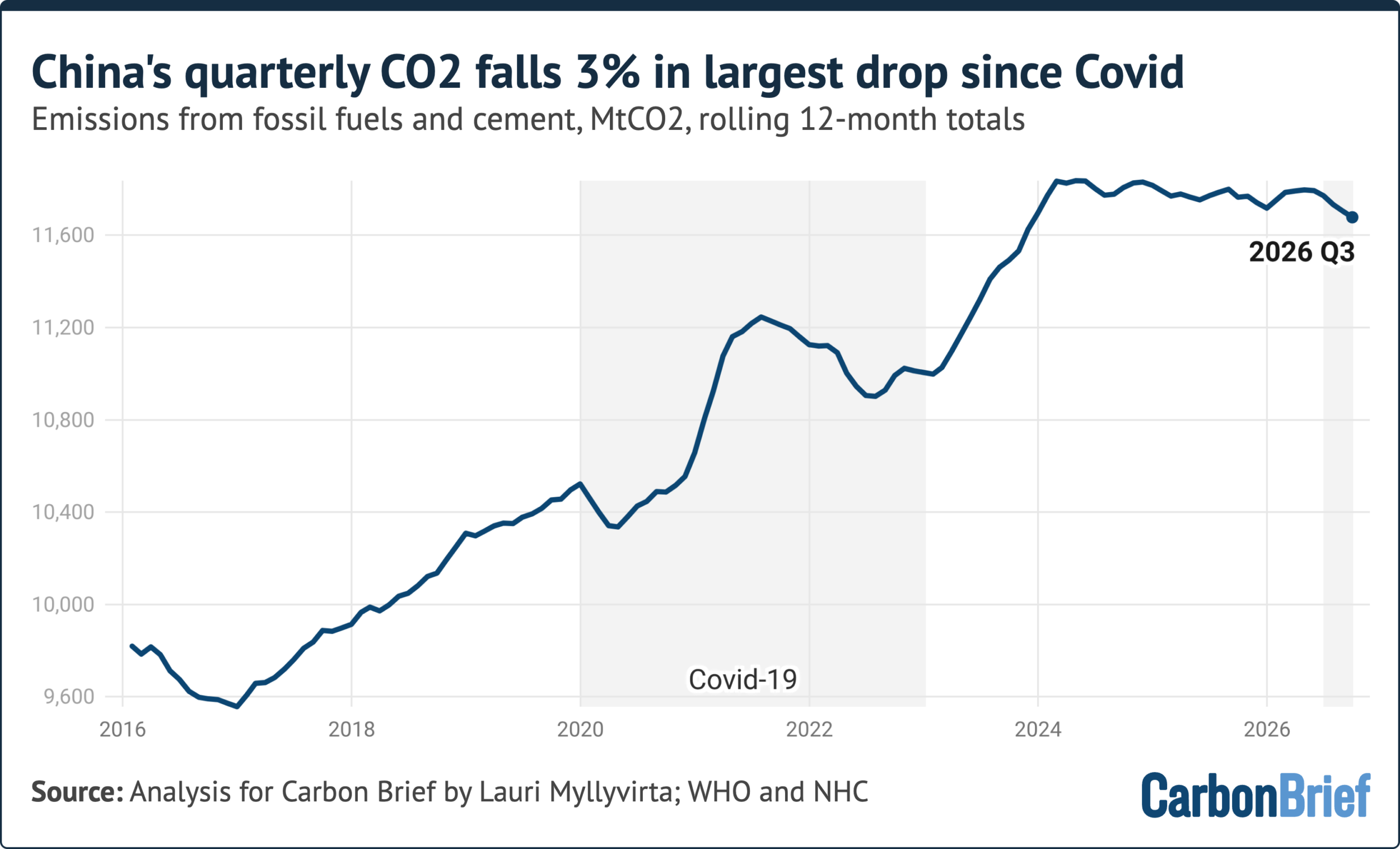
China’s carbon dioxide (CO2) emissions fell by 3.1% in the third quarter of 2026, as the Hormuz crisis continued to hit oil demand and coal use also dropped.
This guest post is by:
Lauri Myllyvirta, lead analyst at the Centre for Research on Energy and Clean Air
This was the largest quarterly reduction since the 2022 Covid lockdowns and means that China’s CO2 emissions have now fallen by an estimated 0.5% in the year to date.
The new analysis for Carbon Brief, based on official figures and commercial data, shows that coal use fell by 3% year-on-year in the third quarter of 2026, while oil was down 4%.
The main drivers were a fall in power-sector coal consumption, a continued sharp reduction in transport oil consumption and slowing growth in the coal-to-chemical industry.
The sharp decline in China’s CO2 emissions extends a “flat or falling” trend that began in March 2024 and has now lasted more than two years, as shown in the figure below.
The outlook for China’s CO2 emissions depends on the balance between rising energy demand, clean-energy growth and the government response to a GDP slowdown.
Decline drivers
Key drivers of the fall in CO2 in the third quarter of 2026 included a 3.3% drop in coal-power generation, after demand growth slowed and the amount of “wasted” wind and solar fell.
Power generation from solar, wind and nuclear increased by 110 terawatt hours (TWh) year-on-year, more than twice as much as the growth in total electricity demand. This added clean-power generation equal to Germany’s total power output in the same time period.
The fall in coal-power output and CO2 emissions came despite the fact that China continues to build new coal-power capacity at near-record rates. This means that average running hours for coal plants are falling even faster than total generation, eroding their profits.
Meanwhile, transport oil consumption continued to fall sharply, down 9% year-on-year in the third quarter of 2026. Electric vehicles (EVs) continued to gain market share, hitting a record 67% of passenger car sales and 50% of heavy trucks in September.
The amount of electricity used by EVs grew by 53%, much faster than the number of EVs on the road, showing increased usage of the existing fleet in preference to fuelled vehicles.
Elsewhere, growth in the coal-to-chemical industry continued to slow down in the third quarter of 2026. The sector has been a key source of emissions growth, but high coal prices have weakened profitability and higher output prices hurt downstream demand.
Finally, CO2 emissions from cement and steel production continued to fall in the third quarter, as the contraction in construction volumes accelerated.
Outlook for emissions
Energy consumption growth has been falling after a period of exceptionally high growth during Covid, while clean-power growth has been robust.
This makes it likely that the growth in clean-power generation will exceed total energy demand growth this year, maintaining the structural fall in fossil-fuel use.
Looking ahead, this balance also relies on progress in removing barriers to new solar and wind power being added to the grid, which result in some clean electricity being “wasted”.
The recent slowdown in energy demand growth is partly – but not fully – explained by exceptionally mild weather in the third quarter.
Another key factor is weaker GDP growth. Since reported GDP growth remains within target, however, there is reduced pressure for further stimulus policies.
The focus of the economic stimulus announced to date is “six networks”, which includes the power grid and the transportation network.
These networks are highly relevant for energy and emissions – and they are already covered by policies that emphasise “green” and zero-carbon solutions.

The post Analysis: China’s quarterly CO2 falls 3% in largest drop since Covid appeared first on Carbon Brief.
Analysis: China’s quarterly CO2 falls 3% in largest drop since Covid
Climate Change
Coles, Woolworths grilled as beef buyers receive fail grade on new deforestation scorecard
MELBOURNE, Friday 6 November 2026 — As Coles holds its Annual General Meeting today, Greenpeace Australia Pacific has branded the major supermarkets with a fail grade on their commitment to source deforestation-free beef, with an updated scorecard revealing none of the major beef buyers are following through on forest sustainability commitments.
It comes after Woolworths’s AGM last week where the board copped a grilling by environmentalists and shareholders over its failed sustainability commitments. Both Coles and Woolworths committed to eliminating deforestation in their supply chains by the end of 2025, but a year past the deadline, neither company could guarantee that their beef was not sourced from deforested pastures.
From outside the Coles AGM, Adele Chasson, Nature Policy Lead at Greenpeace Australia Pacific, said:
“This is a report card Coles and Woolworths should be ashamed to take home. While all major beef buyers had promised to take deforestation off the shelves, none of them followed through. Shareholders and the public demanded answers from Woolworths last week and from Coles today, and we will continue to hold their feet to the fire on their promises.
“Beef is the leading cause of deforestation in Australia, and Coles and Woolworths keep putting off action while koalas continue losing their homes. Aussies must be able to get their groceries without having to worry if their dinner is contributing to the bulldozing of forests or driving extinction of iconic Australian animals.
“Without strong, rapid implementation plans, these companies continue with business as usual, flying in the face of Australia’s deforestation crisis. Big beef buyers like Coles and Woolworths must stop the bulldozers now, make good on their sustainability promises and play their part in stopping Australian forest destruction.”
The scorecard assesses how eight of Australia’s largest beef buyers stack up against a conversion and deforestation-free target. It charts whether the major supermarkets, Aldi, McDonalds, Hungry Jacks, Teys, Metcash/IGA and JBS are taking proper action to end Australia’s deforestation crisis. They all failed.
-ENDS-
Media contact: Kimberley Bernard on 0407 581 404 or kbernard@greenpeace.org
Coles, Woolworths grilled as beef buyers receive fail grade on new deforestation scorecard