

The UK government warned the Carbon Capture and Storage Association’s (CCSA) annual conference on Tuesday that the fledgling industry should prepare to receive less financial support from taxpayers in the future.
As the left-wing Labour government, under its new leader Andy Burnham, seeks to boost military spending in line with NATO allies, it is reportedly looking to cut funding for emissions-reduction projects, with subsidies for carbon capture and heat pumps among the projects in the firing line.
Martin McCluskey, a junior minister in the UK’s Department for Energy and Net Zero (DESNZ), told the CCSA conference in Westminster that, while the government supports the industry, “it is no secret that we are operating in a challenging fiscal environment and this government remains committed to meeting its fiscal rules”.
“So I owe it to you today to level with you,” he said. “The next phase of the CCUS (carbon capture, use and storage) programme will be in the context of broader, difficult decisions on funding. We must ensure that public investment is targeted where it can deliver the greatest value while continuing to build confidence in the long-term future of the sector.”

He warned that this may mean “making decisions about priorities, sequencing and pace and recognising that progress will not always happen everywhere at once”. “But this will also mean opportunity as we move beyond first-of-a-kind projects,” he added.
Earlier in the day, the energy ministry’s industrial carbon capture and storage (CCS) lead Stefanie Murphy was asked by an audience member if it had become clear that the government could not afford to support future carbon transport and storage projects at the same level as in the past.
“I think yes,” she replied. “We can all see the fiscal realities that we’re facing,” she said, adding that the government’s top priority is tackling the cost of living and, while it also wants to grow the economy, there are lots of competing priorities for its money.
She urged the industry to reduce costs and demonstrate its benefits in terms of job creation and regeneration of economically deprived areas.
-
Japan uses “diplomatic muscle” to push carbon capture as fossil fuel panacea
Two regional summits led by Japan, with a major focus on carbon capture and storage in Asia-Pacific, have drawn criticism from climate campaigners -
Q&A: “False” climate solutions help keep fossil fuel firms in business
Researcher Freddie Daley talks to Climate Home News about how fossil energy giants are using green technologies as a way to shore up their power -
Industry says carbon capture still an expensive last resort to cut emissions
Carbon capture players told a recent global conference that the technology remains a costly way to reduce CO2 and needs more government support


Opening the conference, the CCSA’s chief executive Olivia Powis made that case, arguing that CCS “engineers in Teesside, fabricators in Hartlepool, construction workers in north Wales” are “what reindustrialisation looks like”.
Speaking before the government officials took the stage, she warned that “this momentum is not inevitable. The first projects have created confidence because governments made commitments and industry invested against them.”
“If that commitment weakens now, investment and developers will not simply wait. They will go elsewhere. The UK has worked hard to establish itself as a global leader in CCUS. We cannot afford to lose that position just as delivery begins,” she said.
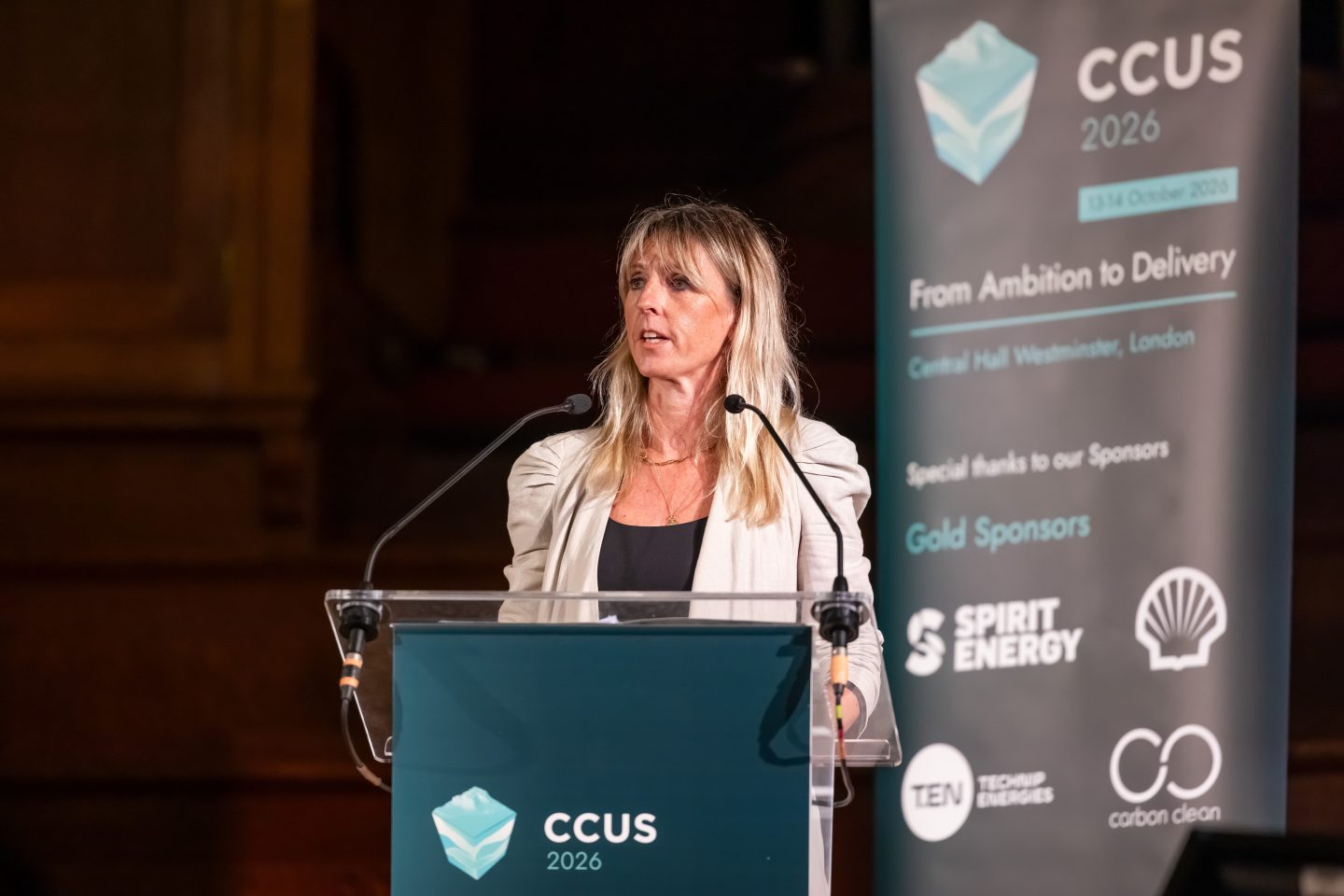
Eoin Devane, acting director of net zero for the UK government’s official advisers, the Climate Change Committee, said the government is relying on CCS to meet its carbon budgets and 2050 net zero target, but has “insufficient plans” to deliver these emissions cuts and there are “significant risks” it will fail.
Necessary but limited
CCS is when carbon dioxide is captured from a concentrated source – like a cement kiln’s exhaust – and then transported by pipeline, train or ship to be stored underground either at sea or on land.
It is controversial among many climate campaigners, as it is favoured as a solution to greenhouse gas emissions by fossil fuel companies that are keen to keep on making money both by producing more oil and gas and by storing carbon dioxide in reservoirs they have already exploited.
But experts describe it as having a necessary – although limited and expensive role – in the transition to clean energy. Scientists with the UK’s Climate Change Committee and the Intergovernmental Panel on Climate Change’s (IPCC) say it is required to help clean up the emissions of industries like cement and chemical production that are hard to replace with renewable electricity.
But the IPCC also says that CCS is one of the costliest ways to reduce climate-heating emissions. Whereas industries like solar and wind energy are now mostly profitable without subsidies, the CCS industry continues to rely on taxpayers for support.
Northern Lights, the crown jewel of Europe’s CCS industry, was 80% funded and “enabled very much” by the Norwegian government, its managing director Tim Heijn told the conference.
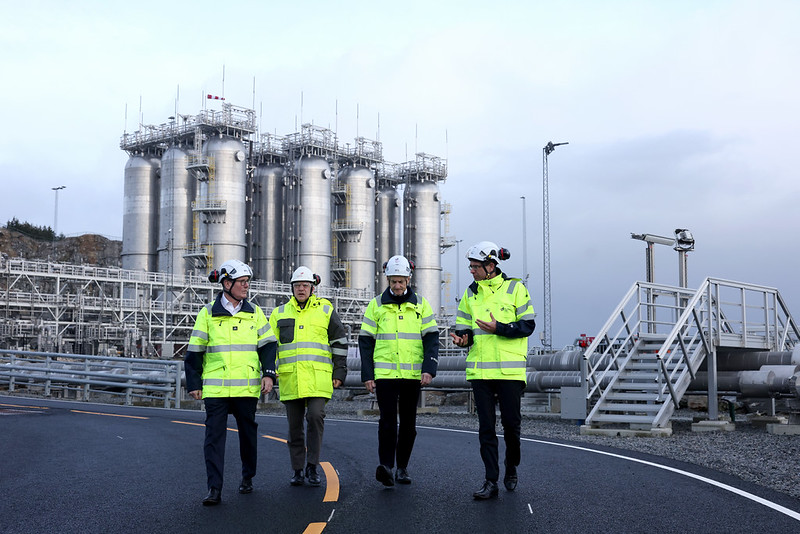
The project captures carbon dioxide from emitters across Europe, ships it as a liquid to Norway’s west coast and transports it through a 100km pipeline to be injected into a reservoir 2,600 metres below the seabed.
Carbon dioxide emitters, like cement plants, also receive government subsidies and carbon credit revenues to help them pay to store their carbon dioxide, Hejn added. They can sell their products, like low-carbon cement, for a green premium.
Ways to become financially sustainable
With subsidies in the UK likely to dwindle, panellists at the conference were asked whether – and how – their business could become financially sustainable.
Cristel Lambton, technical and operations director of Italian oil company Eni’s CCUS arm, said the industry “still needs funding at this stage”. “We all want the CCUS market to be a sustainable market but we can’t just rush towards it,” she added.
Tanisha Beebee, CCS lead at British oil and gas company Harbour Energy, said the shifting economic and political situation had led her company to try and change business models in a bid to reduce reliance on government subsidies and lower its costs.
Jack Richards, CCS lead at a company called Spirit Energy which wants to repurpose its Morecambe gas field to store carbon, argued that reliance on government funding would ease if there was a higher carbon price, making emitting greenhouse gases more expensive compared to capturing and storing them and therefore boosting demand for CCS.
Another problem is that the interest of some CCS customers in the UK appears to be waning. Hydrogen-maker BOC, a subsidiary of Linde, withdrew its interest in the Northern Endurance Partnership offshore carbon storage scheme in September 2025. BP also withdrew after cancelling a blue hydrogen project in the region, leaving just one gas-fired power plant called Net Zero Teesside as a customer.
Waste management company Viridor, however, is still interested in paying for its emissions to be captured and stored. Its CCUS director James Eyton said the timeline for becoming independent of government support is “tricky”, adding that the sale of carbon credits could be a “fundamental alternative revenue source” for the CCUS industry.
The post Carbon capture industry faces tough future, as UK raids green spending appeared first on Climate Home News.
Carbon capture industry faces tough future, as UK raids green spending

As an extreme El Niño breaks marine temperature records, COP31 is set to boost the profile of the ocean’s role in solving climate change, but finance and clear conservation measures will be needed for it to move the needle, experts said.
The Turkish presidency has announced plans for an Antalya Ocean Declaration that recognises the centrality of the global ocean – the world’s largest carbon sink – in regulating the climate and minimising the now unavoidable overshoot of global temperatures above 1.5C over pre-industrial levels.
Meanwhile, as part of the formal UN negotiations, Australia has announced plans to land a cover decision in Antalya, which, according to veteran former US negotiator Sue Biniaz, would be the only section of the formal negotiations where the role of oceans could be included.
She added that an outcome at COP31 seems likely, given the initiative from both presidencies and a push from over 100 countries – including Brazil, the EU and the African Group of countries – calling for the UN negotiations to deliver a plan for implementing ocean measures.
Governments will arrive in Antalya with a “super El Niño” adding stress to marine ecosystems and expected to continue to intensify until December 2026, with parts of the Pacific averaging almost 30C (86F) – over 3C more than normal – in October, according to monthly EU sea temperature data.
-
COP31 Briefing: What to expect from the Antalya climate summit?
Electrification, the fossil fuel transition, adaptation to rising impacts, climate science and trade are key themes as governments gather for COP31 in Türkiye -
European nations signal support for fossil fuel roadmap, says COP30 president
André Corrêa do Lago told Climate Home News that it’s up to other nations to decide how the fossil fuel and deforestation roadmaps are used -
Nepal seeks stronger recognition of mountain issues in UN climate process
Flood-hit Nepal wants COP31 to adopt a new agenda item formalising work on mountains and climate change and boosting the response to rising risks



Needs for ocean conservation and funding
While elevating the ocean agenda is “critical”, it must lead to funding for ocean conservation and a clear plan for reaching the global target – set at UN biodiversity talks in 2022 – of protecting 30% of the global ocean by 2030, said Pradeep Singh, senior ocean governance expert at Oceano Azul Foundation.
The ocean is precisely where governments are farthest off track from meeting this target – informally known as the 30×30 goal. Even if countries meet all their nature conservation plans, only about 12% of the global ocean would be protected, the UN says.
“Acknowledgment of marine protected areas and the 30×30 target as climate infrastructures will certainly boost efforts and funding for science and management,” Singh told Climate Home News.
Shamini Selvaratnam, director of international climate and clean energy at Ocean Conservancy, said an ocean commitment that makes a difference in coastal communities “takes funding, local capacity and support that countries can actually access”.
An analysis by climate think tank Zero Carbon Analytics shows that investment in the blue economy – through activities like sustainable fisheries or cleaner shipping – is only at about 2% of the needs, which are estimated at $550 billion per year.

Following-through on commitments
Selvaratnam added that countries must also establish mechanisms to follow through on these measures, which currently only exists in the form of a non-binding dialogue that is not expected to produce any negotiated agreements.
She said that countries at COP31 must find ways for their ocean commitments to inform the next global stocktake, the UN’s five-yearly review of progress on climate action. Some countries – including African countries, Latin American nations, small island states and the European Union – have backed a process that culminates in the next global stocktake.
At climate negotiations, countries are not mandated to include ocean conservation measures in their climate plans. But a group of countries led by France and Brazil is pushing them to do so voluntarily through an initiative called Blue NDC Challenge. Seventeen countries have joined the initiative so far.
In its list of COP31 priorities, the EU has called for the “critical role” of oceans to be recognised, but falls short of calling for any specific actions to feature marine action more prominently in climate plans.
As part of their demands, ocean campaign groups have called for the establishment of an “Antalya Ocean Compact”, a platform where countries can coordinate efforts across different environmental treaties, including the UN climate, biodiversity and high seas negotiations.
Ultimately, Selvaratnam said a strong deal “must accelerate emissions cuts, clean energy, and a transition away from fossil fuels, including offshore oil and gas”.
Ilana Seid, chair of the AOSIS group of small island states and permanent representative of Palau to the UN, said during a press briefing last week that “meaningful progress” on emissions reduction is “the best way” to alleviate stress on the ocean.
The post ‘Blue COP31’ set to spotlight need for ocean protections amid record heat appeared first on Climate Home News.
‘Blue COP31’ set to spotlight need for ocean protections amid record heat
In the wake of its recent glacial flooding disaster, Nepal and the kingdom of Bhutan have proposed a new agenda item on mountains and climate change for the COP31 summit which opens on Monday in the Turkish city of Antalya.
In a submission addressed to the COP31 presidency and the head of the UN climate secretariat (UNFCCC), Nepal said the agenda item, entitled “1.5°C Warming in Mountains”, is an effort to strengthen the response of the international community to the climate risks facing the world’s mountain regions.
The item proposes that mountain issues should become a regular part of the formal UN climate change process, with a focus on scientific assessment of the risks associated with warming overshooting 1.5C, an annual high-level dialogue, a dedicated work programme and improved access to climate finance.
Maheshwar Dhakal, chief of the climate change management division of Nepal’s Ministry of Agriculture, Forests and Environment, told Climate Home News that Himalayan countries face similar problems such as collapsing glaciers and flooding from glacial lakes.
“We are trying to bring all Himalayan countries together under this agenda item,” he said.
COP31 Briefing: What to expect from the Antalya climate summit?
At this year’s UN General Assembly, Nepal’s Prime Minister Balendra Shah called for strong global action to ensure climate justice and proposed creating a Himalayan Climate Resilience Mechanism led by India, China and Nepal. It would share satellite data, monitor glacial slopes and lakes, strengthen early warning systems and coordinate cross-border disaster response.
Nepal has experienced significant infrastructure losses and human casualties from flooding every year since 2020. In late August, the collapse of a glacial slope on the border with Tibet caused a torrent of water and debris to course down the Bhote Koshi River, leaving more than 6,000 people dead or missing.
According to a government needs assessment, the disaster caused an estimated $2.7 billion in physical damage and economic losses, while around $4.8 billion will be required for recovery and reconstruction.
More research needed on threats
Although high mountain regions are known to be fragile ecosystems, especially as global warming accelerates glacier melt, the extent of their vulnerability is still not fully understood. When the devastating Bhote Koshi floods hit, it opened the eyes of the world to the risks.
Dhakal said the Bhote Koshi floods “have proved the impacts of climate change in the Himalayan region”, which were linked to rising temperatures by scientists with the World Weather Attribution group. “Therefore, Nepal wants scientific studies, research and political discussions on mountain climate risks to receive greater attention at international climate conferences,” he added.
Nepal has been making efforts on this front since 2009, when it held a cabinet meeting at Kalapatthar near Mount Everest. Since COP28 in Dubai, Nepal has organised high-level events and dialogues on mountain issues at COPs and is co-hosting one at COP31 with Bhutan, Pakistan, Kyrgyzstan and Tajikistan.
Editor’s Desk: Nepal’s disaster has laid bare the world’s adaptation accountability gap
Dhakal said the dialogues held so far have raised awareness, but mountain concerns must become part of the formal UN climate process to unlock climate finance and technical support that can bolster countries’ capacity to tackle climate threats.
If specific indicators and priorities are developed for mountain regions, vulnerable developing countries like Nepal would have better access to finance to help them adapt to the climate warming they have done very little to cause, he added.
More detailed data would enable them to prepare stronger project proposals for international climate funds, including the Green Climate Fund (GCF). In 2025, the GCF backed a project to protect livelihoods from climate-induced flooding in Nepal but it took seven years to get approval.
Sindhu Dhungana, an alternate board member at the GCF, said the problem is becoming more widespread and urgent for the Hindu Kush Himalaya region.
“The economies, cultures and almost everything in Himalayan countries depend on mountains,” he explained. “For us, climate change is mountain change… [it has] affected everything, including the economy and biodiversity.”
Destroyed development projects
Nepal wants the UN climate process to address mountain risks both before and after disasters. Countries need better research, technology, early warning systems and other adaptation measures to protect people and infrastructure. But even when countries take precautions, loss and damage is likely to occur and will require international support to address it.
Nepal has been provisionally allocated $21.6 million from the United Nations’ new Fund for Responding to Loss and Damage (FRLD) to help with the aftermath of the Bhote Koshi disaster, but this is just a fraction of needs and the money will come only months after it made an initial request.
Dhakal pointed to the damage caused by floods to infrastructure built with loans, such as the Melamchi Drinking Water Project, which received $312 million from the Asian Development Bank but was destroyed by a major flood in 2021, shortly after it began operating. The recent Bhote Koshi disaster wiped out a dozen hydropower facilities, as well as solar energy systems.
Nepal flood destruction shows “limits to adaptation”, scientists say
Nepal wants international discussions on what should happen when climate-related disasters destroy development projects built using credit, and how the loans should be treated afterwards.
“Climatic disasters wash out… projects, but the burden of loan is still paid by Nepal,” Dhakal said.
For now, it remains unclear whether the opening session of COP31 will consider or adopt the proposed agenda item on mountains and climate change, with consultations on how to respond still underway among governments and the COP31 co-presidencies.
“If countries agree to discuss the proposal and include it in the agenda, that would be another step forward,” Dhakal said. “Further discussions in the coming years could gradually give the mountain agenda a stronger shape.”
The post Nepal seeks stronger recognition of mountain issues in UN climate process appeared first on Climate Home News.
Nepal seeks stronger recognition of mountain issues in UN climate process