

COP30 must take concrete steps to help vulnerable people adapt to worsening climate impacts and avoid a “dystopian scenario” in which the rich can afford to protect themselves while the poor are left exposed, the Brazilian president of next month’s UN climate summit said on Thursday.
André Aranha Corrêa do Lago, a veteran diplomat, wrote in an open letter that he had listened to the voices of people “from all walks of life” in recent months and “a single message echoes everywhere: a call for urgency and tangible outcomes on adaptation at COP30“.
The COP30 president has issued a series of letters this year, detailing how he wants countries to approach the climate negotiations that Brazil will host in its Amazon region. Thursday’s letter, his eighth so far, focuses on the importance of putting climate adaptation – which has long lacked political attention and funding – on a par with the need to cut planet-heating emissions as global warming increases.
“As the age of warnings gives way to the age of consequences, humanity confronts a profound truth: climate adaptation is no longer a choice that follows mitigation; it is the first half of our survival,” he wrote.
Rich-poor divide on climate resilience
For many years, some advocates of stronger efforts to reduce emissions painted adaptation as a sign of giving up on that mission – but, with the COP30 presidency acknowledging on Thursday that warming is likely to overshoot a globally agreed limit of 1.5C, it emphasised that the two areas of climate action “are complementary to each other”.
Corrêa do Lago warned that “we are entering a perilous era in which the wealthy – in both developed and developing nations – insulate themselves behind climate-resilient walls while the poor are left exposed.”
“Such a future must be rejected outright. It is unethical, immoral, and ultimately self-destructive, for it corrodes the very cooperation that has made human evolution possible,” he added.
Momentum builds for strong adaptation outcome at COP30
In his letter, he said he had heard people speaking of flooded homes, failed harvests, local economies collapsing after storms, and schools and hospitals destroyed.
He noted how climate-related disasters already cost Africa between 2% and 5% of GDP each year, and in small island developing states, one hurricane can wipe out years of progress.
“Behind each story is the same reality: climate impacts are eroding development gains, widening inequality, and pushing millions back into poverty,” he said.
Adaptation finance in short supply
Corrêa do Lago and COP30 CEO Ana Toni told journalists that far more effort has to be made – both by governments and businesses – to boost funding for adaptation, which accounts for less than a third of climate finance and covers only about a 10th of the needs of developing countries.
The call comes at a tough time, however, with the US slashing aid under President Donald Trump and other key donor countries paring back development spending amid wars and fiscal strains.
As a result, adaptation finance from wealthy governments is expected to decline and may only reach $26 billion in 2025, according to projections by NGOs Oxfam and the CARE Climate Justice Center.
That would be far short of the estimated $40 billion needed to meet a promise developed countries made four years ago at COP26 in Glasgow to double their adaptation finance from 2019 levels by this year.
The group of Least-Developed Countries (LDCs), meanwhile, has proposed for COP30 to set a new goal of around $100 billion a year by 2030. It is unclear whether donor countries will agree to such a target but adaptation is expected to feature strongly in a new roadmap for raising $1.3 trillion a year in climate finance from all sources by 2035.
-
Loss and damage fund will launch call for proposals at COP30
The fund will ask for projects to be submitted which address the loss and damage caused by climate change in developing countries -
Foreign aid cuts put adaptation finance pledge at risk, NGOs warn
Rich countries’ support for resilience-boosting measures in developing nations may fall far short of their promise to double adaptation finance by this year, says a new report -
“No future”: Climate projects face existential threat after Trump’s aid shutdown
The Trump administration’s attack on USAID puts at risk close to $500 million a year in grant-based climate funding for developing countries


Corrêa do Lago and Toni said on Thursday that it is in the interests of the private sector to invest in making transport and other infrastructure more resilient to extreme weather and rising seas so as to protect their supply chains.
But they also insisted that government funding will be essential to help the poorest stay safe and maintain their homes and incomes as climate threats rise.
COP30 is due to agree a set of around 100 indicators to measure progress on the Global Goal on Adaptation that was enshrined in the Paris climate pact in 2015 but has yet to be operationalised as countries have been slow to decide how to put it into practice.
Half of developing nations have adaptation plans
Separately, developing countries have been working on National Adaptation Plans (NAPs), which outline their needs in climate-hit areas like agriculture, water and health – and projects to tackle them.
The UN climate change body published a progress report this week showing that about half – nearly 70 – have been completed, including 23 from the LDCs and 14 small island developing states. It said governments should expect the activities they propose in their NAPs – which are costed – to be funded.
UN climate chief Simon Stiell described the NAPs produced so far as “a big collective commitment, despite very limited capacity and resources”, noting that adaptation is increasingly being integrated into countries’ development plans.
He said governments are putting in place coordination mechanisms, financing strategies and monitoring systems for adaptation across all sectors of their economies and involving more social groups, from youth to women and Indigenous peoples.
“The systems are increasingly ready, but the finance must flow right now” – and be of better quality, meaning “long-term, predictable and equitable”, he emphasised. Countries have now set the right direction on adaptation, he said, adding “we have a serious need for speed”.
The post Climate adaptation can’t be just for the rich, COP30 president says appeared first on Climate Home News.
Climate adaptation can’t be just for the rich, COP30 president says

Three countries have been named by the Paris Agreement’s compliance committee for failing to submit a nationally determined contribution (NDC) and repeatedly snubbing offers of help with their climate plans.
After months of internal debate over whether to identify serial non-responders, the Paris Agreement’s Implementation and Compliance Committee (PAICC) named the three countries which have failed to engage with it over their NDCs on Friday.
It named Democratic Republic of Congo, Senegal and North Korea in a footnote of its annual report, adding that it decided to name them “with a view to facilitating engagement”, adding that representatives of the three nations had been invited to its meeting in early 2027 “with the purpose of identifying any challenges and constraints”.
“The Committee noted the importance of Parties engaging with the Committee in a timely manner, while noting that some delays may be due to the national capabilities and circumstances of the Parties”, the report said.
-
Under US pressure, World Bank says it will back gas “where appropriate”
The US wants the World Bank to expand its gas support while climate campaigners are pushing for it to end – its head spoke this week of limited backing for the fossil fuel -
IPCC scientists vow to press on with climate reports despite political deadlock
After governments again failed to agree a timeline, nearly 120 IPCC authors pledged to complete their assessment on time and with full scientific rigour -
Paris Agreement committee snubbed over missing NDC climate plans
Many governments have still not submitted a nationally determined contribution to the UN, breaching a key requirement of the Paris Agreement

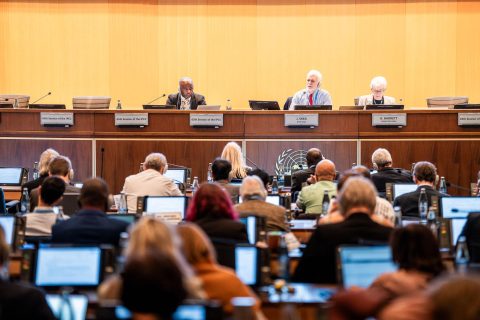

In July, PAICC said 12 countries had ignored its repeated attempts to discuss why they had not published an NDC as required every five years under the 2015 Paris accord.
Members of the committee had been divided over whether to name them, but at a September meeting decided to do so in their annual report to the annual climate COP summit.
By the time the report was published on Friday, only Congo, Senegal and North Korea “had not communicated an NDC or submitted a [Biennial Transparency Report] and had not yet responded to any of the Committee’s notifications, despite several reminders issued by the Committee in this regard”.
Rainforest and renewable energy ambitions
The silence from Congo and Senegal is notable because the former is home to much of the Congo Basin rainforest while the latter has sought billions of dollars in climate finance to support its renewable energy ambitions.
After Brazil, Congo has more rainforest than any country in the world. This forest, and the country’s peatlands, absorb huge amounts of greenhouse gas but are fast being lost to expanding farmland, charcoal production, logging and mining.
Senegal signed a Just Energy Transition Partnership with Canada and wealthy European nations in 2023, to help it meet its renewable energy targets under the-then government of Macky Sall. It was chair of the Least Developed Countries group between January 2022 and December 2023.

Tejas Rao, who is researching the PAICC as part of a doctoral thesis at Cambridge University, said the governments of the three countries should engage with the committee.
“Engagement costs these governments very little and the committee has shown it will listen,” he said.
“Silence leaves the committee with no basis to help, and it leaves the [governments] exposed to the narrative that they are simply disengaged,” he told Climate Home News.
Paris Agreement requirement
The 2015 Paris Agreement requires all parties to publish an NDC every five years outlining their emissions reduction targets, with each plan meant to be more ambitious than the country’s last NDC.
The latest set – the third round of plans, with new targets for 2035 – was due in February 2025. While most countries missed this deadline, all but around 30 – mostly small emitters but including Egypt, Vietnam and Argentina – have now submitted them.
Over the year, the PAICC – which is made up of government climate officials from developed and developing countries – has been communicating with governments that have not submitted NDCs and trying to overcome barriers to them doing so.
Some nations have cited exceptional circumstances as the reason for not submitting an NDC, a process that requires a significant amount of work in tracking emissions and consulting on how to curb them across the economy. For example, a letter from a Sudanese official to the PAICC, seen by Climate Home News, said that the country’s civil war had led to the suspension of its NDC preparation.
-
IPCC scientists vow to press on with climate reports despite political deadlock
After governments again failed to agree a timeline, nearly 120 IPCC authors pledged to complete their assessment on time and with full scientific rigour -
Under US pressure, World Bank says it will back gas “where appropriate”
The US wants the World Bank to expand its gas support while climate campaigners are pushing for it to end – its head spoke this week of limited backing for the fossil fuel -
Who shapes climate science? The equity question facing the IPCC
Early completion of the next global climate science assessment reports risks excluding research from the Global South, which is key to ensuring the findings are fair
The US and Iran are not signed up to the Paris Agreement and so do not have active NDCs, nor does Taiwan, which is not a UN member state.
Rao said that because the PAICC is “facilitative and non-punitive”, naming the countries “is meant to open a door, not close one – the invited consultation is the point”.
“In recent months, governments that explained their constraints, whether capacity, finance or domestic process, have been met with follow-up and support rather than sanction, and the number of silent governments has fallen sharply,” Rao said.
The post Paris Agreement committee names three countries snubbing it over NDCs appeared first on Climate Home News.
Paris Agreement committee names three countries snubbing it over NDCs