

Even the busiest streets of Shanghai have become noticeably quieter as sales of electric vehicles (EVs) skyrocketed in China, with charging points mushrooming in residential compounds, car parks and service stations across the megacity.
Many Chinese drivers have upgraded their conventional vehicles to electric ones – or already replaced old EVs with newer models – incentivised by the government’s generous trade-in policies, or tempted by the latest hi-tech features such as controls powered by artificial intelligence (AI).
“Different from conventional cars, EVs are more like fast-moving consumer goods, like smartphones,” explained Mo Ke, founder and chief analyst of Tianjin-based battery-research firm, RealLi Research. Their digital systems can become outdated quickly, so Chinese people typically change their EVs after five or six years while a conventional car can be driven much longer, he told Climate Home News.
EV sales surpassed 16 million in China last year. Roughly 10% of all vehicles on the road were electric, and half of all new vehicles sold carried a green EV number plate, with an average of 45,000 EVs rolling off the production lines each day.
But while fast-growing EV uptake is good news for Chinese EV and battery manufacturers, it is creating a huge volume of spent batteries.
Tsunami of spent batteries
Last year, China generated nearly 400,000 tonnes of old or damaged power batteries, largely consisting of vehicle batteries, according to government data. That is projected to rise to one million tonnes per year in 2030, officials forecast.
The growing waste problem has spurred the government to launch a series of new policies aimed at regulating the country’s battery recycling industry, which though well-established is marked by a high degree of informality – especially in the lucrative repurposing sector where discarded EV batteries are given a new lease of life in less energy-intensive uses, such as power storage.
-
West Africa’s first lithium mine awaits go-ahead as Ghana seeks better deal
Ghana wants to benefit from the scramble for lithium but its reliance on mining firms for revenue and expertise weakens its ability to negotiate preferential terms, experts say -
At ‘Davos of mining’, Saudi Arabia shapes new narrative on minerals
Over 100 countries attended the Future Minerals Forum in Riyadh, putting the Kingdom at the heart of discussions on minerals for the energy transition -
How green are batteries for electric vehicles?
What you need to know about electric vehicles (EVs) and their batteries


China is determined to build a “standardised, safe and efficient” recycling system for batteries, Wang Peng, a director at China’s Ministry of Industry and Information Technology, told a press conference as the government launched a recycling industry push in mid-January.
A policy paper published by the government last month detailed Beijing’s plans to mandate end-of-life recycling for EVs together with their batteries to prevent them from entering the grey, informal market, and establish a digital system to track the lifecycle of every battery manufactured in the country. Under the plans, EV and battery makers will be held responsible for recycling the batteries they produce and sell.
“The volume of the Chinese market is too big, so it has to take actions ahead of other countries,” Mo said, adding that he expected the government to release more details about implementation of the plans in the near future.

Critical minerals choke point
China’s strategy for the battery recycling sector could also prove a boon for the world’s largest battery producer by bolstering its supply of minerals such as lithium, cobalt, nickel and manganese.
Along with the looming large-scale battery retirement, policymakers’ focus on battery recycling also reflects concern about critical minerals supplies, said Li Yifei, assistant professor of environmental studies at New York University Shanghai. “The government also felt the increasing pressure of securing resources,” he told Climate Home News.
“When you set up an efficient battery-recycling system, you essentially secure a new source for critical minerals, and that can help you enhance economic security. That’s why the industry is so important,” Lin Xiao, chief executive of Botree Recycling Technologies, a Chinese company offering battery-recycling solutions, told Climate Home News.
Cobalt and nickel-free electric car batteries boom in “good news” for rainforests
China dominates global refining of several minerals critical for producing EV batteries, but it still relies on imports of the raw materials – a choke point Beijing is acutely aware of, industry experts say.
China imports more than 90% of its cobalt, nickel and manganese, which are important ingredients for EV batteries, Hu Song, a senior researcher with the state-run China Automotive Technology and Research Centre, told China’s CCTV state broadcaster in June 2025. For lithium, the figure was around 60% in 2024, according to a separate report.
“If [those] resources cannot be recycled, then we will keep facing strangleholds in the future,” Hu said.
Big players gain ground
Spent EV batteries can be reused in settings that have lower energy requirements, such as in two-wheelers or energy-storage systems. When they become too depleted for repurposing, they can be scrapped and shredded into “black mass”, a powdery mixture containing valuable metals that can be recovered.
Reflecting the size of China’s EV market, the country already dominates global battery recycling capacity. It is home to 78% of the world’s battery pre-treatment capacity, which is for scrapping and shredding, and 89% of the capacity for refining black mass, according to 2025 forecasts by Benchmark Mineral Intelligence, a UK firm tracking battery supply chains.
A number of large corporate players have emerged in the sector in recent years.
Huayou Cobalt, a major producer of battery minerals, has built a business model for recycling, repurposing and shredding old batteries, as well as refining black mass and making new batteries using recovered materials.
It recently signed a deal with Encory, a joint venture between BMW and Berlin-based environmental service provider Interzero, to develop cutting-edge battery-recycling technologies, with their first joint factory set to open in China this year.
-
Self-taught mechanics give second life to Jordan’s glut of spent EV batteries
As EV sales boom in Jordan, a lack of formal infrastructure for dealing with end-of-life batteries is leading to some innovative solutions -
Efforts to green lithium extraction face scrutiny over water use
Direct lithium extraction has been hailed as a way to reduce mining impacts in South America but experts warn the technology may not be ready for large-scale deployment -
AI and satellite data help researchers map world’s transition minerals rush
Filling “mind-boggling” gaps in mining data will make it easier to track the environmental impact of surging global appetite for critical minerals, experts say


Suzhou-based Botree Recycling Technologies has developed various solutions to turn retired power batteries into new ones. Meanwhile, Brunp Recycling, the recycling arm of Chinese battery giant CATL, has built large factories to recycle lithium iron phosphate (LFP) batteries, a type of lithium battery that does not use nickel or cobalt, as well as nickel manganese cobalt (NMC) batteries, which are more popular outside of China.
But Mo, of RealLi Research, said much remains to be done to regulate and formalise the battery recycling industry.
Underground workshops
Across China, small underground workshops plague the repurposing sector, rebundling depleted batteries for sale without following industry standards or complying with health and safety requirements.
Because these operators have lower operational costs, they are able to offer higher prices to EV owners to buy their old batteries, undercutting formal recycling companies.
“This creates distortions in the market where legitimate players, who invest in proper detection, hazardous waste treatment and compliance, struggle to compete purely on price,” a spokesperson at CATL, the world’s largest battery manufacturer, told Climate Home News.
Despite such challenges, CATL’s Brunp subsidiary produced 17,100 tonnes of lithium in 2024 from the 128,700 tonnes of depleted batteries it recycled that year, according to CATL’s annual report.

Recycling expertise in demand
Since it was founded in 2019, Botree has formed partnerships with several major clients, which together recycle about half of China’s power batteries, the company’s CEO Lin said.
As other countries grapple with rising volumes of spent batteries, Chinese recyclers are also finding new foreign markets for their know-how.
Botree has joined forces with Spanish consulting firm ILUNION and renewable energy company EFT-Systems to build a factory to recycle LFP batteries in Valladolid.
The plant, scheduled to start operation in 2027, will be able to recycle 6,000 tonnes of LFPs annually when it opens, accounting for roughly 15% of demand in the Spanish market.
“(The companies) tell us what batteries they recycle and what battery materials they want to regenerate,” Lin said. “We can design a complete process for them.”
The post China maximises battery recycling to shore up critical mineral supplies appeared first on Climate Home News.
China maximises battery recycling to shore up critical mineral supplies

For the first time, new-energy vehicles (NEVs) made up 67% of new car sales in China in September, according to the latest data from the China Passenger Car Association (CPCA).
The figures show that NEVs, which include battery electric cars and plug-in hybrids, captured a record share of sales, even though fewer were sold than last year.
This is because sales of combustion-engine cars are falling steeply, a trend that the CPCA has attributed to rising petrol prices following the start of the Hormuz crisis.
Indeed, sales of fuel-only cars were down 31% year-on-year in the first nine months of 2026, with plug-in hybrid sales down 26% – whereas battery EV sales were only down 4%.
One analyst tells Carbon Brief that China’s rapidly growing EV fleet has offset demand for 143m barrels of oil since the start of the Hormuz crisis.
Another says that the crisis is “reinforcing China’s electrification of road transport”.
Meanwhile, amid slowing domestic sales, Chinese carmakers’ exports of NEVs more than doubled [in 2026 to date / in September] from a year earlier.
NEV record
A record two out of every three cars sold in September in China were NEVs, according to CPCA data, as shown in the figure below.
(NEVs predominantly include battery electric vehicles – BEVs – and plug-in hybrids – PHEVs. BEVs only run on electricity, whereas PHEVs also have a combustion engine.)
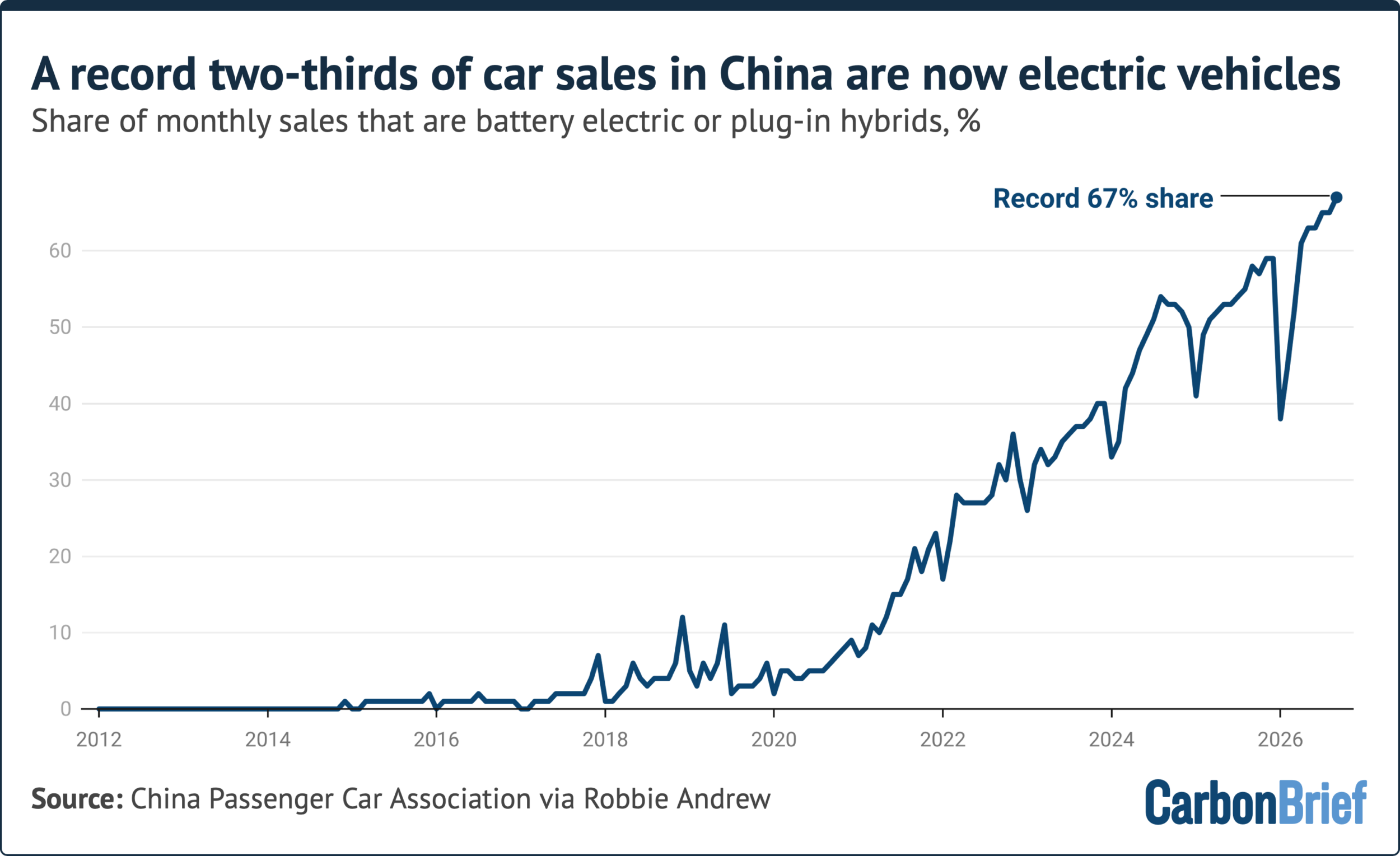
This marks a rapid rise for NEVs from just 6% of new car sales in 2020 up to 58% in 2026 to date – and a record 67% in the month of September.
This year, NEVs’ share of sales has also bounced back from a low of 39% in January, after the full purchase tax exemption that had been in place for more than a decade came to an end in December 2025.
The gain in NEV share in 2026 has come amid a slowdown across the wider domestic passenger-car market, which has hit sales of combustion-engine vehicles particularly hard.
This September, passenger-car retail sales across all categories declined, with overall sales volumes falling 28% year-on-year.
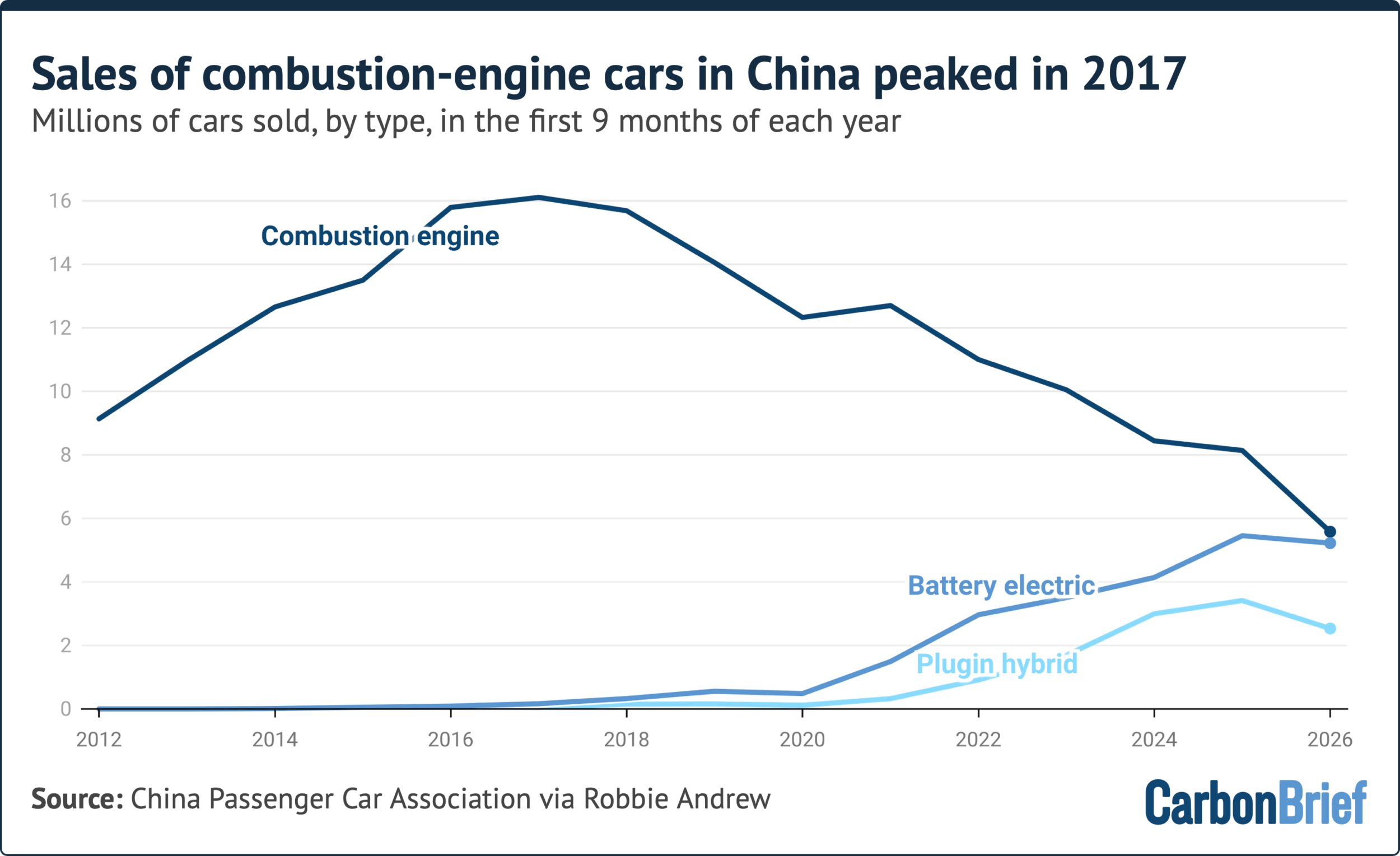
The contraction was led by combustion-engine vehicles, which saw sales fall 43% year-on-year in September and 31% in 2026 to date.
However, sales of PHEVs also fell by 36% year-on-year in September and by 26% in 2026 to date. By comparison, BEVs performed better, although sales still declined 8.5% from a year earlier in September and 4% in 2026 to date.
As a result, NEV sales overall fell by 17% in September and 13% in 2026 to date.
While the market changes in 2026 to date were particularly dramatic, they reflect a broad continuation of trends seen over the past decade.
Indeed, sales of combustion-engine cars in China peaked in 2017 and they have been declining ever since, shown in the figure below.
Impact of Hormuz
Part of the reason for the advance of NEVs in 2026, said Chinese technology news outlet OFweek, was petrol cars “giving up market share” as they were outperformed by electric alternatives.
Cui Dongshu, secretary-general of the CPCA, cited higher petrol prices as an explanation for September’s weak combustion-car sales, in comments to financial news outlet National Business Daily.
Imports of oil into China in January-September have fallen 15% compared to 2025, equivalent to 470m barrels, as ongoing conflict tightened supply and drove up prices.
China’s passenger-car NEV fleet has