Welcome to Carbon Brief’s China Briefing.
China Briefing handpicks and explains the most important climate and energy stories from China over the past fortnight. Subscribe for free here.
Key developments
Shanghai cooperation summit
SUSTAINABLE COOPERATION: A “final declaration” from the Shanghai Cooperation Organization (SCO) summit in Tianjin this week included a pledge to “strengthen cooperation on sustainable development issues”, said Russian news agency Tass. The SCO grouping, which includes China, India, Russia and others, adopted a “statement on sustainable energy development and approved a roadmap for implementing the strategy for energy cooperation” out to 2030, according to the full text of the declaration published by the Hindustan Times.

‘GREEN INDUSTRY’: In his speech at the summit, Chinese president Xi Jinping said that “China will establish three major platforms” for cooperation with other SCO members, covering “energy, green industry and the digital economy”, according to a transcript released by state news agency Xinhua. Xi committed to host the “SCO green and sustainable development forum” and to “work with” SCO countries to increase the installed capacity of solar and wind each by 10 gigawatts (GW) in the next five years. Xi added that SCO members “have rich energy resources” and “should seek integration, not decoupling”, according to the transcript. The Associated Press said that Xi was “attempting to expand the scope of the SCO”, originally a security forum. It added that his plans included a “development bank run by the organisation” and $1.4bn in loans over the next three years to member states.
-
Sign up to Carbon Brief’s free “China Briefing” email newsletter. All you need to know about the latest developments relating to China and climate change. Sent to your inbox every Thursday.
POWER OF SIBERIA 2: Meanwhile, Russia announced that it had signed a deal with China to build the Power of Siberia 2 gas pipeline linking the two countries, the Financial Times reported. Bloomberg cited Alexey Miller, CEO of Russian energy company Gazprom, saying the long-anticipated scheme could send as much as 50bn cubic metres of gas a year to China via Mongolia for 30 years. It noted that China had “yet to confirm the detail” of the deal. The flow of pipeline gas to China could “extend the oversupply period [of liquefied natural gas (LNG)] beyond the late 2020s”, according to a LinkedIn post by Anne-Sophie Corbeau, global research scholar at Center on Global Energy Policy. In another LinkedIn post, Michal Meidan, director of China energy programme at the Oxford Institute for Energy Studies, called the announcement a “huge turning point in the geopolitics of energy”. She said that China is “hedging against over reliance on US LNG” and that the project would “increase China’s reliance on Russian gas considerably”.
‘Absolute’ carbon market caps from 2027
ETS CAP: From 2027, China will begin introducing “absolute emissions caps in some industries for the first time” under its national carbon market, the emissions trading scheme (ETS), reported Reuters, citing a statement from the State Council. The newswire added that, according to this statement, the cap will be implemented with a combination of “free and paid carbon emissions allowances”. Bloomberg explained: “The plan also calls for setting absolute limits on emissions, a tougher standard than the current system, which imposes caps based on carbon intensity and allows emissions to rise over time.” The outlet quoted the official statement saying China is aiming to have a “transparent, standardised and internationally aligned voluntary reduction market” in place by 2030. State broadcaster CCTV reported the news in its morning bulletin, available online in three videos.
N2O ACTION PLAN: Meanwhile, China has published an action plan for controlling industrial emissions of nitrous oxide (N2O), industry news outlet BJX News reported. N2O is a powerful greenhouse gas with 273-times the warming impact of carbon dioxide (CO2). The plan called for the emissions of N2O, per unit of production for specific chemicals, to decrease to a “world-leading level” by 2030. A government official said that N2O accounted for 4.3% of China’s total greenhouse gas emissions in 2021, according to energy news outlet International Energy Net, with industrial processes accounting for 28% of N2O emissions overall.
MARKET INCENTIVES: The plan’s key measures include finance and market incentives and technology development, as well as monitoring and reporting, according to a summary published by the Institute for Governance and Sustainable Development. Dr Jiang Lin from Lawrence Berkeley National Lab said in a LinkedIn post that the “successful implementation” of this plan could “reduce emissions by about 120m tonnes of CO2 [carbon dioxide] equivalent a year”. China has pledged that its next 2035 “nationally determined contribution” (NDC) under the Paris Agreement will cover all greenhouse gases, whereas it previously only targeted CO2. It also discussed controls on N2O – and on methane – in talks with the outgoing Biden administration of the US late last year.
‘GREEN’ CITIES: China has also announced a policy for the construction of “high-quality urban development”, reported Xinhua. The headline of the report called the policy – issued by the Central Committee of the Communist party of China and the State Council – a “roadmap” (路线图) for China’s urban development, referring to a comment from Yang Baojun, chairman of the Urban Planning Society of China. The “main goal”, according to the policy, is to make “significant progress”, including cities’ “green and low-carbon” transitions, by 2030, and establishing “modern people’s cities” by 2035, added Xinhua.
Wind and solar capacity ‘tripled since 2020’
ENERGY ‘ACHIEVEMENTS’: At a press conference on China’s energy “achievements” during the 14th “five-year plan” period (2020-25), China’s National Energy Administration (NEA) said the capacity of wind and solar has more than tripled since the end of 2020, with the total hitting 1,680GW as of the end of July, reported finance news outlet Caixin. The head of the NEA said China was on track to achieve its “key” energy goals for the 14th five-year plan period “on schedule”, Xinhua reported, citing the agency’s head Wang Hongzhi. Wang stated that China’s wind and solar exports in the same period have allowed other countries to cut carbon emissions by 4bn tonnes, said another Xinhua article. CCTV said that, according to Wang, China’s “newly increased” electricity consumption between 2020-25 will exceed the “annual electricity consumption of the EU”.
‘SURGING’ POWER DEMAND: Electricity consumption growth over the next 10 years will ease from 5.6% per year out to 2030 to 4.3% a year to 2035, predicted Ouyang Changyu, deputy chief engineer of State Grid Corporation of China, according to financial outlet Yicai. He said China will “increasingly look” at its west and north regions of Xinjiang, Inner Mongolia and Tibet – which are rich in renewable energy resources such as solar, wind and hydropower – to meet this “surging” demand, added the outlet. Meanwhile, top economic planner the National Development and Reform Commission (NDRC) released new draft regulations on rules for the “medium- and long-term electricity market”, according to BJX News.
Solar and steel face ‘overcapacity’ controls
TACKLING ‘OVERCAPACITY’: The Chinese government has been continuing in its efforts to curb overcapacity of the solar industry, with Bloomberg reporting “signs of progress”. The Financial Times reported: “China has ordered the solar sector to rein in overcapacity and cut-throat pricing as the biggest manufacturers suffer billions of dollars in losses.” The steel industry, which has also been “tackl[ing] overcapacity”, will face a production cut between 2025 and 2026, Reuters reported, citing an “official document reviewed by Reuters and a source with knowledge of the matter”. A new steel policy will tighten controls on the production capacity and output of the sector, said Xinyi Shen, China team lead at thinktank the Centre for Research on Energy and Clean Air (CREA), on LinkedIn.
EXPORTS TO AFRICA: Meanwhile, China exported more than 15GW in solar equipment to Africa over the past 12 months, Bloomberg reported, citing analysis of customs data by thinktank Ember. The New York Times, covering the same report, said Africa offered “huge” markets to Chinese solar panels when domestic prices had “fallen sharply” due to “overproduction”. Wired wrote that while solar sales remain small in Africa, the “global south appears to be at a turning point in how it thinks about energy”, with solar “emerging as the cheaper and greener way forward” for the first time. A Wall Street Journal newsletter also noted the African solar figures and the debate around “overcapacity”, adding: “There’s a novel dimension to China’s clean-tech boom. It’s possible, in the context of climate change, to estimate the ‘correct’ production volume – not based on current levels of supply and demand, but on what’s required to limit global warming.”
Captured
Spotlight
China’s adaptation to ‘more frequent and intense’ heat extremes
China has seen a series of temperature records broken this summer. The China Meteorological Administration (CMA) says that “extreme high temperatures” have shown an “increasing trend” in China since its records began in 1961.
In this issue, Carbon Brief looks into the heat extremes in China and how the country is adapting to the impacts. The full article is available on Carbon Brief’s website.
How are heat extremes changing in China?
China’s average annual temperature is rising, according to data from the CMA’s Climate Bulletins, with 2024 being the hottest year on record.
Moreover, as the global climate has warmed, the number of “hot days” that China is experiencing has been on the rise.
The CMA defines a “hot day” or “high temperature day” as one that reaches or exceeds 35C. It adds that “high temperatures for several consecutive days constitute a heatwave”.
Prof Wenjia Cai, from the department of earth system science of Tsinghua University, told Carbon Brief that there are more ways to define heatwaves than CMA’s absolute threshold of 35C.
However, regardless of the definition used, the “number of heatwave days is definitely increasing as a result of climate change”, she added.
What role does human-caused climate change play?
A field of climate science called “attribution” has emerged over the past two decades to establish the role that human-caused warming plays in individual extreme weather events.
Some 114 extremes and trends in China have been the subject of an attribution study, including more than 20 relating specifically to extreme heat.
One study found that “more intense and more frequent warm extremes” were observed across “most regions” in China during 1951-2018 and that “greenhouse gas forcing plays a dominant role” in this.
What impact are these heatwaves having?
Heatwaves have a wide variety of impacts on human activities, such as public health, crop yields and economic output.
In 2023, more than 30,000 deaths were related to heatwaves in China – 1.9 times higher than the average over 1986-2005, according to a report by Cai and her colleagues.
Another profound impact of heatwaves is that they can exacerbate droughts, with knock-on impacts for agriculture.
Droughts in 2024 hit more than 11 million people in China, with more than 1.2m hectares of affected crops and direct economic losses topping nearly 8.4bn yuan ($1.2bn), the Ministry of Emergency Management said in early 2025.
Heat-related economic losses could reach nearly 5% of China’s GDP by 2060, according to a recent guest post for Carbon Brief.
Other than manufacturing, electricity supplies in China have also been frequently reported to be affected by hot days.
Dr Muyi Yang, senior energy analyst at thinktank Ember, told Carbon Brief that “when temperatures soar, electricity demand spikes – mainly due to air conditioning – and that can stretch the grid, especially in already tight systems”.
How is China adapting to heatwaves?
In recent years, China has implemented more and more policies aimed at adapting to heatwaves. For example, weather forecasts and heatwave alerts have been provided.
Central and local governments have also issued labour policies aimed at protecting workers against extreme heat.
Last year, China published the “national climate change health adaptation action plan (2024-30)”. This followed the 2022 publication of a national adaptation strategy for 2035, which mentions heatwaves in relation to the power sector, agriculture and health.
Ember’s Yang says that in terms of the electricity system, the old “planning psychology” needs to shift towards a more coordinated strategy, so that it can better cope with extreme heat:
“For example, during extreme heat, instead of just ramping up supply, we should also be encouraging users to reduce or shift their electricity use during peak hours, using price signals or incentives.”
Watch, read, listen
HONG KONG ROOF: Climate outlet Xylom published an article exploring why rooftop solar panels have not been rolled out at scale in Hong Kong.
GRID REFORM: In an article for China Electricity Power News shared by Xinhua, Prof Xia Qing of Tsinghua University and Chen Yuguo, director of Qingneng Interconnection Consulting, discussed how developing “new energy market entry and trading mechanisms” will help China’s grid reforms.
ENERGY AND TECHNOLOGY: Dan Wang, research fellow at Stanford University’s Hoover History Lab, talked to Bloomberg’s Odd Lots podcast about China’s “breakneck economic growth”, as well as developments in energy, industry and technology.
AMAZON REPORTING: Greenpeace East Asia interviewed Liu Min, one of only three independent Chinese journalists who reported from the COP16 biodiversity summit last November in Colombia, finding out her reporting journeys in the Amazon.
52.2 billion yuan
The value of “direct economic losses” in China – equivalent to $7.3bn in July 2025 alone – due to flooding, landslides, earthquakes and drought, according to a Reuters report citing China’s Ministry of Emergency Management. The newswire said “road damages” since 1 July amounted to 16bn yuan ($2.2bn), according to the Ministry of Transport.
New science
Climate impacts and future trends of hailstorms in China based on millennial records
Nature Communications
The number of “hailstorm days” in China “increased significantly” after 1850 due to global warming, according to a new study. The authors combined hail damage records from Chinese historical books, governmental hail damage records and hailstorm observations from more than 2,000 meteorological stations around China to analyse the variation in hailstorm days over the past 2,890 years. They also developed a model, which suggests a further increase in the number of hailstorm days as the planet continues to warm.
The 2021 Henan flood increased citizen demand for government-led climate change adaptation in China
Communications earth and environment
The 2021 flood in Henan – one of the deadliest floods in China’s history – led to a “sharp increase” in petitions for drainage, neighborhood safety and flood prevention, according to new research. The authors analysed “citizen engagement” on a government-run petition platform to “examine how residents communicate demands for public safety and infrastructure”. The study showed that “climate risk can catalyse political engagement in non-democratic settings, highlighting the value of citizen input in adaptation planning”, according to the authors.
China Briefing is compiled by Wanyuan Song and Anika Patel. It is edited by Wanyuan Song and Dr Simon Evans. Please send tips and feedback to china@carbonbrief.org

The post China Briefing 4 September 2025: Shanghai cooperation summit; ETS ‘absolute emissions cap’; China’s heatwave adaptation appeared first on Carbon Brief.

Drought and heatwaves occurring together – known as “compound” events – have “surged” across the world since the early 2000s, a new study shows.
Compound drought and heat events (CDHEs) can have devastating effects, creating the ideal conditions for intense wildfires, such as Australia’s “Black Summer” of 2019-20 where bushfires burned 24m hectares and killed 33 people.
The research, published in Science Advances, finds that the increase in CDHEs is predominantly being driven by events that start with a heatwave.
The global area affected by such “heatwave-led” compound events has more than doubled between 1980-2001 and 2002-23, the study says.
The rapid increase in these events over the last 23 years cannot be explained solely by global warming, the authors note.
Since the late 1990s, feedbacks between the land and the atmosphere have become stronger, making heatwaves more likely to trigger drought conditions, they explain.
One of the study authors tells Carbon Brief that societies must pay greater attention to compound events, which can “cause severe impacts on ecosystems, agriculture and society”.
Compound events
CDHEs are extreme weather events where drought and heatwave conditions occur simultaneously – or shortly after each other – in the same region.
These events are often triggered by large-scale weather patterns, such as “blocking” highs, which can produce “prolonged” hot and dry conditions, according to the study.
Prof Sang-Wook Yeh is one of the study authors and a professor at the Ewha Womans University in South Korea. He tells Carbon Brief:
“When heatwaves and droughts occur together, the two hazards reinforce each other through land-atmosphere interactions. This amplifies surface heating and soil moisture deficits, making compound events more intense and damaging than single hazards.”
CDHEs can begin with either a heatwave or a drought.
The sequence of these extremes is important, the study says, as they have different drivers and impacts.
For example, in a CDHE where the heatwave was the precursor, increased direct sunshine causes more moisture loss from soils and plants, leading to a drought.
Conversely, in an event where the drought was the precursor, the lack of soil moisture means that less of the sun’s energy goes into evaporation and more goes into warming the Earth’s surface. This produces favourable conditions for heatwaves.
The study shows that the majority of CDHEs globally start out as a drought.
In recent years, there has been increasing focus on these events due to the devastating impact they have on agriculture, ecosystems and public health.
In Russia in the summer of 2010, a compound drought-heatwave event – and the associated wildfires – caused the death of nearly 55,000 people, the study notes.

The record-breaking Pacific north-west “heat dome” in 2021 triggered extreme drought conditions that caused “significant declines” in wheat yields, as well as in barley, canola and fruit production in British Columbia and Alberta, Canada, says the study.
Increasing events
To assess how CDHEs are changing, the researchers use daily reanalysis data to identify droughts and heatwaves events. (Reanalysis data combines past observations with climate models to create a historical climate record.) Then, using an algorithm, they analyse how these events overlap in both time and space.
The study covers the period from 1980 to 2023 and the world’s land surface, excluding polar regions where CDHEs are rare.
The research finds that the area of land affected by CDHEs has “increased substantially” since the early 2000s.
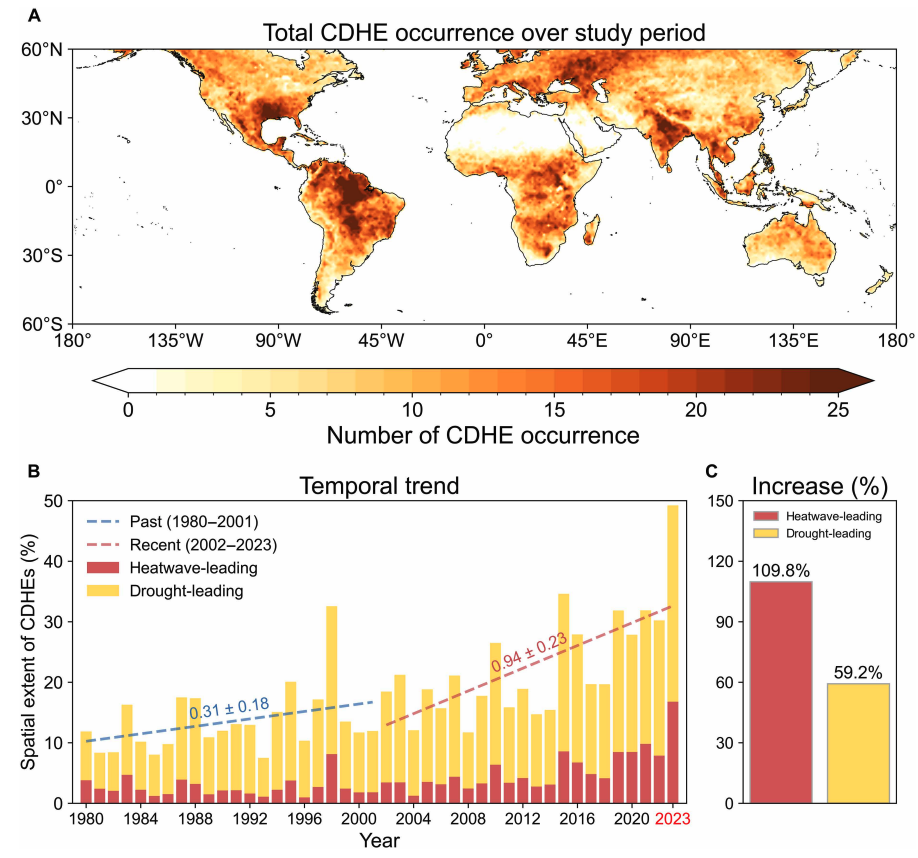
Heatwave-led events have been the main contributor to this increase, the study says, with their spatial extent rising 110% between 1980-2001 and 2002-23, compared to a 59% increase for drought-led events.
The map below shows the global distribution of CDHEs over 1980-2023. The charts show the percentage of the land surface affected by a heatwave-led CDHE (red) or a drought-led CDHE (yellow) in a given year (left) and relative increase in each CDHE type (right).
The study finds that CDHEs have occurred most frequently in northern South America, the southern US, eastern Europe, central Africa and south Asia.
Threshold passed
The authors explain that the increase in heatwave-led CDHEs is related to rising global temperatures, but that this does not tell the whole story.
In the earlier 22-year period of 1980-2001, the study finds that the spatial extent of heatwave-led CDHEs rises by 1.6% per 1C of global temperature rise. For the more-recent period of 2022-23, this increases “nearly eightfold” to 13.1%.
The change suggests that the rapid increase in the heatwave-led CDHEs occurred after the global average temperature “surpasse[d] a certain temperature threshold”, the paper says.
This threshold is an absolute global average temperature of 14.3C, the authors estimate (based on an 11-year average), which the world passed around the year 2000.
Investigating the recent surge in heatwave-leading CDHEs further, the researchers find a “regime shift” in land-atmosphere dynamics “toward a persistently intensified state after the late 1990s”.
In other words, the way that drier soils drive higher surface temperatures, and vice versa, is becoming stronger, resulting in more heatwave-led compound events.
Daily data
The research has some advantages over other previous studies, Yeh says. For instance, the new work uses daily estimations of CDHEs, compared to monthly data used in past research. This is “important for capturing the detailed occurrence” of these events, says Yeh.
He adds that another advantage of their study is that it distinguishes the sequence of droughts and heatwaves, which allows them to “better understand the differences” in the characteristics of CDHEs.
Dr Meryem Tanarhte is a climate scientist at the University Hassan II in Morocco, and Dr Ruth Cerezo Mota is a climatologist and a researcher at the National Autonomous University of Mexico. Both scientists, who were not involved in the study, agree that the daily estimations give a clearer picture of how CDHEs are changing.
Cerezo-Mota adds that another major contribution of the study is its global focus. She tells Carbon Brief that in some regions, such as Mexico and Africa, there is a lack of studies on CDHEs:
“Not because the events do not occur, but perhaps because [these regions] do not have all the data or the expertise to do so.”
However, she notes that the reanalysis data used by the study does have limitations with how it represents rainfall in some parts of the world.
Compound impacts
The study notes that if CDHEs continue to intensify – particularly events where heatwaves are the precursors – they could drive declining crop productivity, increased wildfire frequency and severe public health crises.
These impacts could be “much more rapid and severe as global warming continues”, Yeh tells Carbon Brief.
Tanarhte notes that these events can be forecasted up to 10 days ahead in many regions. Furthermore, she says, the strongest impacts can be prevented “through preparedness and adaptation”, including through “water management for agriculture, heatwave mitigation measures and wildfire mitigation”.
The study recommends reassessing current risk management strategies for these compound events. It also suggests incorporating the sequences of drought and heatwaves into compound event analysis frameworks “to enhance climate risk management”.
Cerezo-Mota says that it is clear that the world needs to be prepared for the increased occurrence of these events. She tells Carbon Brief:
“These [risk assessments and strategies] need to be carried out at the local level to understand the complexities of each region.”