Welcome to Carbon Brief’s China Briefing.
China Briefing handpicks and explains the most important climate and energy stories from China over the past fortnight. Subscribe for free here.
Key developments
China’s next ‘five-year plan’
NEW PLAN: The Chinese Communist party held its fourth plenum meeting, reported the Guardian, which described it as a “key meeting in the country’s political cycle and a crucial one in the development of its 15th ‘five-year plan’”. China’s “five-year plans” serve as blueprints guiding the country’s economic and social development. The 15th one runs from 2026-30. While the plan will not be released until next year, the full text of the official “adopting recommendations” said a “main target” will be making “major new progress in building a beautiful China”. This includes a “green production and lifestyle to be basically established [and] the carbon-peak target [for 2030] to be achieved as scheduled”, according to the text.
TECHNOLOGY AND ‘INVOLUTION’: The Guardian’s report highlighted the “recommendations” for technology investments and a “crackdown on ‘involution’” – a reference to “fierce internal competition” that has, in the past, led to oversupply. In a “15th ‘five-year plan’ explanation” speech, Chinese president Xi Jinping said “it should be noted that the development of new quality productive forces”, which largely relies on technology, requires “full consideration of practical feasibility”, according to the transcript published by state news agency Xinhua. He also called on local officials to avoid a “rush” to develop projects, when talking about using technological innovation for “promoting a comprehensive green transformation”.
‘GREEN’ TRANSITION: At a post-meeting press conference, Zheng Shanjie, head of the National Development and Reform Commission (NDRC), said the “comprehensive realisation of green transformation” requires the construction and implementation of the “dual control of carbon” system and the “green and low-carbon” transition of energy, as well as “industrial structure” and “production and lifestyle”. The National Energy Administration (NEA) also pledged to “focus on” building a “clean, low-carbon, safe and efficient new energy system” at a separate meeting, reported industry news outlet BJX News. Belinda Schäpe, China policy analyst from the Centre for Research on Energy and Clean Air (CREA), commented on LinkedIn that the commitment to build the “dual control of carbon” was “expected”. She added that the “reaffirmation” of renewable expansion was an “important signal given the uncertainty of the sector’s future after the policy pricing reform” came into force earlier this year.
EXPERT REACTION: Schäpe called the mention of “[promoting the] peaking [of] coal and oil consumption” an “important signal”, as this is the first time “such language appears in a top-level planning document”. The oil-peak target “aligns with international expectations” and the “references to ‘clean and efficient use’ and ‘orderly replacement’ suggest a managed transformation of coal’s role – focusing on retrofits, flexibility and system support rather than new capacity growth”, she added. This suggestion of a peaking for coal and oil “allows” coal consumption to “increase in the early years of the five-year period”, according to a LinkedIn post by Lauri Myllyvirta, lead analyst from CREA. He said the peaking suggestion, although “in line with the goal of peaking [carbon dioxide] CO2 emissions before 2030”, provides “no guarantees of achieving a [CO2] reduction from 2025 to 2030, let alone starting from 2025”. The “most important question” for the next “five-year plan”, he added, is “whether China is committed to honouring the 2021 commitments: reducing carbon intensity by 65% from 2005 to 2030 and ‘gradually reducing coal consumption’” over the next five years.
Pre-COP30 report
CLIMATE REPORT: The Chinese Ministry of Ecology and Environment (MEE) released an annual report on “China’s policies and actions on climate change 2025” ahead of COP30, reported the Chinese media outlet 21st Century Business Herald. The newspaper quoted Xia Yingxian, director of the MEE’s department of climate change, saying the report “showcased” China’s “significant contributions to mitigation, adaptation, carbon markets, carbon footprint, climate policies and regulations and leading global climate governance”.
GLOBAL COOPERATION: The Paper, a Shanghai-based media outlet, reported that Xia said China “follows through” on its global climate cooperation commitments. Speaking about the 10th anniversary of the Paris Agreement, Chinese foreign minister Wang Yi said climate change has become an “urgent issue” and – in an apparent reference to the US – added that no country can “be a deserter”, according to a video posted by China News. Vice premier Ding Xuexiang also “said that China stands ready to work with all parties to advance global green development”, reported Xinhua. China’s stance on global climate cooperation was reiterated at a G20 environmental meeting in South Africa, according to International Energy Net.
China-EU climate cooperation
FINANCE: The 21st Century Business Herald wrote that the MEE’s report indicated COP30 should make “positive progress” in meeting the financial targets agreed at COP29 – the “aspirational” target of $1.3tn a year and at least $300bn of climate finance a year by 2035. Xia said the $300bn pledge did not “fully reflect” the “capital contribution obligations of developed countries”, added the outlet. Meanwhile, the EU’s climate chief Wopke Hoekstra asked China to boost its climate-finance offering, reported European news website Euractiv. He said “China is an upper middle income country” and “Europe just simply does not have the pockets” to provide all the needed climate finance “by itself”, according to the outlet.
CLIMATE TIES: In a press release following a recent meeting between Chinese premier Li Qiang and European Council president António Costa, Costa was quoted saying that “climate action has to remain [at the] top of our agendas” and that COP30 will “offer an opportunity for the EU and China to lead with ambition in order to achieve a successful outcome”. The Hong Kong-based South China Morning Post said Li also expressed Beijing’s willingness to work with the EU on matters including “the environment”. Costa added that “I shared my strong concern about China’s expanding export controls on critical raw materials”, urging Li to “restore as soon as possible fluid, reliable and predictable supply chains”, according to the press release.
-
Sign up to Carbon Brief’s free “China Briefing” email newsletter. All you need to know about the latest developments relating to China and climate change. Sent to your inbox every Thursday.
EXPORT CONTROLS: The trade dispute over China’s supply of rare earths was “settled” during a meeting between US president Donald Trump and his counterpart Xi in South Korea earlier today, reported the Guardian. Reuters said China agreed to delay the introduction of the next round of export controls, but that earlier restrictions on critical minerals will remain. The rare-earth minerals “play tiny, but vital roles” in products such as cars, planes and weapons, the newswire added. The US will also lower tariffs on some Chinese imports, according to ABC News.
More wind, less coal
COAL DECLINE: Official data showed that China’s thermal power generation – mainly from coal – dropped 5.4% in September, reported Bloomberg. Meanwhile, the Ministry of Industry and Information Technology is consulting on its new steel capacity “swap” policy that aims to “promote market supply and demand balance”. Reuters said this was a “more stringent” swapping plan than the previous one that has been paused for 14 months. Shen Xinyi, researcher from CREA, explained on LinkedIn that the new programme “raises the replacement ratio to 1.5:1 nationwide” and encourages cross-regional swaps. She added the measures “signal a deeper shift: from expansion control to structural optimisation and decarbonisation”, calling it a “strategic move to restructure and rebalance China’s steel landscape”.
MORE WIND: A new industry proposal, the “Beijing Declaration on Wind Energy 2.0”, put forward a goal for the country’s wind capacity to reach “1.3 terawatts (TW) by 2030, at least 2TW by 2035 and a staggering 5TW by 2060”, said state-run newspaper China Daily. The outlet called the new plan a “significant increase” from an earlier declaration, which had targeted 3TW by 2060. The same group of wind-industry players are “lobbying the government to install at least 120 gigawatts (GW) of wind-power capacity in each of the next five years, an acceleration of the country’s energy transition that would more than double output by the end of the decade”, reported Bloomberg. The official goal is to install 3.6TW of capacity for wind and solar power combined by 2035, added the outlet.
OVERSEAS EXPANSION: After two years of talk with the UK government, Chinese wind turbine manufacturer Ming Yang announced that it wants to build a £1.5bn project in Scotland, said BBC News. European governments, however, were “increasingly wary of Chinese companies’ involvement” in offshore wind, which is a “cornerstone of northern Europe’s clean-energy strategy”, reported Reuters. Exports of China’s other renewable energy products, namely, the “new three” – lithium-ion batteries, solar cells and electric vehicles (EVs) – rose nearly 40% year-on-year in September, according to official data, reported financial outlet Caixin. Separately, China “sent a clear signal that it is willing to pull the plug on subsidies” for the EV industry, said Reuters.
Spotlight
Q&A: How China is developing ‘vehicle-to-grid’ to strengthen its electricity system
China’s surging electric vehicles (EVs) ownership – now exceeding 25.5m – is opening the door to a new technology that turns EVs into “power banks” to help with the flexibility of electricity supply.
Carbon Brief looks into the technology, known as “vehicle-to-grid” (V2G), and explains how it has sparked interest in China. The full article is available on Carbon Brief’s website.
How can V2G help balance the grid?
In China, EVs with bidirectional batteries, when plugged into V2G-capable charging stations, are able to sell their stored electricity back to the grid in nine “pilot cities”, including Shanghai, Guangzhou and Shenzhen.
Dr Muyi Yang, senior electricity analyst at thinktank Ember, told Carbon Brief that a fleet of grid-connected EVs could help China achieve its broader plan to restructure its power sector towards a “new power system” that aims to be more flexible and responsive to power volatility.
Zhou Xiaohang, China clean-power project manager at the US-registered Natural Resource Defense Council in Beijing, told Carbon Brief that, in the long run, V2G can help to address the curtailment issue for renewable energy, which is often referred to as the “Xiaona” problem in China.
What is the current state of V2G adoption?
Currently, V2G has not been widely deployed in China. The cost of V2G infrastructure installation remains high.
Zhou said the success of large-scale roll out of V2G depends on whether there are enough EVs equipped with the bidirectional batteries and able to be plugged into V2G-capable charging stations.
China “already [has] enough EVs on the road to make [V2G] possible”, she added.
Meanwhile, popular car brands such as BYD and Nio have released new EV models with V2G features and many more are actively testing and preparing for two-way electric charging.
There are 30 demonstration projects going on at the moment. Shenzhen, for example, received more than 70,000 kilowatt hours (kWh) of electricity from about 2,500 EVs in June.
Regional governments have also been working to introduce more profitable pricing systems to boost user participation.
Guangdong province, in south China, launched a V2G pricing plan that is “appealing” enough for EV owners to see a profit from participating in the scheme, according to Zhou.
What are the challenges in expansion?
A large share of China’s electricity is still traded through long-term power contracts, which could limit incentives for individual EV owners to engage in power-trading.
Shen Xinyi, researcher at Centre for Research on Energy and Clean Air (CREA), told Carbon Brief:
“Flexible systems like V2G and distributed solar power need a well-developed spot market and experienced, professional players such as power retailers to truly thrive.”
Zhou said whether V2G can be rolled out at scale also depends on the attitudes of consumers.
Chinese media outlet the Paper reported that people had expressed concerns on battery health and safety issues, including whether frequent discharges could cause battery degradation.
In April 2024, Hui Dong, chief technical expert at the China Electric Power Research Institute, a research institute affiliated to the State Grid Corporation of China, stated that, in terms of lifespan, chemical energy storage systems, represented by lithium-ion batteries, are still “underperforming”.
Watch, read, listen
CARBON REDUCTION: Prof Jiang Yi, director of building energy research centre at Tsinghua University, explained how to “reduce carbon” on both “the side of production” and “the side of consumption” in an interview with financial outlet Yicai.
INDONESIA’S JOURNEY: The China Global South Project aired a podcast on China’s role in “Indonesia’s push for clean energy and more coal”.
CLIMATE STATEMENTS: China Daily published a list of climate statements from prominent Chinese politicians and researchers, including Liu Zhenmin, China special envoy for climate change.
ENERGY CHALLENAGES: In a long interview with 21st Century Business Herald, Energy Foundation China president Zou Ji said “grid integration challenges” are the most “immediate obstacle” to China’s clean-energy buildout.
5tn
The growth in “added value” – a component of economic output – of China’s “green industries” from 2020-25, in Chinese yuan ($700bn), according to 21st Century Business Herald. The newspaper quoted Ren Yong, chief engineer at the Ministry of Ecology and Environment, saying that the “added value of green and low-carbon sectors in key industries” accounted for 8.3% of GDP in 2020 and is expected to rise to 11.7% in 2025, according to the newspaper. [Previous analysis for Carbon Brief found clean-energy industries accounted for 10% of China’s GDP in 2024.]
New science
Ecology and Society
New research examined different approaches to assessing the vulnerability of fisheries to climate impacts, finding that using a data-driven approach can result in differing vulnerability than using a “knowledge-driven” one. The authors wrote that their results underline the “importance of engaging local knowledge to validate findings and provide contextualised interpretations for more effective management strategies”.
Mechanisms behind the rapid rise of extreme heat discomfort days in south China
Npj climate and atmospheric science
The number and strength of extreme heat discomfort days in south China has undergone a “sharp rise” since 2000, according to a new study. Researchers used observational weather data and a machine-learning model to determine the atmospheric circulation patterns that cause the extreme events. They found that an area of high pressure over the Pacific Ocean weakened the summer monsoon winds.
China Briefing is compiled by Wanyuan Song and Anika Patel. It is edited by Wanyuan Song and Dr Simon Evans. Please send tips and feedback to china@carbonbrief.org
The post China Briefing 30 October 2025: 15th ‘five-year plan’ priorities; 2035 wind goal; ‘Vehicle-to-grid’ tech appeared first on Carbon Brief.

Drought and heatwaves occurring together – known as “compound” events – have “surged” across the world since the early 2000s, a new study shows.
Compound drought and heat events (CDHEs) can have devastating effects, creating the ideal conditions for intense wildfires, such as Australia’s “Black Summer” of 2019-20 where bushfires burned 24m hectares and killed 33 people.
The research, published in Science Advances, finds that the increase in CDHEs is predominantly being driven by events that start with a heatwave.
The global area affected by such “heatwave-led” compound events has more than doubled between 1980-2001 and 2002-23, the study says.
The rapid increase in these events over the last 23 years cannot be explained solely by global warming, the authors note.
Since the late 1990s, feedbacks between the land and the atmosphere have become stronger, making heatwaves more likely to trigger drought conditions, they explain.
One of the study authors tells Carbon Brief that societies must pay greater attention to compound events, which can “cause severe impacts on ecosystems, agriculture and society”.
Compound events
CDHEs are extreme weather events where drought and heatwave conditions occur simultaneously – or shortly after each other – in the same region.
These events are often triggered by large-scale weather patterns, such as “blocking” highs, which can produce “prolonged” hot and dry conditions, according to the study.
Prof Sang-Wook Yeh is one of the study authors and a professor at the Ewha Womans University in South Korea. He tells Carbon Brief:
“When heatwaves and droughts occur together, the two hazards reinforce each other through land-atmosphere interactions. This amplifies surface heating and soil moisture deficits, making compound events more intense and damaging than single hazards.”
CDHEs can begin with either a heatwave or a drought.
The sequence of these extremes is important, the study says, as they have different drivers and impacts.
For example, in a CDHE where the heatwave was the precursor, increased direct sunshine causes more moisture loss from soils and plants, leading to a drought.
Conversely, in an event where the drought was the precursor, the lack of soil moisture means that less of the sun’s energy goes into evaporation and more goes into warming the Earth’s surface. This produces favourable conditions for heatwaves.
The study shows that the majority of CDHEs globally start out as a drought.
In recent years, there has been increasing focus on these events due to the devastating impact they have on agriculture, ecosystems and public health.
In Russia in the summer of 2010, a compound drought-heatwave event – and the associated wildfires – caused the death of nearly 55,000 people, the study notes.

The record-breaking Pacific north-west “heat dome” in 2021 triggered extreme drought conditions that caused “significant declines” in wheat yields, as well as in barley, canola and fruit production in British Columbia and Alberta, Canada, says the study.
Increasing events
To assess how CDHEs are changing, the researchers use daily reanalysis data to identify droughts and heatwaves events. (Reanalysis data combines past observations with climate models to create a historical climate record.) Then, using an algorithm, they analyse how these events overlap in both time and space.
The study covers the period from 1980 to 2023 and the world’s land surface, excluding polar regions where CDHEs are rare.
The research finds that the area of land affected by CDHEs has “increased substantially” since the early 2000s.
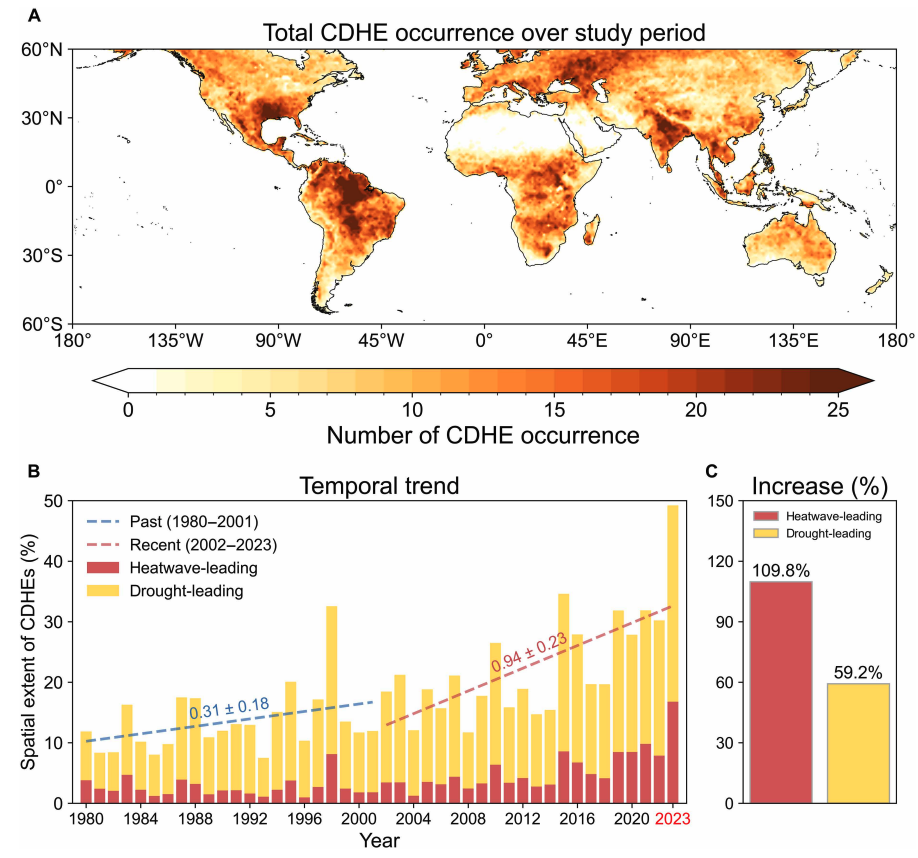
Heatwave-led events have been the main contributor to this increase, the study says, with their spatial extent rising 110% between 1980-2001 and 2002-23, compared to a 59% increase for drought-led events.
The map below shows the global distribution of CDHEs over 1980-2023. The charts show the percentage of the land surface affected by a heatwave-led CDHE (red) or a drought-led CDHE (yellow) in a given year (left) and relative increase in each CDHE type (right).
The study finds that CDHEs have occurred most frequently in northern South America, the southern US, eastern Europe, central Africa and south Asia.
Threshold passed
The authors explain that the increase in heatwave-led CDHEs is related to rising global temperatures, but that this does not tell the whole story.
In the earlier 22-year period of 1980-2001, the study finds that the spatial extent of heatwave-led CDHEs rises by 1.6% per 1C of global temperature rise. For the more-recent period of 2022-23, this increases “nearly eightfold” to 13.1%.
The change suggests that the rapid increase in the heatwave-led CDHEs occurred after the global average temperature “surpasse[d] a certain temperature threshold”, the paper says.
This threshold is an absolute global average temperature of 14.3C, the authors estimate (based on an 11-year average), which the world passed around the year 2000.
Investigating the recent surge in heatwave-leading CDHEs further, the researchers find a “regime shift” in land-atmosphere dynamics “toward a persistently intensified state after the late 1990s”.
In other words, the way that drier soils drive higher surface temperatures, and vice versa, is becoming stronger, resulting in more heatwave-led compound events.
Daily data
The research has some advantages over other previous studies, Yeh says. For instance, the new work uses daily estimations of CDHEs, compared to monthly data used in past research. This is “important for capturing the detailed occurrence” of these events, says Yeh.
He adds that another advantage of their study is that it distinguishes the sequence of droughts and heatwaves, which allows them to “better understand the differences” in the characteristics of CDHEs.
Dr Meryem Tanarhte is a climate scientist at the University Hassan II in Morocco, and Dr Ruth Cerezo Mota is a climatologist and a researcher at the National Autonomous University of Mexico. Both scientists, who were not involved in the study, agree that the daily estimations give a clearer picture of how CDHEs are changing.
Cerezo-Mota adds that another major contribution of the study is its global focus. She tells Carbon Brief that in some regions, such as Mexico and Africa, there is a lack of studies on CDHEs:
“Not because the events do not occur, but perhaps because [these regions] do not have all the data or the expertise to do so.”
However, she notes that the reanalysis data used by the study does have limitations with how it represents rainfall in some parts of the world.
Compound impacts
The study notes that if CDHEs continue to intensify – particularly events where heatwaves are the precursors – they could drive declining crop productivity, increased wildfire frequency and severe public health crises.
These impacts could be “much more rapid and severe as global warming continues”, Yeh tells Carbon Brief.
Tanarhte notes that these events can be forecasted up to 10 days ahead in many regions. Furthermore, she says, the strongest impacts can be prevented “through preparedness and adaptation”, including through “water management for agriculture, heatwave mitigation measures and wildfire mitigation”.
The study recommends reassessing current risk management strategies for these compound events. It also suggests incorporating the sequences of drought and heatwaves into compound event analysis frameworks “to enhance climate risk management”.
Cerezo-Mota says that it is clear that the world needs to be prepared for the increased occurrence of these events. She tells Carbon Brief:
“These [risk assessments and strategies] need to be carried out at the local level to understand the complexities of each region.”