

Welcome to Carbon Brief’s China Briefing.
China Briefing handpicks and explains the most important climate and energy stories from China over the past fortnight. Subscribe for free here.
Key developments
Gearing up
PRE-COP COMMITMENTS: China has “become the defender of international cooperation on climate change”, said state-sponsored newspaper Global Times the day before COP30 opened. China’s commitment to “dual carbon” goals will be the “driving force” of building a “beautiful China”, said an article by the Communist party-affiliated newspaper People’s Daily under the byline of Wang Huning, chairman of the Chinese People’s Political Consultative Conference.

WORLD’S EXPECTATIONS: China’s deputy permanent representative to the UN, Geng Shuang, said the country is “globally recognised as the [one] with the strongest determination, the most vigorous actions” on tackling climate issues, reported news agency Xinhua. John Kerry, former US climate envoy, told the Shanghai-based Paper: “The global climate agenda has undergone a fundamental shift, and calls are being made for China to continue playing a leading role in the event of a possible absence of the US.”
-
Sign up to Carbon Brief’s free “China Briefing” email newsletter. All you need to know about the latest developments relating to China and climate change. Sent to your inbox every Thursday.
FINANCE PLEA: Meanwhile, Brazilian president Luiz Inacio Lula da Silva “urged” China’s vice premier Ding Xuexiang at a pre-COP30 meeting to “join financing initiatives for climate transition and resilience” and “help fund green technology and investment projects”, said the Hong Kong-based South China Morning Post (SCMP).
‘OUTPERFORM[ING]’ TARGETS: Most experts in a new survey expect China to “outperform” its 2035 emissions-reduction target, reported Bloomberg. About 71% of the surveyed experts believe China’s carbon-emission peak will “happen between 2026 and 2030, with most expecting it in 2028” – ahead of the official timeline of 2030, said Agence France-Presse.
Early moves
‘PROMISES KEPT’: China “keeps its promises and delivers on its commitments” on climate change, Ding said on 6 November, in remarks at COP30’s leaders summit, according to a transcript published by Communist party-affiliated newspaper the People’s Daily. Ding suggested that, to “advance” climate action, the world must “stay on the right track”, balancing “environmental protection, economic development, job creation and poverty eradication”. In addition, Ding said countries must “remove trade barriers” if the world is to meet its targets, said BBC News.
BUILDING COALITIONS: Over the weekend ahead of COP, Brazil, China and the UK co-led a summit on methane, launching initiatives that could “accelerate global action on methane and other non-CO2 greenhouse gases”, said a press release published on the COP30 website. These included “mobilising” at least $150m to support seven developing countries’ efforts, it added. China and the EU also agreed to join a Brazilian-led carbon-market coalition, Bloomberg reported, which “aims to develop common standards for monitoring, reporting and verification”.
TFFF FOREGONE: There are “still no guarantees” that China will contribute to Brazil’s Tropical Forest Forever Facility (TFFF), CNN Brasil said, contrary to reporting by Reuters in July that China might invest in the fund. The outlet added that Brazil may be able to push for Chinese participation again at the G20 meeting in late November. SCMP said “Chinese negotiators told their Brazilian counterparts that Beijing supported the fund in principle”, but cited the common but differentiated responsibilities concept as a reason not to commit.
OPENING STATEMENTS: In the face of an “intensifying” climate crisis, China “will not stop supporting” international action, Huang said at the opening of the China pavilion at COP30, attended by Carbon Brief. A number of representatives of major international organisations – including the UNFCCC’s Simon Stiell, the UN climate advisor Selwin Hart, UNEP executive director Inger Andersen – as well as Chinese climate envoy Liu Zhenmin all spoke at the event. Hart captured the mood, saying: “We are certain to count on the leadership of China over the course of the next two weeks, and also over the next decade.”
Trade spats
AGENDA FIGHT: The agenda for COP30 was “adopted on Monday as originally drafted without any amendments”, despite a request by a country group that includes China that the lineup include “provision of finance from rich countries and unilateral trade measures” such as the EU’s carbon border adjustment mechanism, Climate Home News reported. The topics are instead being discussed in presidency-led consultations, alongside calls from small-island states to push for greater emissions-cutting ambition and from the EU on emissions reporting. Carbon Brief’s Simon Evans set out the issues on Bluesky.
RIGHT HERE RIGHT NOW: The Like-Minded Developing Countries (LMDCs) group – of which China is a part – together with the Arab Group stated that unilateral trade measures “penalise developing countries and impact their ability to take action to address climate change”, reported Earth Negotiation Bulletin. They pushed back against arguments by Japan, the EU and others that discussions of unilateral trade measures would be “more appropriate under the World Trade Organization”, it added.
PRESIDENCY PAUSE: A “stocktaking plenary” on Wednesday ended abruptly with COP30 president André Corrêa do Lago announcing a further plenary on Saturday. Do Lago said that – despite “more than eight hours” of discussions – further consultations were still needed. Rumours are flying around how Brazil will manage this, with many expecting a COP30 decision responding to these thorny issues. It may be called a “cover decision” or be part of a “mutirão package”, a reference to an Indigenous word for collective efforts.
Cough up the cash
INDIA FOR BASIC: Meanwhile, according to a government press release, India has submitted a statement on behalf of the BASIC group, an institution initiated by China, as well as LMDCs, reaffirming that the “architecture of the Paris Agreement must not be altered, and that [common but differentiated responsibilities (CBDR)] remains the cornerstone of the global climate regime”. It added that “developed countries must…fulfil their obligations on finance, technology transfer and capacity-building to developing countries”, in particular by increasing adaptation finance flows by “nearly fifteen times” from current levels.
STATUS QUO: Chinese delegates have repeatedly emphasised China’s status as a developing country and the need for CBDR in early statements at COP. Writing in the Backchannel substack, Asia Society Policy Institute China climate hub and climate diplomacy director Kate Logan and E3G senior policy advisor Lily Hartzell wrote that China’s “high-level delegations have cautiously avoided any wording that might suggest a bid for formal climate leadership, particularly when it comes to climate finance”.
LEADING COMMENT: In his speech at the leaders’ summit, Ding stated that “developed countries should fulfill their obligations to take the lead in reducing emissions, honour their financial commitments and provide developing countries with more technical and capacity-building support”. This contrasts his address at COP29, where Ding highlighted China’s role in “provid[ing] and mobilis[ing]” climate finance – sparking much speculation that the country may soon change its approach to the topic.
COME BACK TO US: Li Gao, the head of China’s delegation at COP30, told Agence France-Presse that China “welcome[d]” the “Baku to Belém roadmap” towards the aspirational target of $1.3tn in climate finance by 2035 from all sources, but that it is “crucial” for the developed countries to fulfil their $300bn commitment made at COP29. Li added that “we hope that some day, and we also believe that some day in the future, the US will come back”, because “addressing climate change needs every country”.
Global south solidarity
KEY THEME: China is working towards “jointly creating a green future” for the global south, Huang said in a session on south-south development held on the first day of COP30, attended by Carbon Brief. He added: “We pay attention to the needs of developing countries.” President of the Belt and Road International Green Development Coalition (BRIGC) Zhao Yingmin said on a separate event at the China pavilion that “construction of the [Belt and Road Initiative (BRI)] is also an important driver for developing countries to advance their green transitions”. A number of initiatives were publicised during the first few days of COP, including an agreement between China, Malawi and Kenya on clean cooking and a project to collate “global case studies on green development” by BRIGC.
BUILDING CAPACITY: The BRIGC programme is “exactly the type of example we want [to see at] the COP – implementation, implementation, implementation”, said COP30 CEO Ana Toni, speaking at the launch event attended by Carbon Brief. Selwin Hart, special adviser to the secretary-general on climate action and just transition at the United Nations, emphasised at a China pavilion event that Brazil and China showed “leadership” in climate action, noting that “you [emerging economies] understand us better” than developed countries – referencing an understanding of the need for capacity building in global south countries.
‘FRANK REMARKS’: Meanwhile, an opinion article in the state-supporting Global Times, bylined simply as “Global Times”, quoted COP30 president André Corrêa do Lago saying “You can’t insist that China has to lower its emissions [and then] complain that China is putting cheap [electric vehicles] all over the world”. It added that these “frank remarks should serve as a wake-up call” against “politicising China’s green efforts”.
STRONG INTEREST: The two events on south-south cooperation, both attended by Carbon Brief, appeared to be the best-attended China pavilion events so far. One audience member, a Brazilian chemical engineer, told Carbon Brief that she was attending the session because she was interested in understanding China’s experience of navigating the energy transition as a developing country.
Views on the energy transition
‘CONCRETE PROGRESS’: “We have made concrete progress in energy transformation”, Li said at the China pavilion, adding it involved a “very hard effort”. Climate envoy Liu noted at the same event that “China, as a major country, reaffirms its confidence in achieving the [Paris Agreement] goals”. He said that China “sees the next 10 years as a critical period for delivering on the commitments made under the Paris Agreement”, adding: “We look forward to all countries delivering their contributions on this goal.”
FOSSIL PHASE-OUT?: In his opening speech at the leaders’ summit, Brazil’s Lula called on world leaders to draw roadmaps to “overcome dependence on fossil fuels”, adding that he was “convinced” that this could be done “despite [countries’] difficulties and contradictions”, Argus Media reported. In the opening session of the China pavilion, attended by Carbon Brief, UNEP’s Andersen said she “encourage[d] China to take even bolder action…[and] explore setting targets on coal”.
PRIORITIES FOR 2030: Lyu Wenbin, director general of China’s Energy Research Institute, stated that a key task in the next five years included “improving the quality of energy supply”, including “boosting non-fossil energy” while “shifting coal power to a supporting role” in the energy mix. He added that in the medium- to long-term, China will build an energy system that has “non-fossil energy as the main supply [of power] and fossil energy as a guarantee [of energy security]”.
FLAT OR FALLING: Meanwhile, analysis for Carbon Brief found that China’s carbon dioxide emissions were “unchanged from a year earlier in the third quarter of 2025, extending a flat or falling trend that started in March 2024”. The analysis has been covered widely in publications including China’s Global Times, the New York Times, Financial Times, Reuters, Bloomberg and on the frontpage of the Guardian.
Captured

Bai Quan, director of the Energy Research Institute of the Academy of Macroeconomic Research – a research institution managed by the National Development and Reform Commission – outlined how China’s energy landscape might evolve between 2024 and 2060, during the launch of the China Energy Transformation Outlook (CETO) 2025 at the China Pavilion, attended by Carbon Brief. Guest posts for Carbon Brief on previous CETO reports can be found here and here.
Watch, read, listen
EV MARKET: Research institute the Centre for Strategic and International Studies published a series of two videos talking about China’s EVs in the global market.
HEALTH AND CLIMATE CHANGE: The “Lancet Countdown” China report led by Tsinghua University found that “climate-related health risks in China reached record levels last year”, according to media outlet China.org.cn.
‘DOCUMENT 136’: China Power Enterprise Management analysed the impact of China’s “document 136” pricing reforms for new renewable energy projects.
CHINA-LAOS: A long article by Sky News talked about China’s “green technology exports” in developing countries, such as Laos.
789
The number of delegates China has sent to Belém, according to analysis by Carbon Brief. This includes more than 100 party delegates and almost 700 “overflow” delegates, including from local government, the private sector, non-government organisations and foreign consulting firms.
New science
Scientific Reports
“Environmental penalties indirectly influence climate-friendly technological innovation through their effects on the digital economy and financial technology”, according to a new study. The paper used data from Chinese cities to model this influence. The authors found that environmental penalties have a “U-shaped” effect, noting a “critical inflection point where environmental penalties shift from promoting to inhibiting these innovations”.
Scientific Reports
New research investigated the “carbon rebound effect”, defined in the paper as “the phenomenon in which, after energy efficiency improvements, carbon emissions rebound due to increased economic activity, thus undermining the reduction in emissions achieved through efficiency gains”. Using machine-learning methods, the authors assessed data from Chinese cities collected over 2010-21. According to the paper, the effect is stronger in the north of China than the south and in the east than the west.
China Briefing is compiled by Wanyuan Song and Anika Patel. It is edited by Wanyuan Song and Dr Simon Evans. Please send tips and feedback to china@carbonbrief.org
The post China Briefing 13 November 2025: COP30 special appeared first on Carbon Brief.

Drought and heatwaves occurring together – known as “compound” events – have “surged” across the world since the early 2000s, a new study shows.
Compound drought and heat events (CDHEs) can have devastating effects, creating the ideal conditions for intense wildfires, such as Australia’s “Black Summer” of 2019-20 where bushfires burned 24m hectares and killed 33 people.
The research, published in Science Advances, finds that the increase in CDHEs is predominantly being driven by events that start with a heatwave.
The global area affected by such “heatwave-led” compound events has more than doubled between 1980-2001 and 2002-23, the study says.
The rapid increase in these events over the last 23 years cannot be explained solely by global warming, the authors note.
Since the late 1990s, feedbacks between the land and the atmosphere have become stronger, making heatwaves more likely to trigger drought conditions, they explain.
One of the study authors tells Carbon Brief that societies must pay greater attention to compound events, which can “cause severe impacts on ecosystems, agriculture and society”.
Compound events
CDHEs are extreme weather events where drought and heatwave conditions occur simultaneously – or shortly after each other – in the same region.
These events are often triggered by large-scale weather patterns, such as “blocking” highs, which can produce “prolonged” hot and dry conditions, according to the study.
Prof Sang-Wook Yeh is one of the study authors and a professor at the Ewha Womans University in South Korea. He tells Carbon Brief:
“When heatwaves and droughts occur together, the two hazards reinforce each other through land-atmosphere interactions. This amplifies surface heating and soil moisture deficits, making compound events more intense and damaging than single hazards.”
CDHEs can begin with either a heatwave or a drought.
The sequence of these extremes is important, the study says, as they have different drivers and impacts.
For example, in a CDHE where the heatwave was the precursor, increased direct sunshine causes more moisture loss from soils and plants, leading to a drought.
Conversely, in an event where the drought was the precursor, the lack of soil moisture means that less of the sun’s energy goes into evaporation and more goes into warming the Earth’s surface. This produces favourable conditions for heatwaves.
The study shows that the majority of CDHEs globally start out as a drought.
In recent years, there has been increasing focus on these events due to the devastating impact they have on agriculture, ecosystems and public health.
In Russia in the summer of 2010, a compound drought-heatwave event – and the associated wildfires – caused the death of nearly 55,000 people, the study notes.

The record-breaking Pacific north-west “heat dome” in 2021 triggered extreme drought conditions that caused “significant declines” in wheat yields, as well as in barley, canola and fruit production in British Columbia and Alberta, Canada, says the study.
Increasing events
To assess how CDHEs are changing, the researchers use daily reanalysis data to identify droughts and heatwaves events. (Reanalysis data combines past observations with climate models to create a historical climate record.) Then, using an algorithm, they analyse how these events overlap in both time and space.
The study covers the period from 1980 to 2023 and the world’s land surface, excluding polar regions where CDHEs are rare.
The research finds that the area of land affected by CDHEs has “increased substantially” since the early 2000s.
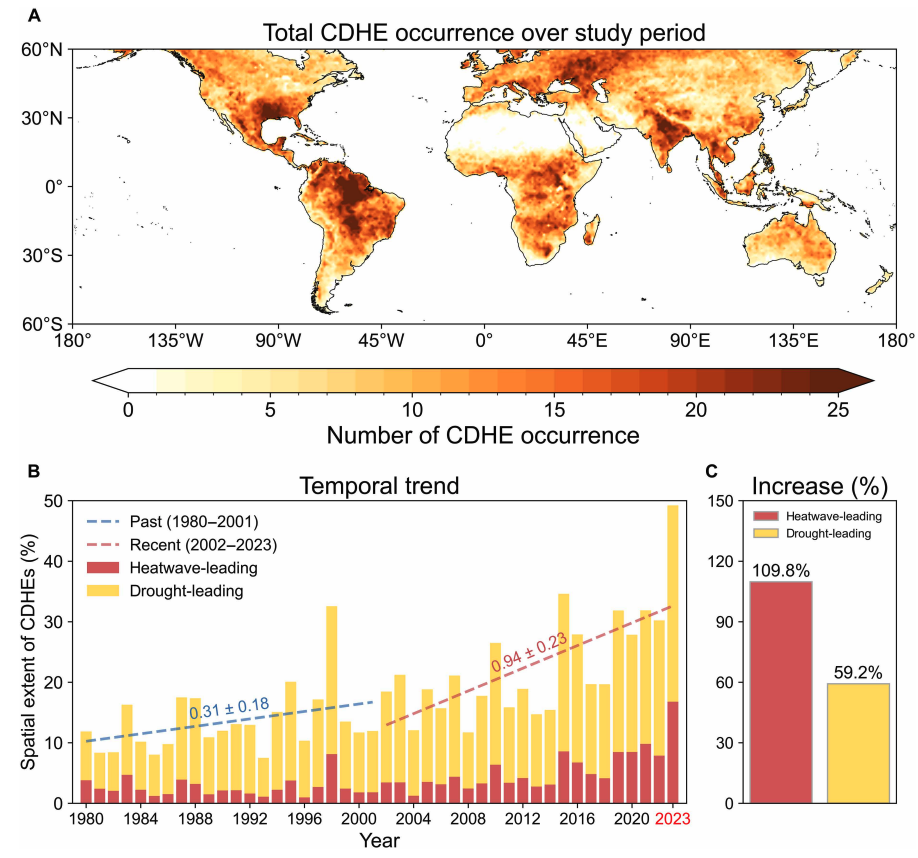
Heatwave-led events have been the main contributor to this increase, the study says, with their spatial extent rising 110% between 1980-2001 and 2002-23, compared to a 59% increase for drought-led events.
The map below shows the global distribution of CDHEs over 1980-2023. The charts show the percentage of the land surface affected by a heatwave-led CDHE (red) or a drought-led CDHE (yellow) in a given year (left) and relative increase in each CDHE type (right).
The study finds that CDHEs have occurred most frequently in northern South America, the southern US, eastern Europe, central Africa and south Asia.
Threshold passed
The authors explain that the increase in heatwave-led CDHEs is related to rising global temperatures, but that this does not tell the whole story.
In the earlier 22-year period of 1980-2001, the study finds that the spatial extent of heatwave-led CDHEs rises by 1.6% per 1C of global temperature rise. For the more-recent period of 2022-23, this increases “nearly eightfold” to 13.1%.
The change suggests that the rapid increase in the heatwave-led CDHEs occurred after the global average temperature “surpasse[d] a certain temperature threshold”, the paper says.
This threshold is an absolute global average temperature of 14.3C, the authors estimate (based on an 11-year average), which the world passed around the year 2000.
Investigating the recent surge in heatwave-leading CDHEs further, the researchers find a “regime shift” in land-atmosphere dynamics “toward a persistently intensified state after the late 1990s”.
In other words, the way that drier soils drive higher surface temperatures, and vice versa, is becoming stronger, resulting in more heatwave-led compound events.
Daily data
The research has some advantages over other previous studies, Yeh says. For instance, the new work uses daily estimations of CDHEs, compared to monthly data used in past research. This is “important for capturing the detailed occurrence” of these events, says Yeh.
He adds that another advantage of their study is that it distinguishes the sequence of droughts and heatwaves, which allows them to “better understand the differences” in the characteristics of CDHEs.
Dr Meryem Tanarhte is a climate scientist at the University Hassan II in Morocco, and Dr Ruth Cerezo Mota is a climatologist and a researcher at the National Autonomous University of Mexico. Both scientists, who were not involved in the study, agree that the daily estimations give a clearer picture of how CDHEs are changing.
Cerezo-Mota adds that another major contribution of the study is its global focus. She tells Carbon Brief that in some regions, such as Mexico and Africa, there is a lack of studies on CDHEs:
“Not because the events do not occur, but perhaps because [these regions] do not have all the data or the expertise to do so.”
However, she notes that the reanalysis data used by the study does have limitations with how it represents rainfall in some parts of the world.
Compound impacts
The study notes that if CDHEs continue to intensify – particularly events where heatwaves are the precursors – they could drive declining crop productivity, increased wildfire frequency and severe public health crises.
These impacts could be “much more rapid and severe as global warming continues”, Yeh tells Carbon Brief.
Tanarhte notes that these events can be forecasted up to 10 days ahead in many regions. Furthermore, she says, the strongest impacts can be prevented “through preparedness and adaptation”, including through “water management for agriculture, heatwave mitigation measures and wildfire mitigation”.
The study recommends reassessing current risk management strategies for these compound events. It also suggests incorporating the sequences of drought and heatwaves into compound event analysis frameworks “to enhance climate risk management”.
Cerezo-Mota says that it is clear that the world needs to be prepared for the increased occurrence of these events. She tells Carbon Brief:
“These [risk assessments and strategies] need to be carried out at the local level to understand the complexities of each region.”



The post Heatwaves driving recent ‘surge’ in compound drought and heat extremes appeared first on Carbon Brief.
Heatwaves driving recent ‘surge’ in compound drought and heat extremes
Greenhouse Gases
DeBriefed 6 March 2026: Iran energy crisis | China climate plan | Bristol’s ‘pioneering’ wind turbine
Welcome to Carbon Brief’s DeBriefed.
An essential guide to the week’s key developments relating to climate change.
This week
Energy crisis
ENERGY SPIKE: US-Israeli attacks on Iran and subsequent counterattacks across the Middle East have sent energy prices “soaring”, according to Reuters. The newswire reported that the region “accounts for just under a third of global oil production and almost a fifth of gas”. The Guardian noted that shipping traffic through the strait