Connect with us

Published

on

China and Indonesia partnered for a series of business agreements worth $10 billion during the Indonesia-China Business Forum in Beijing on Sunday. This high-level forum followed a Saturday meeting between China’s President Xi Jinping and Indonesia’s President Prabowo Subianto. Reuters revealed that the leaders expressed their plans for strategic economic growth across sectors like food, clean tech, biotechnology, and pressing issues related to water conservation, maritime resources, and mining, particularly nickel.

Notably President Prabowo Subianto said,

“We must give an example that in this modern age, collaboration — not confrontation — is the way for peace and prosperity.”

The joint statement further explained their plans to expand cooperation across new energy vehicles, lithium batteries, photovoltaic projects, and the digital economy. They also committed to advancing the global energy transition, securing mineral resources, and stabilizing supply chains.

Indonesia Nickel

Indonesia’s Nickel Surge: Fresh Billion-Dollar Deals from China

Indonesia’s nickel industry was a significant topic of discussion during the meeting. The country, which leads global nickel production always has been a major investment hub for Chinese firms.

In this regard, the latest news is that Chinese battery materials producer GEM Co., Ltd striking a groundbreaking deal with Indonesia’s PT Vale to build a high-pressure acid leaching (HPAL) plant in Central Sulawesi. The agreement with a deal value of $1.42 billion, will ensure the nickel plant maintains nickel supplies which is crucial for battery-grade materials.

Moving on, Tsingshan Holding Group and Zhejiang Huayou Cobalt, the two major Chinese companies, continue to dominate Indonesia’s nickel industry. Their investments reflect faith in Indonesia as a prominent supplier of raw materials for EVs, lithium-ion batteries, and other green technologies.

Elaborating this further, Bloomberg reported that Zhejiang Huayou Cobalt Co. is pursuing $2.7 billion in financing for its battery-nickel plant in Indonesia. The financing deal, backed by Ford Motor Co., is being coordinated by HSBC Holdings Plc and Standard Chartered Plc, who are inviting additional banks to participate.

The Pomalaa plant, located in Southeast Sulawesi, will use high-pressure acid leaching (HPAL) technology to produce battery-grade nickel for electric vehicles. Notably, it will have a capacity of 120,000 tons of nickel annually, making it one of Indonesia’s largest HPAL projects. 

Both nations consider the timing of these deals a boon to the slump nickel market. Currently, nickel prices are weak due to low demand in the stainless-steel market and slow growth of the EV sector.

The Ever-Expanding Indonesian Nickel Industry

Indonesia has always attracted foreign investment to boost its domestic nickel production. The country sees this as essential for boosting and adding value to its vast natural resources. Despite these market pressures, Indonesia and China remain committed to their long-term goals, with Indonesia flagging its nickel industry as an integral part of its economic strategy.

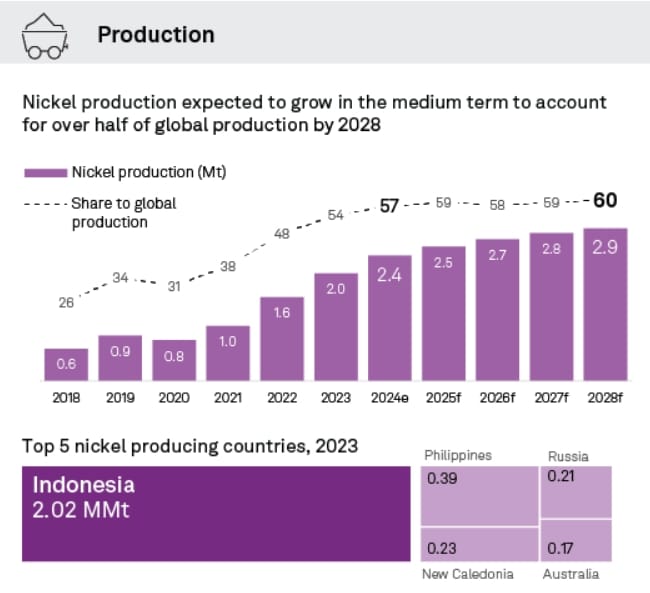
As one of the top producers of metallic commodities—including gold, copper, cobalt, and especially nickel—Indonesia produced over half of the world’s mined nickel in 2023. Indonesia’s cost-effective nickel industry spurred major shifts in the nickel market. While nickel prices have dropped since last year, the country still maintained a resilient and steady production.

According to S&P Global Commodity Insights, Indonesia’s mined nickel production is expected to reach 2.1 million metric tons in 2024. This value is more than 50% of the anticipated global output and more than 2X its 2020 levels.
Indonesia Nickel

Source: S&P Global Commodity Insights

However, the rapid increase could eventually result in a global supply shortage, pushing prices back up to $28,000 per metric ton.

New Ventures in Tech, Travel, and Trade

China and Indonesia are not limiting their partnerships to the resources sector. Credible media agencies reported that GoTo Gojek Tokopedia, a prominent Indonesian technology company, signed agreements with China’s Tencent and Alibaba to bolster Indonesia’s digital infrastructure.

These partnerships can advance cloud services and foster local digital talent. It also signals a long-term investment in Indonesia’s digital economy and improving digital literacy and infrastructure at large.

Notably, President Subianto envisions transforming Indonesia’s tech landscape with investments in the most advanced sectors like AI and cloud computing.

Reuters reported, in addition to high-level industry deals, China and Indonesia agreed to streamline travel and visa policies, introducing measures like multi-entry long-term visas. This will enable more bilateral exchanges, business trips, and tourism.

Furthermore, the nations also agreed to deepen trade in agricultural products, including fresh coconuts. Interestingly, President Subianto also secured export agreements during his visit. This expansion of agricultural exports creates new opportunities for Indonesian farmers while fulfilling China’s demand for tropical produce.

Overall, it is evident that President Subianto’s decision to choose China as its first state visit shows the nation’s strong intention to deepen ties with Beijing.

Source: China, Indonesia seal $10 billion in deals focused on green energy and tech | Reuters

The post China and Indonesia Bolster Ties with $10B Deal in Strategic Sectors. How will it Impact Indonesia’s Nickel Industry? appeared first on Carbon Credits.

Continue Reading

Carbon Footprint

The EU’s New Green Claims Rules and Carbon Credits

Published

on

EU Directive: Empowering Consumers for the Green Transition (ECGT)

The EU Directive, Empowering Consumers for the Green Transition (ECGT), takes effect on September 27, 2026.(1) The goal of ECGT is to protect consumers by ensuring that environmental claims are fair, understandable, and reliable. This regulation does create a new compliance requirement for businesses, but it also provides sustainability and marketing teams with important guidance that helps create consistency in sustainability communications.

Key takeaways

  • ECGT takes effect September 27, 2026, and prohibits claims that a product or service has a neutral, reduced, or positive environmental impact based on offsetting alone.
  • Named example phrases the regulation prohibits include climate neutral, CO2 neutral certified, carbon positive, climate net zero, climate compensated, reduced climate impact, and limited CO2 footprint.
  • ECGT does not want to deter investment in carbon credits. It wants companies to communicate the real benefits of the projects they support instead.
  • SBTi’s guidance recommends framing carbon credits as taking responsibility for ongoing emissions, not as making a product or company neutral.
  • Voluntary carbon projects deliver real climate progress: reducing super-pollutants, protecting and restoring ecosystems, and supporting communities.

Regarding carbon credits specifically, voluntary carbon projects deliver important climate progress and environmental benefits that provide many talking points for companies. They reduce climate super-pollutants by removing industrial emissions like methane, N2O, HFCs and others. They protect and restore valuable ecosystems and carbon sinks like forests, mangroves and grasslands. They help communities by reducing local pollution, creating employment opportunities, improving access to healthcare, and more.

The Science Based Targets Initiative (SBTi), a global leader in business climate action, concludes that alongside aggressive decarbonization, we should also use high quality carbon credits to take responsibility for our ongoing emissions. SBTi recognizes that carbon credits are important “to help limit temperature overshoot, mitigate transition risks, and support climate solutions.”(2)

ECGT language on carbon offsetting says that they do not want to deter investment in carbon credits. They just want companies to focus on communicating the benefits of the projects they support and avoid claims beyond the scope of carbon credits, which is good for everyone, companies and consumers alike.

The regulation reinforces that carbon credits do not change the sustainability of your products, so carbon credit buyers should not suggest that their products are more sustainable because of carbon credits. Instead, companies need to promote their climate contributions as a way to compensate or take responsibility for their carbon emissions by supporting projects that do great things like reducing global carbon emissions, reducing pollution, preventing deforestation, restoring forests, and more.

ECGT language related to carbon offsetting

The regulation is particularly focused on prohibiting claims, based on offsetting greenhouse gas emissions, that a product or service has a neutral, reduced, or positive impact on the environment in terms of greenhouse gas emissions. These claims are prohibited in all circumstances because they mislead consumers into believing the claim relates to the product itself, or to how it was made and supplied, or into thinking that using the product carries no environmental impact at all.

Named examples of prohibited claims include:

  • climate neutral
  • CO2 neutral certified
  • carbon positive
  • climate net zero
  • climate compensated
  • reduced climate impact
  • limited CO2 footprint

These claims are only allowed when they rest on a product’s actual lifecycle impact, not on offsetting emissions outside that product’s value chain, since the two are not equivalent. This prohibition does not stop companies from advertising their investments in environmental initiatives, including carbon credit projects, as long as they present that information in a way that is not misleading and that meets the other requirements of Union law.(1)

SBTi also provides guidance on climate contribution language in its Corporate Net Zero Standard Version 2.0 Draft for Second Public Consultation, November 2025. While the SBTi language is fairly technical, it has a good framework for crafting a climate contribution message.

SBTi Language for Carbon Credits(3)

  • Take responsibility for ongoing emissions by delivering mitigation impact contributions
  • Carbon credits certify the mitigation outcomes of projects that reduce, avoid, or remove carbon emissions
  • Activities that reduce emissions from emission sources not located within the company’s value chain
  • Activities that conserve, protect, and enhance natural carbon sinks
  • Activities that capture and store carbon in storage pools

SBTi’s draft standard also walks through sample claim language for this kind of contribution. In general, the samples move from a simple percentage statement, to naming a specific verified tonnage tied to that percentage, to a fuller statement that breaks the tonnage into reductions versus removals. Across all three, the framing stays consistent: a company took responsibility for a defined share of its ongoing emissions over a set period, by funding a specific, verified amount of mitigation, achieved through emission reductions or removals.(3)

FAQ: ECGT and Carbon Credit Claims

When does the ECGT directive take effect?

The rules apply across the EU from September 27, 2026, after member states transposed the directive into national law by March 27, 2026.

Does ECGT ban carbon offsetting?

No. It bans specific marketing claims that a product or service is environmentally neutral, reduced impact, or positive based on offsetting. Advertising investment in carbon credit projects themselves is still allowed if it is not misleading.

What phrases does ECGT specifically prohibit?

Named examples include climate neutral, CO2 neutral certified, carbon positive, climate net zero, climate compensated, reduced climate impact, and limited CO2 footprint, when those claims are based on offsetting rather than a product’s actual lifecycle impact.

How should a company describe its carbon credit purchases instead?

SBTi’s guidance recommends stating the specific verified tonnage of emissions reductions or removals funded and describing that as taking responsibility for a defined share of ongoing emissions, rather than claiming the company or product is neutral.

Does this rule apply to company level sustainability claims too?

ECGT is focused on claims about specific products and services in consumer marketing. Broader company level sustainability communication is a separate matter still governed by other existing rules.

While ECGT does add a new compliance burden for businesses, it helps create consistency in sustainability messaging that is important to building confidence in voluntary carbon projects and scaling the industry to help us achieve progress on global carbon emissions.

Disclaimer: Terrapass does not provide legal or regulatory advice. Any interpretation of regulation must be approved by your legal representative.

References:
(1) https://eur-lex.europa.eu/eli/dir/2024/825/oj
(2) https://files.sciencebasedtargets.org/production/files/Corporate-Net-Zero-Standard-version-2.pdf
(3) https://files.sciencebasedtargets.org/production/files/CNZS-V2-Second-Consultation-Draft.pdf

The post The EU’s New Green Claims Rules and Carbon Credits appeared first on Terrapass.

Continue Reading

Carbon Footprint

Want a simpler way to buy carbon credits? Discover our carbon marketplace

Published

on

Most businesses that decide to act on their net-zero targets reach the same point of friction. Buying carbon credits has meant tracking down brokers, sitting through sales calls, and requesting a quote just to learn a price, sometimes with limited proof of what you are buying.

Continue Reading

Carbon Footprint

Climate-Linked Supply Chain Risk Is Already in Your P&L

Published

on

The earnings calls that quietly reframed climate from sustainability question to operating risk.

Three earnings calls in the last 18 months tell the story without any help from a press release.

Hershey, May 2024: cocoa price exposure compresses margin, and the company attributes part of the cost shock to West African weather. Olam, July 2024: coffee climate exposure quantified in the annual report. JBS, January 2025: supply chain climate disclosures expanded materially in response to investor pressure and regulatory expectation. None of these companies issued the announcement as climate news. They issued it as financial news. The climate-linked supply chain risk did not arrive with a sustainability framing; it arrived as a P&L line.

You are probably reading this article because you suspect the same thing is happening to your business. This piece walks through what is showing up on which earnings calls, how procurement and finance leaders are quantifying the exposure, and what serious corporates are doing about it before the regulator asks.

Where climate risk has already appeared in earnings

The pattern is consistent across resource-intensive sectors. A weather event compresses supply, the price spikes, the cost flows through the income statement, and the analyst on the call asks whether the event is anomalous or structural. Increasingly, the honest answer is the second one.

Cocoa is the cleanest example. The 2023 to 2024 West African harvest fell sharply on the back of erratic rainfall and disease. Cocoa futures more than tripled. Companies with concentrated West African sourcing absorbed the cost; companies with diversified sourcing absorbed less. The exposure was not climate as ESG topic. It was climate as cost of goods.

Coffee follows the same pattern. Brazilian and Vietnamese harvests have moved on weather more sharply across the last several seasons. Roasters with long-tenor supplier relationships and origin diversification have managed the volatility; roasters with spot-market exposure have not. Wheat, sugar, palm oil, beef: the same dynamic in different commodities, a pattern the IPCC AR6 Working Group II report projects will intensify across agricultural systems through mid-century.

What this means: climate risk is no longer a footnote in the 10-K. It is a line item the CFO has to explain on the call.

The three commodity exposures that hit margin first

For most companies with material Scope 3 exposure, three exposures dominate the near-term P&L risk.

  • Concentrated single-origin sourcing in a climate-vulnerable region. If your tier-one supply for any material commodity sits in one geography, you have a concentration risk that climate amplifies. Diversification across origins is the obvious hedge, but it takes years to build and requires relationships you cannot acquire by tender.
  • Supplier financial fragility under climate stress. Smallholder farmers, who supply a large share of the global cocoa, coffee, and palm oil market, do not carry the balance sheets to absorb yield shocks. When yields collapse, they exit. When they exit, your supply base shrinks, and the surviving suppliers raise prices. The risk is structural, not cyclical.
  • Logistics and storage exposure to extreme weather. Hurricane disruptions to Gulf shipping, drought-driven Panama Canal restrictions, flooding in European inland waterways: each of these has moved input costs in the last three years, a pattern documented in Munich Re’s natural catastrophe data. The exposure shows up as a one-quarter event in the financial press but accumulates over time on the cost line.

TCFD and ISSB disclosure changes

The disclosure architecture has now caught up with the risk. The Task Force on Climate-related Financial Disclosures, whose recommendations are now embedded in the ISSB’s IFRS S2 climate standard, requires companies to disclose climate-related risks across physical and transition categories, with quantification where possible.

For physical risk specifically (the climate-linked supply chain risk you are reading about), the disclosure must address both acute exposures (extreme weather events) and chronic exposures (gradual changes in temperature, precipitation, and growing seasons). The disclosure must address the time horizon over which the risk is material, the parts of the value chain exposed, and the financial impact under different scenarios.

The CSRD imposes similar requirements under European law, with double materiality (both financial and impact materiality) embedded in the assessment. The practical effect: your auditors and your investor relations team now need a defensible answer to the climate-linked supply chain risk question, and the answer needs to be quantified.

What procurement and finance can do now

Three actions matter near-term.

Map your exposure. Most companies do not have a clear view of which tier-one and tier-two suppliers sit in which climate-vulnerable geographies. Without the map, you cannot quantify the risk, and without the quantification, you cannot disclose it credibly. The map is the foundation, and World Resources Institute climate risk research provides useful public tooling to start.

Diversify and deepen, in that order. Diversification across origins reduces concentration risk, but the deeper move is to invest in the resilience of the suppliers you already have. Regenerative practices, agroforestry, soil health interventions: these reduce yield volatility under climate stress and protect your input cost trajectory.

Embed the climate spend inside procurement, not outside it. Treating climate risk as a sustainability cost line subordinates it to the ESG budget. Treating it as a procurement and resilience investment puts it in the budget that matters, which is the cost-of-goods budget that the CFO defends quarterly.

Nature-based supply chain investments are the asset class designed for exactly this purpose. They sit inside the value chain, they reduce climate-linked supply risk, they generate verifiable Scope 3 reductions, and they produce the documentation an auditor and a regulator can both test.

If you are quantifying climate-linked supply chain risk in advance of the next earnings cycle or the next disclosure period, the carbon and sustainability experts at Carbon Credit Capital can help you map your exposure and structure a Dual-Value Model response that addresses reduction, resilience, and disclosure-readiness in a single program. Schedule a consultation.

Continue Reading

Trending

Copyright © 2022 BreakingClimateChange.com

