

China, Brazil, Italy and Belgium have joined a pledge, launched at COP28 two years ago, to triple global nuclear energy capacity between 2020 and 2050.
Ministers from these four countries announced their support at this week’s Nuclear Energy Summit in Paris, increasing the total number of backers to 38.
At the summit, Chinese Vice Premier Zhang Guoqing said China endorsed the pledge to help tackle climate change and strengthen energy security. “To deliver such ambitious goals we should uphold multilateralism, strengthen solidarity and cooperation and resist unilateralism and protectionism,” he said.
In the last 15 years, China has added more nuclear energy capacity than the rest of the world combined, mainly through large conventional reactors. The country is also planning to become a nuclear exporter, constructing its Hualong One reactor in Pakistan and Argentina.
Sama Bilbao y León, head of World Nuclear Association (WNA), said the new endorsements add “tremendous momentum” to the initiative.
Victor Ibarra, head of the nuclear energy programme at the climate think tank Clean Air Task Force (CATF), said that these endorsements reflect growing recognition for nuclear as a “reliable source of clean, firm power”.
He added that “geopolitical tensions and instability in oil and gas markets” highlight the risks of relying on “volatile fuel supplies”, motivating countries to seek a “more flexible, innovation-driven approach to the energy transition”.
In a report from last year, the International Energy Agency (IEA) heralded a “new era of growth” for nuclear power, as demand for clean electricity rises to power electric vehicles, data centres and artificial intelligence.
A 2026 WNA report projects the tripling goal is achievable if current planning targets hold. On the other hand, Jacopo Buongiorno, nuclear science and engineering professor at the Massachusetts Institute of Technology (MIT) told Climate Home News last August that meeting the target would need a supply chain scale-up of “epic” proportions.
-
Paris Agreement watchdog weighs action against countries missing climate plan
With more than 60 countries – including India, Argentina and Vietnam – still failing to submit updated NDCs, the oversight committee will discuss this month how to respond -
New summit in Colombia seeks to revive stalled UN talks on fossil fuel transition
Colombia will host the first conference on transitioning away from fossil fuels, after more than 80 countries pushed at COP30 for an end to coal, oil and gas -
Africa needs more than export bans to cash in on critical minerals, experts say
Restricting raw materials exports is well-intentioned but without other policies to foster domestic processing, they can backfire


Nuclear emerging in Global South
As the construction of new reactors has stagnated in the US and Europe over the last decade, large emerging economies like China, India, the UAE and South Korea have taken the lead. Now, Brazil is also voicing support.
Brazil’s foreign ministry said in a statement that the country would develop nuclear power responsibly and with “elevated standards for safety, protection and non-proliferation”.

In an interview with Deutsche Welle last week, Brazil’s energy minister Alexandre Silveira said that Brazil’s “future is nuclear”. Silveira has proposed replacing fossil fuel power plants in the Amazon with small modular reactors (SMR), of which only two exist in the world: one in China and one in Russia.
Brazil’s foreign ministry said the country’s large uranium reserves offer it energy security. Uranium is the main fuel used in nuclear reactors, but it requires a refining process known as “enrichment” before it can be used to produce power.
Caio Victor Vieira from the Brazilian climate think tank Talanoa Institute, said nuclear expansion offers only “limited” economic benefit for Brazil, given that the country already sources almost 90% of its electricity from clean sources – mostly hydropower.
He said Brazil’s signing of the pledge “is better understood as a diplomatic and strategic move” to support nuclear globally. “If Brazil were to pursue additional nuclear capacity in the future, it would require a broader domestic policy debate,” he added.
Deep divisions persist as plastics treaty talks restart at informal meeting
Europeans divided on nuclear
About half of the pledge’s signatories are European but the continent has long been divided on the issue of nuclear power. France – which derives two-thirds of its power supply from nuclear – has championed this technology, with Germany pulling in the opposite direction.
At the summit on Tuesday, European Commission president Ursula von der Leyen weighed into this debate, calling Europe’s move away from “reliable, affordable” nuclear in the last 30 years a “strategic mistake” that “should change”.
She added that the oil and gas crisis in the Middle East – which has raised the cost of electricity in gas-reliant countries – “gives a stark reminder of the vulnerabilities” that come from phasing out nuclear capacity.
“Europe has been a pioneer in nuclear technology and could once again lead the world in it. Next-generation nuclear reactors could become a European high-tech high-value export”, she said.
She argued that nuclear and renewables should be used in combination, as renewable energy is cheap but intermittent and often best produced far from where it is needed so nuclear energy, storage and improved grids are needed for a reliable energy system.

Europe’s move away from nuclear was led by its biggest economy Germany. Following Von der Leyen’s comments, German environment minister Carsten Schneider said that subsidising new reactors would require “very large amounts of money that would then not be available elsewhere”.
“Clean, safe electricity from wind and solar energy is affordable, has long been a driver of the energy transition and does not produce radioactive waste,” Schneider said.
However, German chancellor Friedrich Merz has indicated he would not oppose classifying nuclear as a clean energy source. His centre-right party governs in coalition with Schneider’s centre-left party
Japan’s anti-nuclear stance has also softened. The country shut down all reactors after the 2011 Fukushima disaster but is now restarting some, though it faces resistance over waste storage.
In the United States, the Trump administration has continued Biden-era support for nuclear energy—pushing new SMRs while weakening safety oversight and exempting reactors from some environmental reviews.
The post China and Brazil join pledge to triple global nuclear energy capacity appeared first on Climate Home News.
China and Brazil join pledge to triple global nuclear energy capacity

For the first time, new-energy vehicles (NEVs) made up 67% of new car sales in China in September, according to the latest data from the China Passenger Car Association (CPCA).
The figures show that NEVs, which include battery electric cars and plug-in hybrids, captured a record share of sales, even though fewer were sold than last year.
This is because sales of combustion-engine cars are falling steeply, a trend that the CPCA has attributed to rising petrol prices following the start of the Hormuz crisis.
Indeed, sales of fuel-only cars were down 31% year-on-year in the first nine months of 2026, with plug-in hybrid sales down 26% – whereas battery EV sales were only down 4%.
One analyst tells Carbon Brief that China’s rapidly growing EV fleet has offset demand for 143m barrels of oil since the start of the Hormuz crisis.
Another says that the crisis is “reinforcing China’s electrification of road transport”.
Meanwhile, amid slowing domestic sales, Chinese carmakers’ exports of NEVs more than doubled [in 2026 to date / in September] from a year earlier.
NEV record
A record two out of every three cars sold in September in China were NEVs, according to CPCA data, as shown in the figure below.
(NEVs predominantly include battery electric vehicles – BEVs – and plug-in hybrids – PHEVs. BEVs only run on electricity, whereas PHEVs also have a combustion engine.)
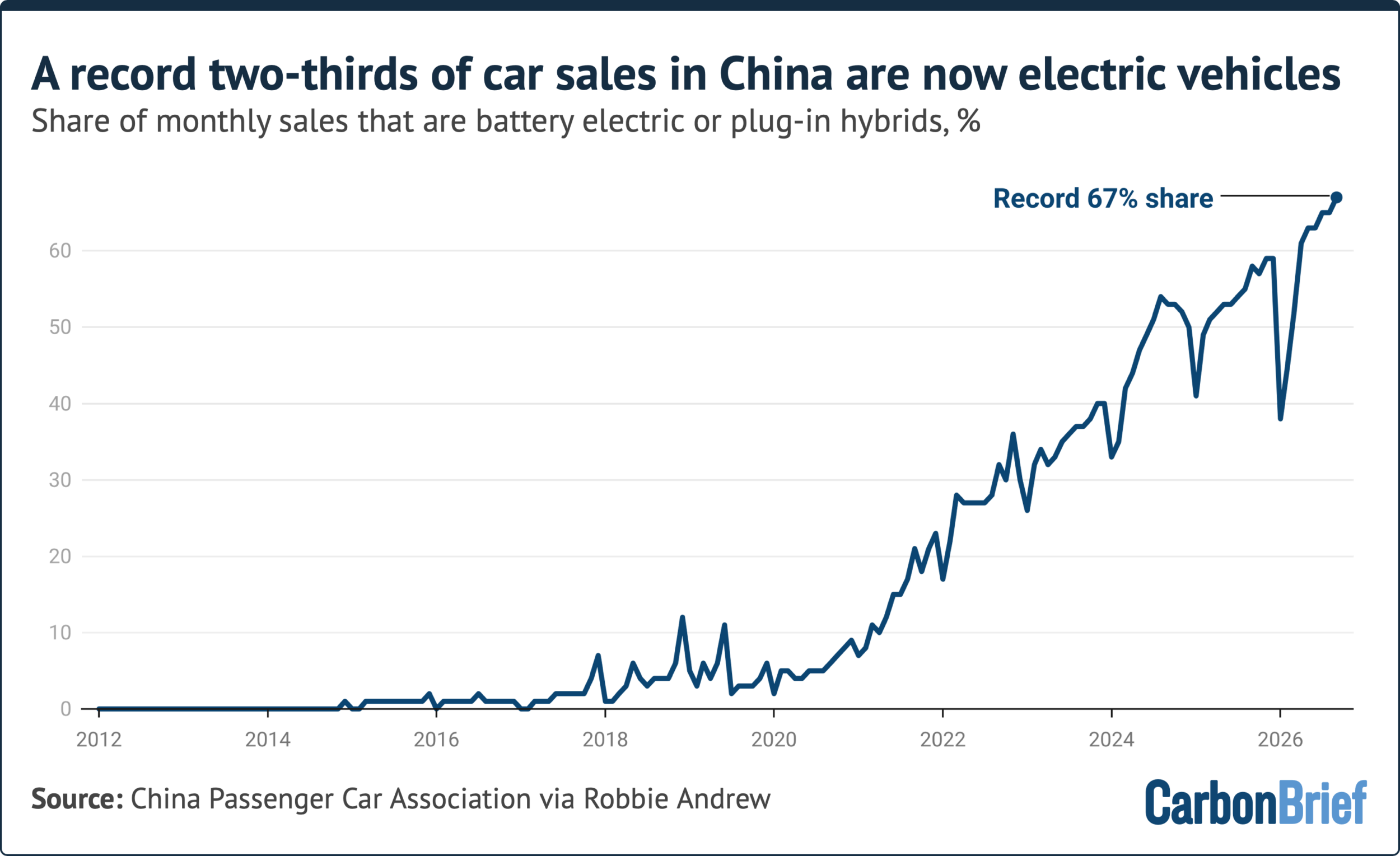
This marks a rapid rise for NEVs from just 6% of new car sales in 2020 up to 58% in 2026 to date – and a record 67% in the month of September.
This year, NEVs’ share of sales has also bounced back from a low of 39% in January, after the full purchase tax exemption that had been in place for more than a decade came to an end in December 2025.
The gain in NEV share in 2026 has come amid a slowdown across the wider domestic passenger-car market, which has hit sales of combustion-engine vehicles particularly hard.
This September, passenger-car retail sales across all categories declined, with overall sales volumes falling 28% year-on-year.
The contraction was led by combustion-engine vehicles, which saw sales fall 43% year-on-year in September and 31% in 2026 to date.
However, sales of PHEVs also fell by 36% year-on-year in September and by 26% in 2026 to date. By comparison, BEVs performed better, although sales still declined 8.5% from a year earlier in September and 4% in 2026 to date.
As a result, NEV sales overall fell by 17% in September and 13% in 2026 to date.
While the market changes in 2026 to date were particularly dramatic, they reflect a broad continuation of trends seen over the past decade.
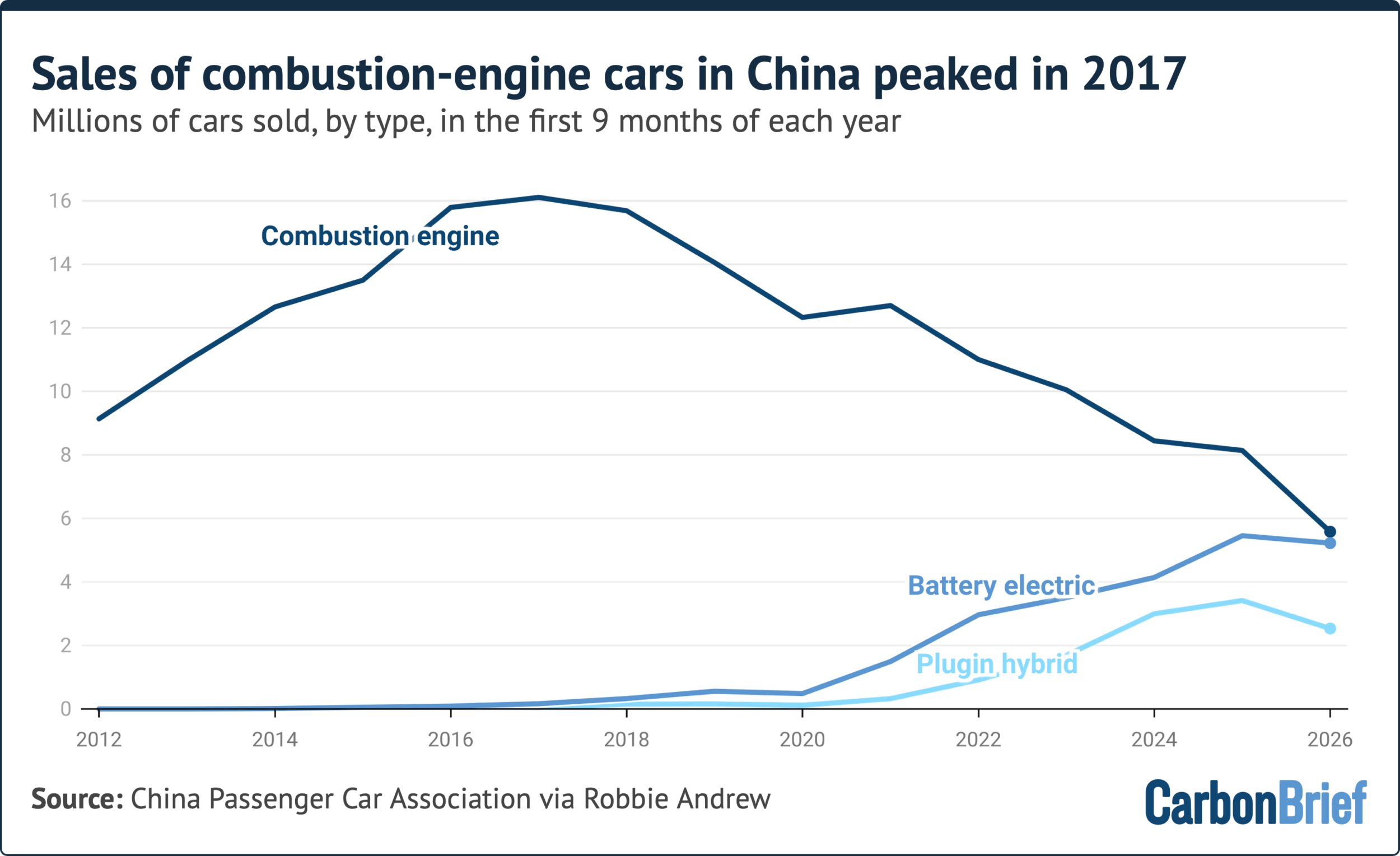
Indeed, sales of combustion-engine cars in China peaked in 2017 and they have been declining ever since, shown in the figure below.
Impact of Hormuz
Part of the reason for the advance of NEVs in 2026, said Chinese technology news outlet OFweek, was petrol cars “giving up market share” as they were outperformed by electric alternatives.
Cui Dongshu, secretary-general of the CPCA, cited higher petrol prices as an explanation for September’s weak combustion-car sales, in comments to financial news outlet National Business Daily.
Imports of oil into China in January-September have fallen 15% compared to 2025, equivalent to 470m barrels, as ongoing conflict tightened supply and drove up prices.
China’s passenger-car NEV fleet has displaced 143m barrels of oil so far during the strait of Hormuz crisis, Euan Graham, senior energy analyst at thinktank Ember, tells Carbon Brief.
EVs “accounted for 12% of the decrease in China’s oil use post-Hormuz”, according to an estimate provided to thinktank the Brookings Institute by an unnamed analyst.